

안녕하세요! Welcome back to Daily Hangul!
Hey there, my amazing Korean-learner chingu (친구 – friend)! It’s your K-culture navigator and Senior Editor from Daily Hangul.
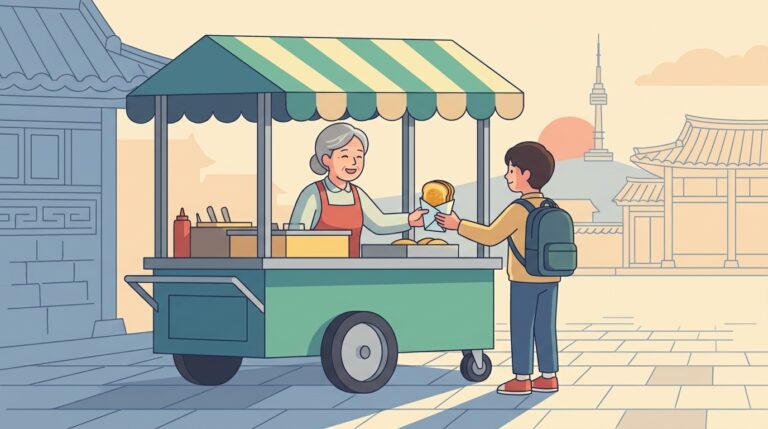
Picture this: You are walking down a bustling street in Seoul on a crisp autumn morning. Your nose catches a heavenly scent—melting butter, sweet cabbage, and sizzling eggs. You follow your nose and find a cozy street food cart. It’s a classic Korean Toast (길거리 토스트) stand!
You want to order that warm, sweet-and-savory masterpiece, but suddenly your mind goes blank. “How do I ask for no sugar?” “How do I pay?” Don’t worry! Today, we are going to master the art of ordering Korean street toast like a true local. No stress, just delicious food!
Phase 2: Top 3 Essential Expressions
Let’s look at the three most important phrases you need to order street toast with confidence.
1. 토스트 하나 주세요. (Toast hana juseyo.)
- Pronunciation: Toast ha-na joo-seh-yo (Sounds like “ha-na” as in “harness” without the ‘s’, and “joo-seh-yo” like “Juice-eh-yo”).
- Meaning: “One toast, please.”
- K-Culture Moment: You will see characters in K-dramas grabbing a quick toast near subway stations before rushing to work.
- Editor’s Insight:
하나 (hana)means “one” and주세요 (juseyo)means “please give me.” You can replace토스트with any street food, like붕어빵(bungeoppang – fish-shaped pastry)! - Situation Spectrum: Casual (✅) | Semi-formal (✅) | Formal (⚠️)
- 🤔 Think About It: In your country, do you usually specify the quantity first, or the item name first? Korean grammar places the quantity
하나 (one)right before주세요 (please give)!
2. 설탕 뿌려주세요? (Seoltang ppuryeojuseyo?)
- Pronunciation: Seol-tang ppoo-ryeo-joo-seh-yo?
- Meaning: “Can you sprinkle sugar on it?”
- K-Culture Moment: Korean street toast is famous for its unique sweet-and-savory profile because vendors literally sprinkle white sugar on the egg patty!
- Editor’s Insight: If you don’t want sugar, you can say: “설탕 빼주세요” (Seol-tang ppae-joo-seh-yo – Please leave out the sugar).
- Situation Spectrum: Casual (✅) | Semi-formal (✅) | Formal (🚫)
- 🤔 Think About It: Adding white sugar to a savory egg and cabbage sandwich might sound unusual at first, but it’s the secret to the ultimate Korean comfort food. Would you try it with or without sugar?
3. 카드로 해도 돼요? (Kadeuro haedo dwaeyo?)
- Pronunciation: Kah-deu-ro hae-do dwae-yo?
- Meaning: “Can I pay by card?”
- K-Culture Moment: While Korea is almost 100% cashless, some very small older street carts still prefer cash or bank transfers (계좌이체).
- Editor’s Insight: This is a lifesaver phrase. Most modern toast stalls (like Isaac Toast) accept cards, but it’s always polite to check first at smaller older stands.
- Situation Spectrum: Casual (⚠️) | Semi-formal (✅) | Formal (✅)
- 🤔 Think About It: Why do you think street food culture still holds onto cash options in a highly digital country like Korea? It’s a sweet nod to traditional market dynamics!
Phase 3: Textbook vs. Real Korean
Let’s compare what textbooks teach you versus how real Koreans actually talk at a toast stand!
Situation 1: Ordering your food
- 📖 Textbook style: “토스트를 한 개 주시겠습니까?” (Toast-reul han gae ju-si-get-seup-ni-ka? – Would you kindly give me one piece of toast?)
- 🗣️ Real Korean: “토스트 하나 주세요.” (Toast hana juseyo. – One toast, please!)
- 💡 Why the difference? The textbook version is grammatically perfect but way too stiff and formal for a cozy street stall. Keep it friendly and simple with
주세요.
Situation 2: Asking for a carry bag
- 📖 Textbook style: “봉투를 제공해 주십시오.” (Bong-tu-reul je-gong-hae ju-sip-si-o. – Please provide a bag.)
- 🗣️ Real Korean: “봉투에 넣어주세요.” (Bong-tu-e neoeo-juseyo. – Please put it in a bag.)
- 💡 Why the difference? Koreans prefer active phrases like “put it in” rather than formal business vocabulary like “provide.”
Phase 4: K-Culture Deep Dive & Non-Verbal Manners
4-1. Nunchi (눈치) & Gestures
When ordering at a busy street stand, timing is everything. Use Nunchi (tact/situational awareness). If the vendor (often a warm elderly lady we call 이모님 – Imonim / Auntie) is busy flipping toast, wait for her to make eye contact before speaking. When paying with a card or cash, always hand it over with both hands as a sign of respect!
4-2. The Korean Toast Phenom
Korean toast isn’t just breakfast; it’s a nostalgic hug in a paper cup. Unlike Western toast, Korean street toast uses shredded cabbage mixed directly into the egg batter, fried in butter, topped with ham, cheese, ketchup, mayo, and a generous dusting of sugar. It’s usually served folded inside a thick paper cup so you can eat it easily on the go!
Phase 5: Interactive Roleplay Scenario
Meet 이모님 (Imonim), the friendly owner of “Happy Toast” outside Exit 3 of Hongdae Station.
- [Turn 1] 이모님 (Imonim): 어서 오세요! 뭐 드릴까요? (Welcome! What can I get you?)
- [Turn 2] You: 🎭 [Smiling and pointing at the menu] 토스트 하나 주세요. (One toast, please.)
- [Turn 3] 이모님 (Imonim): 설탕 뿌려 드릴까요? (Shall I sprinkle sugar on it?)
- [Turn 4] You: 🎭 [Nodding enthusiastically] 네, 설탕 많이 뿌려주세요! (Yes, sprinkle lots of sugar, please!)
- [Turn 5] 이모님 (Imonim): 매운 소스도 괜찮아요? (Is spicy sauce okay too?)
- [Turn 6] You: 🎭 [Waving your hand slightly] 아니요, 안 맵게 해주세요. (No, please make it not spicy.)
- [Turn 7] 이모님 (Imonim): 네~ 여기 있습니다. 뜨거우니까 조심해요. (Okay~ Here you go. Be careful, it’s hot.)
- [Turn 8] You: 🎭 [Receiving the toast with both hands] 감사합니다! 카드로 해도 돼요? (Thank you! Can I pay by card?)
🔀 Choose Your Path!
If the Auntie asks: “케첩도 뿌려줄까요?” (Should I put ketchup on it too?)
* A) “네, 뿌려주세요!” (Yes, sprinkle it please!)
* B) “아니요, 케첩 빼주세요.” (No, please leave out ketchup.)
* C) “케첩은 싫어요.” (I hate ketchup.)
💡 Feedback:
- Best Choice – A: Perfect! You will get the classic sweet, savory, and tangy Korean street toast taste.
- Good Alternative – B: Polite and clear if you don’t like ketchup.
- Avoid – C: While grammatically correct, “싫어요” (I hate/dislike) can sound a bit childish or too blunt to an older vendor. Stick to “빼주세요” (Please leave it out).
Phase 6: 10-Second Emotion Shadowing Drill
Let’s practice saying these with natural rhythm and feelings! / means a short pause.
- [😊 Friendly & Excited]
- 토스트 / 하나 / 주세요! (Toast / hana / juseyo!)
- [🥺 Polite & Requesting]
- 설탕은 / 빼고 / 케첩만 / 뿌려주세요. (Seoltang-eun / ppaego / ketchup-man / ppuryeojuseyo. – Please leave out sugar and only put ketchup.)
- [😉 Quick & Cute]
- 이모님! / 카드로 / 해도 돼요? (Imonim! / kadeuro / haedo dwaeyo?)
Phase 7: K-Culture Mini Dictionary
- 길거리 토스트 (Gilgeori Toast) | Street Toast | The classic cabbage-and-egg butter toast sold on Korean streets.
- 이모님 (Imonim) | Auntie | A warm, respectful way to address middle-aged female restaurant or food stall owners.
- 포장 (Pojang) | Takeout / To-go | If you want your toast packed to eat later, say “포장해주세요” (Pojang-hae-juseyo).
- 종이컵 (Jong-i-keop) | Paper cup | The traditional eco-friendly holder used by street vendors to hand you your hot toast.
Phase 8: Traveler’s Survival Kit
Survival Phrases TOP 3
- 이거 얼마예요? (Igeo eolmayeyo?) – How much is this?
- 여기서 먹고 갈게요. (Yeogiseo meokgo galgeyo.) – I’ll eat here.
- 휴지 좀 주세요. (Hyuji jom juseyo.) – Please give me some tissues.
📌 Editor’s Travel Note:
To find the best local toast stands, download the Naver Map App before your trip. Street food stands don’t always have English names, so searching for “토스트” on Naver Map will lead you to hidden local gems nearby! Note: Cash is still king at very small temporary stalls, so keep a few 1,000 KRW bills handy!
Phase 9: “A Step Deeper” (Thinking Question)
In Korea, eating street food is a shared communal memory. Koreans often stand right in front of the cart to eat their food while chatting with the owner, rather than walking away immediately. It shows a warm sense of human connection called 정 (Jeong – affection/bonding).
💬 Your Turn: Is street food in your home country usually eaten standing up right in front of the vendor, or do you take it to go? Let me know in the comments below!
Phase 10: FAQ & Common Mistakes
Q: Can I customize my street toast ingredients?
A: Absolutely! You can ask to remove sugar (설탕 빼주세요), ketchup (케첩 빼주세요), or even cheese (치즈 빼주세요). Most imonims are extremely happy to accommodate your taste!
Q: Is it rude to eat street food while walking in Korea?
A: It is not legally forbidden, but most Koreans prefer to stand near the cart to eat it or carry it to a park bench. Eating while walking fast in crowded streets can lead to bumping into others and spilling sauce!
Q: Do street food stands accept credit cards?
A: Established kiosks or chains (like Isaac Toast) always do. Small pop-up carts on wheels might prefer cash or bank transfers, but nowadays, many accept cards too. Always ask: “카드로 해도 돼요?” first!
🚨 Common Mistakes Alert!
- Wrong: “토스트 한 개 원해요” (Toast han gae won-hae-yo – I want one toast).
- Correct Action: In Korean, using “원해요” (I want) sounds like a dramatic movie line. Always use “주세요” (Please give me) instead!
Phase 11: Action Mission
- 🥉 Bronze Mission: Read “토스트 하나 주세요” out loud 3 times in front of your mirror.
- 🥈 Silver Mission: Write “설탕 많이 뿌려주세요” (Sprinkle lots of sugar please!) in the comments section below.
- 🥇 Gold Mission: Go to a Korean bakery or toast shop (or make one at home!) and order/take a photo using your new phrases, tagging #DailyHangul on Instagram!
Phase 12: Interactive Quiz Challenge
Test your street food skills!
Q1. How do you politely ask for NO sugar on your toast?
- A) 설탕 주세요
- B) 설탕 빼주세요
- C) 설탕 싫어요
👉 Click to reveal Answer & Explanation
Correct Answer: B) 설탕 빼주세요 (Seoltang ppae-juseyo)
* Explanation: 빼주세요 means “please take it out/leave it out.” A means “give me sugar,” and C is a bit too rude/childish!
Q2. True or False: You should always hand your card to the vendor with only one hand.
- A) True
- B) False
👉 Click to reveal Answer & Explanation
Correct Answer: B) False
* Explanation: In Korea, handing items (especially money or cards) with both hands is a key sign of politeness and respect, especially to elders!
See you in the next lesson! 다음에 또 만나요! (See you next time!)







