

Master Korean Online Shopping: How to Exchange and Return Items Like a Pro!
Phase 1: Empathy (Your K-Shopping Companion)
안녕하세요! (Annyeonghaseyo!) It’s your favorite Daily Hangul editor and local culture navigator!
Imagine this: You’ve been eyeing that gorgeous oversized pastel knit cardigan worn by your favorite K-drama lead. After browsing Musinsa or ZigZag for days, you finally hit ‘Order’. Your phone buzzes with that satisfying KakaoTalk notification: “배송이 완료되었습니다” (Delivery complete). You tear open the box, try it on, and… oh no. It’s not ‘fashionably oversized’—you look like you’re wearing a sleeping bag. The sleeves cover your entire hands!
If you’ve ever felt the cold sweat of realizing you need to return or exchange something in Korea, you are not alone. Many of our intermediate learners tell us, “I can buy things easily, but when it comes to dealing with return shipping fees (반품비) or choosing between an exchange (교환) and a refund (환불), my mind goes blank!”
Today, we’re going to conquer this shopping anxiety together. By the end of this guide, you’ll know exactly how to navigate Korean shopping apps, use the correct natural phrasing, and handle exchanges smoothly without breaking a sweat. Let’s dive in!
Phase 2: Deep-Dive into 3 Essential Expressions
1. 사이즈를 한 단계 큰 걸로 교환하고 싶어요 (sai-jeu-reul han dan-gye keun geol-ro gyo-hwan-ha-go sip-eo-yo)
- Pronunciation: “Sye-jeu-reul han dahn-gyeh keun geol-lo gyoh-hwan-hah-goh sheep-uh-yo” (Think of ‘keun’ like the German ‘können’ without the ‘n’ at the end, and ‘geol-ro’ sounds like ‘girl-lo’)
- Meaning: I would like to exchange this for one size larger.
- K-Culture Moment: You will see this phrase frequently in the customer service (고객센터) chat boards of top Korean fashion platforms. Because Korean sizing tends to run smaller and slimmer compared to Western sizing, this is a lifesaver phrase!
- Editor’s Insight: While “더 큰 사이즈” (a bigger size) is grammatically fine, native Koreans naturally use “한 단계 큰 걸로” (one step bigger) or “한 사이즈 큰 걸로” (one size bigger) to sound precise and polite.
- Situation Spectrum: Casual (⚠️ 사이즈 한 단계 큰 걸로 바꿀래) / Semi-formal (✅ 사이즈를 한 단계 큰 걸로 교환하고 싶어요) / Formal (✅ 한 사이즈 더 큰 상품으로 교환을 요청드립니다)
- 🤔 Think About It: In Korean, using nominalizers like “~걸로” (contraction of ~것으로) softens the request, making it sound less demanding than “Give me a bigger size.” How does your native language soften direct requests?
2. 반품 배송비는 어떻게 결제하나요? (ban-pum bae-song-bi-neun eo-tteo-ke gyeol-je-ha-na-yo)
- Pronunciation: “Bahn-poom baeh-song-bee-neun uh-ttuh-keh gyul-jeh-hah-nah-yo?” (Sounds like ‘bahn-poom’ as in ‘bomb-poom’, and ‘gyeol-je’ like ‘gyul-jeh’)
- Meaning: How do I pay for the return shipping fee?
- K-Culture Moment: In Korea’s ultra-fast delivery ecosystem, returns are amazingly convenient, but they aren’t always free. Usually, you pay around 3,000 to 6,000 KRW for return shipping unless the item was damaged. You often choose between deducting it from your refund or bank-transferring it.
- Editor’s Insight: The word “반품” (ban-pum) literally means “returning goods,” and “배송비” (bae-song-bi) is shipping fee. Combine them, and you have “return shipping fee.” Asking this upfront prevents confusion.
- Situation Spectrum: Casual (🚫 반품비 어떻게 내?) / Semi-formal (✅ 반품 배송비는 어떻게 결제하나요?) / Formal (✅ 반품 배송비 결제 수단에 대해 문의드립니다)
- 🤔 Think About It: Korea has a highly developed “wire transfer” (계좌이체) culture, even for small customer service fees. Be prepared to ask for an account number!
3. 단순 변심으로 인한 교환입니다 (dan-sun byeon-sim-eu-ro in-han gyo-hwan-im-ni-da)
- Pronunciation: “Dahn-soon byun-sheem-eu-roh een-hahn gyoh-hwan-eem-nee-dah” (Think of ‘byeon’ as ‘byun’ like ‘bun’ with a ‘y’, and ‘sim’ like ‘sheem’)
- Meaning: This is an exchange due to a simple change of mind.
- K-Culture Moment: When selecting a reason for return/exchange on apps like Coupang or Naver Shopping, you must choose a category. “단순 변심” (change of mind/flavor/color preference) is the official term when nothing is wrong with the product, but you just changed your mind.
- Editor’s Insight: If the seller made a mistake, they pay for shipping. If it is “단순 변심,” you (the buyer) pay. Honesty in this category keeps the process fast and trouble-free!
- Situation Spectrum: Casual (🚫 그냥 마음이 바뀌었어) / Semi-formal (⚠️ 그냥 단순 변심으로 바꿀게요) / Formal (✅ 단순 변심으로 인한 교환/반품입니다)
- 🤔 Think About It: Why do you think Korean e-commerce differentiates so strictly between seller fault (판매자 귀책) and buyer’s change of mind (구매자 변심)? It’s all about who bears the logistics cost!
Phase 3: Textbook Korean vs. Real-Life Korean
Scenario 1: Describing that the clothes don’t fit
- 📖 Textbook Korean: 옷이 너무 작아서 맞지 않습니다. (The clothes are too small, so they do not fit.) – Too robotic and formal for customer service chats.
- 🗣️ Real-Life Korean: 사이즈가 애매해서 한 사이즈 큰 걸로 바꿀게요. (The size is a bit awkward/in-between, so I’ll swap it for one size larger.)
- 💡 Why the Difference? “애매하다” (ae-mae-ha-da) means “vague” or “awkward.” Koreans use “사이즈가 애매하다” when a size is slightly off—not completely unwearable, but just uncomfortable enough to warrant an exchange.
Scenario 2: Asking if a return has been processed
- 📖 Textbook Korean: 제가 반품한 물건을 받으셨습니까? (Did you receive the item I returned?) – Sounds like a detective asking for confirmation of evidence.
- 🗣️ Real-Life Korean: 반품 수거 확인이랑 환불 언제쯤 처리되는지 알 수 있을까요? (Could I know around when the return collection will be confirmed and the refund processed?)
- 💡 Why the Difference? In Korea’s “Palli-Palli” (hurry-hurry) culture, you don’t just ask if they received it; you politely bundle “collection status” (수거 확인) and “refund processing time” (환불 처리) together.
Phase 4: K-Culture Deep-Dive & Non-Verbal Manners
4-1. The “Box Out” Etiquette (택배 상자 매너)
When returning an item in Korea, the non-verbal presentation matters.
1. Do not ruin the original box: Never write directly on the product packaging (like a shoebox). Place the shoebox inside a shipping box.
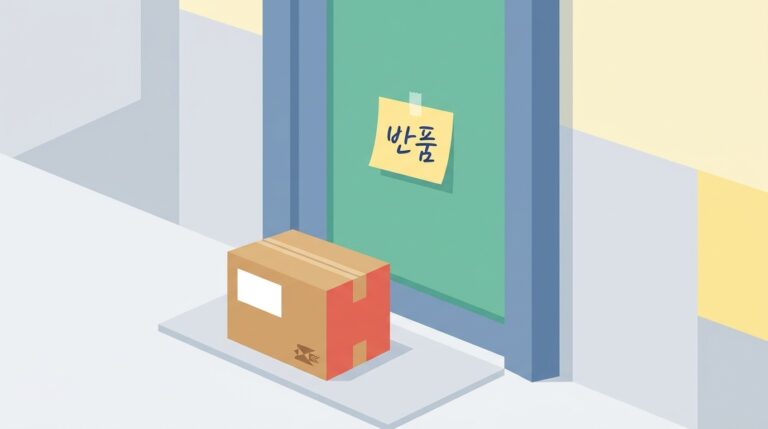
2. The Front Door Placement: In Korea, returns are usually collected right from your doorstep (문앞 수거). Simply write “반품” (Return) or “교환” (Exchange) on a post-it note and stick it on the box. It signals the busy delivery hero (택배 기사님) to grab the correct box instantly.
4-2. The “Coupang-Life” and Return Culture
Korea’s online shopping is dominated by “Rocket Delivery” (로켓배송). For members, some platforms offer free returns within 30 days. This has shaped a culture where people order two sizes of the same shoe, keep the one that fits, and instantly return the other. However, abusing this system is frowned upon, and maintaining polite, clear communication with customer service agents (상담원님) is highly valued.
Phase 5: Real-Life Roleplay Scenario
Setting: You are at a local multi-brand clothing store in Hongdae. You bought a jacket yesterday, but realized it’s too tight around the shoulders.
Characters:
* 민지 (Minji): The friendly shop assistant.
* You (Intermediate Korean Learner)
민지: 어서 오세요! 어떤 것 도와드릴까요?
      (Welcome! How can I help you?)

You: 🎭 (Holding up the bag politely)
     안녕하세요, 어제 여기서 이 재킷을 샀는데요. 사이즈를 교환하고 싶어서요.
     (Hello, I bought this jacket here yesterday. I’d like to exchange the size.)

민지: 아, 그러시군요! 혹시 어떤 사이즈로 변경하시겠어요?
      (Ah, I see! Which size would you like to change it to?)

You: 🎭 (Unzipping the jacket to show)
     지금 입은 것보다 한 단계 큰 걸로 입어보고 싶은데, 라지(L) 사이즈 재고가 있을까요?
     (I want to try on one size larger than this. Do you have a Large (L) size in stock?)

민지: 잠시만요, 전산으로 확인해 드릴게요... 아, 지금 매장에 라지 사이즈 재고가 딱 하나 남아 있네요! 가져다 드릴 테니 탈의실에서 한번 입어보시겠어요?
      (One moment, let me check the system for you... Ah, we have exactly one Large size left in stock right now! I'll bring it to you, would you like to try it on in the fitting room?)

You: 🎭 (Nodding gratefully)
     네, 감사합니다. 입어보고 결정할게요.
     (Yes, thank you. I'll try it on and decide.)

(After trying it on, the fit is perfect!)

You: 🎭 (Smiling warmly)
     이 사이즈가 딱 좋네요! 이걸로 교환해 주세요. 영수증 여기 있습니다.
     (This size is perfect! Please exchange it for this one. Here is the receipt.)

민지: 네, 영수증 확인했습니다. 추가 비용은 없고, 교환 처리 완료해 드렸습니다!
      (Yes, receipt confirmed. No extra charge, and the exchange has been processed!)
🔀 Interactive Choice Point!
What if the size you wanted was completely out of stock? How would you react?
- Choice A: “그럼 그냥 환불해 주세요.” (Then please just give me a refund.)
- Feedback (Best): Excellent! Straightforward and natural. If the exchange is impossible, requesting a refund (환불) is the next logical step.
- Choice B: “사이즈 없으면 돈을 다시 주세요.” (If there’s no size, give me back the money.)
- Feedback (Bad): Too direct and demands money in a slightly rude tone. Avoid “돈을 다시 주세요” in shops.
- Choice C: “환불 신청을 하고 싶습니다만…” (I would like to apply for a refund, but…)
- Feedback (Risk): Grammatically correct, but sounds a bit too formal/written for a casual brick-and-mortar retail shop in Hongdae.
Phase 6: 10-Second Emotional Shadowing Drill
Practice speaking with real Korean emotion! Use the pauses / and follow the emotional guides.
- [🥺 Disappointed and slightly pleading]
- “사이즈가 / 생각보다 / 너무 작아서요… / 한 단계 큰 걸로 / 바꿀 수 있을까요?”
- Sai-jeu-ga / saeng-gak-bo-da / neo-mu jag-a-seo-yo… / han dan-gye keun geol-ro / ba-kkul su is-seu-kka-yo?
- [😊 Relieved and extremely polite]
- “아, / 재고가 있네요! / 그럼 이걸로 / 교환 부탁드립니다! / 감사합니다!”
- Ah, / jae-go-ga in-nae-yo! / geu-reom i-geol-ro / gyo-hwan bu-tak-deu-rim-ni-da! / gam-sa-ham-ni-da!
Phase 7: K-Culture Mini-Dictionary
- 맞교환 (Mat-gyo-hwan) | Direct Exchange
- A service where the delivery courier brings your new exchanged item and collects your return item simultaneously at your doorstep. Super fast!
- 반품 수거 (Ban-pum Su-geo) | Return Collection
- The process where a courier agent comes to your designated location (usually your door) to pick up the package you want to return.
- 교환 배송비 (Gyo-hwan Bae-song-bi) | Exchange Shipping Fee
- The shipping fee charged when exchanging an item due to buyer preference (usually round-trip cost, around 5,000–6,000 KRW).
- 미개봉 (Mi-gae-bong) | Unopened / Brand New
- Used often in secondhand markets like Danggeun Market or customer service. If it is ‘미개봉,’ returns are processed without any questions asked.
Phase 8: The Traveler’s Survival Kit
Survival Expressions TOP 3
- “영수증 없어도 교환 되나요?” (Yeong-su-jeung eop-seo-do gyo-hwan doe-na-yo?)
- Pro Tip: Ask this if you lost your physical paper receipt but have a card payment history on your phone.
- “택(tag)을 제거했는데 교환 가능한가요?” (Taek-eul je-geo-haet-neun-de gyo-hwan gang-eung-han-ga-yo?)
- Pro Tip: In Korea, once you remove the price tag (택), exchanges are almost always impossible. It’s best to ask just in case, but keep those tags on!
- “문앞에 놔두었습니다.” (Mun-ap-e nwa-du-eot-seum-ni-da.)
- Pro Tip: Text this to your delivery driver when leaving your return package outside your door.
Editor’s Travel Note
If you are shopping online in Korea, we highly recommend downloading the Naver Map App to easily locate physical convenience stores (편의점) nearby. Many shipping companies allow you to drop off your return packages at GS25 or CU convenience stores (편의점 택배), which is incredibly cheap and accessible 24/7! (Note: Standard localized shipping fees apply and may vary slightly based on weight and distance).
Phase 9: “A Step Deeper” (Reflective Question)
In Korea, the speed of shipping and returns is a point of national pride. Because of this, customer service is highly systemized. However, beneath this fast-paced structure lies a deep sense of trust and mutual respect. Delivery drivers often leave expensive parcels at doorsteps without fear of theft, and buyers return items packaged with care. Keeping your communications polite and using soft endings (like “~요” and “~부탁드립니다”) reflects this social harmony.
💬 Your Turn: Have you ever returned an item in Korea, or did you find the process of returning items in your home country different? Let us know in the comments below!
Phase 10: FAQ & Avoiding Mistakes
Q: Can I return an item purchased online at a physical retail store?
A: Generally, no. In Korea, online shopping systems and offline retail systems operate independently. Items bought on online platforms like Musinsa must be returned through their online app interface.
Q: What should I do if the seller is not answering my exchange request?
A: You can use the app’s “1:1 문의” (One-on-One Inquiry) or call their “고객센터” (Customer Center). Writing a polite but clear message often triggers an automatic system alert to the seller.
Q: I received a defective item. Do I still have to pay the return shipping fee?
A: Absolutely not! If the product has a defect (하자) or the wrong item was sent (오배송), the seller pays 100% of the return costs. Just take clear photos as proof!
🚨 Common Mistakes Alert!
- Writing the return address by hand: Do not manually write addresses on the box unless instructed. Once you request a return on the app, the system generates a digital barcode for the driver.
- Returning damaged packaging: Opening a plastic bag roughly can sometimes invalidate a return. Try to open clothing bags carefully.
- Forgetting to select the reason code: Selecting “Simple Change of Mind” (단순 변심) when the item is actually damaged will slow down your refund. Always pick the correct category.
Phase 11: Action Mission
- Bronze Mission: Read the Phase 6 Shadowing Drill aloud 3 times, focusing on sounding disappointed for the first sentence!
- Silver Mission: Take a screenshot of a Korean shopping app product page and locate the words “교환” (Exchange) and “반품” (Return).
- Gold Mission (K-Culture Mission): Watch a K-Drama shopping scene, or look at a Korean YouTuber’s “Haul” (하울) video, and write down one phrase they use when talking about sizes!
Phase 12: Interactive Quiz Challenge
Test your skills! Can you get 3/3?
Q1. What is the correct term for “Simple Change of Mind”?
- A) 기분 전환
- B) 단순 변심
- C) 그냥 싫음
Q2. Complete the sentence: “한 사이즈 ( ) 걸로 교환하고 싶어요.”
- A) 작은
- B) 큰
- C) 예쁜
Q3. True or False: You should write the return address on the box with a marker even if you applied via the app.
- A) True
- B) False
🎉 Click here to reveal the Answers & Explanations!
- Q1 Answer: B) 단순 변심 (dan-sun byeon-sim). This is the formal term used across all shopping platforms.
- Q2 Answer: B) 큰 (keun – big/large). To exchange for a larger size, you say “한 사이즈 큰 걸로” (one size larger).
- Q3 Answer: B) False. The courier driver has a pre-printed sticker label with all shipping details. Writing it manually can confuse the scanning system!







