

Surfeited with Tension: Navigating the High-Stakes Atmosphere of Korea’s Suneung Day
안녕하세요! Daily Hangul‘s Senior Editor and your cultural navigator here. Have you ever experienced a day when an entire nation collectively holds its breath, planes are grounded, and police escorts are deployed for teenagers? Welcome to Suneung (수능) day in South Korea—the College Scholastic Ability Test day.
For C1 learners, understanding Suneung isn’t just about learning vocabulary; it’s about grasping the socio-cultural psyche of Korea. Today, we’ll dive deep into the high-stakes linguistic and cultural landscape of this unforgettable day.
Phase 1: Empathy (Anxious Silence and Cheering Squads)
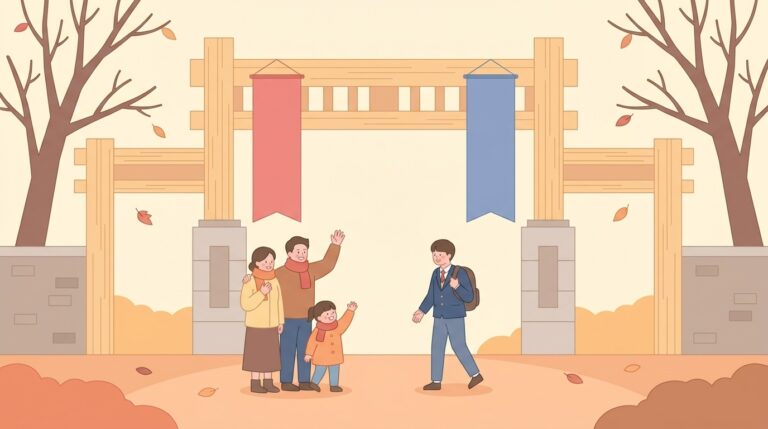
Imagine walking down the street at 7:30 AM on a chilly November morning in Seoul. Usually, the city is buzzing with traffic. Today, however, there is an eerie, focused silence—until you approach a high school gate. There, junior students are beating drums, chanting, and handing out hot tea. Police motorcycles zoom past, carrying stressed test-takers who woke up late.
If you’ve watched K-Dramas like Sky Castle or Reply 1988, you’ve seen the sheer weight of this exam. As an advanced learner, being able to discuss this event using native-level nuances will instantly connect you with Koreans. Let’s unpack the linguistic tools you need to discuss this national event.
Phase 2: Deep-Dive into 3 Essential Expressions
1. 재수를 결심하다 (Jaesureul gyeolsimhada)
- Pronunciation: Jae-soo-reul gyuhl-sim-ha-da (Sounds like “Jae-sue” + “gyuhl-seem-ha-da”)
- Meaning: To decide to retake the college entrance exam (literally, “to resolve to do a second study”).
- K-Culture Moment: In K-Dramas, characters who failed to get into their dream university go to Jaesusaeng (재수생) academies. They study 14 hours a day for another shot.
- Editor’s Insight: Jae (재) means “again,” and su (수) refers to taking an exam. If someone does it a third time, they are Sam-su-saeng (삼수생).
- Situation Spectrum: Casual (✅) | Semi-formal (✅) | Formal (✅)
- 🤔 Think About It: In your culture, is taking an entire gap year solely to retake a standardized exam common, or is it viewed as an extreme measure?
2. 수능 대박을 기원하다 (Suneung daebageul giwonhada)
- Pronunciation: Su-neung dae-ba-geul gee-won-ha-da (“Suneung” + “Dae-bak” + “gee-won-ha-da”)
- Meaning: To wish someone hitting the jackpot on the Suneung exam.
- K-Culture Moment: K-Pop idols annually upload “Suneung Cheering Videos” (수능 응원 영상) wishing their student fans a “Suneung Daebak.”
- Editor’s Insight: While daebak is often used as “awesome,” here it acts as a noun meaning “great success” or “jackpot.”
- Situation Spectrum: Casual (✅) | Semi-formal (✅) | Formal (⚠️ – slightly casual due to ‘daebak’)
- 🤔 Think About It: How does your language express wishing someone luck on a life-defining exam without sounding too casual?
3. 긴장해서 시험을 망치다 (Ginjanghaeseo siheomeul mangchida)
- Pronunciation: Geen-jang-hae-seo shee-hum-eul mang-chee-da
- Meaning: To ruin/botch the exam due to nervousness.
- K-Culture Moment: This is the ultimate tragedy in high school dramas—the straight-A student who gets too anxious and gets stomach cramps during the listening test.
- Editor’s Insight: Mangchida is a strong verb. It means to spoil, ruin, or mess up completely.
- Situation Spectrum: Casual (✅) | Semi-formal (✅) | Formal (⚠️)
- 🤔 Think About It: Is there a specific idiom in your language for failing not due to lack of knowledge, but due to psychological pressure?
Phase 3: Textbook Korean vs. Real-Life Korean
Situation 1: Encouraging someone before the exam
- 📖 Textbook: 시험 잘 보세요. (Siheom jal boseyo. – “Take the exam well.”)
- 🗣️ Real-Life: 찍는 것도 다 맞기를 바랄게! (Jingneun geotdo da matgireul baralge! – “I hope even the questions you guess are all correct!”)
- 💡 Why the difference? Koreans know that Suneung is incredibly difficult, and guessing (찍기) is inevitable. Wishing someone luck on their guesses shows true empathy.
Situation 2: Describing someone who is studying excessively
- 📖 Textbook: 공부를 아주 열심히 하고 있어요. (Gongbureul aju yeolsimhi hago isseoyo.)
- 🗣️ Real-Life: 독기를 품고 공부하더라고요. (Dokgireul pumgo gongbuhadeoragoyo. – “They are studying with fierce, venomous determination.”)
- 💡 Why the difference? Advanced speakers use metaphors. Dokgi (독기) means “venom” or “spite.” It describes an intense, desperate drive to succeed.
Phase 4: K-Culture Deep-Dive & Non-Verbal Etiquette
4-1. The Art of Gift Giving: What NOT to Give
On Suneung, sticky foods like Yeot (엿 – traditional taffy) and Chapssaltteok (찹쌀떡 – glutinous rice cakes) are given because their stickiness symbolizes “sticking” (passing) to the university. Conversely, never give seaweed soup (미역국) or bananas, because they are slippery, symbolizing “slipping” (failing) the exam.
4-2. The Absolute Silence (영어 듣기 평가 시간)
During the English Listening Evaluation (usually 1:10 PM to 1:35 PM), the entire country goes silent. Flights are barred from landing or taking off, trains slow down, and construction is halted. It is considered highly rude to make loud noises near school zones during this time.
Phase 5: Interactive Roleplay Scenario
Setting: A local cafe near a Suneung exam center. You (Min-ho’s older cousin/friend) are waiting with Min-ho’s mother (Aunt), who is extremely anxious.
Characters:
- Aunt (이모 – Imo): Clutching her hands, staring at the school gate.
- You (Advanced Learner): Trying to calm her down while showing deep cultural empathy.
Dialogue:
- 이모: (손을 떨며)
Frequently Asked Questions (FAQ)
Q: What does "재수를 결심하다 (Jaesureul gyeolsimhada)" mean in Korean and how do you pronounce it?
A: In Korean, "재수를 결심하다 (Jaesureul gyeolsimhada)" is pronounced [Jae-soo-reul gyuhl-sim-ha-da (Sounds like "Jae-sue" + "gyuhl-seem-ha-da"] and means: To decide to retake the college entrance exam (literally, "to resolve to do a second study").
Q: What does "수능 대박을 기원하다 (Suneung daebageul giwonhada)" mean in Korean and how do you pronounce it?
A: In Korean, "수능 대박을 기원하다 (Suneung daebageul giwonhada)" is pronounced [Su-neung dae-ba-geul gee-won-ha-da ("Suneung" + "Dae-bak" + "gee-won-ha-da"] and means: To wish someone hitting the jackpot on the Suneung exam.
Q: What does "긴장해서 시험을 망치다 (Ginjanghaeseo siheomeul mangchida)" mean in Korean and how do you pronounce it?
A: In Korean, "긴장해서 시험을 망치다 (Ginjanghaeseo siheomeul mangchida)" is pronounced [Geen-jang-hae-seo shee-hum-eul mang-chee-da] and means: To ruin/botch the exam due to nervousness.







