

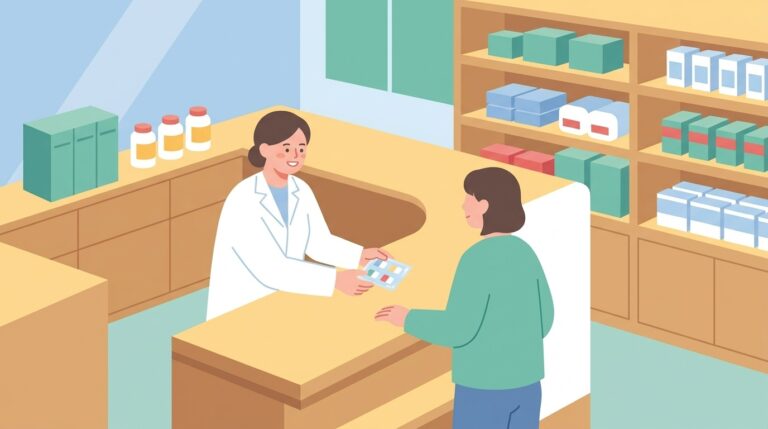
Decoding Your Korean Pharmacy Visit: Master Medicine Instructions Like a Local
Phase 1: Empathy (Your K-Drama Moment in Real Life)
안녕하세요! (An-nyeong-ha-se-yo!) Your favorite Daily Hangul editor here!
Imagine this: You’ve successfully navigated a doctor’s appointment in Seoul. You walk into the pharmacy (약국 – yak-guk), hand over your prescription, and receive a small white paper envelope filled with neatly divided little plastic pouches of pills. The pharmacist looks at you and rapidly says: “식후 삼십 분에 드세요!” (Shik-hu sam-ship-bun-e deu-se-yo!).
Your mind goes blank. Does that mean before, during, or after meals? How many times a day? In K-Dramas like Hospital Playlist, doctors and pharmacists seem to explain things in a comforting, lightning-fast blur. But in real life, not knowing how to take your medicine is both stressful and a safety hazard.
Don’t worry! Today, we are cracking the code of Korean prescription labels. This guide is built based on real feedback from intermediate learners who faced this exact struggle. By the end of this article, you’ll walk into any Korean pharmacy with the confidence of a native speaker. Let’s dive in!
Phase 2: Deep Dive into 3 Essential Expressions
1. 식후 30분에 드세요 (Sik-hu sam-sip-bun-e deu-se-yo)
- Pronunciation: Sheek-hoo sam-sheep-boon-eh deu-seh-yo (Sounds like “Seek who? Sam’s sheep boone deh-say-yo”)
- Meaning: Please take this 30 minutes after a meal.
- K-Culture Moment: In family dramas, you often see a mother or partner placing a pouch of medicine next to a half-empty rice bowl, saying this phrase to a sick family member. It carries a warm undertone of nurturing care.
- Editor’s Insight: “식후” (Sik-hu) combines “식사” (sik-sa/meal) and “후” (hu/after). While “30분” (30 minutes) is the traditional medical guideline to prevent stomach irritation, nowadays many pharmacists will tell you “식사하시고 바로 드셔도 돼요” (You can take it right after eating) to make sure you don’t forget!
- Situation Spectrum: Casual 🚫 | Semi-formal ✅ | Formal ✅
- 🤔 Think About It: In Korea, the concept of “밥” (rice/food) is deeply connected to health. Why do you think Korean medical instructions are almost always tied to meal times rather than strict clock hours?
2. 식전 30분에 복용하세요 (Sik-jeon sam-sip-bun-e bok-yong-ha-se-yo)
- Pronunciation: Sheek-jeon sam-sheep-boon-eh bok-yong-ha-seh-yo (Sounds like “Seek john sam’s sheep boone eh poke-yong ha-say-yo”)
- Meaning: Please take/ingest this 30 minutes before a meal.
- K-Culture Moment: Usually said for specific stomach medicines or diabetes medications. In dramas, characters who are chronically stressed often gulp down a liquid pouch of stomach protective medicine right before going into a tough corporate meeting.
- Editor’s Insight: “복용하다” (bok-yong-ha-da) is a formal clinical term meaning “to take medicine” (combining ‘take’ and ‘use’). Pharmacists use this to sound professional, but they might also swap it for the friendlier “드세요” (deu-se-yo / please eat/drink).
- Situation Spectrum: Casual 🚫 | Semi-formal ⚠️ | Formal ✅
- 🤔 Think About It: How does your home country’s pharmacy culture differ in the vocabulary used? Is it as strictly polite as Korea’s honorific “복용하세요”?
3. 졸릴 수 있으니 운전은 피하세요 (Jol-ril su isseu-ni un-jeon-eun pi-ha-se-yo)
- Pronunciation: Jol-leel soo ee-seu-nee oon-jeon-eun pee-ha-seh-yo (Sounds like “Jolt-reel sue is-nee oon-jun-eun pea-ha-say-yo”)
- Meaning: This may make you drowsy, so please avoid driving.
- K-Culture Moment: Commonly warned when you get cold medicine (감기약 – gam-gi-yak). In Korea’s fast-paced society, people often push through illnesses, leading pharmacists to double-warn them about drowsiness.
- Editor’s Insight: “졸리다” (jol-li-da) means “to be sleepy”. The grammar “-을 수 있다” indicates possibility. If you hear “졸려요” (jol-lyeo-yo) on a label, expect heavy antihistamines!
- Situation Spectrum: Casual 🚫 | Semi-formal ✅ | Formal ✅
- 🤔 Think About It: Why is public safety advice like “avoid driving” or “avoid alcohol” so heavily emphasized at Korean pharmacies compared to self-serve drugstores abroad?
Phase 3: Textbook Korean vs. Real-Life Korean
Scenario 1: Asking how many times to take the medicine
- 📖 Textbook Korean: 하루에 몇 번 먹어야 합니까? (Ha-ru-e myeot beon meog-eo-ya hap-ni-ka? – “How many times must I eat this per day?”)
- 🗣️ Real-Life Korean: 이거 하루에 몇 번 먹는 거예요? (I-geo ha-ru-e myeot beon meong-neun geo-yeo? – “How many times a day do I take this one?”)
- 💡 Why is it different?: The textbook version uses the archaic and stiff “-해야 합니까” (must do). Locals use the friendly, conversational “-는 거예요?” (is it that I do…) which sounds natural and polite without being robotic.
Scenario 2: Asking if the medicine makes you sleepy
- 📖 Textbook Korean: 이 약은 졸음을 유발합니까? (I ya-geun jo-reum-eul yu-bal-hap-ni-ka? – “Does this medication induce sleepiness?”)
- 🗣️ Real-Life Korean: 이 약 많이 졸려요? (I yak ma-ni jol-lyeo-yo? – “Is this medicine super sleepy/drowsy?”)
- 💡 Why is it different?: “유발하다” (induce) is a medical journal term. In real life, Koreans simply use the descriptive adjective “졸리다” (to be sleepy) to ask about side effects directly.
Phase 4: K-Culture Deep Dive & Non-Verbal Etiquette
4-1. Nunchi & Gesture Etiquette at the Pharmacy
- The Two-Handed Receive: When receiving your medicine envelope and your card back, always use two hands (or place your left hand under your right forearm/wrist as a sign of respect). It shows great nunchi (social wit and politeness).
- The Head Bow: A slight nod or bow when saying “감사합니다” (gam-sa-hap-ni-da) as you leave is highly appreciated.
- The Attentive Listening Nod: Pharmacists explain instructions quickly. Keep eye contact and nod gently (“네, 네…”) to show you follow along. If they tap a specific part of the envelope with their pen, that is your cue that it’s a critical instruction!
4-2. The Korean “Pouch” Culture (PTP & Al-yak)
In Korea, medicines are rarely given in big plastic bottles with child-proof caps. Instead, pharmacies use automatic dispensing machines that pack your exact dose for breakfast (아침), lunch (점심), and dinner (저녁) into individual plastic pouches (약포지 – yak-po-ji).
This is incredibly convenient but means you must follow the “one packet per meal” rule strictly. If a pouch says “아침” (morning), it is formulated specifically for your start of the day!
Phase 5: Real-Life Roleplay Scenario
Setting: A clean, busy pharmacy next to a subway station in Hongdae.
Characters:
* Pharmacist Kim (약사 김씨): Professional, helpful, speaks with a warm but brisk tone.
* Alex (알렉스): An intermediate Korean learner dealing with a nasty cold.
[1] Pharmacist Kim: 처방전 주시겠어요?
    (Cheo-bang-jeon ju-shi-gess-eo-yo?)
    🎭 [Reaches hand out politely to receive the prescription paper]
    "May I have your prescription?"

[2] Alex: 네, 여기요. 감기 기운이 좀 심해서요.
    (Ne, yeo-gi-yo. Gam-gi gi-un-i jom shim-hae-seo-yo.)
    🎭 [Hands over the paper with both hands]
    "Yes, here it is. My cold symptoms are a bit severe."

[3] Pharmacist Kim: 아, 목이 많이 부으셨네요. 약 금방 준비해 드릴게요.
    (Ah, mok-i ma-ni bu-eu-shyeot-nae-yo. Yak geum-bang jun-bi-hae deu-ril-ge-yo.)
    🎭 [Enters data into the computer and retrieves the medicine pouches]
    "Ah, your throat is quite swollen. I'll prepare the medicine right away."

[4] Pharmacist Kim: (Hands over the envelope) 이 약은 하루 세 번, 식후 삼십 분에 드세요.
    (I yak-eun ha-ru se beon, shik-hu sam-ship-bun-e deu-se-yo.)
    🎭 [Points to the morning, lunch, and evening icons printed on the packet]
    "Take this medicine three times a day, 30 minutes after meals."

[5] Alex: 식사 전에 먹으면 안 되나요? 가끔 입맛이 없어서요.
    (Shik-sa jeon-e meog-eu-myeon an doe-na-yo? Ga-kkeum ip-mat-i eob-seo-seo-yo.)
    🎭 [Looks slightly worried, tilting head]
    "Is it not okay to take it before meals? Sometimes I have no appetite."

[6] Pharmacist Kim: 위장 장애가 생길 수 있으니까, 꼭 뭐라도 조금 드시고 나서 약을 복용하세요.
    (Wi-jang jang-ae-ga saeng-gil su isseu-ni-kka, kkok mwo-ra-do jo-geum deu-shi-go na-seo yak-eul bok-yong-ha-se-yo.)
    🎭 [Speaks with a gentle but firm, warning tone]
    "It can cause stomach irritation, so please make sure to eat at least a little bit before taking it."

[7] Alex: 아, 그렇군요. 혹시 이 약 많이 졸린가요?
    (Ah, geu-reoh-gun-yo. Hok-shi i yak ma-ni jol-lin-ga-yo?)
    🎭 [Leans in slightly, showing concern about work productivity]
    "Ah, I see. By the way, is this medicine very drowsy?"

[8] Pharmacist Kim: 네, 졸음 성분이 있어서 운전은 피하셔야 합니다. 졸리면 한숨 자는 게 제일 좋아요.
    (Ne, jol-eum seong-bun-i isseu-nyeo un-jeon-eun pi-ha-shyeo-ya hap-ni-da. Jol-li-myeon han-sum ja-neun ge je-il jo-a-yo.)
    🎭 [Smiles warmly and pats the counter reassuringly]
    "Yes, it has drowsy ingredients, so you must avoid driving. If you're sleepy, taking a quick nap is best."
🔀 Interactive Choice Point
How should Alex respond to finalize the pharmacy visit?
- A) “귀찮은데 그냥 대충 먹을게요.” (Too troublesome, I’ll just take it whenever.)
- 🔴 Feedback (Bad): This sounds rude and dismissive of the pharmacist’s professional advice. It breaks the social harmony (Inhwa).
- B) “네, 알겠습니다. 주의할게요. 얼마인가요?” (Yes, understood. I’ll be careful. How much is it?)
- 🟢 Feedback (Best): Perfect! Polite, acknowledging the safety warning, and smoothly transitioning to payment.
- C) “약 안 먹고 그냥 주사 맞을래요.” (I won’t take the medicine, I’d rather just get a shot.)
- 🟡 Feedback (Risk): Too late for this request! Shots are administered at the clinic/hospital, not the pharmacy. This will confuse the pharmacist.
Phase 6: 10-Second Emotional Shadowing Drill
Practice saying these lines with the exact emotional nuance of a local. Pay attention to the pauses (/).
- [🥺 Exhausted & Sick]
목이 너무 / 아파서 / 잠을 못 잤어요.
(Mog-i neo-mu / a-pa-seo / jam-eul mot jat-eo-yo.)
“My throat hurt so much / that / I couldn’t sleep.” -
[🙋♂️ Politely Curious]
이 약은 / 식전에 / 먹는 거예요?
(I yak-eun / shik-jeon-e / meong-neun geo-yeo-yo?)
“Is this medicine / before meals / to be taken?” -
[🙏 Grateful & Relieved]
친절하게 / 설명해 주셔서 / 정말 감사합니다!
(Chin-jeol-ha-ge / seol-myeong-hae ju-shyeo-seo / jeong-mal gam-sa-hap-ni-da!)
“Thank you so much / for / explaining so kindly!”
Phase 7: K-Culture Mini-Dictionary
- 처방전 (Cheo-bang-jeon) | Prescription
- The official paper issued by a doctor. In Korea, you must present this at the pharmacy counter to get prescription-strength drugs.
- 감기약 (Gam-gi-yak) | Cold Medicine
- A staple in Korean winters. Usually comes with a warning about drowsiness.
- 위장약 (Wi-jang-yak) | Stomach Medicine
- Often prescribed alongside strong painkillers or antibiotics to protect the stomach lining.
- 연고 (Yeon-go) | Ointment/Cream
- If you skin your knee or have an allergy, you ask for this (e.g., Fucidin, the legendary Korean healing ointment).
Phase 8: Survival Kit for Travelers
Survival Expressions TOP 3
- “소화제 주세요.” (So-hwa-je ju-se-yo)
- Pro Tip: Use this when you overeat during a K-BBQ feast. It means “Please give me digestive medicine.”
- “밴드랑 빨간약 주세요.” (Ban-deu-rang ppal-gan-yak ju-se-yo)
- Pro Tip: “Ppal-gan-yak” literally means “red medicine” (iodine antiseptic). Use this for minor cuts.
- “처방전 없이 살 수 있는 감기약 있나요?” (Cheo-bang-jeon eop-shi sal su in-neun gam-gi-yak in-na-yo?)
- Pro Tip: Use this to ask for over-the-counter (OTC) cold medicine without a doctor’s prescription.
Editor’s Travel Note
Need a pharmacy late at night? Most close around 7-8 PM, but Seoul operates designated “Public Late-Night Pharmacies” (공공심야약국) that stay open until 1 AM. To find the nearest one or map your route to a hospital, make sure to download the Kakao Map App or Naver Map App, which provide live operating hours.
(Note: Operating hours may vary based on local government policies.)
Phase 9:
Frequently Asked Questions (FAQ)
Q: What does "식후 30분에 드세요 (Sik-hu sam-sip-bun-e deu-se-yo)" mean in Korean and how do you pronounce it?
A: In Korean, "식후 30분에 드세요 (Sik-hu sam-sip-bun-e deu-se-yo)" is pronounced [Sheek-hoo sam-sheep-boon-eh deu-seh-yo (Sounds like "Seek who? Sam's sheep boone deh-say-yo"] and means: Please take this 30 minutes after a meal.
Q: What does "식전 30분에 복용하세요 (Sik-jeon sam-sip-bun-e bok-yong-ha-se-yo)" mean in Korean and how do you pronounce it?
A: In Korean, "식전 30분에 복용하세요 (Sik-jeon sam-sip-bun-e bok-yong-ha-se-yo)" is pronounced [Sheek-jeon sam-sheep-boon-eh bok-yong-ha-seh-yo (Sounds like "Seek john sam's sheep boone eh poke-yong ha-say-yo"] and means: Please take/ingest this 30 minutes before a meal.
Q: What does "졸릴 수 있으니 운전은 피하세요 (Jol-ril su isseu-ni un-jeon-eun pi-ha-se-yo)" mean in Korean and how do you pronounce it?
A: In Korean, "졸릴 수 있으니 운전은 피하세요 (Jol-ril su isseu-ni un-jeon-eun pi-ha-se-yo)" is pronounced [Jol-leel soo ee-seu-nee oon-jeon-eun pee-ha-seh-yo (Sounds like "Jolt-reel sue is-nee oon-jun-eun pea-ha-say-yo"] and means: This may make you drowsy, so please avoid driving.







