

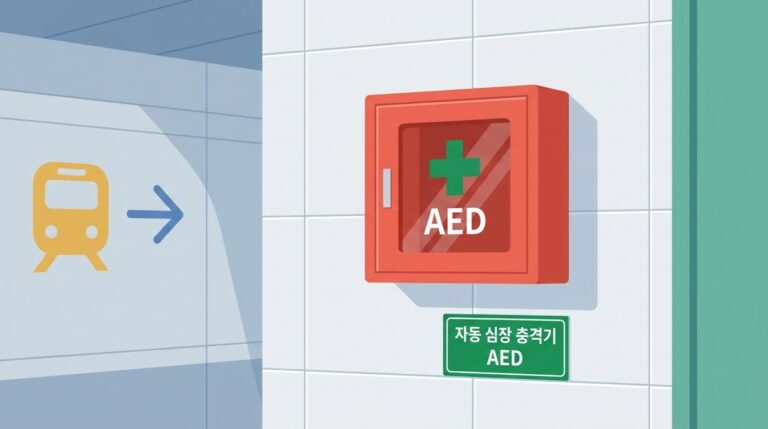
C1 Korean Masterclass: Saving Lives in Seoul — Operating an Automated External Defibrillator (AED)
Phase 1: Empathy (An Immersive Opening)
안녕하세요! It’s your premium tutoring editor and native culture navigator from Daily Hangul (매일한글). Let’s paint a picture that every C1 learner living in or traveling to Korea should mentally prepare for.
Imagine you are strolling through a bustling subway station like Gangnam or Hongdae, or perhaps grabbing a coffee near Han River. Suddenly, an elderly gentleman collapses. Passersby freeze, and someone screams, “누가 자동 심장 충격기 좀 가져다주세요!” (Someone, please get an AED!). You spot the metallic box on the wall, but when you open it, the voice prompt blares in Korean. Under immense pressure, will you understand what the machine is telling you to do? Or what the bystanders are pleading for?
Medical emergencies are high-stress situations where even C1 speakers can experience a linguistic cognitive block. Translating raw medical terms in your head under a countdown is a recipe for panic. Today, we are moving beyond textbook “hospital vocabulary” into survival-grade, real-time command of Korean life-saving protocols. Your ability to understand and speak precisely in these golden minutes could literally save a life.
Phase 2: Deep Dive into 3 Essential Expressions
1. 자동 심장 충격기 (ja-dong-sim-jang-chung-gyeok-gi)
- Pronunciation: Jah-dong sim-jahng choong-gyeok-gee (Sounds like “Jah-dong” + “Sim-jang” like heart + “Chung-gyuk-gi” like shock machine)
- Meaning: Automated External Defibrillator (AED) / Automated Cardiac Shock Device
- K-Culture Moment: In medical K-Dramas like Hospital Playlist (슬기로운 의사생활) or emergency response reality shows, you will hear paramedics or doctors frantically asking for the “AED” or “자동제세동기” (the older, Sino-Korean medical term still widely used by pros).
- Editor’s Insight: While the official term on public signs is 자동 심장 충격기, medical professionals might call it 제세동기 (je-se-dong-gi). Knowing both ensures you won’t hesitate when someone yells either term.
- Situation Spectrum: Casual: 🚫 | Semi-formal: ⚠️ | Formal/Emergency: ✅
- 🤔 Think About It: In English, we use the acronym “AED.” Why do you think Korean public signs spell out the entire phrase “자동 심장 충격기” instead of just “AED”? How does this reflect the Korean community’s desire for public-wide clarity in critical moments?
2. 패드를 가슴에 부착하세요 (pae-deu-reul ga-seum-e bu-chak-ha-se-yo)
- Pronunciation: Pah-deu-reul gah-seum-eh boo-chahk-hah-seh-yo (Think “pad” + “gah-seum” (chest) + “boo-chahk” (attach/adhere))
- Meaning: Please attach the pads to the chest.
- K-Culture Moment: This is the most crucial voice prompt you will hear from the AED machine once you open it. The machine will guide you step-by-step through its built-in speaker.
- Editor’s Insight: The verb 부착하다 (to attach/paste) is highly formal and precise. In casual Korean, we say 붙이다 (but-i-da), but in emergency or machine instruction contexts, 부착하다 is exclusively used.
- Situation Spectrum: Casual: 🚫 | Semi-formal: ⚠️ | Formal/Emergency: ✅
- 🤔 Think About It: Contrast the nuance of “붙이세요” (stick it on) with “부착하십시오” (adhere/attach formally). How does the level of formality help in establishing authority and calm during a crisis?
3. 환자에게서 떨어지세요 (hwan-ja-e-ge-seo tteo-leo-ji-se-yo)
- Pronunciation: Hwan-ja-eh-geh-suh ttuh-luh-jee-seh-yo (Sounds like “Hwan-ja” (patient) + “ttuh-luh-ji-da” (step away/separate))
- Meaning: Step away from the patient / Clear of the patient.
- K-Culture Moment: Right before the AED delivers the electric shock, it will analyze the heart rhythm and issue this urgent warning. Touching the patient at this moment is highly dangerous.
- Editor’s Insight: 떨어지다 usually means “to fall” in basic Korean, but in this physical space context, it means “to distance oneself” or “to keep clear.”
- Situation Spectrum: Casual: 🚫 | Semi-formal: ⚠️ | Formal/Emergency: ✅
- 🤔 Think About It: When the machine says “떨어지세요,” you must also yell this out to the surrounding crowd. How does the urgent imperative ending ‘-세요’ function as both a polite request and a non-negotiable direct command in Korean society?
Phase 3: Textbook Korean vs. Real-World Korean
Scenario 1: Requesting an AED from a bystander
- 📖 Textbook Korean: “저기 있는 자동 제세동기를 가져와 주시겠습니까?” (Could you please bring the automated external defibrillator over there?)
- 🗣️ 진짜 한국어: “거기 빨간 모자 쓰신 분! AED 좀 빨리 가져다주세요!” (You there, in the red cap! Please bring the AED quickly!)
- 💡 Why the Difference?: In an emergency, using passive, ultra-polite indirect questions like “~주시겠습니까?” wastes time and causes bystander paralysis. Real-world Korean emergency training teaches you to point directly at a specific person, describe their appearance (e.g., “빨간 모자 쓰신 분”), and use the direct imperative “~주세요!”
Scenario 2: Informing people that the shock is about to discharge
- 📖 Textbook Korean: “기기에서 전기가 방출되오니 물러나 주십시오.” (Electricity is discharging from the device, so please step back.)
- 🗣️ 진짜 한국어: “다 물러나세요! 손 떼세요!” (Everyone step back! Hands off!)
- 💡 Why the Difference?: When the AED is charging, nobody reads a manual. Shouting short, highly active commands like “물러나세요!” (Step back!) and “손 떼세요!” (Take your hands off!) is standard protocol to prevent accidental electrocution.
Phase 4: K-Culture Deep Dive & Non-Verbal Manners
4-1. The Korean Concept of “Nunchi” (눈치) in Emergencies
In Korea, collective action and quick Nunchi (situational awareness) play a huge role during emergencies. If you are administering CPR or using an AED, shouting clear, authoritative commands is expected. Do not hesitate because of honorifics; in a life-or-death situation, saving a life supersedes excessive politeness.
- The Pointing Gesture: When appointing someone to call 119 or fetch an AED, do not point with a single finger (which can feel accusatory or rude in Korea). Instead, extend your hand with your palm facing slightly upwards, pointing towards the person, or make eye contact so direct that there is no ambiguity.
4-2. Cultural Context: The “Good Samaritan” Law in Korea
Many foreigners worry about legal liabilities when helping in Korea. Korea has a “Good Samaritan” clause under the 응급의료에 관한 법률 (Emergency Medical Service Act, Article 5-2). It protects laypersons who perform emergency medical services (like CPR or using an AED) in good faith from civil and criminal liability if things go wrong. Knowing this cultural and legal safety net should give you the confidence to act immediately!
Phase 5: Real-Life Roleplay Scenario
Setting: A subway platform at Yongsan Station. An elderly man suddenly collapses. You and a Korean subway staff member (역무원) rush to help.
Characters:
- 민우 (Min-woo): You (C1 Speaker, calm but urgent)
- 역무원 (Subway Staff): Professional, trying to secure the area
The Script:
- 민우: 🎭 (Urgently kneeling near the patient, checking breathing) 여기 사람 쓰러졌어요! 의식이 없어요!
(Yeo-gi sa-ram sseu-reo-jyeot-eo-yo! Ui-sig-i eop-seo-yo! / Someone collapsed here! He’s unconscious!) -
역무원: 🎭 (Rushing over with a radio) 119에 신고하겠습니다. 혹시 심폐소생술 하실 줄 아십니까?
(Ior-il-gu-e sin-go-ha-get-seum-ni-da. Hok-si sim-pye-so-saeng-sul ha-sil jul a-sip-ni-ka? / I’ll call 119. By any chance, do you know how to perform CPR?) -
민우: 네, 할 수 있어요! 가슴 압박하고 있을 테니, 저기 벽에 있는 자동 심장 충격기 좀 빨리 가져다주세요!
(Ne, hal su is-seo-yo! Ga-seum ap-bak-ha-go is-seul te-ni, jeo-gi byeok-e in-neun ja-dong sim-jang chung-gyeok-gi jom ppar-li ga-jyeo-da-ju-se-yo! / Yes, I can! I’ll do chest compressions, so please quickly bring the AED on that wall over there!) -
역무원: 🎭 (Running to grab the AED and coming back) 가져왔습니다! 기기 전원 켭니다!
(Ga-jyeo-wat-seum-ni-da! Gi-gi jeon-won kyeom-ni-da! / Brought it! Turning the device power on!) -
민우: 좋아요. 패드 부착 위치 확인하고 바로 붙일게요. 환자 상의 좀 풀어주세요.
(Jo-a-yo. Pae-deu bu-chak wi-chi hwa-gin-ha-go ba-ro but-il-ge-yo. Hwan-ja sang-ui jom pul-eo-ju-se-yo. / Good. I’ll check the pad attachment positions and stick them on right away. Please undo the patient’s shirt.) -
AED 기기 (Voice Prompt): 🔊 “환자로부터 멀리 떨어지세요. 심장 리듬 분석 중입니다.”
(“Hwan-ja-ro-bu-teo meol-li tteo-leo-ji-se-yo. Sim-jang ri-deum bun-seok jung-im-ni-da.” / “Step away from the patient. Analyzing heart rhythm.”) -
민우: 🎭 (Raising both hands to stop bystanders) 모두 물러나세요! 환자한테서 손 떼세요!
(Mo-du mul-ler-na-se-yo! Hwan-ja-han-te-seo son tte-se-yo! / Everyone step back! Hands off the patient!) -
역무원: 네, 아무도 안 만지고 있습니다. 기기 지시 대로 제세동 버튼 누르겠습니다!
(Ne, a-mu-do an man-ji-go is-seum-ni-da. Gi-gi ji-si dae-ro je-se-dong beot-eun nu-reu-get-seum-ni-da! / Yes, nobody is touching him. I’ll press the shock button as instructed by the device!)
🔀 Interactive Choice Point
The AED device issues a shock, and then prompts: “심폐소생술을 즉시 시작하세요” (Resume CPR immediately). What is your next move?
- A) “119 올 때까지 그냥 기다립시다.” (Let’s just wait until 119 arrives.)
- B) “가슴 압박 다시 시작합니다. 하나, 둘, 셋, 넷…” (I’m starting chest compressions again. One, two, three, four…)
- C) “환자가 깨어났는지 뺨을 때려볼게요.” (I’ll slap his cheeks to see if he woke up.)
Feedback:
- A (Bad): Waiting without continuous CPR dramatically decreases survival rates. The AED explicitly tells you to resume CPR.
- B (Best!): Perfect. You immediately start chest compressions to the beat of the AED’s built-in metronome.
- C (Risk): Slapping an unconscious patient is ineffective and could cause neck injuries. Stick to standard CPR protocols.
Phase 6: 10-Second Emotion Shadowing Drill
In a crisis, your voice must carry absolute clarity and authority. Practice these with the exact emotional tones indicated!
- [🚨 Urgently and loudly]
- “거기 파란색 / 셔츠 입으신 분, / 119에 / 신고해 주세요!”
- Ge-gi pa-ran-saek / syeo-tsu ib-eu-sin bun, / il-il-gu-e / sin-go-hae ju-se-yo!
- (You over there in the blue shirt, please call 119!)
- [⚠️ Commanding and strict]
- “기기 작동합니다! / 모두 / 손 떼고 / 물러나세요!”
- Gi-gi jak-dong-ham-ni-da! / Mo-du / son tte-go / mul-ler-na-se-yo!
- (The device is operating! Everyone take your hands off and step back!)
Phase 7: K-Culture Mini-Dictionary
- 심폐소생술 (sim-pye-so-saeng-sul) | CPR
- Literally “Cardiopulmonary Resuscitation.” In daily life, it is heavily abbreviated as CPR (씨피알).
- 골든 타임 (gol-deun ta-im) | Golden Time / Golden Hour
- Borrowed from English but used constantly in Korean medical emergency contexts to describe the crucial 4 minutes during cardiac arrest.
- 제세동 (je-se-dong) | Defibrillation
- The formal clinical Sino-Korean word for eliminating cardiac fibrillation. You’ll see this printed on older AED boxes.
- 의식 (ui-sik) | Consciousness
- Used to check if a patient is awake. “의식이 있어요?” (Are they conscious?) / “의식이 없어요” (They are unconscious).
Phase 8: Emergency Survival Kit for Travelers
Survival Expressions TOP 3
- “제세동기 어디에 있어요?” (Je-se-dong-gi eo-di-e is-seo-yo?)
- Pro Tip: Ask station staff or convenience store clerks if you can’t find one.
- “119에 신고해 주시고 자동 심장 충격기 좀 가져다주세요.” (Il-il-gu-e sin-go-hae ju-si-go ja-dong sim-jang chung-gyeok-gi jom ga-jyeo-da-ju-se-yo.)
- Pro Tip: The absolute textbook emergency command phrase to use on bystanders.
- “숨을 안 쉬어요!” (Sum-eul an swi-eo-yo!)
- Pro Tip: “He/She is not breathing!” Use this to convey maximum urgency to the dispatcher.
Editor’s Travel Note
Did you know that you can locate the nearest public AED in Korea in real-time? Download the KakaoMap App or Naver Map App and search for “자동심장충격기” or “AED”. It will show you the nearest locations, which are typically inside subway stations, government buildings, and large apartment complexes.
Phase 9:
Frequently Asked Questions (FAQ)
Q: What does "자동 심장 충격기 (ja-dong-sim-jang-chung-gyeok-gi)" mean in Korean and how do you pronounce it?
A: In Korean, "자동 심장 충격기 (ja-dong-sim-jang-chung-gyeok-gi)" is pronounced [Jah-dong sim-jahng choong-gyeok-gee (Sounds like "Jah-dong" + "Sim-jang" like heart + "Chung-gyuk-gi" like shock machine] and means: Automated External Defibrillator (AED) / Automated Cardiac Shock Device
Q: What does "패드를 가슴에 부착하세요 (pae-deu-reul ga-seum-e bu-chak-ha-se-yo)" mean in Korean and how do you pronounce it?
A: In Korean, "패드를 가슴에 부착하세요 (pae-deu-reul ga-seum-e bu-chak-ha-se-yo)" is pronounced [Pah-deu-reul gah-seum-eh boo-chahk-hah-seh-yo (Think "pad" + "gah-seum" (chest] and means: Please attach the pads to the chest.
Q: What does "환자에게서 떨어지세요 (hwan-ja-e-ge-seo tteo-leo-ji-se-yo)" mean in Korean and how do you pronounce it?
A: In Korean, "환자에게서 떨어지세요 (hwan-ja-e-ge-seo tteo-leo-ji-se-yo)" is pronounced [Hwan-ja-eh-geh-suh ttuh-luh-jee-seh-yo (Sounds like "Hwan-ja" (patient] and means: Step away from the patient / Clear of the patient.







