

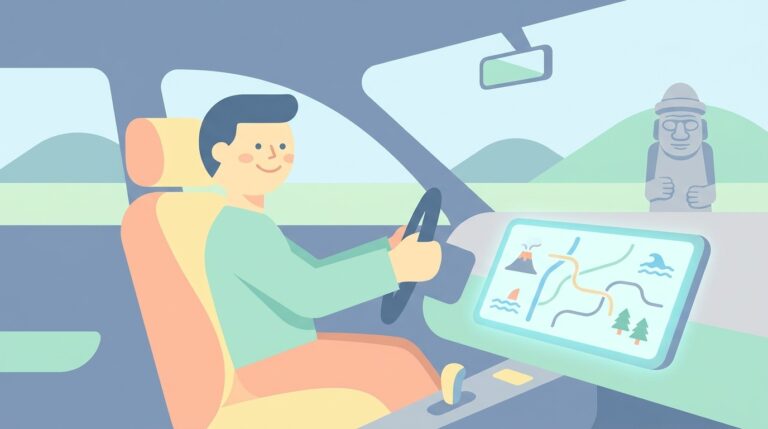
Master Your Korean Rental Car GPS: How to Ask for Navigation Help Like a Local
Phase 1: Empathy (Your Rental Car Adventure Awaits!)
안녕하세요! (An-nyeong-ha-se-yo!) I’m your Daily Hangul editor and your personal cultural navigator.
Picture this: You’ve finally landed in beautiful Jeju Island or bustling Busan. You rented a sleek car, ready for an epic Korean road trip. You hop into the driver’s seat, but as you turn on the ignition, a robotic voice greets you entirely in fast Korean, and the GPS screen looks like a futuristic spaceship control panel. Your hotel is only 15 minutes away, but you have no idea how to type the address!
You might feel a wave of panic, but don’t worry. This is a classic “Pain Point” for many first-time travelers in Korea. This guide is built from real-world feedback from learners just like you who successfully navigated Korea’s scenic routes after mastering just a few simple phrases. Let’s learn how to ask for help with your car navigation system confidently!
Phase 2: Deep-Dive into 3 Key Expressions
1. 네비게이션 어떻게 켜요? (Ne-bi-ge-i-syeon eo-tteo-ke kyeo-yo?)
- Pronunciation: Ne-bi-gay-shun uh-ttuh-kay kyuh-yo? (Rhymes with “show yo”)
- Meaning: How do I turn on the navigation?
- K-Culture Moment: In K-Dramas, you often see characters starting a road trip, tapping the screen, and saying this to their passenger when the screen stays black.
- Editor’s Insight: Koreans almost always shorten “navigation” to “네비 (ne-bi)” in casual speech.
- Situation Spectrum:
- Casual: ✅ (네비 어떻게 켜?)
- Semi-formal: ✅ (네비게이션 어떻게 켜요?)
- Formal: ⚠️ (네비게이션 어떻게 켭니까?)
- 🤔 Think About It: In Korea, English loanwords are highly integrated but pronounced with a distinct Korean accent. How does your native language adapt modern technology words?
2. 주소 어떻게 입력해요? (Ju-so eo-tteo-ke im-ryeok-hae-yo?)
- Pronunciation: Joo-so uh-ttuh-kay im-ryuk-hay-yo?
- Meaning: How do I input/type the address?
- K-Culture Moment: Imagine stopping at a scenic rest stop (휴게소 – hyu-ge-so) to buy some delicious walnut cakes (호두과자) and asking a friendly local to help you type in your next destination.
- Editor’s Insight: Korean addresses can have two formats: the old “Ji-beon” (land-lot) and the new “Doro-myeong” (road name). If you get confused, asking this phrase will prompt locals to show you exactly which search bar to use.
- Situation Spectrum:
- Casual: ✅ (주소 어떻게 입력해?)
- Semi-formal: ✅ (주소 어떻게 입력해요?)
- Formal: ✅ (주소 어떻게 입력합니까?)
- 🤔 Think About It: Why do you think Korea uses two different address systems, and how might that affect digital navigation?
3. 영어로 바꿀 수 있어요? (Yeong-eo-ro ba-kkul su is-seo-yo?)
- Pronunciation: Yung-uh-ro bah-kkool soo eet-suh-yo?
- Meaning: Can I change (the language) to English?
- K-Culture Moment: At the rental car counter, before you even drive off, this is your golden ticket to a stress-free trip!
- Editor’s Insight: Most modern Korean rental cars have a system language setting. Even if the voice stays in Korean, changing the text to English makes a world of difference.
- Situation Spectrum:
- Casual: 🚫 (Too blunt for staff: 영어로 바꿀 수 있어?)
- Semi-formal: ✅ (영어로 바꿀 수 있어요?)
- Formal: ✅ (영어로 변경 가능합니까?)
- 🤔 Think About It: Asking for language options politely shows respect for the local system while finding a practical solution for your safety.
Phase 3: Textbook Korean vs. Real-World Korean
Scenario 1: Setting the destination
- 📖 Textbook Korean: 목적지를 설정해 주시겠습니까? (Mok-jeok-ji-reul seol-jeong-hae ju-si-get-seum-ni-ka? – “Would you please configure the destination?”)
- 🗣️ Real-World Korean: 여기 어떻게 가요? (Yeo-gi eo-tteo-ke ga-yo? – “How do I get here?” while pointing to your map/phone)
- 💡 Why the difference? Nobody uses heavy administrative words like “configure destination” in real life. Pointing and asking “How do I go here?” is natural, friendly, and highly effective.
Scenario 2: Asking for a change of language
- 📖 Textbook Korean: 언어 설정을 영어로 변경해 주십시오. (Eon-eo seol-jeong-eul yeong-eo-ro byeon-gyeong-hae ju-sip-si-o. – “Please modify the language settings to English.”)
- 🗣️ Real-World Korean: 영어로 해주세요. (Yeong-eo-ro hae-ju-se-yo. – “English, please.”)
- 💡 Why the difference? Short, polite requests ending in “~해 주세요 (hae-ju-se-yo)” are extremely natural and prevent you from sounding like a textbook robot.
Phase 4: K-Culture Deep-Dive & Non-Verbal Manners
4-1. Nunchi (눈치) & Body Language
When asking a rental agent or a passerby for help with your GPS, use the “Two-Handed Hover”. When handing them your phone with the address or pointing to the car screen, use both hands or support your right elbow with your left hand. This gesture shows immense respect and instantly triggers the helper’s Jeong (정 – warm affection/helpfulness).
4-2. The Korean GPS Phenomenon
In Korea, GPS is famously hyper-detailed. It doesn’t just tell you to turn left; it warns you about speed bumps, speed cameras, school zones (where speed drops to 30km/h), and even tells you which lane to stay in using color-coded paths on the screen (green and pink lines on the road). Understanding this “Visual Guide” will save you even if you don’t fully understand the Korean voice commands!
Phase 5: Real-Life Roleplay Scenario
Setting: Jeju Island Rental Car Depot. You just got the keys to your car, but the GPS screen is entirely in Korean. You call over the friendly staff member, Min-su.
- You (Guest): 저기요, 죄송한데 네비게이션이 한국어예요.
(Jeo-gi-yo, joe-song-han-de ne-bi-ge-i-syeon-i han-guk-eo-yeo-yo.)
🎭 (Smiling nervously, pointing at the dashboard screen)
“Excuse me, sorry but the navigation is in Korean.” -
Min-su (Staff): 아, 네! 도와드릴까요?
(A, ne! Do-wa-deu-ril-ka-yo?)
🎭 (Nodding helpfully, leaning into the car window)
“Oh, yes! Shall I help you?” -
You (Guest): 네, 이거 영어로 바꿀 수 있어요?
(Ne, i-geo yeong-eo-ro ba-kkul su is-seo-yo?)
🎭 (Showing a hopeful expression)
“Yes, can we change this to English?” -
Min-su (Staff): 이 모델은 영어 지원이 안 돼요. 죄송합니다.
(I mo-del-eun yeong-eo ji-won-i an dwae-yo. Joe-song-ham-ni-da.)
🎭 (Making a slight bowing motion, looking apologetic)
“This model doesn’t support English. I’m sorry.” -
You (Guest): 아, 괜찮아요! 그럼 주소 어떻게 입력해요?
(A, gwen-cha-na-yo! Geu-reom ju-so eo-tteo-ke im-ryeok-hae-yo?)
🎭 (Waving hands slightly to say it's okay)
“Ah, that’s okay! Then how do I input the address?” -
Min-su (Staff): 여기 검색창에 전화번호나 주소를 치시면 돼요.
(Yeo-gi geom-saek-chang-e jeon-hwa-beon-ho-na ju-so-reul chi-si-myeon dwae-yo.)
🎭 (Tapping the search bar on the screen)
“You can just type the phone number or the address in this search bar.” -
You (Guest): 아! 전화번호도 돼요? 진짜 편하네요!
(A! Jeon-hwa-beon-ho-do dwae-yo? Jin-짜 pyeon-ha-ne-yo!)
🎭 (Eyes widening with pleasant surprise)
“Oh! Phone numbers work too? That’s really convenient!” -
Min-su (Staff): 네, 맞아요. 번호만 누르시면 바로 안내해요! 즐거운 여행 되세요!
(Ne, ma-ja-yo. Beon-ho-man nu-reu-si-myeon ba-ro an-nae-hae-yo! Jeul-geo-un yeo-haeng doe-se-yo!)
🎭 (Giving a warm, welcoming thumbs-up)
“Yes, that’s right. Just press the number and it guides you right away! Have a great trip!”
🔀 Interactive Choice Point
What do you say to Min-su to wrap up the conversation?
- Option A: 고마워! (Go-ma-wo!)
- Option B: 감사합니다! 안전 운전 할게요! (Gam-sa-ham-ni-da! An-jeon un-jeon hal-ge-yo!)
- Option C: 네비게이션이 너무 어렵습니다. (Ne-bi-ge-i-syeon-i neo-mu eo-ryeop-seum-ni-da.)
Feedback:
- Option A (Bad): Too casual! Using “반말 (ban-mal)” with a helpful staff member might sound rude.
- Option B (Best): Perfect! “Thank you! I will drive safely!” shows great manners and warmth.
- Option C (Risk): Grammatically correct, but saying “Navigation is too difficult” makes you sound frustrated instead of ending on a positive, thankful note.
Phase 6: 10-Second Emotional Shadowing Drill
Practice speaking with the flow and emotions of a real Korean driver!
- [🥺 Confused & Helpless]
네비게이션이… / 안 켜져요.
(Ne-bi-ge-i-syeon-i… / an kyeo-jyeo-yo.)
“The navigation… / won’t turn on.” -
[😊 Relieved & Friendly]
아, / 전화번호로 / 검색하면 되네요!
(Ah, / jeon-hwa-beon-ho-ro / geom-saek-ha-myeon doe-ne-yo!)
“Ah, / searching by / phone number works!” -
[💖 Super Polite & Grateful]
도와주셔서 / 정말 감사합니다!
(Do-wa-ju-syeo-seo / jeong-mal gam-sa-ham-ni-da!)
“Thank you / so much / for helping me!”
Phase 7: K-Culture Mini-Dictionary
- 네비 (Ne-bi) | Navigation | The casual slang abbreviation for GPS navigation used by every Korean driver.
- 휴게소 (Hyu-ge-so) | Highway Rest Stop | Far more than just bathrooms! Korean rest stops are food paradises with gourmet meals, snacks like Sotteok-Sotteok (sausage & rice cake skewers), and beautiful gardens.
- 안전 운전 (An-jeon Un-jeon) | Safe Driving | A sweet phrase used to wish drivers a safe trip. Often said as “안전 운전 하세요!” (Drive safely!).
- 티맵 (T-map) | T-Map App | The absolute king of Korean mobile GPS apps. Even rental car screens often run on T-Map systems.
Phase 8: Survivor Kit for Travelers
Survival Phrases TOP 3
- 여기 찍어 주세요. (Yeo-gi jji-geo ju-se-yo.)
- “Please tap/enter this place (on the screen) for me.” (Handy when you can’t type the Korean characters yourself).
- 소리 조금 키워 주세요. (So-ri jo-geum ki-wo ju-se-yo.)
- “Please turn up the volume a bit.”
- 길이 너무 막혀요. (Gil-i neo-mu mak-hyeo-yo.)
- “The traffic is too heavy.”
Editor’s Travel Note 🚗
Pro-Tip: Standard Google Maps does not work well for driving directions in South Korea due to government security laws. Before you leave the airport, download 네이버 지도 (Naver Map) or 카카오내비 (KakaoNavi). These apps offer English menus and are incredibly accurate!
Note: Traffic rules and app features may change; check current local guidelines before departure.
Phase 9:
Frequently Asked Questions (FAQ)
Q: What does "네비게이션 어떻게 켜요? (Ne-bi-ge-i-syeon eo-tteo-ke kyeo-yo?)" mean in Korean and how do you pronounce it?
A: In Korean, "네비게이션 어떻게 켜요? (Ne-bi-ge-i-syeon eo-tteo-ke kyeo-yo?)" is pronounced [Ne-bi-gay-shun uh-ttuh-kay kyuh-yo? (Rhymes with "show yo"] and means: How do I turn on the navigation?
Q: What does "주소 어떻게 입력해요? (Ju-so eo-tteo-ke im-ryeok-hae-yo?)" mean in Korean and how do you pronounce it?
A: In Korean, "주소 어떻게 입력해요? (Ju-so eo-tteo-ke im-ryeok-hae-yo?)" is pronounced [Joo-so uh-ttuh-kay im-ryuk-hay-yo?] and means: How do I input/type the address?
Q: What does "영어로 바꿀 수 있어요? (Yeong-eo-ro ba-kkul su is-seo-yo?)" mean in Korean and how do you pronounce it?
A: In Korean, "영어로 바꿀 수 있어요? (Yeong-eo-ro ba-kkul su is-seo-yo?)" is pronounced [Yung-uh-ro bah-kkool soo eet-suh-yo?] and means: Can I change (the language) to English?







