

Don’t Let ‘Ramen Face’ Stop You: How to Worry About Bloating Like a True Korean!
Phase 1: Empathy (공감)
안녕하세요! (Annyeonghaseyo!) It’s your trusty Korean culture navigator and Daily Hangul editor!
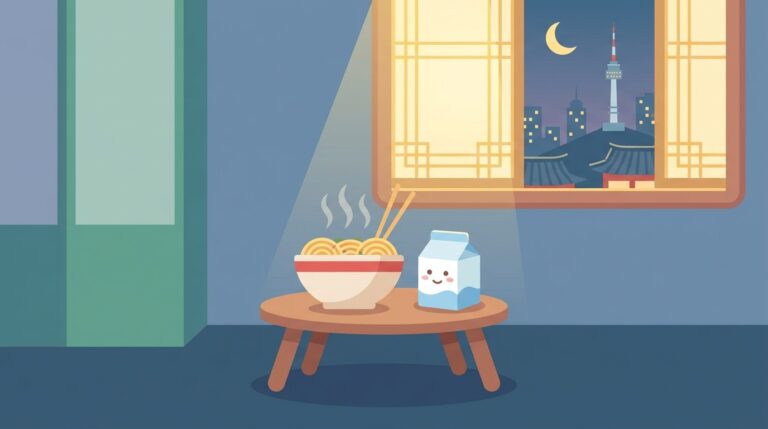
Imagine this: It’s 11 PM in Seoul. You’re cozy in your room, watching your favorite K-Drama, and suddenly, the main characters start slurping down spicy, steaming instant ramen (라면) or sharing a golden plate of crispy Korean fried chicken (치킨). Your stomach rumbles. You want to order some late-night food—known as 야식 (yasik) in Korea—but a terrifying thought crosses your mind:
“If I eat this now, my face is going to look like a fully blown balloon tomorrow morning!”
If you’ve ever hesitated to join in on the glorious Korean yasik culture because you’re worried about waking up with a puffy face, you are not alone! In Korea, worrying about your face bloating—specifically referred to as 얼굴 붓는 것 (eolgul bunneun geot)—is a national late-night ritual.
Many of my students have confessed, “Editor, I want to suggest late-night snacks to my Korean roommates, but I don’t know how to playfully express my fear of waking up puffy!” Today, we’re going to learn the exact colloquial expressions, cultural hacks (like why Koreans drink milk with ramen!), and dramatic scripts to help you master this essential social bonding moment. Let’s dive in!
Phase 2: Deep Dive into 3 Key Expressions (핵심 표현 3선)
Let’s look at the three most natural ways to express your “puffy face anxiety” to your Korean friends.
1. 내일 얼굴 엄청 부을 텐데… (Nae-il eolgul eom-cheong bu-eul tende…)
- Pronunciation: Nay-il eol-gool eom-cheong boo-eul ten-dae… (Sounds like “tende” at the end, trailing off with a sigh)
- Meaning: “My face is going to bloat so much tomorrow, though…”
- K-Culture Moment: This is the ultimate “soft hesitation” line you use when your friend suggests ordering food late at night. You want to say yes, but you need to show you are struggling with your conscience first.
- Editor’s Insight: The ending ~ㄹ/을 텐데 carries a nuance of worry, regret, or expectation. Trailing off the sentence makes you sound cute and relatable.
- Situation Spectrum: Casual ✅ | Semi-formal ✅ | Formal ⚠️
- 🤔 Think About It: Why do you think Korean culture places so much emphasis on temporary facial bloating? In a society that values sharp features, discussing “bloating” is a very common, lighthearted icebreaker.
2. 라면 먹고 갈래? …대신 우유 마시고 자야 돼. (Ramen meokgo gallae? …daesin uyu masigo jaya dwae.)
- Pronunciation: Rah-myeon meok-go gal-lae? …dae-shin oo-yoo mah-shi-go jah-yah dwae.
- Meaning: “Do you want to eat ramen? …But we have to drink milk before sleeping to compensate.”
- K-Culture Moment: You will hear this in almost every college-themed K-drama or webtoon.
- Editor’s Insight: Why milk? Korean urban legend (backed by some science!) says the potassium in milk helps flush out the sodium from the ramen, preventing a puffy face. Saying “우유 마시고 자야 돼” (We must drink milk before sleeping) is the ultimate life hack excuse to eat guilt-free.
- Situation Spectrum: Casual ✅ | Semi-formal ⚠️ | Formal 🚫
- 🤔 Think About It: Does your culture have a unique “antidote” or food combination to prevent morning-after bloating or hangovers?
3. 나 내일 부으면 네가 책임져! (Na nae-il bueumyeon nega chaegim-jyeo!)
- Pronunciation: Nah nay-il boo-eu-myeon nee-gah chaek-im-jyeo!
- Meaning: “If I bloat tomorrow, you’re taking responsibility!”
- K-Culture Moment: Best friends or couples say this playfully when one person is teasingly tempting the other with delicious food.
- Editor’s Insight: 책임져 (chaegim-jyeo) means “take responsibility.” It’s highly colloquial, affectionate, and establishes a fun, close bond. Do not use this with your boss!
- Situation Spectrum: Casual ✅ | Semi-formal 🚫 | Formal 🚫
- 🤔 Think About It: How does teasing your friend and holding them “responsible” for your late-night snack guilt make the bond stronger?
Phase 3: Textbook Korean vs. Real Korean (교과서 vs. 진짜 한국어)
Let’s compare what dry textbooks teach you versus how cool, modern Koreans actually speak at 11:30 PM!
Scenario A: Expressing that you will bloat tomorrow
- 📖 Textbook style: “야식을 먹으면 다음 날 얼굴이 부을 것입니다.” (If you eat late-night snacks, your face will bloat.) – Too robotic, sounds like a medical textbook!
- 🗣️ Real Korean: “나 지금 먹으면 내일 백퍼(100%) 붓는다.” (If I eat right now, I’m 100% bloating tomorrow.)
- 💡 Why the difference? 백퍼 (baek-peo) is a very common slang short for “100 percent” (백 퍼센트). Using it makes your warning sound casual and dramatic.
Scenario B: Worrying about looking like a swollen bean
- 📖 Textbook style: “얼굴이 붓는 것이 걱정됩니다.” (I am worried about my face bloating.) – Too stiff and formal.
- 🗣️ Real Korean: “내일 얼굴 팅팅 부을 텐데 어쩌지?” (My face is going to be super puffy tomorrow, what should I do?)
- 💡 Why the difference? 팅팅 (ting-ting) is an onomatopoeia describing something swollen or bloated to the maximum. It adds vivid color and cuteness to your sentence!
Phase 4: K-Culture Deep Dive & Non-Verbal Manners
4-1. The “Late-Night” Body Language
When Koreans express worry about bloating, they rarely just say it with words. Use these non-verbal cues to sound like a local:
1. The Double-Cheek Pat: Lightly pat both of your cheeks with your palms while saying “아, 부을 텐데…” (Ah, I’ll bloat…). This physically mimics the worry of chubby cheeks.
2. The Hand Wave: Wave your hand in front of your nose as if waving away the temptation of the food delivery app on your phone.
4-2. The “Ramen and Milk” Cultural Phenomenon
In Korea, yasik is a lifestyle. Because the country has one of the most efficient late-night delivery systems in the world (you can get chicken, feet, or pizza at 2 AM in less than 30 minutes), the “puffy face” is an active national struggle.
To combat this, the “Ramen-Milk Combo” became a massive meme. Many convenience stores even place small cartons of milk right next to the instant ramen stands! It’s the ultimate display of “I want to eat delicious food, but I care about my appearance tomorrow.”
Phase 5: Real-Life Roleplay Scenario (실전 롤플레이)
Let’s practice! You are at your Korean friend Minji’s apartment. It’s midnight, and she is opening her favorite delivery app.
Characters:
- 민지 (Minji): Your late-night snack tempter. Energetic, loves spicy food.
- 유진 (You/Yujin): Hungry but terrified of looking puffy for tomorrow’s class presentation.
민지: 야, 유진아! 우리 엽떡(엽기떡볶이) 시켜 먹을래? 지금 딱 배고프지 않아?
(Hey, Yujin! Should we order Yeop-tteok [spicy tteokbokki]? Aren’t you hungry right about now?)
유진: 🎭 [Looking at the phone screen with wide eyes, patting cheeks]
아… 진짜 맛있겠다. 근데 우리 내일 발표 있잖아. 나 얼굴 엄청 부을 텐데…
(Ah… that looks so good. But we have a presentation tomorrow. My face is going to bloat so much…)
민지: 에이, 맛있게 먹으면 영(0) 칼로리 몰라? 그리고 붓는 건 내일 생각하자!
(Come on, don’t you know eating happily means zero calories? And let’s worry about bloating tomorrow!)
유진: 🎭 [Shaking head playfully]
말도 안 돼! 나 내일 팅팅 부으면 네가 책임져!
(No way! If I get super puffy tomorrow, you’re taking responsibility!)
민지: 걱정 마, 내 방에 우유 있어! 라면 먹고 우유 마시고 자면 진짜 괜찮아.
(Don’t worry, I have milk in my room! If we eat and drink milk before bed, it’s seriously fine.)
유진: 🎭 [Sighing in defeat but smiling]
진짜지? 그럼… 단무지 많이 추가해서 시켜줘!
(Seriously? Then… please add extra yellow pickled radish!)
민지: 오케이, 접수 완료! 가자!
(Okay, order received! Let’s go!)
🔀 Choose Your Path!
What will you say to Minji now?
* Choice A: “우유 진짜 효과 있는 거지?” (Milk really works, right?)
* Choice B: “나 그냥 안 먹을래. 잘 거야.” (I think I’ll pass. I’m going to sleep.)
* Choice C: “그럼 닭발도 같이 시키자!” (Then let’s order chicken feet together too!)
Feedback on your choice:
- Choice A (Best!): Perfect! This keeps the conversation playful and natural, showing you understand the Korean milk-ramen myth.
- Choice B (Bad): Boo! You killed the late-night snack vibe. (Though wise for your skin, it halts the social roleplay!)
- Choice C (Risk): Spicy chicken feet (닭발) are extremely high in sodium! You are choosing absolute puffiness tomorrow, but you will have a legendary night.
Phase 6: 10-Second Emotion Shadowing Drill (감정 섀도잉)
Practice saying these lines with the correct dramatic pauses (/) and emotional tone!
[🥺 Worried and hesitant]
아… / 내일 얼굴 / 엄청 부을 텐데… / 어쩌지?
(Ah… / tomorrow face / will bloat so much… / what should I do?)-
[😜 Playfully dramatic and blaming your friend]
나 / 내일 팅팅 부으면 / 네가 / 백퍼 책임져!
(If I / bloat super puffy tomorrow / you / 100% take responsibility!)
Phase 7: K-Culture Mini-Dictionary (미니 사전)
- 야식 (Ya-sik) | Late-night snacks. Often consumed after 10 PM. Popular menu items include chicken, tteokbokki, jokbal, and ramen.
- 팅팅 (Ting-ting) | Onomatopoeia for being swollen/bloated to the limit. E.g., “눈이 팅팅 부었어” (My eyes are swollen shut).
- 엽떡 (Yeop-tteok) | Slang abbreviation for “Yupgi Tteokbokki,” a wildly popular, intensely spicy brand of tteokbokki in Korea.
- 백퍼 (Baek-peo) | Slang for “100%” (totally, absolutely). Used to show absolute certainty about a future disaster (like bloating!).
Phase 8: Travel Survival Kit (여행자 생존 키트)
Survival Phrases for Late-Night Foodies
- “이거 많이 짜요?” (I-geo man-i jja-yo?)
- Meaning: Is this very salty? (Great for avoiding high-sodium foods if you bloat easily).
- “편의점 우유 코너 어디에요?” (Pyeon-ui-jeom u-yu ko-neo eo-di-e-yo?)
- Meaning: Where is the convenience store milk section?
- “붓기 빼는 차 있어요?” (But-gi pae-neun cha is-seo-yo?)
- Meaning: Do you have tea that helps reduce bloating? (Look for 호박즙 [pumpkin extract] or 옥수수수염차 [corn silk tea] at Olive Young!).
📌 Editor’s Travel Note:
To order late-night snacks like a pro, you must download the delivery app Baemin (배달의민족). Note that you usually need a Korean phone number or a friend’s help for foreign card payments. If you are stuck, look for a nearby 24-hour GS25 or CU convenience store!
Phase 9: “A Step Deeper” (한 발 더 깊이)
In many Western cultures, complaining about temporary morning bloating might seem overly self-conscious or unnecessary. However, in Korea, expressing concern about “얼굴 붓기” (facial bloating) is actually a form of social empathy. By complaining about your face bloating, you are showing your friends that you care about your self-presentation, while also inviting them to laugh at the shared human struggle of loving late-night food. It’s a warm, collective experience of shared guilt and delicious joy.
💬 Your Turn: Have you ever experienced the dreaded “Ramen Face” (라면 먹고 부은 얼굴)? What is your favorite late-night snack? Let me know in the comments below!
Phase 10: FAQ & Common Mistakes
Q: Is drinking milk after ramen really effective?
A: Yes! Scientifically, the calcium and potassium in milk help excrete the sodium from the ramen, which reduces fluid retention. Many Koreans swear by this method!
Q: What is the difference between “붓다” (but-da) and “부풀다” (bu-pul-da)?
A: 붓다 is used specifically for body parts swelling or bloating (e.g., face, legs, eyes). 부풀다 is used for objects expanding like balloons, or abstract things like hopes and dreams swelling up.
Q: Can I use “네가 책임져” to my boss at work?
A: Absolutely not! This is a very casual, intimate expression used only between close friends, peers, or romantic partners.
🚨 Common Mistakes Warning Board
- Mistake 1: Saying “얼굴이 뚱뚱해요” (My face is fat) instead of “얼굴이 부었어요” (My face is bloated).
- Correct Action: Being “fat” (뚱뚱하다) and “bloated” (붓다) are totally different in Korean. Use 부었다 for temporary morning bloating!
- Mistake 2: Saying “나 내일 불어요” (I will blow tomorrow).
- Correct Action: The verb is 붓다 (irregular verb). It conjugates to 부어요 or 부을 텐데. Saying “불어요” means you are swelling like noodles soaking in water!
Phase 11: Action Mission!
- 🥉 Bronze Mission: Go to your mirror, make a worried face, and say “아… 내일 얼굴 팅팅 부을 텐데…” out loud three times!
- 🥈 Silver Mission: Take a picture of your favorite late-night snack and upload it to Instagram. Tag your Korean study buddy with the caption: “내일 부으면 네가 책임져! 😉”
- 🥇 Gold Mission: Next time you order food late at night with a Korean friend, dramatically ask them: “우유도 같이 살까?” (Should we buy milk too?)
Phase 12: Interactive Quiz Challenge (퀴즈 챌린지)
1. Which of the following is the best slang word for “super puffy”?
- A) 빵빵 (Ppang-ppang)
- B) 팅팅 (Ting-ting)
- C) 뚱뚱 (Ddung-ddung)
Reveal Answer & Explanation
Correct Answer: B) 팅팅 (Ting-ting)
– 팅팅 is the specific onomatopoeia for bloated skin.
– 빵빵 means “stuffed tight/full like a balloon,” and 뚱뚱 means chubby/fat.
2. True or False: You should say “책임져!” (Take responsibility!) to your teacher if they give you too much homework.
- A) True
- B) False
Reveal Answer & Explanation
Correct Answer: B) False
– “책임져!” is a highly casual, playful, or intense demand. Saying it to a teacher or boss is considered rude and disrespectful.







