

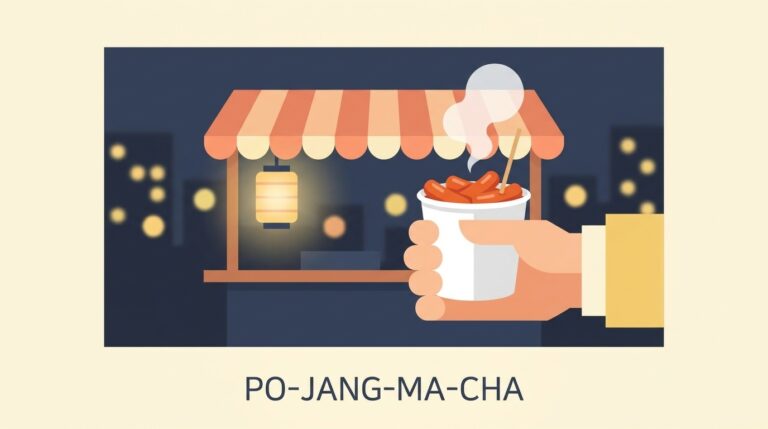
Master the Art of Cup Street Food: How to Eat Comfort Food Like a Local!
Phase 1: Empathy (Welcome, Street Food Explorers!)
안녕하세요! (An-nyeong-ha-se-yo!) Welcome back to Daily Hangul, your friendly neighborhood guide to living and breathing Korean culture like a local. I’m your Korean bestie and editor, and today, we are going on a delicious virtual trip to a bustling Korean street food stall (포장마차 – Po-jang-ma-cha)!
Picture this: It’s a chilly evening in Seoul. You smell the sweet, savory scent of spicy rice cakes (떡볶이 – Tteok-bok-ki) and sweet pancakes (호떡 – Ho-tteok). You walk up to the cart, order a snack, and the vendor hands it to you… in a tiny paper cup with a toothpick.
Wait, how do I eat this without making a mess? Do I ask for a plate? Is it okay to eat standing up?
If you’ve ever felt a bit clumsy trying to balance hot food in a small cup while standing on a crowded street, you are not alone! Many of our learners have told us they felt too shy to order street food because they didn’t know the “cup etiquette” or the right phrases. Don’t worry! Today, you’ll learn the exact words to get your food served in a cup and the cool hacks to eat it like a true Seoulite. Let’s dive in!
Phase 2: Three Essential Expressions to Order Like a Pro
Here are the three magic phrases you need to get your delicious street treats in a cup, explained simply for A2 learners!
1. 컵에 담아 주세요 (Keop-e dam-a ju-se-yo)
- Pronunciation: “Cup-eh dahm-ah joo-seh-yo” (Sounds like “cup” + “ah” + “joo-say-yo”)
- Meaning: “Please put it in a cup for me, please.”
- K-Culture Moment: In K-Dramas, you often see characters stopping by a street cart after school or work, quickly grabbing a cup of tteokbokki to eat while walking.
- Editor’s Insight: 담다 (dam-da) means “to put into a container.” By adding 주세요 (ju-se-yo), which means “please give me,” you are making a polite and natural request.
- Situation Spectrum: Casual (✅) | Semi-formal (✅) | Formal (⚠️ – Street stalls are casual places, so this is perfect!)
- 🤔 Think About It: In many Western countries, street food is served in large paper boxes or foil. Why do you think Korea loves using small, handy paper cups? (Hint: It’s all about fast-paced walking and sharing!)
2. 종이컵 하나만 더 주세요 (Jong-i-keop ha-na-man deo ju-se-yo)
- Pronunciation: “Jong-ee-cup ha-na-mahn duh joo-seh-yo” (Sounds like “Jong-ee” + “cup” + “hah-nah-mahn” + “duh”)
- Meaning: “Just one more paper cup, please.”
- K-Culture Moment: When buying 호떡 (Ho-tteok)—a sweet pancake filled with hot, melted brown sugar—locals often use a second cup to slide over the first one so they don’t burn their hands!
- Editor’s Insight: 종이 (jong-i) means paper, and 컵 (keop) is cup. 하나만 (ha-na-man) means “only one,” and 더 (deo) means “more.”
- Situation Spectrum: Casual (✅) | Semi-formal (✅) | Formal (🚫)
3. 꼬치 하나 주세요 (Kko-chi ha-na ju-se-yo)
- Pronunciation: “Kkoh-chee ha-na joo-seh-yo” (Rhymes with “coachy”)
- Meaning: “Please give me one skewer/toothpick.”
- K-Culture Moment: Street food stalls rarely give you forks. Instead, they give you long wooden skewers (꼬치) or toothpicks to poke your food.
- Editor’s Insight: If you are eating with a friend, you might need an extra skewer. Just ask for “꼬치 하나 더 주세요” (One more skewer, please)!
- Situation Spectrum: Casual (✅) | Semi-formal (✅) | Formal (🚫)
Phase 3: Textbook Korean vs. Real-Life Korean
Let’s look at how textbooks teach food ordering versus how real Koreans actually say it at a street food cart!
Situation 1: Ordering Tteokbokki in a cup
- 📖 Textbook Style: “떡볶이를 컵에 넣어 주시겠습니까?” (Tteok-bok-ki-reul keop-e neo-eo ju-si-get-seup-ni-ka?) – “Would you be so kind as to insert the rice cakes into a cup?” (Too formal, sounds like a robot!)
- 🗣️ Real-Life Local: “떡볶이 컵으로 주세요!” (Tteok-bok-ki keop-eu-ro ju-se-yo!) – “Tteokbokki in a cup, please!”
- 💡 Why the difference? At a busy street cart, speed is key! Using ~으로 (~eu-ro), which means “as/in the form of,” makes your order short, clear, and natural.
Situation 2: Asking for an extra toothpick
- 📖 Textbook Style: “이쑤시개를 제공해 주실 수 있나요?” (I-ssu-si-gae-reul je-gong-hae ju-sil su in-na-yo?) – “Can you provide a toothpick?” (Extremely unnatural and overly academic.)
- 🗣️ Real-Life Local: “이것 좀 찍어 먹게 꼬치 하나 주세요.” (I-geot jom jjik-eo meok-ge kko-chi ha-na ju-se-yo.) – “Give me a skewer so I can poke this to eat.”
- 💡 Why the difference? Locals focus on the action. 찍어 먹다 (jjik-eo meok-da) means “to poke/dip and eat.” Saying you want a skewer to eat with is much friendlier!
Phase 4: K-Culture Deep Dive & Non-Verbal Manners
4-1. The “Folded Cup” Magic (Nunchi & Gestures)
When eating 호떡 (Ho-tteok – Sweet Syrup Pancake), vendors will fold a paper cup in half and slide the hot pancake inside.
* The Non-Verbal Hack: Hold the cup near the bottom and gently squeeze it to push the pancake up as you take bites. Never squeeze too hard, or the boiling hot syrup might squirt out!
* Eye Contact: Keep an eye on your surroundings. Street stalls are small, so make sure your elbows are tucked in while eating standing up.
4-2. The “Fish Cake Broth” Etiquette (어묵국물 – Eomuk Gukmul)
If you order food, you are usually welcome to drink the warm fish cake broth (국물 – Gukmul) for free!
* Find the paper cups next to the broth container.
* Use the ladle to pour yourself a cup.
* Sip it quietly—slurping is okay, but blowing on it gently to cool it down is safer! It is bad manners to double-dip your skewer back into the shared broth container.
Phase 5: Real-Life Roleplay Scenario
Let’s practice! You are at a famous street food cart near Myeongdong Station in Seoul. The friendly owner (이모 – I-mo, meaning “Auntie”) is cooking up delicious food.
Characters:
- 이모 (Imo): The energetic stall owner.
- You (The hungry traveler)
1. 이모: 어서 와요! 뭐 드릴까?
   (Eo-seo wa-yo! Mwo deu-ril-ka?)
   🎭 [With a big smile, holding a spatula]
   "Welcome! What can I get you?"

2. You: 떡볶이 일인분 주세요.
   (Tteok-bok-ki il-in-bun ju-se-yo.)
   🎭 [Pointing politely at the red, bubbling rice cakes]
   "One portion of tteokbokki, please."

3. 이모: 서서 먹고 갈래요, 포장해 갈래요?
   (Seo-seo meok-go gal-lae-yo, po-jang-hae gal-lae-yo?)
   🎭 [Holding a plastic bag and a paper plate]
   "Would you like to eat here standing up, or pack it to go?"

4. You: 길에서 먹을 거예요. 컵에 담아 주세요!
   (Gil-e-seo meok-eul geo-yeo-yo. Keop-e dam-a ju-se-yo!)
   🎭 [Smiling and gesturing to a paper cup]
   "I’ll eat on the street. Please put it in a cup!"

5. 이모: 오케이! 꼬치는 몇 개 필요해요?
   (O-kei! Kko-chi-neun myeot gae pil-yo-hae-yo?)
   🎭 [Picking up long wooden toothpicks]
   "Okay! How many skewers do you need?"

6. You: 두 개 주세요. 친구랑 같이 먹어요.
   (Du gae ju-se-yo. Chin-gu-rang gat-i meok-eo-yo.)
   🎭 [Showing two fingers and pointing to your friend]
   "Two, please. I am eating with my friend."

7. 이모: 여기 있어요. 뜨거우니까 조심해요!
   (Yeo-gi is-seo-yo. Tteu-geo-u-ni-ka jo-sim-hae-yo!)
   🎭 [Handing you a steaming cup filled with rice cakes]
   "Here you go. It's hot, so be careful!"

8. You: 와, 감사합니다! 잘 먹겠습니다!
   (Wa, gam-sa-hap-ni-da! Jal meok-get-seup-ni-da!)
   🎭 [Bowing slightly and taking the cup with both hands]
   "Wow, thank you! I will eat well!"
🔀 Interactive Choice Point
The sauce from your cup is about to drip onto your white sneakers! What do you do?
* A) Panic and ask for a towel in English.
* B) Calmly say “휴지 좀 주세요” (Hyu-ji jom ju-se-yo – Please give me some tissues).
* C) Try to lick the sauce off the side of the cup.
Feedback:
- Best Choice – B: Perfect! Stalls always have a roll of toilet paper hanging nearby for easy clean-ups. Asking politely for 휴지 (hyu-ji) will save your shoes and impress the owner!
- Risk Choice – A: The owner might not understand English well under pressure, and you might lose precious seconds while the sauce stains your shoes!
- Bad Choice – C: Oops! Not only is this unhygienic, but you might also burn your tongue on the hot sauce!
Phase 6: 10-Second Emotion Shadowing Drill
Let’s practice saying these like a real Korean! Pay attention to the pauses (/) and the emotions.
- [😊 Friendly & Excited]
- “이모! / 떡볶이 / 컵에 / 담아 주세요!”
- Imo! / Tteok-bok-ki / keop-e / dam-a ju-se-yo!
- (Auntie! Please put the tteokbokki in a cup!)
- [🥺 Polite & Needy]
- “저기요, / 휴지 / 좀 / 주세요.”
- Jeo-gi-yo, / hyu-ji / jom / ju-se-yo.
- (Excuse me, please give me some tissues.)
- [😋 Hungry & Happy]
- “와! / 진짜 / 맛있겠다!”
- Wa! / Jin-jja / mas-it-get-da!
- (Wow! It looks so delicious!)
Phase 7: K-Culture Mini-Dictionary
- 컵떡볶이 (Keop-tteok-bok-ki): Tteokbokki served in a cup. It is the ultimate nostalgic childhood snack for Koreans.
- 어묵꼬치 (Eo-muk-kko-chi): Fish cake skewers served in a hot savory broth. Perfect for warming up in winter.
- 길먹 (Gil-meok): A slang abbreviation for “eating on the street” (길에서 먹기).
- 이모 (Imo): Literally “maternal aunt,” but used widely to friendly older female restaurant or street food owners.
Phase 8: Traveler’s Survival Kit
Survival Phrases TOP 3
- 이거 얼마예요? (I-geo eol-ma-yeo-yo?) – How much is this?
- Pro Tip: Useful if there is no menu board!
- 카드 돼요? (Ka-deu dwae-yo?) – Do you accept cards?
- Pro Tip: Most modern street stalls in Seoul accept cards, but keeping some cash is always smart.
- 덜 맵게 해주세요. (Deol maep-ge hae-ju-se-yo.) – Please make it less spicy.
- Pro Tip: Crucial if you can’t handle high spice levels!
Editor’s Travel Note
- App Recommendation: If you are hunting for legendary street food markets like Gwangjang Market or Mangwon Market, avoid Google Maps (which doesn’t work well in Korea). Instead, download the Naver Map App for perfect pedestrian directions.
- Waste Tip: Do not throw your empty cups on the street! Bring them back to the stall owner, and they will gladly throw them away for you in their designated trash bins.
Phase 9: A Step Deeper (Cultural Reflection)
In Western countries, eating while walking is often considered rushed or slightly bad manners. However, in Korea, “Cup Street Food” represents a warm, shared culture. Because Korean apartments and study rooms are historically small, the street itself became a living room for teenagers and busy workers to gather, share a cheap meal, and talk. When you hold that warm paper cup, you are holding a piece of Korean community history.
💬 Your Turn: Have you ever tried street food in Korea or your hometown? How do people usually carry and eat it? Let me know in the comments below!
Phase 10: FAQ & Common Mistakes
Q: Can I ask to refill my cup with fish cake broth?
A: Yes, absolutely! You can naturally walk up to the broth pot and scoop some more broth into your cup. It’s completely free and expected!
Q: Can I pay with my phone (Apple Pay) at street carts?
A: While Apple Pay is growing in Korea, most small street stalls do not support it yet. It is highly recommended to carry physical cash (1,000 to 5,000 KRW bills) or a local transit card like T-Money.
Q: Is it okay to walk around while eating street food?
A: While you can do it, most locals prefer to stand near the cart to eat. This prevents spilling hot sauce on busy streets and makes it easier to throw away the cup when finished.
🚨 Common Mistakes Alert!
- Mistake 1: Double-dipping your food into the shared sauce container.
- Correct Action: Pour some sauce onto your own cup or plate first!
- Mistake 2: Throwing the toothpick in the normal plastic bin without folding it.
- Correct Action: Break the sharp toothpick in half before throwing it away so the cleaning staff won’t get hurt!
- Mistake 3: Not saying “잘 먹겠습니다” (I will eat well) before eating.
- Correct Action: A small polite greeting builds a warm connection with the 이모!
Phase 11: Action Mission!
- Bronze Mission 🥉: Practice saying “컵에 담아 주세요” out loud 3 times in front of your mirror.
- Silver Mission 🥈: Share this post on your social media and tag your favorite street food partner!
- Gold Mission 🥇 (K-Culture Mission): Watch a K-drama today and spot a scene where characters eat street food. Look closely at how they hold their cups!
Phase 12: Interactive Quiz Challenge!
Test your knowledge below! Click the boxes to see the answers.
1. What is the most natural way to ask for tteokbokki in a cup?
Click to reveal the answer!
Answer: “떡볶이 컵으로 주세요!” (Tteok-bok-ki keop-eu-ro ju-se-yo!)
Explanation: This is short, fast, and natural for street food settings!
2. What does “종이컵” (Jong-i-keop) mean?
Click to reveal the answer!
Answer: Paper Cup
Explanation: “종이” means paper, and “컵” is the Korean phonetic spelling of cup!
3. True or False: You should pay for the fish cake broth at a street food cart.
Click to reveal the answer!
Answer: False!
Explanation: The broth is free to drink as long as you order some food! Just grab a cup and scoop it yourself.







