

Silent Study, K-Style: Surviving the Korean Reading Room (열람실)
Phase 1: Empathy (공감) – Inside the Study Sanctuary
안녕하세요! Welcome back to another edition of Daily Hangul (매일한글), your personal local culture navigator!
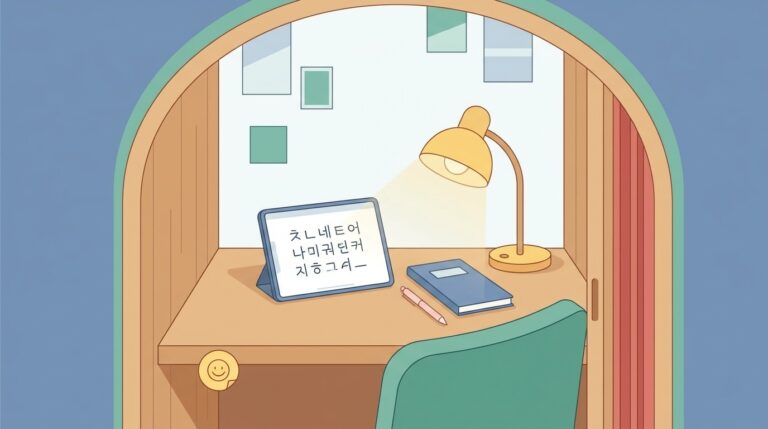
Imagine this: You’ve found the perfect study spot in a majestic Korean university library or a sleek, high-tech local library (도서관). You have your iPad, your notebooks, and a fresh iced Americano (stored safely outside, of course!). You enter the study room, known as the 열람실 (yeollamsil).
Suddenly, the silence hits you. It is not just quiet; it’s monastic. Every rustle of a page or click of a mechanical pencil feels like a tiny thunderclap. You want to ask the person next to you if the seat is taken, or gently remind someone that their phone is vibrating, but you’re terrified of breaking the unspoken social code (눈치 – nunchi).
If you’ve ever felt frozen in a Korean study room, you’re not alone! Many of our intermediate learners have shared how intimidating the absolute silence of Korean yeollamsil can be. Today, we are going to master the art of whispering, polite requests, and non-verbal library etiquette so you can blend in like a true local student! Let’s dive in!
Phase 2: Deep-Dive into 3 Essential Expressions (핵심 표현)
1. 혹시 옆자리 비었나요? (Hoksi yeop-jari bieonnayo?)
- Pronunciation: Hoke-shee yep-jah-ree bee-uhn-nah-yo?
- Meaning: “By any chance, is the seat next to you empty/available?”
- K-Culture Moment: In K-Dramas like Cheese in the Trap or True Beauty, you often see college students scanning a crowded library. This is the ultimate polite icebreaker before you sit next to a stranger.
- Editor’s Insight: 혹시 (hoksi) means “by any chance.” Starting your sentence with 혹시 instantly softens your request, making you sound extremely polite and considerate.
- Situation Spectrum: Casual: ⚠️ | Semi-formal: ✅ | Formal: ✅ (Always use polite yo-form with strangers in a quiet room!)
- 🤔 Think About It: In your home country, do you usually ask before sitting next to someone in a library, or do you just sit down? Why do you think Koreans prefer to ask first, even in public spaces?
2. 조금만 살살 말씀해 주시겠어요? (Jogeumman salsal malsseumhae jusigesseoyo?)
- Pronunciation: Jo-geum-mahn sahl-sahl mahl-sseum-hae joo-shee-get-suh-yo?
- Meaning: “Could you please speak a little more softly/quietly?”
- K-Culture Moment: You are studying hard, but two people nearby start whispering too loudly about their weekend plans. Instead of giving them a harsh glare, you approach them with this gentle request.
- Editor’s Insight: 살살 (salsal) is a delightful Korean ideophone meaning “gently,” “softly,” or “lightly.” It sounds much friendlier than saying “Be quiet!” (조용히 하세요!).
- Situation Spectrum: Casual: ⚠️ | Semi-formal: ✅ | Formal: ✅
- 🤔 Think About It: How does using a soft word like 살살 (gently) change the atmosphere of a confrontation compared to a direct command?
3. 진동으로 바꿔 주세요. (Jindong-euro bakkwo juseyo.)
- Pronunciation: Jin-dong-euro bahk-kwo joo-seh-yo.
- Meaning: “Please switch (your phone) to vibrate mode.”
- K-Culture Moment: Someone’s phone keeps buzzing on a wooden desk, creating a drilling sound that echoes through the room.
- Editor’s Insight: 진동 (jindong) means “vibration.” In Korea, keeping your phone on silent or vibrate in public study zones is a core social rule. This phrase is a polite but firm reminder of that rule.
- Situation Spectrum: Casual: 🚫 | Semi-formal: ✅ | Formal: ✅
- 🤔 Think About It: Korea has a highly collective social structure where individual actions are expected to harmonize with the group. How does this apply to keeping devices silent?
Phase 3: Textbook Korean vs. Real-Life Korean
Situation A: Asking someone to be quiet
- 📖 Textbook: 시끄러워요. 조용히 하세요. (Sikkeureowoyo. Joyonghi haseyo.) – “It’s noisy. Be quiet.”
- 🗣️ Real-Life: 저기 죄송한데, 조금만 조용히 해 주실 수 있으세요? (Jeogi joesonghande, jogeumman joyonghi hae jusil su isseuseyo?) – “Excuse me, I’m sorry, but could you possibly be a little quieter?”
- 💡 Why the difference? The textbook version sounds aggressive and confrontational. Real-life Korean relies heavily on layering apologies (죄송한데 – I’m sorry, but) and indirect questions (~수 있으세요? – Could you possibly?) to maintain social harmony.
Situation B: Checking a seat’s availability
- 📖 Textbook: 이 자리에 사람이 있습니까? (I jarie sarami isseumnika?) – “Is there a person in this seat?”
- 🗣️ Real-Life: 여기 자리 있어요? (Yeogi jari isseoyo?) or 혹시 여기 맡아두신 자리인가요? (Hoksi yeogi mata-dusin jari-ingayo?) – “Is this seat taken/reserved?”
- 💡 Why the difference? The textbook version is grammatically correct but sounds like an interrogation. Real-life Korean uses warmer, more natural phrasing like 자리 있어요? (Is there a seat?) or 맡아두신 자리 (a seat you saved).
Phase 4: K-Culture Deep-Dive & Non-Verbal Manners
4-1. The Art of “Nunchi” (눈치) in the Study Room
In a Korean yeollamsil, actions speak louder than words. In fact, speaking should be your absolute last resort! Here are the non-verbal cues you need to know:
1. The Gentle Head Bow (목인사): When entering or leaving a row where people are studying, make brief eye contact, give a tiny 5-degree nod, and slip in quietly.
2. The Sticky Note Culture (포스트잇 쪽지): If someone is being too loud, Koreans rarely confront them directly. Instead, they write a super polite note on a Post-it (e.g., “Sleeve friction is a bit loud, thank you!”) and leave it on the desk with a piece of candy. It’s polite, non-confrontational, and effective!
4-2. Culture Code: “K-Study Cafes” (스카)
Have you heard of 스카 (seuka)? It’s short for 스터디 카페 (Study Cafe). Unlike traditional libraries, these are premium, beautifully designed paid spaces where students and remote workers study in semi-silent zones, complete with free coffee, printer access, and individual booths. It’s a massive trend among young Koreans!
Phase 5: Real-Life Roleplay Scenario
Setting: You are at a beautiful public library in Seoul. You want to sit at a large communal desk, but there is a bag on the chair next to Min-ho (민호), a local university student.
- You: 저기요… 혹시 옆자리 임자 있나요?
(Jeogiyo… hoksi yeop-jari imja innayo?)
🎭 (Pointing gently to the chair with a polite smile)
“Excuse me… by any chance, does this seat have an owner?” -
Min-ho: 아, 아니요! 제 친구 자리인데, 지금 다른 데로 갔어요. 치워 드릴게요.
(A, aniyo! Je chin-gu jari-inde, jigeum dareun dero gasseoyo. Chiwo deurilgeyo.)
🎭 (Hurriedly moving his friend's backpack to the floor)
“Oh, no! It was my friend’s seat, but they went somewhere else. I’ll clear it for you.” -
You: 아, 감사합니다. 공부하는데 방해 안 되게 할게요.
(A, gamsahabnida. Gongbuhanunde banghae an doege halgeyo.)
🎭 (Whispering and giving a small nod)
“Oh, thank you. I’ll make sure not to disturb your studying.” -
Min-ho: 아니에요, 괜찮습니다. 열공하세요!
(Anieyo, gwaenchansumnida. Yeolgong-haseyo!)
🎭 (Smiling warmly and returning to his books)
“Not at all, it’s fine. Happy studying!”
🔀 Interactive Choice Point
Min-ho’s phone begins to buzz loudly on the desk. What do you say?
- Choice A: “저기요, 전화 좀 꺼 주세요!” (Jeogiyo, jeonhwa jom kkeo juseyo! – “Hey, turn off your phone!”)
- Choice B: “혹시 핸드폰 진동 소리가 조금 크게 들려서요…” (Hoksi haendeupon jindong soriga jogeum keuge deullyeoseoyo… – “By any chance, your phone’s vibration is sounding a bit loud…”)
- Choice C: Just stare at him intensely until he notices.
💡 Choice Feedback
- Best Choice: B! This uses indirect pointing (It’s sounding a bit loud…) which allows him to save face and fix it immediately without feeling attacked.
- Bad Choice: A! Extremely rude and confrontational. It will create an awkward atmosphere for the rest of your study session.
- Risk Choice: C! Staring can be interpreted as aggressive or passive-aggressive in Korea. It might make him defensive.
Phase 6: 10-Second Emotion Shadowing Drill
Practice these with the exact emotional tone! / means a short pause.
[🥺 Whispering with polite caution]
저기요… / 혹시 / 여기 앉아도 될까요?
(Jeogiyo… / hoksi / yeogi anjado doelkkayo?)
“Excuse me… / by any chance / may I sit here?”-
[🤫 Extremely quiet and apologetic]
죄송한데… / 노트북 타이핑 소리 / 조금만 살살 해주세요.
(Joesonghande… / noteubuk taiping sori / jogeumman salsal hae-juseyo.)
“I’m sorry, but… / your laptop typing / could you do it a bit more gently?”
Phase 7: K-Culture Mini-Dictionary
- 열공 (Yeol-gong) | Hot Study | Short for 열심히 공부하기 (studying hard). Used to cheer on friends who are studying.
- 노트북 석 (Notebook-seok) | Laptop Seat | Designated areas in Korean libraries where laptop typing is allowed. Regular seats strictly forbid keyboard sounds!
- 독서실 (Dokseosil) | Private Study Room | Ultra-quiet, partitioned individual study booths, famous for intensive exam prep.
- 매점 (Maejeom) | Library Cafeteria/Snack Bar | The magical place inside libraries to eat ramyun and snacks during study breaks.
Phase 8: Survivor Kit for Travelers
Survival Phrases TOP 3
- 여기 와이파이 비밀번호가 뭐예요? (Yeogi waipai bimilbeonhoga mwoyeyo?) – “What is the Wi-Fi password here?” (Pro Tip: Check the columns or the main desk before asking!)
- 담요 혹시 빌릴 수 있나요? (Damyo hoksi billil su innayo?) – “Can I borrow a blanket by any chance?” (Pro Tip: Many modern Korean libraries and study cafes provide free rental blankets!)
- 사물함 사용하려면 어떻게 해요? (Samulham sayong-haryeomeon eotteoke haeyo?) – “How do I use the lockers?”
Editor’s Travel Note
Before visiting beautiful libraries like the Starfield Library in COEX or the Seoul Metropolitan Library, make sure to download the Naver Map App to check opening hours. Note: Many public libraries require a resident card to book study room seats, but open reading lounges are free for everyone!
Phase 9: “Going Deeper” (한 발 더 깊이)
In Korea, public spaces like the yeollamsil are microscopic reflections of the country’s collective culture (우리 – Uri culture). Because Koreans grow up sharing dense urban spaces, respecting others’ personal peace by minimizing noise is considered the ultimate form of social etiquette. When you whisper or use a polite indirect phrase, you aren’t just communicating; you are actively participating in maintaining the peaceful, shared harmony of the community.
💬 Your Turn: Have you ever experienced a unique library rule in another country? How does it compare to Korea’s silent yeollamsil? Let us know in the comments below!
Phase 10: FAQ & Avoiding Misunderstandings
Q: Can I eat snacks in the Korean library study room?
A: Generally, no. Only bottled water or closed drinks are allowed in the yeollamsil. Eating crunchy snacks or hot food is strictly restricted to the designated cafeteria (매점) or outdoor terrace.
Q: What should I do if my mechanical pencil is too loud?
A: Try using a pen with a silent click or silent gel pens. In Korea, there are actually specialty “silent pencils and calculators” sold for library users!
Q: Can I reserve a seat for my friend who is coming in an hour?
A: No, saving seats (자리 맡아두기) for a long time is considered bad manners (민폐 – minpye). If someone is away for more than 30 minutes, others have the right to move their things.
🚨 Common Mistakes Warning Board
- Mistake: Clicking your pen repeatedly while thinking.
- Correct Action: Keep your pen on the desk. The clicking sound echoes louder than you think!
- Mistake: Whispering in a normal voice pitch.
- Correct Action: Use a “breath-only” whisper. If your vocal cords vibrate, it’s too loud.
- Mistake: Leaving your laptop charger wire tangled across the aisle.
- Correct Action: Keep wires tucked under your desk to prevent tripping hazards.
Phase 11: Action Mission & Participation
- Bronze Mission: Practice saying “Hoksi yeop-jari bieonnayo?” in front of your mirror with a polite nod.
- Silver Mission: Take a photo of your study setup at home, post it on Instagram, and tag us using the hashtag
#DailyHangulStudy! - Gold Mission (K-Culture Mission): Watch an episode of a college-themed K-Drama and spot at least one library scene. Check what gestures the characters use to communicate silently!
Phase 12: Interactive Quiz Challenge
Test your library survival skills!
1. Situation Quiz
You need to use your laptop to type an essay, but you are in a regular silent study room. What should you do?
* A) Type as softly as possible.
* B) Move to the designated 노트북 석 (Notebook-seok).
* C) Put a cloth over your keyboard.
2. Fill in the Blank
Complete the polite request: “혹시 조금만 ______ 말씀해 주시겠어요?” (Could you please speak a little more softly?)
3. True or False?
In Korea, it is acceptable to leave your books on a library desk for 3 hours to save your spot while you go out for lunch.
🔍 Reveal Answers & Explanations
- Answer: B! Keyboard typing is strictly banned in silent zones. You must move to the designated laptop section.
- Answer: 살살 (salsal). This word softens your voice and makes the request polite.
- Answer: False! Leaving a spot for that long is considered 민폐 (minpye – a nuisance). Your things might be moved to the lost and found.







