

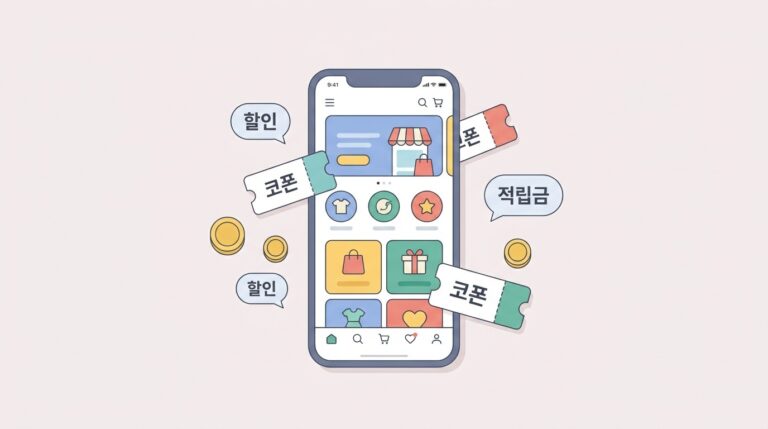
Master the Art of Online Discounts in Korea: How to Apply Points and Coupons Like a Local
Phase 1: Empathy (Welcome, Shoppers!)
안녕하세요! Welcome back to another edition of Daily Hangul, your personal portal to mastering Korean culture and language. I’m your Senior Editor and native culture navigator.
Imagine this: You’ve filled your online shopping cart on Coupang (쿠팡) or Musinsa (무신사) with the trendiest Korean streetwear and K-beauty essentials. You are about to check out when you notice a dizzying array of buttons: 적립금 (Points), 할인 쿠폰 (Discount Coupons), and 포인트 선할인 (Advance Point Discounts). You want to save money, but you’re terrified of clicking the wrong button and paying full price—or worse, accidentally signing up for a recurring subscription!
If you’ve ever felt overwhelmed by the complex discount systems of Korean online shopping, you are not alone. Many of our intermediate (B2) learners have told us, “I know the basic words, but I always freeze when trying to apply my welcome coupons!”
Don’t worry! Today, we are going to unlock the exact phrases and cultural nuances you need to navigate Korean checkout screens like a seasoned Seoulite. Let’s make sure you never miss out on a discount again!
Phase 2: Deep-Dive into 3 Key Expressions
Let’s master three crucial expressions you will encounter during your online checkout adventures.
1. 적립금을 사용하다 (Jeok-rip-geum-eul sa-yong-ha-da)
- Pronunciation: Jeok-rip-geum (sounds like “juck-reep-gum” with a soft ‘r’) eul sa-yong-ha-da.
- Meaning: To use earned points / store credit.
- K-Culture Moment: In K-Dramas, you’ll often see characters who are obsessed with collecting tiny increments of 적립금 from various apps to buy a luxurious meal. It is a highly respected “frugal-chic” lifestyle choice in Korea!
- Editor’s Insight: 적립금 comes from the verb 적립하다 (to accumulate/save up). Unlike cash refunds, these points must be used within the specific shopping mall. Many sites have a minimum threshold (e.g., “Must have at least 2,000 KRW in points to use them”).
- Situation Spectrum: Casual ✅ | Semi-formal ✅ | Formal ✅ (Universally used on all shopping interfaces).
- 🤔 Think About It: In many Western countries, points are automatically converted or kept in the background. In Korea, actively “accumulating” (적립) and “pulling out” (조회/사용) points is a highly interactive part of daily consumerism. How active are you with your shopping points back home?
2. 쿠폰을 적용하다 (Ku-pon-eul jeok-yong-ha-da)
- Pronunciation: Ku-pon (sounds like the English “coupon” but with sharper ‘u’ and ‘o’ sounds) eul jeok-yong-ha-da.
- Meaning: To apply a coupon.
- K-Culture Moment: Live commerce shows on Grip or Naver Shopping where hosts scream, “여러분! 지금 바로 쿠폰 적용하셔야 이 가격 나옵니다!” (Everyone! You must apply the coupon right now to get this price!)
- Editor’s Insight: 적용하다 means “to apply/implement.” Be careful: simply downloading (다운로드) a coupon does not mean it is applied to your cart! You must actively press “쿠폰 적용” at the checkout screen.
- Situation Spectrum: Casual ✅ | Semi-formal ✅ | Formal ✅
- 🤔 Think About It: Why do you think Korean platforms separate “downloading” and “applying” coupons? It creates an extra psychological step that keeps shoppers engaged with the platform!
3. 영끌해서 결제하다 (Yeong-kkeul-hae-seo gyeol-je-ha-da)
- Pronunciation: Yeong-kkeul (sounds like “young-kkeul” with a tensed ‘kk’ sound) hae-seo gyeol-je-ha-da.
- Meaning: To gather every single penny (including points and coupons) to make a payment. (Literally: “To drag from the depths of your soul to pay”).
- K-Culture Moment: A popular phrase among the MZ generation in Korea when discussing buying a house, a car, or even just checking out a massive shopping cart during a seasonal sale.
- Editor’s Insight: This is a trendy slang combination of 영혼 (soul) + 끌어모으다 (to gather/drag together). It shows the passionate, almost desperate effort to get the absolute lowest price possible.
- Situation Spectrum: Casual ✅ | Semi-formal ⚠️ | Formal 🚫 (Keep this to friends or lighthearted social media captions!)
- 🤔 Think About It: What is the closest equivalent slang in your language for squeezing every last resource to afford something?
Phase 3: Textbook Korean vs. Real Korean
To sound like a true native, you need to transition from stiff textbook phrases to what Koreans actually type and say online.
Scenario A: Asking if points can be used together with coupons
- 📖 Textbook: “쿠폰과 적립금을 동시에 사용할 수 있습니까?” (Can coupons and points be used simultaneously?)
- 🗣️ Real Korean: “쿠폰이랑 적립금 중복 적용 돼요?” (Can I double-apply/stack coupons and points?)
- 💡 Why the difference? Natives rarely use the formal 동시에 사용할 수 있습니까 in chat support. Instead, they use the highly efficient term 중복 적용 (overlapping/double application).
Scenario B: Expressing that you used all your points
- 📖 Textbook: “저는 가지고 있는 포인트를 모두 소비했습니다.” (I consumed all the points I possessed.)
- 🗣️ Real Korean: “적립금 털었어요!” or “적립금 탈탈 털어 썼어요!” (I completely dusted off/emptied my points!)
- 💡 Why the difference? 털다 means “to dust off” or “to empty out.” Saying you “dusted off your points” is a vivid, native-like way to express that you used every single cent of your store credit.
Phase 4: K-Culture Deep-Dive & Non-Verbal Etiquette
4-1. The “Frugal Tech” (앱테크 – App-Tech) Culture
In Korea, saving money online isn’t just about finding sales; it’s a daily ritual called 앱테크 (App-Tech) (App + Microtechnology). Koreans use apps to do “attendance checks” (출석체크), take daily quizzes, and walk certain step counts just to earn 10 to 50 KRW in 적립금 daily. When chatting with Korean friends about shopping, showing pride in your accumulated 적립금 is a great way to bond!
4-2. Visual Clues on Korean UI
When shopping online, look out for these highly visual buttons:
* 모두 사용 (Use All): A magic button next to your points balance that instantly inputs your maximum available points.
* 최대 할인 적용 (Apply Maximum Discount): A button that automatically selects the best coupon combination for you.
Phase 5: Real-Life Roleplay Scenario
Let’s put this into practice! You are chatting with Min-ji (민지), a trendy Korean friend who is an expert at finding online shopping deals. You are trying to buy a winter coat on Musinsa.
Characters:
* You (B2 Learner): Eager to get a discount but confused by the Musinsa coupon policy.
* Min-ji (Your K-Friend): The ultimate “coupon queen” who knows all the shopping hacks.
You: 민지야, 나 무신사에서 아우터 사려고 하는데 결제창이 너무 복잡해.
     (Min-ji, I'm trying to buy outerwear on Musinsa, but the payment screen is so complicated.)

Min-ji: 🎭 (미소를 지으며 휴대폰을 뺏어 들고) 무신사는 쿠폰 적용이 생명이지! 너 쿠폰 다운은 다 받았어?
        (With a smile, grabbing your phone. "Applying coupons is everything on Musinsa! Did you download all of them?")

You: 응, 다운은 받았는데, 쿠폰이랑 적립금 중복 적용이 안 되는 것 같아.
     (Yeah, I downloaded them, but it seems like I can't stack coupons and points.)

Min-ji: 🎭 (눈을 크게 뜨며 가리키며) 아, 이건 선할인 쿠폰이라서 그래. 적립금 먼저 먹이고 쿠폰 적용해 봐!
        (With eyes wide open, pointing. "Ah, that's because this is a pre-discount coupon. Try applying points first, then the coupon!")

You: 아, 그렇게 하니까 된다! 근데 적립금 보유액이 부족하다고 뜨네.
     (Oh, doing it that way works! But it says my point balance is insufficient.)

Min-ji: 🎭 (장난스럽게 혀를 차며) 쯧쯧, 출석 체크 안 했구나? 그럼 그냥 토스 페이 백 영끌해서 결제해!
        (Tsks playfully. "Tsk tsk, you didn't do your daily attendance check, did you? Then just drag everything together using Toss Payback!")

You: 영끌해서 결제하기 완료! 진짜 고마워, 덕분에 이만 원이나 아꼈어.
     (Completed checking out by dragging everything together! Thank you so much, I saved 20,000 won thanks to you.)

Min-ji: 🎭 (윙크를 하며) 다음엔 매일 출석 체크해서 적립금 모아두라고! 맛있는 거 사줘!
        (Winking. "Next time, do the attendance check daily to hoard those points! Buy me something tasty!")
🔀 Interactive Choice Point
How would you respond to Min-ji’s demand for a treat?
* Option A: “돈 없어. 적립금 다 털었단 말이야!” (I have no money. I dusted off all my points!)
* Option B: “적립금으로 떡볶이 사줄게!” (I will buy you Tteokbokki using my store points!)
* Option C: “응, 다음에 내가 살게.” (Yes, I will buy next time.)
Feedback on Your Choice:
- Option A (Best & Funniest!): Perfect! Using “적립금 다 털었다” shows you mastered today’s slang. Min-ji will burst out laughing at your natural Korean.
- Option B (Risky but Cute): Points can’t usually be transferred or used to buy street food directly, but she will appreciate the humorous attempt!
- Option C (Bad/Too Formal): A bit flat and textbook-like. It misses the friendly, playful tone of the conversation.
Phase 6: 10-Second Emotional Shadowing Drill
Practice saying these out loud with natural pauses (/) and emotional inflections!
[😊 Excites & Proud]
와, / 저 이번에 / 적립금 탈탈 털어서 / 샀어요!
(Wa, / jeo i-beon-e / jeok-rip-geum tal-tal teol-eo-seo / sat-eo-yo!)
(Wow, / this time / I completely dusted off my points / to buy this!)-
[🥺 Desperate & Wishing]
제발 / 이 쿠폰이랑 / 적립금 / 중복 적용 되게 해주세요!
(Je-bal / i ku-pon-i-rang / jeok-rip-geum / jung-bok jeok-yong doe-ge hae-ju-se-yo!)
(Please / let this coupon / and points / be double-applied!)
Phase 7: K-Culture Mini-Dictionary
- 앱테크 (App-tech) | App-tech
Doing micro-activities on apps (checking in, quizzes) to earn tiny points. Koreans do this during their subway commutes. - 선할인 (Seon-hal-in) | Advance Discount
A system where you apply discounts ahead of the final billing step, often tied to specific payment methods. - 중복 할인 (Jung-bok hal-in) | Stacking/Double Discounts
The holy grail of Korean online shopping—applying a cart coupon, a product coupon, and points all at once. - 소확행 (So-hwak-haeng) | Small but Certain Happiness
A lifestyle trend. Saving 1,000 KRW using a coupon and buying a cheap convenience store coffee is a classic example.
Phase 8: Traveler’s Survival Kit
Survival Phrases for Customer Service Chatbots:
- “쿠폰 적용이 안 돼요.” (ku-pon jeok-yong-i an dwae-yo) | “The coupon isn’t applying.”
- Pro Tip: Take a screenshot of the error page and send it to the chat agent.
- “적립금 소멸일이 언제인가요?” (jeok-rip-geum so-myeol-il-i eon-je-in-ga-yo) | “When do my points expire?”
- Pro Tip: Keep an eye on points because they usually expire at the end of the calendar year!
- “결제 취소하면 쿠폰 돌려받나요?” (gyeol-je chwi-so-ha-myeon ku-pon dol-ryeo-ban-na-yo) | “If I cancel the payment, do I get the coupon back?”
📓 Editor’s Travel Note
When shopping online in Korea, download the KakaoPay App (카카오페이) or Toss App (토스). These apps integrate seamlessly with Korean e-commerce platforms, offering instant discounts and cashback points that you can stack with your store coupons!
Phase 9: “A Step Deeper” (Reflective Question)
In many cultures, asking for discounts or obsessing over small change can be seen as stingy. However, in Korea, mastering “App-tech” and maximizing “적립금” is viewed as incredibly smart, diligent, and savvy. This reflects the Korean value of 알뜰함 (frugality/resourcefulness). It’s a game of wits against the system, celebrated openly with friends.
💬 Your Turn: Do you think keeping track of small points is worth the time? Let us know in the comments below! Have you ever tried “App-tech” in your country?
Phase 10: FAQ & Common Mistakes
Q: What is the difference between 포인트 (Point) and 적립금 (Jeok-rip-geum)?
A: 포인트 is a general term often tied to credit cards or multi-platform systems (like L.Point). 적립금 specifically refers to store credit accumulated within that specific online store from past purchases.
Q: Can I transfer my earned points to my friend’s account?
A: In most cases, no. 적립금 is non-transferable and tied strictly to your verified identity (본인인증) account.
Q: I downloaded a coupon, but my final total didn’t change. Why?
A: Korean checkout pages require you to manually click “쿠폰 적용” (Apply Coupon) and select the specific coupon from a pop-up window before clicking “결제하기” (Pay).
🚨 Common Mistakes Alert!
- Confusing ‘다운로드’ with ‘적용’: Downloading the coupon only saves it to your account. Correct Action: Make sure to click “쿠폰 선택” at checkout.
- Ignoring ‘최소 주문 금액’ (Minimum Order Limit): Coupons often have a condition like “Valid for purchases over 30,000 KRW.”
- Assuming Points are Cash: You cannot cash out 적립금 back to your bank account; they must be spent on the site.
Phase 11: Action Mission
- 🥉 Bronze: Open any Korean shopping app (like Musinsa, Olive Young) and locate your 적립금 balance page.
- 🥈 Silver: Post a screenshot of your favorite Korean item on social media with the caption: “이거 살 때 적립금 탈탈 털어 쓸 거예요!” (Tag #DailyHangul!)
- 🥇 Gold: Actually complete a purchase online using at least one coupon and some points successfully!
🎮 K-Culture Mission
Watch a modern slice-of-life K-Drama (like Work Later, Drink Now or Because This Is My First Life). Spot a scene where characters talk about saving money, coupons, or taxi points. Write down the phrase they used!
Phase 12: Interactive Quiz Challenge
Test your intermediate shopping wits!
1. Situation Quiz
You want to use both a 10% coupon and your 5,000 KRW points together. What should you ask the customer service agent?
* A) 쿠폰이랑 적립금 버려주세요.
* B) 쿠폰이랑 적립금 중복 적용 돼요?
* C) 쿠폰이랑 적립금 다운로드 해줘요.
Reveal Answer & Explanation
Correct Answer: B
중복 적용 (Double-application/Stacking) is the correct word. Option A means “Please throw away my coupons and points,” and Option C means “Please download coupons and points for me.”
2. Fill in the Blank
“이번 쇼핑할 때 포인트 진짜 영혼까지 _____ 결제했어!”
* A) 털어서 (teol-eo-seo)
* B) 끌어서 (kkeul-eo-seo)
* C) 적용해서 (jeok-yong-hae-seo)
Reveal Answer & Explanation
Correct Answer: B
The slang 영끌 (yeong-kkeul) is short for 영혼까지 끌어모으다. Therefore, 끌어서 is the correct verb to complete the phrase meaning “dragging from my soul.”
3. True or False
In Korea, ‘앱테크’ is considered a hobby of poor people and is generally hidden from friends.
* A) True
* B) False
Reveal Answer & Explanation
Correct Answer: B (False)
It is viewed as a highly respectable, smart, and trendy way of living (알뜰한 생활) among all generations, especially the MZ generation!







