

Master Korea’s Ultimate Social Superpower: ‘Nunchi’ and the Magic of ‘눈치 챙겨’ (Nunchi Chaeng-gyeo)
Phase 1: Empathy (Welcome, My Friend!)
안녕하세요! (Annyeonghaseyo!) I’m your resident Korean bestie and Daily Hangul’s senior editor.
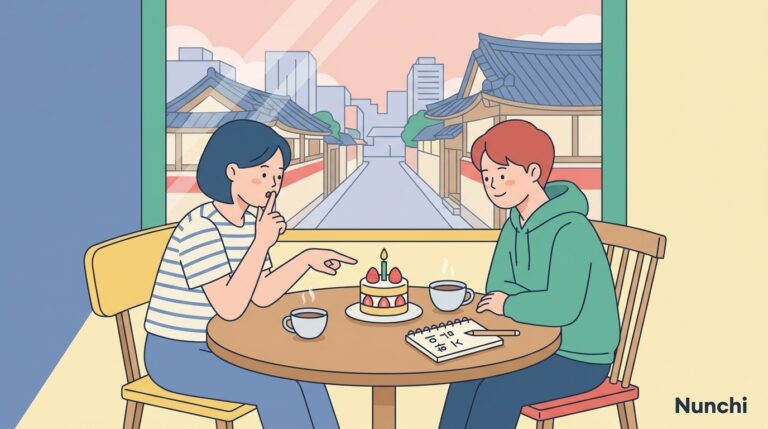
Picture this: You are at a trendy cafe in Hongdae with some new Korean friends. The table is small, and there’s only one slice of strawberry cake left. Everyone is looking at the cake, then at each other, laughing, but nobody is reaching for it. You, being hungry and direct, happily grab the last bite. Suddenly, a subtle, freezing silence sweeps over the table. Your friend nudges you under the table and whispers: “눈치 챙겨! (Nunchi chaeng-gyeo!)”
If you’ve ever felt like there’s an unwritten, invisible script everyone in Korea is reading except you, welcome to the world of Nunchi (눈치).
Don’t worry! You aren’t bad at Korean; you just haven’t unlocked your “social radar” yet. Today, we’re going to master the popular slang “눈치 챙겨” and explore how this single concept will transform you from a confused foreigner into a beloved, culturally-savvy insider. Let’s dive in!
Phase 2: Deep Dive into 3 Essential Expressions
1. 눈치 챙겨 (Nunchi chaeng-gyeo)
- Pronunciation: Noon-chee chaeng-gyeo (Sounds like “noon” as in afternoon + “chee” + “chaeng” as in chang + “gyeo” as in yaw)
- Meaning: “Read the room!” or “Get a clue!” (Literally: “Pack/take your Nunchi”)
- K-Culture Moment: You see this written in fiery red captions on Korean variety shows like Runnan Man or Knowing Bros whenever a guest makes an incredibly awkward comment or ruins a game by being clueless.
- Editor’s Insight: This is highly casual slang. You say this to close friends who are being playfully oblivious. Saying this to a boss or an elder is a huge no-no!
- Situation Spectrum: Casual ✅ | Semi-formal ⚠️ | Formal 🚫
- 🤔 Think About It: In your culture, do people value direct honesty more, or do they appreciate it when you read between the lines? How does “reading the room” differ in your country?
2. 눈치 없다 (Nunchi eopda)
- Pronunciation: Noon-chee eop-da (Sounds like eop as in “up” with a soft ‘p’ ending)
- Meaning: Clueless, tactless, or dense. (Literally: “To not have Nunchi”)
- K-Culture Moment: In K-Dramas, when the male lead doesn’t realize the female lead is freezing cold and just talks about his day, viewers scream at the screen: “아유, 진짜 눈치 없다!” (Ugh, he is so clueless!)
- Editor’s Insight: Calling someone nunchi eopda is a mild criticism. It means they lack the situational awareness to make others comfortable.
- Situation Spectrum: Casual ✅ | Semi-formal ⚠️ | Formal 🚫
- 🤔 Think About It: Have you ever met someone who was academically brilliant but completely “눈치 없다” in social situations?
3. 눈치 빠르다 (Nunchi ppareuda)
- Pronunciation: Noon-chee ppa-reu-da (Make a sharp, double ‘p’ sound, like popping a bubble)
- Meaning: Quick-witted, highly observant, or sharp. (Literally: “Nunchi is fast”)
- K-Culture Moment: In a corporate drama, the junior employee who instantly notices the boss is in a bad mood and quickly brings him his favorite warm coffee before being asked is praised as “눈치 빠르다.”
- Editor’s Insight: This is a fantastic compliment in Korea. It means you are highly empathetic and proactive.
- Situation Spectrum: Casual ✅ | Semi-formal ✅ | Formal ⚠️
- 🤔 Think About It: Why do you think being “fast with Nunchi” is considered a survival skill in fast-paced Korean workplaces?
Phase 3: Textbook Korean vs. Real-Life Korean
Let’s compare the stiff expressions from old textbooks with what young Koreans actually say.
Scenario A: Your friend is talking loudly on a quiet subway train.
- 📖 Textbook style: “시끄러우니 조용히 하세요.” (It is loud, so please be quiet.)
- 🗣️ Real-life slang: “야, 눈치 좀 봐!” (Hey, look around/read the room!)
- 💡 Why the difference? Directly telling someone to be quiet can sound aggressive or overly parental. Asking them to “look around” (눈치 보다) nudges them to realize their own mistake by observing others.
Scenario B: Describing a coworker who always knows exactly what to do.
- 📖 Textbook style: “그 사람은 상황 판단 능력이 좋습니다.” (That person has good situational judgment skills.)
- 🗣️ Real-life slang: “그 사람 진짜 눈치 빨라요.” (That person’s Nunchi is super fast.)
- 💡 Why the difference? Koreans prefer emotional, intuitive descriptions over overly academic terms in daily office chatter.
Phase 4: K-Culture Deep Dive & Non-Verbal Manners
4-1. The “Nunchi Face” and Gestures
How do you practice Nunchi without speaking? It’s all in the eyes and subtle body language.
* The Eye Roll of Alarm: If someone says something awkward, Koreans won’t yell “Stop!” Instead, they might widen their eyes, slightly tilt their head, and glance at the person to signal: Stop talking now.
* The “Last Piece” Hesitation: When sharing food (K-BBQ, fried chicken), never grab the last piece immediately. Pause, look at others, and ask, “드시겠어요?” (Would you like to eat this?). This show of consideration is peak Nunchi.
4-2. Cultural Code: The Silent Harmony of K-Group Dinners (회식)
During a company dinner (Hoesik), Nunchi is your ultimate shield. You must observe: Who is running out of side dishes? Is the boss’s glass empty? If you spot these things and refill them quietly, you have mastered Korean social manners. It’s not about being subservient; it’s about maintaining the collective comfort of the group.
Phase 5: Real-life Roleplay Scenario
Setting: You are having chicken and beer (치맥) with your Korean coworker, Ji-hoon, and your strict team manager, Mr. Kim.
Characters:
- Ji-hoon (Coworker): Young, friendly, but easily worried.
- Mr. Kim (Manager): Traditional, hard-working, but loves a good team atmosphere.
- You (The Hero): Eager to show your amazing social skills.
1. Mr. Kim: (Sighs slightly, looking at his empty glass) "아, 오늘 일 진짜 힘들었네."
   (Ah, work was really tough today.)

2. You: 🎭 (Leaning in warmly) "부장님, 진짜 수고하셨습니다! 맥주 더 한 잔 하실래요?"
   (Manager, you really worked hard! Would you like another beer?)

3. Mr. Kim: (Smiles warmly, pleased by your quick offer) "오, 고마워! 역시 우리 막내밖에 없네."
   (Oh, thank you! As expected, only our youngest team member cares.)

4. Ji-hoon: 🎭 (Whispering quietly to you) "우와, 대박... 방금 진짜 눈치 빨랐어요!"
   (Wow, amazing... Your Nunchi was so fast just now!)

5. You: 🎭 (Smiling modestly) "아니에요, 이 정도는 기본이죠!"
   (No way, this much is basic!)

6. Mr. Kim: (Looking at the single chicken wing left on the plate) "어라, 날개 하나 남았네."
   (Oh, there's one wing left.)

7. Ji-hoon: 🎭 (Eyes wide, signaling you with a subtle head shake) "..."

8. You: (Time to make a choice! What do you do?)
🔀 Interactive Branching Points: What is your next move?
- Choice A: Grab the wing immediately and eat it while saying, “Thank you! I love wings!”
- Choice B: Say, “부장님, 이 날개 드세요! 드시고 힘내세요!” (Manager, please eat this wing! Eat this and cheer up!)
- Choice C: Ignore the chicken completely and ask Mr. Kim to explain a boring work topic to keep the conversation going.
💡 Feedback on Your Choice:
- If you chose A (Bad): 🚫 Oh dear! Ji-hoon is facepalming. You totally ignored Mr. Kim’s hint and showed zero Nunchi.
- If you chose B (Best): ✅ Perfect! Giving the prized final piece to the eldest shows high respect and incredible Nunchi. Mr. Kim will remember this fondly!
- If you chose C (Risk): ⚠️ Safe, but a bit cold. You avoided making a mistake, but you missed a golden opportunity to make Mr. Kim feel respected.
Phase 6: 10-Second Emotion Shadowing Drill
Try speaking these like a native by following the rhythm / and the emotional cues!
[🙄 Annoyed and whispering to a clueless friend]- “야… / 눈치 좀 / 챙겨!”
- Ya… / noon-chee jom / chaeng-gyeo!
- (Hey… pack some Nunchi/Get a clue!)
[🤩 Impressed and energetic]- “와, / 너 진짜 / 눈치 빠르다!”
- Wa, / neo jin-jja / noon-chee ppa-reu-da!
- (Wow, you are incredibly quick-witted!)
[🥺 Disappointed and whining]- “우리 남친은 / 진짜 / 눈치가 없어요.”
- Uri nam-chin-eun / jin-jja / noon-chee-ga eop-seo-yo.
- (My boyfriend really has no clue.)
Phase 7: K-Culture Mini Dictionary
- 눈치게임 (Nunchi-game): | Nunchi Game | A popular Korean drinking/party game where players must count numbers out loud one by one without shouting at the same time as someone else. It requires intense eye contact and reading the room.
- 사회생활 (Sahoe-saenghwal): | Social Life / Corporate Savviness | Often used to describe the clever, political ways people act to survive and thrive in Korean offices.
- 막내 (Maknae): | The Youngest | The youngest person in a group, family, or workplace, who is traditionally expected to show the most Nunchi and take care of small tasks.
- 낄끼빠빠 (Kkil-kkil-ppa-ppa): | An acronym: Join when you should, leave when you should | Peak Nunchi slang. It means knowing when to participate in a conversation and when to mind your own business.
Phase 8: Survivor’s Kit for Travelers
TOP 3 Survival Phrases
- “먼저 하세요.” (Meon-jeo ha-se-yo.)
- Pro Tip: “Please go first.” Use this at subway gates, elevators, or buffets. It shows great manners.
- “혹시 실례가 안 된다면…” (Hok-shi shil-lye-ga an doen-da-myeon…)
- Pro Tip: “If it’s not too much trouble…” This is the perfect polite opener when asking for a favor.
- “제가 눈치가 좀 없어서요, 죄송합니다.” (Je-ga noon-chee-ga jom eop-seo-seo-yo, joe-song-ham-ni-da.)
- Pro Tip: “I lack a bit of Nunchi, I’m sorry.” Use this magic shield if you make a social mistake. Koreans will find it incredibly endearing and instantly forgive you!
🗺️ Editor’s Travel Note:
When traveling in Seoul, download the Naver Map App instead of Google Maps, as Google Maps does not update walking routes well in Korea. Also, keep your Nunchi sharp on buses: do not talk loudly on your phone, as it is considered rude to disrupt the collective quiet space.
Phase 9:
Frequently Asked Questions (FAQ)
Q: What does "눈치 챙겨 (Nunchi chaeng-gyeo)" mean in Korean and how do you pronounce it?
A: In Korean, "눈치 챙겨 (Nunchi chaeng-gyeo)" is pronounced [Noon-chee chaeng-gyeo (Sounds like "noon" as in afternoon + "chee" + "chaeng" as in chang + "gyeo" as in yaw] and means: "Read the room!" or "Get a clue!" (Literally: "Pack/take your Nunchi")
Q: What does "눈치 없다 (Nunchi eopda)" mean in Korean and how do you pronounce it?
A: In Korean, "눈치 없다 (Nunchi eopda)" is pronounced [Noon-chee eop-da (Sounds like eop as in "up" with a soft 'p' ending] and means: Clueless, tactless, or dense. (Literally: "To not have Nunchi")
Q: What does "눈치 빠르다 (Nunchi ppareuda)" mean in Korean and how do you pronounce it?
A: In Korean, "눈치 빠르다 (Nunchi ppareuda)" is pronounced [Noon-chee ppa-reu-da (Make a sharp, double 'p' sound, like popping a bubble] and means: Quick-witted, highly observant, or sharp. (Literally: "Nunchi is fast")







