

안녕하세요! Welcome back to Daily Hangul!
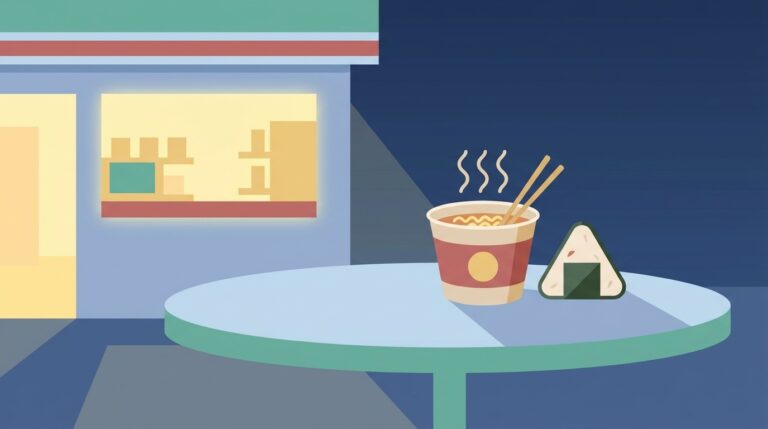
Have you ever watched a K-Drama where the main characters, after a long and tiring day, suddenly stop by a brightly lit convenience store (편의점 – pyeon-ui-jeom) and eat steaming hot instant ramen (라면 – ramyeon) on an outdoor plastic table?
That scene looks incredibly cozy and delicious, right? But when you actually step into a Korean convenience store for the first time, you might feel a bit lost. How do I cook this? Where do I get hot water? Do I need to buy a separate cup?
Don’t worry! Your Korean bestie is here to guide you. Today, we are going to master the art of eating convenience store ramen like a true local, step-by-step. Let’s dive in!
Phase 1: Empathy & Pain Point
Many of my students have told me: “I went to a GS25 to try the famous Han River-style ramen, but I didn’t know how to ask for the right cup, and I couldn’t read the buttons on the cooking machine! I ended up just buying chips.”
It is completely normal to feel intimidated! Cooking ramen at a Korean convenience store involves a tiny bit of self-service etiquette and unique cultural habits. By the end of this guide, you will confidently walk in, choose your favorite noodles, cook them using the hot water dispenser or the cooking machine, and enjoy them like a pro.
Phase 2: Key Expressions Analysis
Here are 3 essential expressions you need for your convenience store ramen adventure!
1. 한강라면 용기 주세요. (Han-gang-ramyeon yong-gi ju-se-yo.)
- Pronunciation: Han-gang-ram-yeon yong-ghee ju-seh-yo. (Think of “yong-gi” like yawn-ghee without a strong ‘y’ glide).
- Meaning: “Please give me the Han River ramen paper bowl.”
- K-Culture Moment: In K-Dramas, characters eat ramen in a disposable foil/paper bowl cooked on an induction machine. This style is called Han-gang ramyeon. To use this machine, you must buy a special paper bowl (yong-gi) at the counter along with your bag of ramen.
- Editor’s Insight: If you just buy a regular bag of ramen, you cannot cook it there without this special bowl. Always ask for the yong-gi!
- Situation Spectrum: Casual ✅ | Semi-formal ✅ | Formal ⚠️
- 🤔 Think About It: Why do you think Koreans love eating ramen outside so much? In your country, is there a food that is similarly associated with a specific outdoor location?
2. 뜨거운 물 어디 있어요? (Tteu-geoun mul eo-di isseo-yo?)
- Pronunciation: Tteu-guh-oon mool-eo-dee eet-suh-yo? (The double ‘t’ in “tteu” is a tense sound. Try saying “spin”—the ‘p’ sound in “spin” is similar to how tense Korean consonants feel).
- Meaning: “Where is the hot water?”
- K-Culture Moment: Instant cup noodles (cup-ramyeon) only require hot water, which is always provided for free at a designated water station inside the store.
- Editor’s Insight: Koreans are very efficient. Once you find the hot water, be quick so others behind you can use it too!
- Situation Spectrum: Casual ⚠️ | Semi-formal ✅ | Formal ✅
- 🤔 Think About It: “Where is…?” (eo-di isseo-yo?) is a magic phrase. You can put any noun in front of it!
3. 국물 버려도 돼요? (Guk-mul beo-ryeo-do dwae-yo?)
- Pronunciation: Gook-mool buh-ryuh-doh dwae-yo?
- Meaning: “Can I throw away the soup here?” / “Is it okay to discard the broth?”
- K-Culture Moment: After finishing your noodles, you will likely have leftover soup (guk-mul). You must never throw liquid soup into a regular trash can! Convenience stores have a special bucket or sink specifically for leftover food waste (eumsikmul sseuregi).
- Editor’s Insight: If you are unsure where to pour the leftover broth, always ask the staff first. It shows great manners (manner)!
- Situation Spectrum: Casual ✅ | Semi-formal ✅ | Formal ⚠️
- 🤔 Think About It: Korea has very strict recycling and food waste separation laws. Being mindful of where you discard food is highly appreciated by locals.
Phase 3: Textbook vs. Real Life
Let’s compare classroom Korean with how locals actually speak!
Situation 1: Asking if you can eat inside the store
- 📖 Textbook Korean: “여기서 먹는 것이 가능합니까?” (Yeo-gi-seo meong-neun geo-si ga-neung-ham-ni-ka? – Is it possible to eat here?)
- 🗣️ Real Life Korean: “여기서 먹고 가도 돼요?” (Yeo-gi-seo meok-go ga-do dwae-yo? – Can I eat here and then go?)
- 💡 Why the difference? Textbook Korean uses overly formal, robotic structures. Real-life Koreans prefer using active, natural verbs like meok-go ga-da (to eat and go).
Situation 2: Asking for chopsticks
- 📖 Textbook Korean: “나무젓가락을 저에게 주십시오.” (Na-mu-jeot-ga-rak-eul jeo-e-ge ju-sip-si-o. – Please give wooden chopsticks to me.)
- 🗣️ Real Life Korean: “젓가락 하나만 주세요.” (Jeot-ga-rak ha-na-man ju-se-yo. – Just one pair of chopsticks, please.)
- 💡 Why the difference? In Korean, dropping pronouns like “me” (jeo) makes the sentence sound much softer and more natural. Adding man (only/just) makes your request sound extremely polite and humble.
Phase 4: K-Culture Deep Dive & Non-Verbal Manners
4-1. The “Ramen Table” Etiquette (눈치 – Nunchi)
When you eat ramen at a convenience store, keep these non-verbal tips in mind:
* Clean up immediately: Wipe down any splashes of soup on the table with a tissue. Leave the space as clean as you found it.
* Mind your volume: These spaces are meant for quick meals. Keep your conversations light and relatively quiet.
* Chopsticks disposal: Separate your wooden chopsticks from the plastic ramen cup before throwing them into separate bins.
4-2. The “Ramen and Chill” Cultural Code
Did you know that saying “Do you want to eat ramen before you go?” (라면 먹고 갈래? – Ramyeon meok-go gal-rae?) is the Korean equivalent of “Netflix and chill”? This famous double entendre started in a classic Korean movie and is now a staple joke in K-Dramas and K-Pop variety shows!
Phase 5: Real-Life Roleplay Scenario
Meet Ji-hoon, a friendly convenience store part-timer at a GS25 near the Han River. You want to buy bag ramen and cook it on the induction machine.
Scenario Dialogue (8 Turns)
- Ji-hoon (NPC): 어서 오세요! 찾으시는 거 있으세요? (Welcome! Is there something you’re looking for?)
- You: 저… 한강라면 먹고 싶어요. 어떻게 해요? (Um… I want to eat Han River ramen. How do I do it?)
- Ji-hoon (NPC): 아, 라면 고르시고 여기 기계용 종이 용기를 같이 계산하시면 돼요! (Ah, just choose your ramen and purchase this paper bowl for the machine at the counter!)
- You: (🎭 Points at the Shin Ramyeon) 네, 이 라면이랑 종이 용기 주세요. (Yes, please give me this ramen and the paper bowl.)
- Ji-hoon (NPC): 네, 계산 도와드릴게요. 봉투 필요하세요? (Sure, let me help you check out. Do you need a plastic bag?)
- You: 아니요, 괜찮아요. 나무젓가락도 주세요. (No, it’s okay. Please give me wooden chopsticks too.)
- Ji-hoon (NPC): 젓가락은 계산대 옆에 있습니다. 맛있게 드세요! (The chopsticks are right next to the register. Enjoy your meal!)
- You: 감사합니다! 많이 파세요! (Thank you! Have a prosperous business day!)
🔀 Interactive Choice
You finished your ramen, but there is still soup left inside the bowl. What do you do?
- A) Leave the bowl on the table for the staff to clean.
- 🔴 Feedback (Bad): Oh no! In Korea, convenience stores are strictly self-service. Leaving your trash behind is considered very rude.
- B) Dump the whole bowl, including the soup, into the plastic recycle bin.
- ⚠️ Feedback (Risk): Wait! If liquid soup mixes with recyclables, it ruins the recycling process.
- C) Find the food waste container, pour the liquid there, and throw the empty paper bowl in the trash.
- 💚 Feedback (Best!): Perfect! You are a master of Korean cultural manners (Nunchi). The staff will highly appreciate your neatness.
Phase 6: 10-Second Shadowing Drill
Let’s practice speaking with the natural rhythm, pauses (/), and emotions of a native speaker!
- Sentence 1: Asking for chopsticks politely
- Chant: [😊 Friendly and polite] 젓가락 / 하나만 / 주세요! (Jeot-ga-rak / ha-na-man / ju-se-yo!)
- Sentence 2: Asking where to throw away food waste
- Chant: [🥺 Curious and cautious] 국물 / 어디에 / 버려요? (Guk-mul / eo-di-e / beo-ryeo-yo?)
Phase 7: K-Culture Mini-Dictionary
- 봉지라면 (Bong-ji-ramyeon) | Bagged Instant Ramen | Ramen packaged in a plastic bag that must be boiled, as opposed to cup ramen.
- 컵라면 (Cup-ramyeon) | Cup Instant Ramen | Instant noodles packaged in paper or plastic cups that only require hot water.
- 삼각김밥 (Sam-gak-gim-bap) | Triangular Kimbap | A popular, affordable triangle-shaped rice ball wrapped in seaweed. It pairs perfectly with ramen broth!
- 2+1 (Two-plus-one) | Buy Two Get One Free | The most common promotion in Korean convenience stores. Look for this tag on drinks and snacks!
Phase 8: Traveler’s Survival Kit
Survival Expressions TOP 3
- 이거 매워요? (I-geo mae-wo-yo?) – “Is this spicy?” (Pro Tip: Many Korean ramens are spicy. If you can’t eat spicy food, ask this before buying!)
- 전자레인지 어디 있어요? (Jeon-ja-rein-ji eo-di isseo-yo?) – “Where is the microwave?” (Pro Tip: You can heat up your triangular kimbap for 15 seconds to make it taste amazing.)
- 계산해 주세요. (Gye-san-hae ju-se-yo.) – “Please check this out / Please scan this.”
Editor’s Travel Note
- Must-Have App: Use Naver Map (네이버 지도) to find the nearest Han River parks or 24-hour convenience stores near you.
- Payment Tip: Most convenience stores accept international credit cards, Apple Pay, and T-money transportation cards. Cash is rarely required!
Phase 9: “A Step Deeper” (Cultural Reflection)
In many Western cultures, convenience stores are just places to quickly buy snacks and leave. However, in Korea, convenience stores serve as social hubs, dining spots, and neighborhood sanctuaries. They are clean, safe, and incredibly well-equipped. Eating ramen together at a convenience store represents casual warmth, shared comfort, and a relaxed pause in a busy city life.
💬 Your Turn: Have you ever tried Korean instant ramen? What is your favorite brand or flavor? Tell us in the comments below!
Phase 10: FAQ & Misconception Buster
Q: Can I use the hot water dispenser for free if I bought the ramen somewhere else?
A: Generally, no. The hot water and microwave facilities are customer services intended for people purchasing items at that specific store.
Q: Do I need to pay for wooden chopsticks?
A: No! Wooden chopsticks (나무젓가락) are provided for free when you buy instant noodles. Just make sure to grab them near the counter or boiling water station.
Q: What does 1+1 or 2+1 mean on the price tags?
A: These are promotional deals! “1+1” means buy one get one free, and “2+1” means buy two get one free. Make sure to bring all of them to the register!
🚨 Common Mistakes Alert!
- Mistake 1: Putting the seasoning packets into the bowl after the hot water in the induction machine.
- Correct Action: Place the noodles and powder soup into the paper bowl before you put it on the machine and press start.
- Mistake 2: Walking away while the induction machine is cooking.
- Correct Action: Keep an eye on it! Sometimes the noodles can boil over, or you might need to stir them gently with chopsticks.
- Mistake 3: Not recycling the cup.
- Correct Action: Empty the soup in the food waste bucket, then throw the cup in the designated plastic or paper trash bin.
Phase 11: Action Mission
- Bronze Medal: Go to your local Asian market, buy a cup of Korean ramen, and practice saying “젓가락 주세요” out loud at home.
- Silver Medal: Take a photo of your favorite instant ramen and share it on Instagram tagging
@DailyHangulwith the caption “라면 먹고 갈래?” - Gold Medal: Visit a Korean convenience store, successfully buy bag ramen with a paper bowl (yong-gi), cook it on the machine, and eat it outdoor without any assistance!
Phase 12: Interactive Quiz Challenge
1. What should you ask for at the counter if you want to cook bagged ramen using the convenience store cooking machine?
- A) 냄비 (Naem-bi)
- B) 종이 용기 (Jong-i yong-gi)
- C) 컵라면 (Cup-ramyeon)
Reveal Answer & Explanation
Answer: B) 종이 용기 (Jong-i yong-gi)
To cook bagged ramen on the induction machine, you need to buy the special paper bowl (종이 용기) at the checkout counter!
2. True or False: It is perfectly fine to dump leftover ramen soup into any trash can.
- A) True
- B) False
Reveal Answer & Explanation
Answer: B) False
Leftover soup must be poured into the designated food waste bucket or sink to protect the environment and keep the store clean!







