

Surviving the Korean ‘Banjiha’ Dampness: Real Talk for Semi-Basement Life
Phase 1: Empathy (스토리 몰입형 오프닝)
안녕하세요! Daily Hangul editor here, your friendly Korean bestie!
If you’ve watched the Oscar-winning movie Parasite (기생충), you probably remember the iconic semi-basement apartment. In Korea, we call this 반지하 (ban-ji-ha). While it’s an affordable and culturally unique housing option in bustling Seoul, living in one comes with a notorious nemesis: 습기 (seup-gi) – extreme humidity/dampness.
Picture this: It’s the humid East Asian monsoon season (장마 – jang-ma). You step into your cozy room after a long day, only to be hit by a heavy, musty smell. Your favorite shoes in the closet have started growing fuzzy green mold, and your bedsheets feel perpetually wet. You want to complain to your landlord or vent to your Korean friends, but you’re not sure how to express this very specific, sticky frustration in Korean.
Don’t worry! Today, we’ll master the exact expressions you need to fight the dampness, complain like a local, and save your precious belongings. Let’s dive in!
Phase 2: Core Expressions Deep Dive (핵심 표현 3선 심층 분석)
Let’s look at three essential expressions to talk about dampness and mold like a native speaker.
1. 눅눅해요 (nung-nung-hae-yo)
- Pronunciation: [Nung-nung-hae-yo] (Sounds like “noong-noong” in a cozy, soft tone, but it represents the unpleasant texture of damp objects)
- Meaning: “It feels damp / soggy.”
- K-Culture Moment: In K-Dramas, you’ll often hear characters complaining about their laundry not drying properly during the rainy season: “빨래가 안 마르고 눅눅해요” (The laundry isn’t drying and feels damp).
- Editor’s Insight: This word specifically describes the texture of things that have absorbed moisture—like damp clothes, sticky bedsheets, or even potato chips left open for too long.
- Situation Spectrum: Casual ✅ | Semi-formal ✅ | Formal ⚠️
- 🤔 Think About It: How does your language differentiate between “wet” (젖은) and “damp/soggy” (눅눅한)? Korean has highly sensory-specific words for textures!
2. 곰팡이가 피었어요 (gom-pang-i-ga pi-eoss-eo-yo)
- Pronunciation: [Gom-pang-ee-ga pee-ut-suh-yo]
- Meaning: “Mold has grown / bloomed.”
- K-Culture Moment: A classic scene in realistic Korean slice-of-life dramas: a character pulls a wardrobe back from the wall only to gasp at the black spots blooming like dark flowers.
- Editor’s Insight: Interestingly, the verb used for mold growing is 피다 (pi-da), which literally means “to bloom” (like a flower). It’s a poetic verb used for a very unpoetic situation!
- Situation Spectrum: Casual ✅ | Semi-formal ✅ | Formal ✅
- 🤔 Think About It: Why do you think Korean culture uses “blooming” to describe mold growth? It shows how visual and metaphorical the Korean language can be.
3. 습기가 안 빠져요 (seup-gi-ga an ppa-jyeo-yo)
- Pronunciation: [Seup-ghee-ga an pah-jyeo-yo]
- Meaning: “The humidity/moisture won’t escape.”
- K-Culture Moment: You might say this to your landlord (집주인 – jip-ju-in) when complaining about the lack of ventilation in your semi-basement room.
- Editor’s Insight: 습기 (seup-gi) means humidity, and 빠지다 (ppa-ji-da) means to drain out or escape. Because banjiha units are semi-underground, air circulation is poor, making it hard for moisture to leave.
- Situation Spectrum: Casual ✅ | Semi-formal ✅ | Formal ✅
- 🤔 Think About It: Ventilation is key to mental and physical health. Sharing these concerns politely yet firmly is an important life skill in Korea.
Phase 3: Textbook Korean vs. Real Korean (교과서 한국어 vs 진짜 한국어)
Let’s see how school-style Korean compares to what natives actually say when they are frustrated with humidity.
Situation 1: Describing the air quality in the room
- 📖 Textbook: “방안의 습도가 너무 높습니다.” (The humidity level in the room is too high.)
- 🗣️ Real Korean: “방이 너무 꿉꿉해요.” (The room feels so muggy and sticky.)
- 💡 Why the difference? The textbook phrase sounds like a weather report. Natives use 꿉꿉하다 (kkup-kkup-ha-da) to describe that sticky, hot, damp sensation that makes you want to take three showers a day.
Situation 2: Asking someone to turn on the dehumidifier
- 📖 Textbook: “제습기를 가동해 주십시오.” (Please operate the dehumidifier.)
- 🗣️ Real Korean: “제습기 좀 틀어줘요.” (Can you turn on the dehumidifier?)
- 💡 Why the difference? “가동하다” is a technical industrial term. In real life, turning on electronic appliances (AC, heater, dehumidifier) uses the verb 틀다 (teul-da).
Phase 4: K-Culture Deep Dive & Non-Verbal Manners (K-Culture 딥다이브)
4-1. Body Language & Sighs
When complaining about the banjiha humidity to a landlord or friend, Koreans often use a deep, exasperated sigh (하… – Ha…) combined with fanning themselves with their hand. Avoid aggressive finger-pointing. Instead, look slightly distressed and touch the walls lightly to show how damp they are.
4-2. The Banjiha Culture
Banjiha was originally built as bomb shelters in the 1970s. Over time, they turned into cheap housing. Because they are cheap, many students and young professionals live there. Living in a banjiha requires specific tools, which leads us to our next phase!
Phase 5: Real-Life Roleplay Scenario (실전 롤플레이)
Here is a realistic dialogue between Sarah (an international student) and Mr. Kim (her landlord, 집주인 아저씨).
- Scene: Sarah meets Mr. Kim in the hallway because she noticed mold on her wallpaper.
- Sarah: “아저씨, 바쁘신데 죄송하지만 제 방에 문제가 좀 있어서요.”
(A-jeos-si, ba-ppeu-sin-de joe-song-ha-ji-man je bang-e mun-jae-ga jom is-seo-seo-yo.)
🎭[Politely raising her hand to get his attention]
“Sir, sorry to bother you when you’re busy, but there’s a small problem with my room.” -
Mr. Kim: “어, 사라 씨! 무슨 일이에요? 어디 고장 났어요?”
(Eo, Sa-ra ssi! Mu-seun il-i-e-yo? Eo-di go-jang nas-seo-yo?)
🎭[Looking curious and helpful]
“Oh, Sarah! What’s up? Is something broken?” -
Sarah: “아니요, 고장 난 건 아닌데 방이 너무 눅눅하고 곰팡이가 피었어요.”
(A-ni-yo, go-jang nan geon a-nin-de bang-i neo-mu nung-nung-ha-go gom-pang-i-ga pi-eoss-eo-yo.)
🎭[Sighing slightly, looking worried]
“No, nothing is broken, but the room is so damp and mold has started growing.” -
Mr. Kim: “아이고, 반지하라 환기를 자주 안 시키면 습기가 안 빠져서 그래요.”
(A-i-go, ban-ji-ha-ra hwan-gi-reul ja-ju an si-ki-myeon seup-gi-ga an ppa-jyeo-seo geu-rae-yo.)
🎭[Clicking his tongue with sympathy]
“Oh dear, because it’s a semi-basement, if you don’t ventilate often, the moisture doesn’t escape.” -
Sarah: “매일 창문 열어두는데도 벽지가 다 젖었어요. 숨쉬기도 힘들어요.”
(Mae-il chang-mun yeol-eo-du-neun-de-do byeok-ji-ga da jeoj-eoss-eo-yo. Sum-swi-gi-do him-deul-eo-yo.)
🎭[Gently pointing toward her room entry]
“Even though I open the window every day, the wallpaper is all wet. It’s even hard to breathe.” -
Mr. Kim: “그래요? 내가 들어가서 한 번 봐줄게요. 도배를 다시 해야겠네.”
(Geu-rae-yo? Nae-ga deu-reo-ga-seo han beon bwa-jul-ge-yo. Do-bae-reul da-si hae-ya-get-ne.)
🎭[Nodding his head seriously]
“Really? Let me go in and take a look. Looks like we need to redo the wallpaper.” -
Sarah: “감사합니다, 아저씨. 제습기도 하나 사야 할 것 같아요.”
(Gam-sa-ham-ni-da, a-jeos-si. Je-seup-gi-do ha-na sa-ya hal geot gat-a-yo.)
🎭[Bow slightly to show gratitude]
“Thank you, sir. I think I need to buy a dehumidifier as well.” -
Mr. Kim: “응, 제습기 필수예요! 그리고 물먹는 하마 사서 옷장에 넣어둬요.”
(Eung, je-seup-gi pil-su-ye-yo! Geu-ri-go Mul-meong-neun Ha-ma sa-seo ot-jang-e neo-heo-dwo-yo.)
🎭[Giving friendly advice with a smile]
“Yes, a dehumidifier is a must! And buy some ‘Mul-meong-neun Hama’ (moisture absorbers) to put in your closet.”
🔀 Interactive Choice
What would you say next to make sure the landlord covers the wallpaper cost?
* A. “벽지 비용은 아저씨가 내주시는 거죠?” (Are you paying for the wallpaper, sir?) -> [Risk: Too direct, might sound rude]
* B. “벽지 도배 비용은 어떻게 처리하면 될까요?” (How should we handle the cost for the wallpapering?) -> [Best: Professional and polite]
* C. “돈 없으니까 아저씨가 해주세요.” (I don’t have money, so you do it.) -> [Bad: Highly demanding and disrespectful]
Phase 6: 10-Second Emotion Shadowing Drill (10초 감정 섀도잉)
Practice these with actual feelings of annoyance and exhaustion!
[🥺 Exhausted and sticky]- “아… / 방이 왜 이렇게 / 꿉꿉하지?”
- Ah… / bang-i wae i-reo-ke / kkup-kkup-ha-ji?
- (Ugh… why is the room so sticky and humid?)
[😱 Shocked and disgusted]- “헐! / 옷장에 / 곰팡이가 / 피었어!”
- Heol! / ot-jang-e / gom-pang-i-ga / pi-eoss-eo!
- (Oh my god! Mold has grown in the closet!)
Phase 7: K-Culture Mini-Dictionary (K-Culture 미니 사전)
- 반지하 (Ban-ji-ha) | Semi-basement apartment. Affordable but prone to lack of sunlight and high moisture.
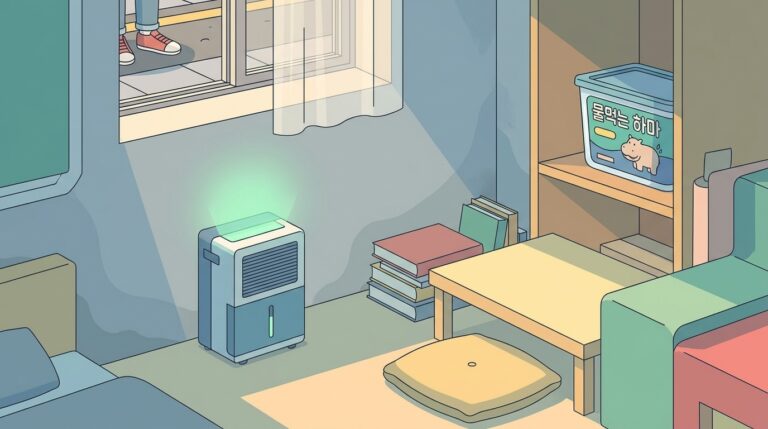
- 물먹는 하마 (Mul-meong-neun Ha-ma) | Literally “Water-eating Hippo.” This is the most famous brand of disposable calcium chloride tubs used to absorb moisture in Korean closets.
- 제습기 (Je-seup-gi) | Dehumidifier. A life-saving appliance during the Korean rainy season.
- 장마 (Jang-ma) | The East Asian rainy/monsoon season in Korea, usually lasting from late June to late July.
Phase 8: Survival Kit for Travelers (여행자를 위한 생존 키트)
Survival Expressions TOP 3
- 에어컨 제습 모드 좀 켜주세요. (Ae-eo-keon je-seup mo-deu jom kyeo-ju-se-yo.)
- Pro Tip: “Please turn on the dehumidifier mode on the AC.” (Great for Airbnbs!)
- 방에서 냄새가 나요. (Bang-e-seo naem-sae-ga na-yo.)
- Pro Tip: “There’s a smell in the room.” (Use this if your room smells musty upon check-in.)
- 환기시켜야 해요. (Hwan-gi-si-kyeo-ya hae-yo.)
- Pro Tip: “We need to ventilate the air.”
💡 Editor’s Travel Note: If you are staying in a rental in Korea during summer, make sure to download shopping apps like Coupang (쿠팡) to buy a quick “Mul-meong-neun Hama” pack to save your clothes!
Phase 9: Deep Thoughts (한 발 더 깊이)
In Korea, “Banjiha” represents more than just a type of housing; it is a social symbol of youth struggles and the housing crisis in Seoul. The battle with “습기” (dampness) is a shared experience of many foreigners and young Koreans trying to make it in the big city.
💬 Your Turn: Have you ever lived in a place with bad humidity or mold? How did you handle it? Let me know in the comments below!
Phase 10: FAQ & Common Mistakes (FAQ & 오해 방지)
Q: Is my landlord responsible for cleaning the mold?
A: Generally, if the mold is caused by structural issues of the semi-basement (poor insulation), the landlord (집주인) should fix the wallpaper. However, if it’s caused by the tenant never opening windows, you might have to pay for it. Always communicate early!
Q: Can I use “축축해요” instead of “눅눅해요”?
A: Yes, but they have a small difference. 축축하다 means something is noticeably wet to the touch (like wet grass or a soggy towel), while 눅눅하다 is that unpleasant, damp, non-crisp feeling (like laundry that didn’t dry well).
Q: What is the most common mistake foreigners make?
- 🚨 Common Mistake: Saying “방에 습기가 많아서 물먹는 하마를 마셨어요.” (I drank the ‘Water-eating Hippo’ because the room was humid.)
- Correct Action: ‘물먹는 하마’ is a chemical product! You should say “물먹는 하마를 놓아두었어요” (I placed/put a moisture absorber).
Phase 11: Action Mission (액션 미션)
- 🥉 Bronze: Go to your room right now, check the humidity, and say out loud: “방이 너무 꿉꿉해요!”
- 🥈 Silver: Take a picture of your dehumidifier or AC remote and post it on Instagram with the hashtag
#DailyHangul #꿉꿉해. - 🥇 Gold: Next time you go to a Korean convenience store (CU, GS25) or Daiso, look for the 물먹는 하마 section!
Phase 12: Interactive Quiz Challenge (인터랙티브 퀴즈 챌린지)
1. What does “눅눅하다” mean?
a) Crisp and fresh
b) Damp and soggy
c) Hot and dry
2. Which appliance removes moisture from the air?
a) 가습기 (Ga-seup-gi)
b) 제습기 (Je-seup-gi)
c) 세탁기 (Se-tak-gi)
👉 Click to reveal Answers & Explanations!
Answers:
1. b) Damp and soggy (Often used for clothes and sheets in summer!)
2. b) 제습기 (Dehumidifier. Note: 가습기 means humidifier, which actually adds moisture!)







