

I Need the Next Episode Now! How to Talk About K-Drama Cliffhangers in Korean
Phase 1: Empathy (Welcome, K-Drama Lovers!)
안녕하세요! (Annyeonghaseyo!) Hello there, my fellow K-drama addict! I’m your Daily Hangul editor and chief K-drama companion.
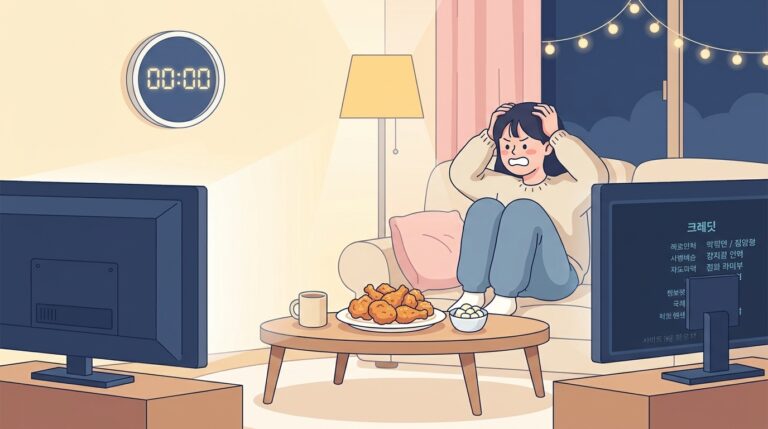
Picture this: It’s Sunday night. You are watching the latest hit K-drama. The main characters are finally about to confess their love, or maybe the villain has just uncovered the shocking truth. The music swells, the screen freezes, and… the credits roll.
“Noooo! Not now!” you scream at your screen. You have to wait a whole week to find out what happens next. The pain of the cliffhanger is real, and it is a universal K-drama struggle!
Many of our beginner students tell us they want to share this excitement (and agony!) with Korean friends online or in drama fan clubs, but they get stuck using dictionary translations that sound too stiff. Today, you will learn the exact phrases real Korean fans use to express that painful, exciting wait for the next episode. Let’s dive in!
Phase 2: Deep Dive into Top 3 Key Expressions
1. 다음 화가 너무 기다려져요! (Daeum hwaga neomu gidaryeojyeoyo!)
- Pronunciation: Dae-um hwa-ga neo-mu gi-da-ryeo-jyeo-yo! (Sounds like “day-um” + “wah” + “gah” + “neo-mu” + “ghee-dah-ryuh-jyuh-yo”)
- Meaning: I am looking forward to the next episode so much! / I can’t wait for the next episode!
- K-Culture Moment: This is the ultimate, polite way to leave a comment on a drama’s official Instagram page or Webtoon update section.
- Editor’s Insight: The word
다음 화(daeum hwa) means “next episode” (or next chapter in webtoons).기다려지다means “to become awaited”—it implies that the wait is happening to you almost against your will because the show is just that good! - Situation Spectrum: Casual (⚠️ 다음 화 너무 기다려져), Semi-formal (✅ 다음 화가 너무 기다려져요), Formal (🚫 다음 화가 매우 기대됩니다 – a bit too cold for drama fans!)
- 🤔 Think About It: In English, we say “I can’t wait” (focused on the person), but in Korean, we often say “the next episode becomes awaited” (focused on the object of desire). How does this change the vibe of your excitement?
2. 현기증 난단 말이에요. (Hyeonggijeung nandan marieyo.)
- Pronunciation: Hyung-ghee-jeung nan-dan mah-ri-eh-yo.
- Meaning: I’m getting dizzy here! (Meaning: “Hurry up and release the next episode, the suspense is killing me!”)
- K-Culture Moment: This started as a famous Korean internet meme and has become a staple expression of extreme, playful impatience. You will see this written in comments under juicy teaser trailers.
- Editor’s Insight:
현기증means dizziness. Saying “I’m getting dizzy” is a dramatic, humorous way to say you are dying of curiosity. Use this with close friends or online communities to show you are in on Korean internet culture! - Situation Spectrum: Casual (✅ 현기증 난단 말이야), Semi-formal (✅ 현기증 난단 말이에요), Formal (🚫)
- 🤔 Think About It: Do you have a dramatic phrase in your language for when you are waiting for something exciting? Is it as physical as “getting dizzy”?
3. 일주일을 어떻게 기다려요? (Iljuireul eotteoke gidaryeoyo?)
- Pronunciation: Il-ju-il-eul uh-tteoh-keh ghee-dah-ryuh-yo?
- Meaning: How am I supposed to wait a whole week?
- K-Culture Moment: Most Korean television dramas air two episodes a week (e.g., Saturday and Sunday). That means once Sunday’s episode ends, you have to survive a painful 5-day drought until the next weekend. This phrase perfectly captures that despair.
- Editor’s Insight:
일주일(il-ju-il) means “one week.” This is a rhetorical question. You aren’t asking for a manual on how to pass the time; you are expressing your shared grief with fellow fans. - Situation Spectrum: Casual (✅ 일주일을 어떻게 기다려), Semi-formal (✅ 일주일을 어떻게 기다려요?), Formal (🚫)
- 🤔 Think About It: Why do you think Korean dramas prefer the 2-episodes-a-week format instead of releasing the whole season at once like western streaming platforms?
Phase 3: Textbook Korean vs. Real Korean
Let’s compare textbook phrases with what Koreans actually say when they are hooked on a drama.
Situation 1: Expressing that a drama is extremely fun
- 📖 Textbook Korean: 이 드라마는 아주 재미있습니다. (I deuramaneun aju jaemi-itseumnida.) – “This drama is very interesting.”
- 🗣️ Real Korean: 이 드라마 진짜 미쳤어요! (I deurama jinjja michyeosseoyo!) – “This drama is seriously crazy/insane!”
- 💡 Why the difference?: While “재미있습니다” is grammatically perfect, it sounds like you are writing a school report. “미쳤다” (to be crazy) is used by modern Koreans to describe anything mind-blowingly good.
Situation 2: Asking if someone watched the latest episode
- 📖 Textbook Korean: 어제 방영된 드라마를 보았습니까? (Eoje bangyeongdoen deuramareul boatseumnika?) – “Did you watch the drama broadcasted yesterday?”
- 🗣️ Real Korean: 어제 본방사수 했어요? (Eoje bonbangsasu haesseoyo?) – “Did you catch yesterday’s episode live?”
- 💡 Why the difference?: Real drama lovers use the slang
본방사수(bon-bang-sa-su), which literally means “Defending the original broadcast”—a cultural term for watching a show live on TV/streaming the second it drops to avoid spoilers!
Phase 4: K-Culture Deep Dive & Non-verbal Manners
4-1. Gestures of Impatience and Despair
When Koreans express K-drama frustration, they don’t just use words. Here is how to look like a native:
* The Head Clutch: Lightly grab both sides of your head and shake it gently while saying “Eotteoke…” (What do I do…). This mimics the “dizziness” of the suspense.
* The Chest Thump (답답해 – Dapdaphae): Gently pat your chest with a fist. This expresses that your chest feels congested or stuffed because you are dying to know the ending.
4-2. The “Cliffhanger” Culture in Korea
In Korea, cliffhangers are called 엔딩 맛집 (Ending Mat-jip), which translates to “Ending Restaurant” (meaning a drama that serves up delicious, mind-blowing endings every single episode). Writers who excel at this are highly praised because they ensure high viewership for the next episode.
Phase 5: Real-Life Roleplay Scenario
Meet Ji-a (지아), your Korean classmate and a massive K-drama fan. You are both standing in front of the school lockers after the weekend, recovering from yesterday’s massive episode 10 ending.
- Ji-a: 혹시 어제 그 드라마 봤어요?
(Hoksi eoje geu deurama bwasseoyo? / Did you by any chance watch that drama yesterday?) - You: 🎭 [Nodding excitedly] 네! 당연히 본방사수 했죠!
(Ne! Dangnyeonhi bonbangsasu haetjyo! / Yes! Of course I watched it live!) - Ji-a: 마지막 장면 진짜 미치지 않았어요?
(Majimak jangmyeon jinjja michiji anasseoyo? / Wasn’t the last scene seriously crazy?) - You: 🎭 [Sighing and holding your head] 맞아요. 다음 화가 너무 기다려져요.
(Majayo. Daeum hwaga neomu gidaryeojyeoyo. / I know. I can’t wait for the next episode.) - Ji-a: 다음 주까지 어떻게 기다려요? 현기증 난단 말이에요!
(Daeum jukkaji eotteoke gidaryeoyo? Hyeonggijeung nandan marieyo! / How do we wait until next week? I’m getting dizzy here!) - You: 🎭 [Laughing in agreement] 진짜 일주일을 어떻게 기다려요?
(Jinjja iljuireul eotteoke gidaryeoyo? / Seriously, how do we wait a whole week?) - Ji-a: 우리 다음 주말에 같이 볼래요?
(Uri daeum jumare gachi bollaeyo? / Do you want to watch it together next weekend?) - You: 🎭 [Bright smile] 좋아요! 꼭 같이 봐요!
(Johayo! Kkok gachi bwayo! / Great! Let’s definitely watch it together!)
🔀 Interactive Choice Point
Ji-a asks: “Do you want to watch the next episode at my place with some K-chicken?” How do you reply?
- Option A: “미안해요, 바빠요.” (Mianhaeyo, bappayo. / Sorry, I am busy.)
- Option B: “우와, 완전 좋아요! 치맥 하면서 봐요!” (Uwa, wanjeon johayo! Chimaek hamyeonseo bwayo! / Wow, I’d absolutely love that! Let’s watch while eating chicken and beer!)
- Option C: “네, 가겠습니다.” (Ne, gagetseumnida. / Yes, I will go.)
Feedback:
- Option A (Bad): While honest, it’s very blunt and might hurt Ji-a’s feelings. It shuts down the friendship building moment!
- Option B (Best!): Perfect! It matches her excitement, uses the fun word “완전” (completely/totally), and suggests “치맥” (Chimaek – chicken and beer), the ultimate Korean drama-watching food.
- Option C (Risk): Too formal. It sounds like you are reporting for military duty rather than going to hang out with a friend to watch a show.
Phase 6: 10-Second Emotion Shadowing Drill
Let’s practice saying these like a true drama fan. Pay attention to the pauses (/) and the emotional cues!
[🥺 Despairing and whiny]- 다음 주까지 / 어떻게 / 기다려요?
- (Daeum jukkaji / eotteoke / gidaryeoyo?)
[😱 Shocked and excited]- 와, / 엔딩 진짜 / 미쳤어요!
- (Wa, / ending jinjja / michyeosseoyo!)
[😵 Dizzy with anticipation]- 빨리 다음 화 주세요, / 현기증 난단 말이에요!
- (Ppalli daeum hwa juseyo, / hyeonggijeung nandan marieyo!)
Phase 7: K-Culture Mini Dictionary
- 본방사수 (Bon-bang-sa-su) | Watching the Live Broadcast | Essential for avoiding spoilers on social media right after an episode airs.
- 정주행 (Jeong-ju-haeng) | Binge-watching | Literally “running straight through.” Perfect for when you wait until the whole drama is finished to watch it all at once.
- 막장 (Mak-jang) | Over-the-top/Extreme drama | Dramas with wild, unbelievable plot twists (birth secrets, fake identities, revenge plots).
- 떡밥 (Tteok-bap) | Cliffhanger clues/Foreshadowing | Literally “fish bait.” Clues left by the writer that fans analyze online to guess the ending.
Phase 8: Traveler’s Survival Kit
Top 3 Survival Phrases
- 이거 요즘 유행하는 드라마예요? (Igeo yojeum yuhaenghaneun deuramayeyo?)
- Pro Tip: Ask this to any Korean convenience store clerk or taxi driver to start a friendly chat about hot local trends.
- 넷플릭스에 이거 있어요? (Netpeullikseue igeo isseoyo?)
- Pro Tip: Use this to ask if a specific Korean show is available on Netflix Korea.
- 스포하지 마세요! (Seupohaji maseyo!)
- Pro Tip: “Don’t spoil it for me!” Essential if your Korean friends start discussing the ending before you’ve watched it.
Editor’s Travel Note
When traveling in Korea, you will want to visit famous drama filming locations! To find them easily, do not use Google Maps (which isn’t fully functional in Korea). Instead, search for the filming locations on the KakaoMap App or Naver Map App. Just copy-paste the Korean name of the location for 100% accurate walking directions!
Phase 9: “Going Deeper” (Thought Reflection)
In many Western countries, “binge-watching” a whole season in one weekend is the standard. However, in Korea, the weekly wait is a massive social event. People watch the episodes at the same time, gather online to analyze “떡밥” (baits/clues), and create memes together. This shared pacing builds a unique community bond. It turns television watching from a lonely hobby into a nationwide, interactive festival.
💬 Your Turn: Do you prefer binge-watching a drama all at once, or do you enjoy the sweet torture of waiting week by week? Let us know in the comments below!
Phase 10: FAQ & Common Mistakes
Q: Can I use “현기증 난단 말이에요” to an older person or my boss?
A: No, please avoid this! It is internet slang and sounds very casual and playful. Use it with friends, peers, or online. To a boss, simply say “다음 화가 매우 기다려집니다” (I am looking forward to the next episode).
Q: What is the difference between ‘화’ (hwa) and ‘회’ (hoe)?
A: Both mean “episode.” 화 (hwa) is more commonly used for webtoons and casual conversations, while 회 (hoe) is slightly more formal and often used in official broadcast announcements (e.g., 제10회 – Episode 10).
Q: How do I say “season” in Korean?
A: We use the English word: 시즌 (sijeun). For example, “시즌 2 언제 나와요?” (When is Season 2 coming out?).
🚨 Common Mistakes Alert!
- Saying “드라마가 매우 재미를 줍니다”
- What’s wrong: It translates to “The drama gives much fun,” which sounds like a Google Translation.
- Correct Action: Just say “이 드라마 진짜 재밌어요!” (I deurama jinjja jaemisseoyo!).
- Confusing ‘본방사수’ with ‘방송사고’
- What’s wrong: ‘방송사고’ (bang-song-sa-go) means a broadcasting accident/error!
- Correct Action: Make sure you say 본방사수 (bon-bang-sa-su) to mean watching it live!
Phase 11: Action Mission for Today
- 🥉 Bronze Mission: Write the phrase “다음 화 너무 기다려져요!” on a sticky note and place it on your laptop or TV screen.
- 🥈 Silver Mission: Go to the Instagram page of your favorite current K-drama and leave a supportive comment using one of today’s phrases!
- 🥇 Gold Mission: Use “현기증 난단 말이에요!” in a text message to a Korean language partner or friend when you are waiting for their reply.
Phase 12: Interactive Quiz Challenge
Test your K-Drama Korean skills!
1. Which word means “watching the drama live as it airs to avoid spoilers”?
- A) 정주행 (Jeong-ju-haeng)
- B) 본방사수 (Bon-bang-sa-su)
- C) 막장 (Mak-jang)
Reveal Answer
Answer: B) 본방사수
Explanation: ‘본방사수’ is the legendary term for defending your spot in front of the TV to watch it live!
2. Fill in the blank: “일주일을 어떻게 ________?” (How do I wait a week?)
- A) 먹어요 (meogoyo)
- B) 가요 (gayo)
- C) 기다려요 (gidaryeoyo)
Reveal Answer
Answer: C) 기다려요 (gidaryeoyo)
Explanation: ‘기다려요’ comes from ‘기다리다’ (to wait).
3. True or False: It is perfectly natural to say “현기증 난단 말이에요” during a formal business presentation to show you want the project to start quickly.
Reveal Answer
Answer: FALSE!
Explanation: This is humorous internet/drama slang. Using it in a business meeting might make your partners think you actually need medical attention!







