

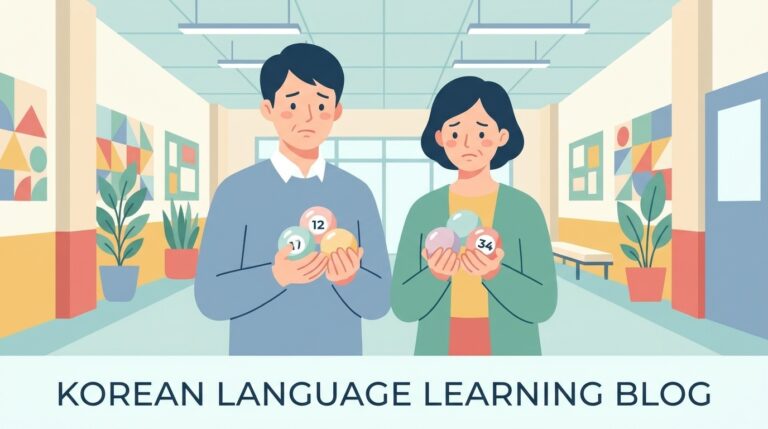
Survival Guide to Korea’s Elite English Kindergarten Lottery War
안녕하세요! Welcome back to another edition of “Daily Hangul”! I’m your host and local culture navigator. If you’ve been watching K-dramas like Sky Castle or Green Mothers’ Club, you might have thought the extreme competition in Korean education was a bit exaggerated. Well, let me tell you—the “English Kindergarten Lottery War” (영어 유치원 추첨 전쟁) is 100% real!
Imagine hundreds of parents holding lottery tickets in a tense auditorium, or clicking refresh on their browser at exactly 8:59 AM just to get their 5-year-old into a “Yong-yu” (short for 영어 유치원). Today, we’re going to dive into this fascinating cultural phenomenon, learn the essential Korean vocabulary used during these “wars,” and practice how to talk about high-pressure situations like a native B1 Korean speaker. Let’s dive in!
Phase 1: Empathy (Welcome to the Jungle of ‘Yong-yu’)
If you have ever tried to book concert tickets for BTS or BLACKPINK, you already know the adrenaline rush, the sweaty palms, and the heartbreaking “sold out” screen. In Korea, parents experience this exact same stress—not for a concert, but to enroll their toddlers in English academies.
Known colloquially as 영어 유치원 (Yeong-eo Yu-chi-won), or simply 영유 (Yeong-yu), these premium private academies cost upwards of $1,000 to $2,000 USD a month. Despite the price, slots are incredibly limited. Parents describe the admission process as a “war” (전쟁). By learning these terms, you will not only understand K-drama plots much better but also connect deeply with Korean friends who are parents, sharing in their daily struggles and triumphs.
Phase 2: Deep-Dive into 3 Essential Expressions
1. 피 튀기는 경쟁 (Pi twi-gi-neun gyeong-jaeng)
- Pronunciation: Pee tui-gi-neun gyeong-jaeng (Sounds like: “Pee tui-ghee-noon kyung-jaeng”)
- Meaning: Blood-splattering competition (Fierce/cutthroat competition)
- K-Culture Moment: This phrase is perfect when describing the college entrance exam (Suneung) season or the kindergarten lottery system in dramas where parents glare at each other in hallways.
- Editor’s Insight: While “치열한 경쟁” (chi-yeol-han gyeong-jaeng) is the polite textbook term for “fierce competition,” “피 튀기는 경쟁” adds a dramatic, visceral color to your speech, emphasizing that survival is on the line.
- Situation Spectrum: Casual (✅) / Semi-formal (⚠️) / Formal (🚫)
- 🤔 Think About It: Why does Korean culture use such vivid, physical metaphors like “blood-splattering” to describe academic placement? How does this compare to how competition is discussed in your home country?
2. 대기 번호 (Daegi beonho)
- Pronunciation: Dae-gi beon-ho (Sounds like: “Day-ghee bun-ho”)
- Meaning: Waiting list number / Queue number
- K-Culture Moment: When a parent receives a text message saying: “Your waiting number is 142.” (대기 번호 142번입니다.) This usually means they have virtually zero chance of getting in this semester.
- Editor’s Insight: In Korea, daegi beonho is a part of daily life—not just for schools, but for famous restaurants, hospital appointments, and popular pop-up stores in Seongsu-dong.
- Situation Spectrum: Casual (✅) / Semi-formal (✅) / Formal (✅)
- 🤔 Think About It: Patience is a virtue, but in fast-paced Korea (Pali-Pali culture), how does having a “waiting number” change people’s social anxiety?
3. 정보력 (Jeong-bo-ryeok)
- Pronunciation: Jeong-bo-ryeok (Sounds like: “Jung-bo-ryuk”)
- Meaning: The power of information / Ability to gather exclusive info
- K-Culture Moment: In K-dramas, the “Alpha Mom” of the neighborhood always has the best jeong-bo-ryeok. She knows which teachers are transferring, which academy has the highest test scores, and when the secret registration links open.
- Editor’s Insight: It’s not just about money anymore; in modern Korea, jeong-bo-ryeok is considered the ultimate currency for success.
- Situation Spectrum: Casual (✅) / Semi-formal (✅) / Formal (✅)
- 🤔 Think About It: Is “who you know and what you know” valued similarly in your country’s school system?
Phase 3: Textbook Korean vs. Real-Life Korean
Let’s compare the sterile sentences from standard textbooks with what you’ll actually hear parents whisper over iced Americanos in Gangnam cafes.
Situation 1: Describing a popular academy
- 📖 Textbook: “그 유치원은 인기가 아주 많습니다.” (Geu yu-chi-won-eun in-gi-ga a-ju man-seub-ni-da.)
- Translation: That kindergarten is very popular.
- 🗣️ Real-Life: “거기 들어가려면 하늘의 별 따기예요.” (Geo-gi deul-eo-ga-ryeo-myeon ha-neul-ui byeol tta-gi-ye-yo.)
- Translation: Getting in there is like plucking a star from the sky (nearly impossible).
- 💡 Why the difference? Koreans love using poetic, hyperbolic idioms (사자성어/관용구) to emphasize extreme difficulty rather than using flat adjectives like “difficult” or “popular.”
Situation 2: Expressing failure to register
- 📖 Textbook: “등록에 실패했습니다.” (Deung-rok-e sil-pae-haet-seub-ni-da.)
- Translation: I failed to register.
- 🗣️ Real-Life: “광클했는데 탈락했어요.” (Gwang-keul-haet-neun-de tal-rak-haet-seo-yo.)
- Translation: I did “crazy clicking” (frantically clicked), but I still got rejected/dropped. (“Gwang-keul” combines “Gwang”/crazy and “keul”/click).
- 💡 Why the difference? With the rise of online registration portals, the slang “Gwang-keul” became the standard way to describe the desperate act of fast-clicking during registration wars.
Phase 4: K-Culture Deep-Dive & Non-verbal Manners
4-1. The Body Language of Despair & Relief
If you attend a school lottery briefing in Korea, you will see a unique physical gesture. When a winning number is drawn, parents do not cheer loudly or jump up and down. Doing so is considered bad manners (shill-ye) to the hundreds of parents who lost. Instead, they quickly bow their heads, cover their mouths with their hands, and offer a silent sigh of relief while quietly bowing to those around them.
4-2. The “Pig Mum” (돼지엄마) Culture
In the realm of Korean English education, you cannot ignore the term 돼지엄마 (Dae-ji-eom-ma / Pig Mom). This is not an insult about weight. It refers to an influential mother who leads a “herd” of other mothers to the best academies and tutors, much like a sow leading her piglets. Having a Pig Mom in your social circle dramatically boosts your jeong-bo-ryeok (information power).
Phase 5: Real-Life Roleplay Scenario
Setting: A local cafe in Daechi-dong (the mecca of Korean private education). Two mothers, Min-ji (a veteran) and Sarah (an expat mother living in Seoul), are discussing the upcoming kindergarten admissions.
- Min-ji (민지): 세라 씨, 다음 주 영유 입학 설명회 가세요? (Sera-ssi, da-eum ju yeong-yu ip-hak seol-myeong-hoe ga-se-yo?)
- (Sarah, are you going to the English kindergarten admission briefing next week?)
- Sarah (세라): 네, 가려고요. 그런데 대기가 벌써 엄청 길다고 들었어요. (Ne, ga-ryeo-go-yo. Geon-de dae-gi-ga beol-sseo eom-cheong gil-da-go deul-eot-seo-yo.)
- (Yes, I plan to. But I heard the waiting list is already super long.)
- Min-ji (민지): 🎭 sighs deeply, sipping her iced coffee 거기는 진짜 하늘의 별 따기예요. 완전 피 튀기는 경쟁이라니까요. (Geo-gi-neun jin-ja ha-neul-ui byeol tta-gi-ye-yo. Wan-jeon pi twi-gi-neun gyeong-jaeng-i-ra-ni-kka-yo.)
- (Getting in there is truly like plucking stars from the sky. It’s a complete blood-splattering competition, I tell you.)
- Sarah (세라): 대기 번호라도 받으면 다행일 정도인가요? (Dae-gi beon-ho-ra-do ba-deu-myeon da-haeng-il jeong-do-in-ga-yo?)
- (Is it to the point where just getting a waiting number is a relief?)
- Min-ji (민지): 그럼요! 작년엔 대기 번호 200번 받고 우신 분도 있어요. 정보력이 생명이에요. (Geu-reom-yo! Jak-nyeon-en dae-gi beon-ho i-baek-beon bat-go u-sin bun-do is-seo-yo. Jeong-bo-ryeok-i saeng-myeong-i-e-yo.)
- (Of course! Last year, someone cried after getting waiting number 200. Information power is everything.)
- Sarah (세라): 🎭 looking worried 아… 저도 오늘부터 광클 연습해야겠어요. (Ah… jeo-do o-neul-bu-teo gwang-keul yeon-seup-hae-ya-get-seo-yo.)
- (Ah… I should start practicing my “crazy clicking” from today too.)
- Min-ji (민지): 제가 단톡방에 초대해 드릴게요. 거기가 정보가 진짜 빨라요! (Je-ga dan-tok-bang-e cho-dae-hae deu-ril-ge-yo. Geo-gi-ga jeong-bo-ga jin-ja ppal-ra-yo!)
- (I’ll invite you to our group chat. The information there is super fast!)
- Sarah (세라): 우와, 민지 씨가 제 구세주예요! 정말 감사합니다. (U-wa, Min-ji-ssi-ga je gu-se-ju-ye-yo! Jeong-mal gam-sa-hap-ni-da.)
- (Wow, Min-ji, you are my savior! Thank you so much.)
🔀 Interactive Choice Point
If you were Sarah, how would you respond to Min-ji’s invitation to the exclusive group chat?
- A: “진짜요? 바쁘실 텐데 귀찮게 해드려 죄송해요.” (Really? I’m sorry to bother you when you must be busy.)
- 💡 Feedback (Risk): Very polite, but slightly too distant for someone offering to bring you into their inner educational circle. It might make her feel you aren’t that eager.
- B: “우와! 진짜 감사해요! 제가 커피 살게요!” (Wow! Thank you so much! I’ll buy the coffee!)
- 💡 Feedback (Best): Perfect! In Korea, reciprocating a favor with a casual cup of coffee (coffee ssol-gae) is the best way to solidify a friendly social connection.
- C: “네, 링크 보내주시면 들어갈게요.” (Yes, send me the link and I’ll join.)
- 💡 Feedback (Bad): Too transactional and cold. It makes you sound like you are just using her for her jeong-bo-ryeok without appreciating her kindness.
Phase 6: 10-Second Emotional Shadowing Drill
To speak natural Korean, you need to master the emotional highs and lows. Practice shadowing these sentences with the indicated emotional tones!
[🥺 Desperate and worried]- 대기 번호만이라도 / 받았으면 / 좋겠어요…
- Dae-gi beon-ho-man-i-ra-do / ba-dat-seu-myeon / jo-get-seo-yo…
- (If I could at least just get a waiting number / I would be so happy…)
[😱 Panicked and rushing]- 빨리요! / 지금 정각이에요! / 빨리 광클하세요!
- Ppal-ri-yo! / Ji-geum jeong-gak-i-e-yo! / Ppal-ri gwang-keul-ha-se-yo!
- (Hurry! / It’s exactly on the hour now! / Do crazy clicking quickly!)
Phase 7: K-Culture Mini-Dictionary
- 영유 (Yeong-yu) | English Kindergarten
- A colloquial abbreviation for 영어 유치원. Though legally registered as private academies (hagwon), most Koreans treat them as full-time preschools.
- 광클 (Gwang-keul) | Crazy Clicking
- A slang compound of 광 (狂 – crazy/mad) and 클릭 (click). Used when trying to book popular tickets, classes, or registrations.
- 설명회 (Seol-myeong-hoe) | Information Session / Briefing
- An official presentation held by schools or academies to explain their curriculum and recruitment process to parents.
- 단톡방 (Dan-tok-bang) | Group Chatroom
- Short for 단체 카카오톡방 (Group KakaoTalk Room). In Korea, this is where vital community information, neighborhood gossip, and educational tips are shared.
Phase 8: Traveler’s Survival Kit
Even if you aren’t a parent, you will need these survival phrases when dealing with busy waiting lines in Korea!
- 대기 줄이 어디예요? (Dae-gi jul-i eo-di-ye-yo?)
- Pro Tip: “Where is the waiting line?” Use this at famous street food spots in Myeongdong or popular cafes in Yeonnam-dong.
- 얼마나 기다려야 해요? (Eol-ma-na gi-da-ryeo-ya hae-yo?)
- Pro Tip: “How long do I have to wait?” Helpful when the restaurant host hands you a tablet for queueing.
- 대기 등록 어떻게 해요? (Dae-gi deung-rok eo-tteo-ke hae-yo?)
- Pro Tip: “How do I register for the waiting list?” Many modern Korean places use automated waiting machines that require a phone number.
🗺️ Editor’s Travel Note:
When dining in Korea, download the Catch Table App (캐치테이블) or Naver Map App (네이버 지도) to check wait times in advance and register for queues digitally without standing in the cold!
Phase 9: “One Step Deeper” (Reflecting on Korea’s Education Fever)
Why are Korean parents so obsessed with “Yong-yu”? In Korea’s highly collective society, there is a deep-seated fear of “falling behind” (낙오). Parents feel that if their child doesn’t start English training by age five, they will lag behind in the race toward the prestigious SKY universities (Seoul National, Korea, and Yonsei University). It shows how language in Korea is not just a tool of communication, but a status symbol and a shield for the future.
💬 Your Turn: Does your country have a similar early-childhood education fever, or do kids get to just run around and play until they are older? Let us know in the comments below!
Phase 10: FAQ & Avoiding Common Mistakes
Q: Can foreigners enroll their kids in Korean English Kindergartens?
A: Yes, absolutely! Many expat families living in Seoul (especially in areas like Songdo, Yongsan, or Gangnam) enroll their children in Yeong-yu to maintain their English skills while living in Korea. However, you still have to participate in the registration process or pass entrance level interviews!
Q: Do kids actually learn real English there?
A: Most Yeong-yu hire native English speakers, so the pronunciation and conversational immersion are quite high. However, the curriculum can be highly academic, focusing heavily on reading and writing from a very young age.
Q: Is “영어 유치원” the legal name?
A: Officially, no. Government regulations prohibit private academies from using the word “유치원” (Kindergarten) in their official registered names because they are classified as hagwons (academies). But in everyday life, everyone calls them Yeong-yu.
🚨 Common Mistakes Alert!
- Mistake 1: Calling it an “English School” (영어 학교) to locals.
- Correct Action: Use 영유 (Yeong-yu) or 영어 유치원 (Yeong-eo Yu-chi-won) to sound natural.
- Mistake 2: Translating “waiting list” directly as “기다리는 리스트”.
- Correct Action: Always use 대기 명단 (Dae-gi myeong-dan) or ask for your 대기 번호 (Dae-gi beon-ho).
- Mistake 3: Pronouncing “광클” as two separate, flat English words.
- Correct Action: Blend them smoothly as gwang-keul, keeping the “gwang” short and snappy.
Phase 11: Action Mission
- Bronze Mission (Solo): Practice saying “대기 번호 몇 번이에요?” (What is my waiting number?) out loud 5 times in front of the mirror with a curious expression.
- Silver Mission (Social): Post a screenshot of a busy queue or a waiting app screen on your Instagram story and caption it with: “오늘도 피 튀기는 경쟁…” (Another blood-splattering competition today…).
- Gold Mission (Real Life): The next time you visit a popular Korean BBQ restaurant or cafe with a long line, ask the staff: “혹시 대기 번호표 받아야 하나요?” (Do I need to get a waiting ticket?).
Phase 12: Interactive Quiz Challenge
Test your knowledge of Korea’s educational culture and vocabulary!
1. Situational Judgment
You want to describe to your friend how insanely difficult it is to sign up for a famous Korean language class. Which phrase is most natural?
* A) 아주 인기가 좋아요. (A-ju in-gi-ga jo-a-yo.)
* B) 하늘의 별 따기예요. (Ha-neul-ui byeol tta-gi-ye-yo.)
* C) 너무 어렵습니다. (Neo-mu eo-ryeop-seub-ni-da.)
🔍 Click here for the Answer & Explanation
Correct Answer: B
While A and C are grammatically correct, B (하늘의 별 따기예요) is the highly natural, idiomatic expression that native speakers use to express that something is extremely difficult and highly competitive. It instantly upgrades your conversational flavor!
2. Fill in the Blank
To register for the concert tickets, I had to do “_________________” (crazy clicking) the second the clock struck 8 PM.
🔍 Click here for the Answer & Explanation
Correct Answer: 광클 (Gwang-keul)
This slang combines “crazy” (광) and “click” (클릭) to represent the intense clicking of a mouse to secure a spot before others do.







