

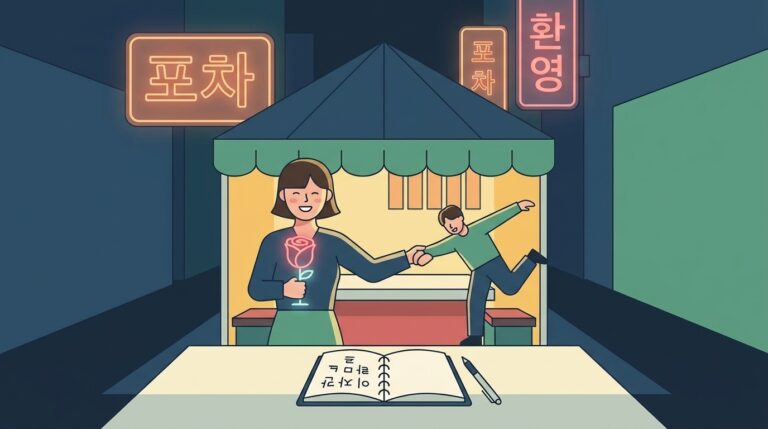
Black Knight, Black Rose: Surviving Korean Drinking Games Like a Local
Phase 1: Empathy (Welcome to the K-Sool Scene!)
안녕하세요! (Annyeonghaseyo!) It’s your friendly neighborhood Korean editor from Daily Hangul.
Imagine this: You are at a lively suljib (술집 – pub) in Hongdae with your new Korean friends. The table is packed with soju, maekju, and half-empty plates of crispy Korean fried chicken. Someone loses a chaotic round of the “Strawberry Game” (딸기 게임) and is sentenced to drink a massive penalty shot of Somaek (Soju + Beer). They look visibly exhausted.
Suddenly, you step in to save the day: “내가 흑기사 해줄게!” (I’ll be your Black Knight!)
The table erupts in cheers, but wait—there is a catch. In Korea, saving someone from a drinking penalty never comes free. The “Black Knight” (or “Black Rose” for women) always demands a wish (소원) in return. If you don’t know the exact phrases and unspoken rules of this dramatic social savior system, you might end up either drinking twice as much or making the atmosphere incredibly awkward.
Don’t worry! Today, we are diving deep into the exciting, slightly dramatic world of Korean drinking game rescues. By the end of this guide, you’ll know exactly how to offer help, make a witty wish, and navigate the cultural nuances like a true B2-level speaker. Let’s get started!
Phase 2: Deep Dive into 3 Essential Expressions
1. 흑기사 / 흑장미 해줄게! (Heuk-gi-sa / Heuk-jang-mi hae-jul-ge!)
- Pronunciation: Heuk-gi-sa (sounds like “heuk-ghee-sah” with a soft ‘g’) / Heuk-jang-mi (sounds like “heuk-jahng-mee”) hae-jul-ge!
- Meaning: “I’ll be your Black Knight!” / “I’ll be your Black Rose!”
- K-Culture Moment: In K-Dramas, this is the ultimate chivalrous move. Usually, the male lead steps in as a “Black Knight” (흑기사) to drink on behalf of the female lead, making eye contact over the glass while the crowd goes “Oooh!”
- Editor’s Insight: While “Black Knight” (흑기사) is historically male and “Black Rose” (흑장미) is female, modern drinking tables are very fluid! Anyone can use these terms, but maintaining the gender-specific term adds a fun, classic K-drama flair to the interaction.
- Situation Spectrum: Casual (✅) | Semi-formal (⚠️ – with younger colleagues) | Formal (🚫)
- 🤔 Think About It: In your culture, is there a concept of “taking a hit” or drinking on behalf of someone else to save them from embarrassment? How does this reflect the differences in group dynamic orientation?
2. 소원이 있어. (So-won-i is-seo.)
- Pronunciation: So-won-i (sounds like “so-one-ee”) is-seo (sounds like “eet-suh”)
- Meaning: “I have a wish.”
- K-Culture Moment: Once the savior drains the cup, the entire table claps and chants, “소원 빌어라! 소원 빌어라!” (Make a wish! Make a wish!). This is the moment where you negotiate your reward.
- Editor’s Insight: The “wish” is the core of this tradition. It shouldn’t be too serious. Usually, it’s something lighthearted like “buy me ice cream next,” “let’s swap seats,” or “speak informally (반말) to me for the rest of the night.”
- Situation Spectrum: Casual (✅) | Semi-formal (⚠️) | Formal (🚫)
- 🤔 Think About It: Why do you think Koreans turn a simple drinking penalty into a system of “favors and wishes”? Hint: It’s all about building jeong (정 – deep social connection)!
3. 소원권 적립해 둘게. (So-won-gwon jeok-rip-hae dul-ge.)
- Pronunciation: So-won-gwon (sounds like “so-one-gwon”) jeok-rip-hae (sounds like “juhk-reep-hae”) dul-ge (sounds like “dool-geh”)
- Meaning: “I will save/bank this wish coupon for later.”
- K-Culture Moment: If you can’t think of a good wish on the spot, you can “bank” it. It’s like keeping a digital voucher in your social credit bank.
- Editor’s Insight: This is a highly advanced B2-level expression! Using the word jeok-rip (accumulation/earning points, usually used for credit card miles) in a casual drinking setting shows an incredible sense of humor and absolute fluency.
- Situation Spectrum: Casual (✅) | Semi-formal (✅) | Formal (🚫)
Phase 3: Textbook Korean vs. Real-Life Korean
Let’s compare what you might find in a standard textbook versus what actually flies at a trendy pub in Seoul.
Situation 1: Offering to drink instead of someone
- 📖 Textbook Korean: “제가 대신 마셔 주겠습니다.” (Je-ga dae-sin ma-syeo ju-get-seub-ni-da. – “I will drink instead of you.”)
- 🗣️ Real-Life Korean: “내가 흑기사 자처한다!” (Nae-ga heuk-gi-sa ja-cheo-han-da! – “I volunteer as your Black Knight!”)
- 💡 Why the difference? The textbook version sounds like a formal business transaction. The real-life version uses the verb ja-cheo-hada (to volunteer/claim a role) which adds a playful, dramatic hero-like tone to the gesture.
Situation 2: Demanding the penalty/wish
- 📖 Textbook Korean: “제 소원을 들어주세요.” (Je so-won-eul deu-reo-ju-se-yo. – “Please grant my wish.”)
- 🗣️ Real-Life Korean: “세상에 공짜가 어디 있어? 내 소원은…” (Se-sang-e gong-jja-ga eo-di is-seo? Nae so-won-eun… – “There’s no such thing as a free lunch in this world! My wish is…”)
- 💡 Why the difference? The textbook phrase sounds like a prayer to a genie in a magic lamp. The real-life phrase uses a common Korean idiom “세상에 공짜는 없다” (There’s nothing free in this world) to tease your friend playfully before delivering the wish.
Phase 4: K-Culture Deep Dive & Non-Verbal Manners
4-1. The Body Language of a Knight / Rose
When volunteering as a Black Knight or Black Rose, timing and body language are everything:
1. The Heroic Grab: Do not hesitate. You must confidently grab the cup before the victim touches it. Speed is key!
2. The Eye Contact: Make direct, playful eye contact with the person you are saving as you lift the glass.
3. The One-Shot Climax: You must finish the drink in one go (One-shot! 원샷!). Sipping a rescue drink ruins the dramatic effect.
4-2. The “Ice Cream” Culture Code
In Korea, the most common “Black Knight” wish is: “편의점 가서 아이스크림 사주기” (Buying me an ice cream at the convenience store).
Why ice cream? Because after eating salty, spicy food and drinking hot alcohol, Koreans love cooling down with a sweet, cold dessert. Going to the convenience store together also provides a quiet, one-on-one moment away from the noisy table—perfect for making closer friends or starting a little romance!
Phase 5: Real-Life Roleplay Scenario
Setting: A bustling soju tent (Pocha) near Sinchon.
Characters:
* Min-ho (민호): The energetic game master.
* Sarah (사라): You, a confident B2 Korean speaker.
* Ji-a (지아): Your friend who is absolutely terrible at drinking games.
Min-ho: 자~ 지아 게임 또 졌다! 마셔라 마셔라, 술이 들어간다 쭉쭉쭉쭉쭉! 🍻
        (Ja~ Ji-a ge-im tto jyeot-da! Ma-syeo-ra ma-syeo-ra, sul-i deu-reo-gan-da jjuk-jjuk-jjuk-jjuk-jjuk!)
        [🎭 Chanting loudly while pointing at Ji-a's overflowing cup]

Ji-a: 아... 나 진짜 더 못 마시겠는데... 머리 아파. 😭
      (Ah... na jin-jja deo mot ma-si-get-neun-de... meo-ri a-pa.)
      [🎭 Holding her head, looking defeated]

Sarah: 잠깐! 내가 지아 흑장미 해줄게! 🌹
       (Jam-gkan! Nae-ga Ji-a heuk-jang-mi hae-jul-ge!)
       [🎭 Boldly snatching the glass from the table]

Min-ho: 오~~ 사락! 멋있다! 진짜 다 마시는 거지? 원샷!
        (Oh~~ Sa-rah! Meot-it-da! Jin-jja da ma-si-neun geo-ji? Won-syat!)
        [🎭 Clapping and banging on the table with chopsticks]

Sarah: [🎭 Gulping down the drink cleanly and putting the cup upside down on her head]
       크으! 맛있다! 자, 세상에 공짜는 없는 거 알지?
       (Keu-eu! Mat-it-da! Ja, se-sang-e gong-jja-neun eop-neun geo al-ji?)

Ji-a: 고마워, 사라야! 살았다 진짜... 네 소원이 뭐야? 다 들어줄게!
      (Go-ma-wo, Sa-rah-ya! Sal-at-da jin-jja... ne so-won-i mwo-ya? Da deu-reo-jul-ge!)
      [🎭 Clasping her hands together in deep gratitude]

Sarah: (Choose your next response!)
🔀 Interactive Choice Point
- A: “소원권 적립해 둘게. 나중에 유용하게 쓸 거야!”
(So-won-gwon jeok-rip-hae dul-ge. Na-jung-e yu-yong-ha-ge sseul geo-ya!) - B: “내일 아침에 나 해장국 사줘.”
(Nae-il a-chim-e na hae-jang-guk sa-jwo.) - C: “나 대신 다음 술값 다 내줘.”
(Na dae-sin da-eum sul-gkap da nae-jwo.)
Feedback:
- Selecting A (Best): Excellent Choice! This is witty, uses high-level vocabulary, and keeps the tension alive. Ji-a will wonder what kind of favor you will ask for in the future!
- Selecting B (Good): Very Practical! Asking for Haejangguk (hangover soup) the next morning is a very authentic Korean response. It ensures you two will meet again tomorrow.
- Selecting C (Bad/Risk): Too Expensive! Asking someone to pay for the entire next round of drinks is considered too heavy and demanding for a simple game rescue. Keep wishes cheap and fun!
Phase 6: 10-Second Emotion Shadowing Drill
Speak these lines out loud with the correct emotional tone. Use the / marks to pause briefly.
- [😎 Proud and Heroic]
“걱정하지 마! / 내가 오늘 / 너의 흑기사 해줄게!”
(Geok-jeong-ha-ji ma! / Nae-ga o-neul / neo-ui heuk-gi-sa hae-jul-ge!) -
[😏 Playful and Teasing]
“세상에 / 공짜는 없거든? / 내 소원은… / 아이스크림이야!”
(Se-sang-e / gong-jja-neun eop-geo-deun? / Nae so-won-eun… / a-i-seu-k’eu-rim-i-ya!) -
[😜 Sassy and Strategic]
“음… 지금은 생각 안 나니까, / 소원권 / 적립해 둘게!”
(Eum… ji-geum-eun saeng-gak an na-ni-kka, / so-won-gwon / jeok-rip-hae dul-ge!)
Phase 7: K-Culture Mini-Dictionary
- 흑기사 (Heuk-gi-sa) | Black Knight
- A male savior who drinks a penalty shot on behalf of someone else in a drinking game.
- 흑장미 (Heuk-jang-mi) | Black Rose
- A female savior who steps in to take the drinking penalty.
- 소원권 (So-won-gwon) | Wish Coupon
- An imaginary voucher earned by a savior, to be redeemed for a favor later.
- 해장 (Hae-jang) | Hangover Cure
- The act of eating hot soup, drinking sports drinks, or consuming food to relieve a hangover the day after drinking.
Phase 8: Survivor’s Travel Kit
Survival Expressions for the Pocha
- “저 진짜 취했어요.” (Jeo jin-jja chwi-haet-seo-yo.)
- Pro Tip: Use this honestly if you have reached your alcohol limit. Koreans respect limits when stated clearly.
- “물 한 잔만 주세요.” (Mul han jan-man ju-se-yo.)
- Pro Tip: Keep yourself hydrated. Always have a cup of cold water nearby.
- “우리 이제 갈까요?” (U-ri i-je gal-kka-yo?)
- Pro Tip: A polite way to suggest wrapping up the drinking session.
Editor’s Travel Note
When navigating late-night Seoul after a lively drinking session, public transportation might be closed. Don’t panic! Make sure you download the Kakao T App beforehand to easily call a taxi to your hotel. Avoid trying to hail random cabs on the street during peak hours (midnight to 2 AM) as it can be incredibly competitive!
Phase 9: Deep Thoughts (Community Over Individualism)
In many Western cultures, drinking games are strictly individualistic; you lose, you drink. In Korea, however, the concept of Jeong (정) and Woori (우리 – We/Us) means the group is always looking out for the individual. The
Frequently Asked Questions (FAQ)
Q: What does "흑기사 / 흑장미 해줄게! (Heuk-gi-sa / Heuk-jang-mi hae-jul-ge!)" mean in Korean and how do you pronounce it?
A: In Korean, "흑기사 / 흑장미 해줄게! (Heuk-gi-sa / Heuk-jang-mi hae-jul-ge!)" is pronounced [Heuk-gi-sa (sounds like "heuk-ghee-sah" with a soft 'g'] and means: "I'll be your Black Knight!" / "I'll be your Black Rose!"
Q: What does "소원이 있어. (So-won-i is-seo.)" mean in Korean and how do you pronounce it?
A: In Korean, "소원이 있어. (So-won-i is-seo.)" is pronounced [So-won-i (sounds like "so-one-ee"] and means: "I have a wish."
Q: What does "소원권 적립해 둘게. (So-won-gwon jeok-rip-hae dul-ge.)" mean in Korean and how do you pronounce it?
A: In Korean, "소원권 적립해 둘게. (So-won-gwon jeok-rip-hae dul-ge.)" is pronounced [So-won-gwon (sounds like "so-one-gwon"] and means: "I will save/bank this wish coupon for later."







