

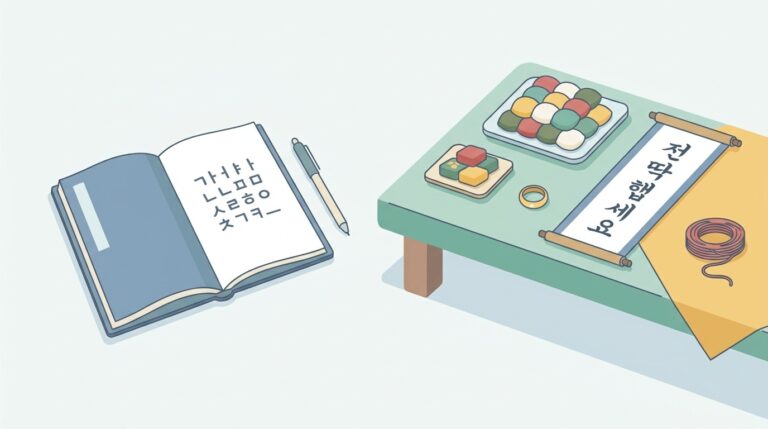
Celebrating a Miracle: Navigating Your First Korean Doljanchi (1st Birthday Party) Like a Local!
Phase 1: Empathy (Welcome to the Party!)
안녕하세요! (Annyeonghaseyo!) It’s your Korean bestie and Daily Hangul’s editor here!
Imagine this: You open your mailbox or KakaoTalk, and you see a beautifully designed invitation. Your Korean coworker’s baby is turning one, and you’ve been invited to a 돌잔치 (Doljanchi)—a traditional Korean first birthday party.
You instantly freeze. “What do I wear? Do I need to buy a gold ring? What on earth do I say to the parents without sounding like a textbook robot?”
Don’t panic! We’ve coached hundreds of expats who felt the exact same anxiety. A Doljanchi is one of the most heartwarming, energetic, and culturally rich celebrations in Korea. By the end of this guide, you’ll not only know exactly what to say to the proud parents, but you’ll also navigate the unique rituals (like the baby choosing their future career!) with absolute confidence. Let’s dive in!
Phase 2: Deep Dive into 3 Essential Expressions
1. 첫돌을 진심으로 축하해요! (Chot-dol-eul jin-sim-eu-ro chuk-ha-hae-yo!)
- Pronunciation: Chut-doll-eul jean-seem-eu-ro chook-ha-hae-yo! (Rhymes with “roll” and “seem”)
- Meaning: Happy first birthday, from the bottom of my heart!
- K-Culture Moment: You will see this written in elegant calligraphy on the main banner behind the baby’s party table, or printed on the envelope of your cash gift.
- Editor’s Insight: “첫돌 (Chot-dol)” refers specifically to the very first birthday. While “생일 축하해요” (Happy Birthday) works, using “첫돌” shows you truly respect and understand this monumental milestone in Korean culture.
- Situation Spectrum:
- Casual: 첫돌 축하해! (To a very close friend) ✅
- Semi-formal: 첫돌을 진심으로 축하해요! (Standard, polite) ✅
- Formal: 첫돌을 진심으로 축하드립니다. (To a boss or senior colleague) ✅
- 🤔 Think About It: In many Western cultures, a first birthday is just cake and balloons. In Korea, it’s a community celebration of survival and health. How does your culture mark a child’s first milestone?
2. 건강하고 밝게 자라기를 바랄게요. (Geon-gang-ha-go bal-ge ja-ra-gi-reul ba-ral-ge-yo.)
- Pronunciation: Gun-gang-ha-go bal-gae ja-ra-gee-reul bah-ral-gae-yo. (“bal-ge” sounds like the “bal” in “ballet” + “gay”)
- Meaning: I hope the baby grows up healthy and bright.
- K-Culture Moment: This is the ultimate card-writing phrase. It’s warm, loving, and avoids sounding overly business-like.
- Editor’s Insight: Korean wishes for children almost always prioritize “건강” (health) and a “밝은 성격” (bright/cheerful personality) over academic success during infancy.
- Situation Spectrum:
- Casual: 건강하고 밝게 자라길 바랄게! ⚠️
- Semi-formal: 건강하고 밝게 자라기를 바랄게요. ✅
- Formal: 건강하고 바르게 자라기를 기원합니다. ✅
3. 누구 닮아서 이렇게 예뻐요? (Nu-gu dal-ma-seo i-reo-ke ye-ppeo-yo?)
- Pronunciation: Noo-goo dahl-mah-suh ee-ruh-kay yeh-ppuh-yo?
- Meaning: Who does the baby take after to be this pretty/cute?
- K-Culture Moment: This is the ultimate “icebreaker ice-cream” of Korean compliments. When you meet the parents holding the baby, saying this brings instant smiles.
- Editor’s Insight: It’s a playful compliment directed at both parents. It subtly flatters them by suggesting the baby inherited their great looks.
- Situation Spectrum:
- Casual: 누구 닮아서 이렇게 예뻐? ✅
- Semi-formal: 누구 닮아서 이렇게 예뻐요? ✅
- Formal: 아버님/어머님을 닮아서 참 늠름하고 예쁩니다. ✅
Phase 3: Textbook Korean vs. Real-Life Korean
Situation 1: Giving the Cash Gift
- 📖 Textbook Korean: “여기 축의금 있습니다.” (Yeo-gi chuk-ui-geum is-seop-ni-da. – “Here is the congratulatory money.”) – Sounds like you’re paying a bill at a government office.
- 🗣️ Real-Life Korean: “작은 성의예요. 아이 선물 사주세요!” (Ja-geun seong-ui-ye-yo. A-i seon-mul sa-ju-se-yo! – “It’s a small token of my heart. Please buy a gift for the baby!”)
- 💡 Why the difference? In Korea, directly mentioning “money” (돈) when giving a gift can feel a bit blunt. Calling it “작은 성의” (small sincerity/heart) keeps the exchange elegant and warm.
Situation 2: Reacting to the Baby’s Choice during the Doljabi (돌잡이)
- 📖 Textbook Korean: “아기가 연필을 집었습니다.” (A-gi-ga yeon-pil-eul jib-eot-seop-ni-da. – “The baby picked up the pencil.”) – Sounds like a dry news broadcast.
- 🗣️ Real-Life Korean: “우와, 연필 집었다! 나중에 공부 잘하겠네!” (U-wa, yeon-pil jib-eot-da! Na-jung-e gong-bu jal-ha-get-ne! – “Wow, they picked the pencil! They’re going to be so smart/study well later!”)
- 💡 Why the difference? Doljabi is a lively game! High-energy exclamations and predicting the baby’s future based on what they grabbed (pencil = scholar, thread = long life, money = wealth) is part of the collective fun.
Phase 4: K-Culture Deep Dive & Non-Verbal Manners
4-1. Nunchi & Gestures: Bowing and Envelope Passing
When you arrive, you will see a reception desk. You should place your cash gift inside a white envelope.
* The Two-Hand rule: Never pass the envelope with one hand. Always hold it with both hands, or support your right wrist/forearm with your left hand as you present it. Bow slightly (a 15-degree angle is perfect) and smile.
4-2. The Star of the Show: Doljabi (돌잡이)
Historically, infant mortality was high, so reaching age one was a miraculous triumph. Today, the highlight of Doljanchi is Doljabi, where various items are placed in front of the baby. Whichever the baby grabs first foretells their future!
* Pencil/Book: Scholar, writer, or smart professional.
* Thread: Long, healthy life.
* Money/Gold Ring: Wealth.
* Microphone: Entertainer, influencer, or K-pop star (a modern favorite!).
Phase 5: Real-Life Roleplay Scenario
Setting: The beautiful banquet hall of a hotel in Seoul. You’ve just arrived and spotted the mother, Minji (민지), holding her baby boy, Hajun (하준).
- Minji (Mother): “어머, 지우 씨! 진짜 오셨네요! 주말인데 와주셔서 감사해요.”
(Oh my, Jiwoo! You actually made it! Thank you for coming on a weekend.) - Jiwoo (You): “🎭 (Smiling warmly and waving to the baby) 당연히 와야죠! 민지 씨, 오늘 너무 예쁘세요!”
(Of course I had to come! Minji, you look so beautiful today!) - Minji (Mother): “에이, 아니에요. 애 키우느라 늙었어요. 우리 하준이 인사해야지?”
(Oh, no way. I’ve aged from raising a kid. Hajun, say hello to Auntie/Uncle?) - Jiwoo (You): “🎭 (Gently peeking at the baby’s cute outfit) 어머, 하준이 좀 봐! 누구 닮아서 이렇게 예뻐요?”
(Oh my, look at Hajun! Who does he take after to be this cute?) - Minji (Mother): “다들 아빠 판박이라고 해요. 호호. 아, 지우 씨, 이따 돌잡이 맞추기 이벤트 꼭 참여해 보세요!”
(Everyone says he’s the spitting image of his dad. Haha. Oh, Jiwoo, make sure to participate in the Doljabi guessing event later!) - Jiwoo (You): “🎭 (Nodding excitedly) 와, 재미있겠네요! 하준이는 뭐 잡을 것 같아요?”
(Wow, that sounds fun! What do you think Hajun will grab?) - Minji (Mother): “저는 돈을 잡았으면 좋겠는데, 남편은 청진기를 잡기를 바래요. 이따 꼭 지켜봐 주세요!”
(I hope he grabs the money, but my husband wants him to grab the stethoscope. Please watch us later!) - Jiwoo (You): “🎭 (Patting Minji’s shoulder gently) 하준이가 뭘 잡든 정말 건강하고 밝게 자랄 거예요! 오늘 축하드려요!”
(Whatever Hajun grabs, he’s going to grow up healthy and bright! Congratulations today!)
🔀 Interactive Choice Point
At the reception desk, they ask you to put your raffle ticket into a cup predicting what Hajun will grab. Which cup do you choose?
* A) The Pencil (연필): You want to wish him academic brilliance.
* B) The Money (돈): You want to wish him a wealthy, comfortable life.
* C) The Thread (실): You want to wish him a long, healthy life.
Feedback:
- If you chose A: Excellent Choice! Wishing intellectual success is highly respected in Korea. You might win a prize if he grabs it!
- If you chose B: The Crowd Favorite! Parents secretly (and openly) love it when their baby grabs money. The crowd will roar with laughter if he does.
- If you chose C: The Most Heartfelt. While less “flashy” than money, wishing for “장수” (long life) via the thread shows a deep appreciation for the traditional roots of Doljanchi.
Phase 6: 10-Second Emotional Shadowing Drill
Speak these out loud! Focus on the rhythm (/ represents a micro-pause) and matching the emotion in the brackets.
- [😊 Bright and Cheerful]
“첫돌을 / 진심으로 / 축하해요!”
(Chot-dol-eul / jin-sim-eu-ro / chuk-ha-hae-yo!) - [🥺 Warm and Earnest]
“건강하고 / 밝게 / 자라기를 / 바랄게요.”
(Geon-gang-ha-go / bal-ge / ja-ra-gi-reul / ba-ral-ge-yo.) - [🤩 Playful and Teasing]
“하준이는 / 누구 닮아서 / 이렇게 예뻐요?”
(Ha-jun-i-neun / nu-gu dal-ma-seo / i-reo-ke ye-ppeo-yo?)
Phase 7: K-Culture Mini Dictionary
- 돌잡이 (Doljabi): The fortunetelling event during a first birthday where the baby selects an item predicting their future career or traits.
- 돌반지 (Dol-ban-ji): A traditional 24k pure gold ring gifted to the baby for financial security. Due to gold prices, cash (축의금) is now equally common!
- 답례품 (Dap-rye-pum): A return gift given by the parents to thank guests. Usually luxury hand towels, salt, or custom rice cakes (떡).
- 판박이 (Pan-bak-i): A spitting image, exact copy, or look-alike (often used to describe a baby looking exactly like their parents).
Phase 8: Traveler’s Survival Kit
Survival Phrases
- 봉투 있어요? (Bong-tu is-seo-yo?): “Do you have an envelope?” (Crucial if you forgot to buy one for your gift cash!).
- 방명록 어디에요? (Bang-myeong-rok eo-di-e-yo?): “Where is the guestbook?”
- 화장실 어디에요? (Hwa-jang-sil eo-di-e-yo?): “Where is the restroom?”
Editor’s Travel Note: If you are traveling to a venue, use Naver Map (네이버 지도 App) to find the precise subway or bus exit. Google Maps is often outdated for local Korean bus routes. Tip: Dress code for Doljanchi is “Smart Casual.” Avoid overly casual sweatpants, but you don’t need a formal wedding suit either.
Phase 9:
Frequently Asked Questions (FAQ)
Q: What does "첫돌을 진심으로 축하해요! (Chot-dol-eul jin-sim-eu-ro chuk-ha-hae-yo!)" mean in Korean and how do you pronounce it?
A: In Korean, "첫돌을 진심으로 축하해요! (Chot-dol-eul jin-sim-eu-ro chuk-ha-hae-yo!)" is pronounced [Chut-doll-eul jean-seem-eu-ro chook-ha-hae-yo! (Rhymes with "roll" and "seem"] and means: Happy first birthday, from the bottom of my heart!
Q: What does "건강하고 밝게 자라기를 바랄게요. (Geon-gang-ha-go bal-ge ja-ra-gi-reul ba-ral-ge-yo.)" mean in Korean and how do you pronounce it?
A: In Korean, "건강하고 밝게 자라기를 바랄게요. (Geon-gang-ha-go bal-ge ja-ra-gi-reul ba-ral-ge-yo.)" is pronounced [Gun-gang-ha-go bal-gae ja-ra-gee-reul bah-ral-gae-yo. ("bal-ge" sounds like the "bal" in "ballet" + "gay"] and means: I hope the baby grows up healthy and bright.
Q: What does "누구 닮아서 이렇게 예뻐요? (Nu-gu dal-ma-seo i-reo-ke ye-ppeo-yo?)" mean in Korean and how do you pronounce it?
A: In Korean, "누구 닮아서 이렇게 예뻐요? (Nu-gu dal-ma-seo i-reo-ke ye-ppeo-yo?)" is pronounced [Noo-goo dahl-mah-suh ee-ruh-kay yeh-ppuh-yo?] and means: Who does the baby take after to be this pretty/cute?







