

건강을 위해서 운동을 좀 해 (You should work out for your health): How to Give Warm Health Advice in Korean Like a True Friend
Phase 1: Empathy (스토리 몰입형 오프닝)
안녕하세요! (An-nyeong-ha-se-yo!) Your friendly neighborhood Daily Hangul editor is here!
Imagine this: You’re watching your favorite K-Drama, and the male lead is working overnight at his office, surviving solely on instant ramyeon and iced americanos. His best friend walks in, sighs deeply, and says: “건강을 위해서 운동을 좀 해” (Geon-gang-eul wi-hae-seo un-dong-eul jom hae).
If you translate this literally, it sounds like: “For your health, do some exercise.” But in Korea, this isn’t just a nagging remark. It’s a profound way of showing love and concern. In Korean culture, caring for someone’s physical well-being is the ultimate form of intimacy.
Many of our B1 learners tell us, “When I try to give advice in Korean, I sound too harsh or like a strict doctor!” Don’t worry. Today, we’re going to master the art of giving gentle, warm, and natural advice in Korean so you can sound like a true Korean bestie. Let’s dive in!
Phase 2: 핵심 표현 3선 심층 분석 (Deep Dive into Top 3 Expressions)
1. 건강을 위해서 운동을 좀 해
- Pronunciation: Geon-gang-eul wi-hae-seo un-dong-eul jom hae (Sounds like: “Gun-gahng-eul wee-hae-suh oon-dong-eul jom hae”)
- Meaning: You should work out a bit for your health.
- K-Culture Moment: This is the ultimate “best friend” line. You’ll hear this in K-Dramas when two characters are sharing a late-night drink and one looks visibly exhausted.
- Editor’s Insight: The word 좀 (jom – a bit) is the magic safety valve here. Without jom, “운동을 해” (un-dong-eul hae – do exercise!) sounds like a military command. Adding jom softens it to “try doing a little bit.”
- Situation Spectrum: Casual (✅) | Semi-formal (⚠️ – needs yo: 운동을 좀 해요) | Formal (🚫)
- 🤔 Think About It: In your culture, does suggesting someone exercise sound too personal or offensive? In Korea, it’s a sign of deep affection and care!
2. 무리하지 말고 쉬어가면서 해
- Pronunciation: Mu-ri-ha-ji mal-go swi-eo-ga-myeon-seo hae (Sounds like: “Moo-ri-ha-jee mahl-go shee-uh-gah-myun-suh hae”)
- Meaning: Don’t overdo it; take breaks while you work.
- K-Culture Moment: Often texted by K-Pop idols to their fans (Ui-jeu/Luvies/Carats) on platforms like Bubble or Weverse during exam seasons or busy weeks.
- Editor’s Insight: 무리하다 (mu-ri-ha-da) means to overexert oneself. Koreans love working hard (hello, Ppalli-ppalli culture!), but they also deeply respect the balance of “쉬어가면서” (while taking breaks).
- Situation Spectrum: Casual (✅) | Semi-formal (✅ – 쉬어가면서 해요) | Formal (⚠️ – 쉬어가면서 하십시오)
- 🤔 Think About It: Why do you think Koreans emphasize “not overdoing it” even though they are famous for working fast?
3. 영양제 꼭 챙겨 먹어
- Pronunciation: Yeong-yang-je kkok chaeng-gyeo meog-eo (Sounds like: “Yung-yang-jeh kkok chaeng-gyuh mug-uh”)
- Meaning: Make sure you take your vitamins/supplements.
- K-Culture Moment: Go to any Korean household, and you will see a kitchen counter stacked with red ginseng (hong-sam), probiotics, and lutein. Giving vitamins as gifts is a massive trend in Korea.
- Editor’s Insight: The verb 챙기다 (chaeng-gi-da) means to pack, take care of, or not miss. Saying “챙겨 먹어” implies “don’t forget to take them for your own good.”
- Situation Spectrum: Casual (✅) | Semi-formal (✅ – 챙겨 드세요 – honorific change) | Formal (🚫)
- 🤔 Think About It: What is the equivalent “health care gift” in your country?
Phase 3: 교과서 한국어 vs 진짜 한국어 (Textbook vs. Real-Life Korean)
Situation 1: Advising someone to sleep early
- 📖 교과서 한국어 (Textbook): “건강에 좋으니 일찍 자십시오.” (It is good for your health, so sleep early. – Sounds like a textbook robot.)
- 🗣️ 진짜 한국어 (Real-Life): “일찍 자야 건강에 좋지. 얼른 자~” (You should sleep early for your health. Hurry up and sleep~)
- 💡 왜 다를까? Korean friends use conversational endings like ~지 (-ji, seeking agreement) and 얼른 (eol-leun, quickly/hurry) to show friendly concern rather than giving an order.
Situation 2: Telling someone they look tired
- 📖 교과서 한국어 (Textbook): “당신은 피곤해 보입니다.” (You look tired. – A bit dry and distant.)
- 🗣️ 진짜 한국어 (Real-Life): “오늘 얼굴이 왜 이렇게 안 좋아 보여? 무슨 일 있어?” (Why does your face look so tired today? Is something going on?)
- 💡 왜 다를까? Instead of stating a dry fact, native speakers ask about the other person’s condition with concern (“무슨 일 있어?”).
Phase 4: K-Culture 딥다이브 & 비언어적 매너 (K-Culture Deep Dive & Non-Verbal Manners)
4-1. 눈치(Nunchi) & Gestures
When advising a Korean friend about their health, your body language must match your words.
* The Head Tilt and Soft Voice: Tilt your head slightly to the side and lower your vocal pitch. A high, loud pitch can make “운동을 좀 해” sound like nagging (jan-so-ri).
* The Shoulder Pat: A light, reassuring pat on the shoulder or upper arm while saying “무리하지 마” (don’t overdo it) instantly builds warmth and trust.
4-2. The “Red Ginseng (홍삼) & Vitamin” Culture
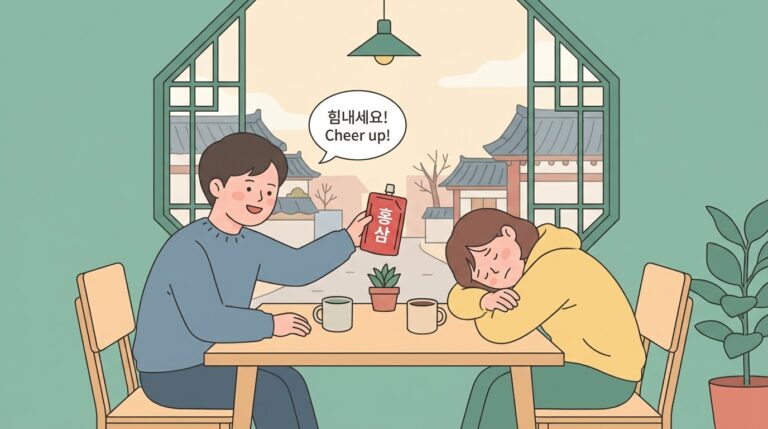
If you visit South Korea, you’ll notice people drinking liquid pouches of red ginseng or taking multi-vitamin packs at 3:00 PM in the office. In Korea, taking care of your body is not just a personal chore; it’s a social courtesy. If you get sick, you might burden your team. Giving someone a health drink (like Bacchus or Vit500) from a convenience store along with the phrase “힘내!” (Cheer up!) is the ultimate friendship hack.
Phase 5: 실전 롤플레이 시나리오 (Real-Life Roleplay Scenario)
Background: You are meeting your Korean friend, Minjun (민준), at a cozy cafe in Hongdae. Minjun has been studying day and night for his university exams and looks incredibly pale and exhausted.
- Minjun: (Yawning deeply) 아… 진짜 피곤하다. 요즘 매일 3시간밖에 못 잤어.
(Ah… jin-jja pi-gon-ha-da. Yo-jeum mae-il se-si-gan-bak-ke mot jat-seo.)
“Ah… I’m so tired. I’ve only been able to sleep 3 hours a day lately.” - You: 🎭 (Frowning with deep worry) 헐, 진짜? 건강을 위해서 운동도 좀 하고 쉬어가면서 해.
(Heol, jin-jja? Geon-gang-eul wi-hae-seo un-dong-do jom ha-go swi-eo-ga-myeon-seo hae.)
“OMG, really? For your health, do some exercise and take some breaks.” - Minjun: 운동할 시간이 어딨어… 밥 먹을 시간도 부족해.
(Un-dong-hal si-gan-i eo-dit-seo… bap meog-eul si-gan-do bu-jok-hae.)
“Where is the time to exercise… I don’t even have enough time to eat.” - You: 🎭 (Sighing gently, tapping his shoulder) 아무리 바빠도 밥은 굶지 마. 영양제는 꼭 챙겨 먹고 있어?
(A-mu-ri bap-pa-do bab-eun gulm-ji ma. Yeong-yang-je-neun kkok chaeng-gyeo meog-go it-seo?)
“No matter how busy you are, don’t skip meals. Are you at least taking your vitamins?” - Minjun: 아, 귀찮아서 안 먹었는데… 이제 진짜 먹어야겠네.
(Ah, gwi-chan-ah-seo an meog-eon-nunde… i-je jin-jja meog-eo-ya-get-ne.)
“Ah, I was too lazy so I didn’t… I guess I really should start taking them now.” - You: 응! 내가 내일 홍삼 하나 선물해 줄게. 무리하지 말고 오늘 밤은 일찍 자.
(Eung! Nae-ga nae-il hong-sam ha-na seon-mul-hae jul-ge. Mu-ri-ha-ji mal-go o-neul bam-eun il-ccik ja.)
“Yeah! I’ll gift you some red ginseng tomorrow. Don’t overdo it and sleep early tonight.” - Minjun: 🎭 (Smiling warmly, touched) 고마워. 너밖에 없다 진짜!
(Go-ma-wo. Neo-bak-ke eop-da jin-jja!)
“Thank you. Seriously, you’re the only one who cares!”
🔀 Interactive Choice Point
Minjun suddenly sighs and says he feels like skipping dinner to study more. What do you say?
- Option A: “그러면 안 돼! 밥 안 먹으면 아파. 얼른 밥 먹으러 가자!” (You shouldn’t do that! If you don’t eat, you’ll get sick. Let’s go grab food right now!)
- Option B: “공부도 좋지만 건강이 최우선이야. 맛있는 거 사줄 테니까 가자.”(Studying is good, but health is the top priority. I’ll buy you something delicious, let’s go.)
- Option C: “네 마음대로 해.” (Do whatever you want.)
Feedback:
- Option A (Good): Great! Showcases active worry and proactive friendship.
- Option B (BEST ⭐): Absolutely perfect! Combining the ultimate truth (“건강이 최우선” – Health is top priority) with buying food (“맛있는 거 사줄게”) is how you win a Korean’s heart forever.
- Option C (BAD 🚫): Too cold! This sounds like you are giving up on them or angry, which might hurt Minjun’s feelings.
Phase 6: 10초 감정 섀도잉 드릴 (10-Second Emotion Shadowing Drill)
Practice saying these lines with the exact emotional intonation marked by / pauses!
- [🥺 Deeply worried and warm]
건강을 위해서 / 운동을 / 좀 해~
(Geon-gang-eul wi-hae-seo / un-dong-eul / jom hae~) -
[🥰 Sweetly urging a friend to take care]
아무리 바빠도 / 영양제는 / 꼭! / 챙겨 먹어!
(A-mu-ri bap-pa-do / yeong-yang-je-neun / kkok! / chaeng-gyeo meog-eo!) -
[💪 Supportive and encouraging]
무리하지 말고 / 쉬어가면서 해!
(Mu-ri-ha-ji mal-go / swi-eo-ga-myeon-seo hae!)
Phase 7: K-Culture 미니 사전 (Mini-Dictionary)
- 영양제 (Yeong-yang-je) | Vitamins/Supplements
- Essential in Korean office culture. Refers to anything from Vitamin C to Omega-3.
- 홍삼 (Hong-sam) | Red Ginseng
- The king of Korean health supplements. Often sold in portable liquid stick packs.
- 무리하다 (Mu-ri-ha-da) | To overdo/Overexert
- Used constantly to warn friends against studying or working too hard.
- 챙기다 (Chaeng-gi-da) | To take care of/Not miss
- A warm verb used when reminding someone to eat, take vitamins, or pack their belongings.
Phase 8: 여행자를 위한 생존 키트 (Traveler’s Survival Kit)
Survival Phrases for Health Concerns:
- “약국이 어디에 있어요?” (Yak-guk-i eo-di-e is-seo-yo?)
- “Where is the pharmacy?”
- “종합감기약 주세요.” (Jong-hap-gam-gi-yak ju-se-yo.)
- “Please give me multi-symptom cold medicine.”
- “피로회복제 추천해 주세요.” (Pi-ro-hoe-bok-je chu-cheon-hae ju-se-yo.)
- “Please recommend something for fatigue recovery (like a health drink).”
🗺️ Editor’s Travel Note:
If you feel sick or extremely tired while traveling in Korea, look for the green neon sign saying 약 (Yak). Unlike some Western countries where pharmacists only dispense prescriptions, Korean pharmacists can recommend highly effective over-the-counter medicine on the spot. If you need to find the nearest open pharmacy, use Kakao Map (카카오맵) and search for “약국” (Pharmacy).
Phase 9: “한 발 더 깊이” (Deep Cultural Insight)
In many Western cultures, giving unsolicited advice about someone’s weight, sleep schedule, or diet can be perceived as invasive. However, in Korea, which has a deeply rooted collectivist background,
Frequently Asked Questions (FAQ)
Q: What does "건강을 위해서 운동을 좀 해" mean in Korean and how do you pronounce it?
A: In Korean, "건강을 위해서 운동을 좀 해" is pronounced [Geon-gang-eul wi-hae-seo un-dong-eul jom hae (Sounds like: "Gun-gahng-eul wee-hae-suh oon-dong-eul jom hae"] and means: You should work out a bit for your health.
Q: What does "무리하지 말고 쉬어가면서 해" mean in Korean and how do you pronounce it?
A: In Korean, "무리하지 말고 쉬어가면서 해" is pronounced [Mu-ri-ha-ji mal-go swi-eo-ga-myeon-seo hae (Sounds like: "Moo-ri-ha-jee mahl-go shee-uh-gah-myun-suh hae"] and means: Don't overdo it; take breaks while you work.
Q: What does "영양제 꼭 챙겨 먹어" mean in Korean and how do you pronounce it?
A: In Korean, "영양제 꼭 챙겨 먹어" is pronounced [Yeong-yang-je kkok chaeng-gyeo meog-eo (Sounds like: "Yung-yang-jeh kkok chaeng-gyuh mug-uh"] and means: Make sure you take your vitamins/supplements.







