

Phase 1: Empathy (Welcome, My Friend!)
안녕하세요! (An-nyeong-ha-se-yo!) Hello! Your Daily Hangul editor is back with another friendly guide to make your Korean journey smooth and fun! ☕✨
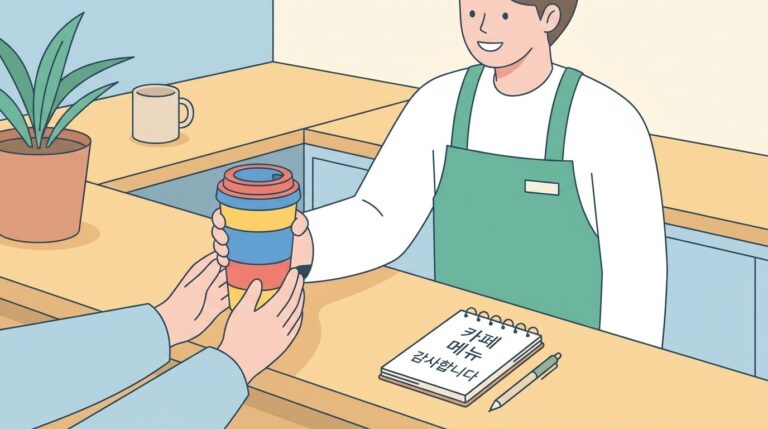
Imagine this: You walk into a cozy, aesthetic cafe in Hongdae. You have your favorite reusable tumbler in your hand, feeling proud of saving the planet. You want to ask the barista, “Can I get a discount if I use my tumbler?” but suddenly, your mind goes blank. Is “tumbler” the same word in Korean? How do you ask for a discount politely without sounding demanding?
Don’t worry! Many of our learners have told us they felt too shy to ask for tumbler discounts, ending up paying the full price. Today, we are going to master this simple, eco-friendly interaction. By the end of this guide, you will confidently hand over your cup and save some Korean Won (and the earth) like a true local!
Phase 2: Three Key Expressions Deep Dive
1. 텀블러 할인 돼요? (Teom-beul-reo hal-in dwae-yo?)
- Pronunciation: teom-beul-reo hal-in dway-yo? (Sounds like: “tom-bull-uh” + “hahl-een” + “dway-yo?”)
- Meaning: Can I get a tumbler discount?
- K-Culture Moment: You will see this written on little signs near cafe registers in trendy areas like Yeonnam-dong. Eco-conscious K-drama characters often hand over their colorful tumblers with this exact line.
- Editor’s Insight: “텀블러” is the English word “tumbler” adapted into Korean phonetics. “할인” means discount, and “돼요?” means “is it possible/okay?”. This is the most natural and direct way to ask!
- Situation Spectrum: Casual ✅ | Semi-formal ✅ | Formal ⚠️
- 🤔 Think About It: In your country, do cafes usually encourage using reusable cups with discounts? In Korea, eco-friendly habits are highly encouraged by both the government and local cafes!
2. 개인 컵에 담아 주세요. (Gae-in keop-e dam-a ju-se-yo.)
- Pronunciation: gae-in cup-eh dahm-ah joo-seh-yo.
- Meaning: Please put it in my personal cup.
- K-Culture Moment: In cafe vlogs on YouTube, you will hear stylish baristas nodding when a customer says this, instantly grabbing the customer’s reusable mug.
- Editor’s Insight: “개인” means personal, “컵” means cup, and “담아 주세요” means “please put/pour it into”. Use this if you want to be extra clear that you want your drink in your own cup instead of a disposable one.
- Situation Spectrum: Casual ✅ | Semi-formal ✅ | Formal ✅
- 🤔 Think About It: Why does Korean use “personal cup” (개인 컵) alongside “tumbler”? Both are used interchangeably, but “personal cup” sounds slightly more general and polite!
3. 할인 얼마나 돼요? (Hal-in eol-ma-na dwae-yo?)
- Pronunciation: hahl-een uhl-mah-nah dway-yo?
- Meaning: How much is the discount?
- K-Culture Moment: Used by smart shoppers in daily sitcoms who love to compare deals before ordering.
- Editor’s Insight: “얼마나” means “how much/to what extent”. It’s a polite way to ask for the discount amount (which usually ranges from 100 to 500 KRW in Korea).
- Situation Spectrum: Casual ✅ | Semi-formal ✅ | Formal ⚠️
- 🤔 Think About It: Korean culture values quick and efficient transactions. Asking this simple question keeps the line moving while getting you the info you need.
Phase 3: Textbook Korean vs. Real-Life Korean
Situation 1: Asking if there is a discount
- 📖 Textbook: 텀블러 할인이 있습니까? (Teom-beul-reo hal-in-i it-seup-ni-ka? – Is there a tumbler discount?)
- 🗣️ Real-Life: 텀블러 할인 돼요? (Teom-beul-reo hal-in dwae-yo? – Can I get a tumbler discount?)
- 💡 Why the difference? The textbook version is grammatically correct but sounds way too formal and rigid, like a robot talking. Real Koreans use the smooth, conversational “돼요?” (Is it possible?).
Situation 2: Handing over the cup
- 📖 Textbook: 이 텀블러에 커피를 넣어 주십시오. (I teom-beul-reo-e keo-pi-reul neo-eo ju-sip-si-o. – Please put the coffee in this tumbler.)
- 🗣️ Real-Life: 여기 담아 주세요. (Yeo-gi dam-a ju-se-yo. – Please put it in here.)
- 💡 Why the difference? In busy Korean cafes, shorter is better! Pointing to your cup and saying “여기 담아 주세요” (Please put it in here) is perfectly polite and much faster.
Phase 4: K-Culture Deep Dive & Non-Verbal Manners
4-1. Nunchi (눈치) & Gestures
When asking for a discount, hand over your tumbler with both hands. Using both hands to give or receive items is an essential sign of respect in Korea. Also, make sure your tumbler is already washed and clean before handing it over; it shows great Nunchi (situational awareness and politeness) to the busy barista!
4-2. The “Eco-Korea” Trend
Korea is extremely passionate about recycling and reducing waste. If you visit big franchise cafes like Starbucks Korea, Twosome Place, or Mega Coffee, you will get an automatic discount (usually 300~400 KRW) just by presenting your tumbler. It’s part of the national “Green Earth” movement!
Phase 5: Real-Life Roleplay Scenario
Setting: A trendy, wood-toned cafe in Seoul called “Forest Cafe.”
Characters:
* Ji-su (지수): A friendly, energetic barista wearing a green apron.
* You (유): An eco-friendly traveler wanting to order an iced latte.
[Dialogue]
- 지수: 어서 오세요! 주문 도와드릴까요?
(Eo-seo o-se-yo! Ju-mun do-wa-deu-ril-ka-yo?)
(🎭 Smiling warmly at you behind the register)
“Welcome! May I take your order?” -
유: 안녕하세요! 아이스 라떼 하나 주세요.
(An-nyeong-ha-se-yo! Ah-i-seu ra-tte ha-na ju-se-yo.)
(🎭 Smiling and holding your tumbler)
“Hello! One iced latte, please.” -
지수: 네, 아이스 라떼 한 잔 맞으시죠?
(Ne, ah-i-seu ra-tte han jan maj-eu-si-jyo?)
(🎭 Tapping on the POS screen)
“Great, one iced latte, correct?” -
유: 네! 혹시 텀블러 할인 돼요?
(Ne! Hok-si teom-beul-reo hal-in dwae-yo?)
(🎭 Gently raising your tumbler with both hands)
“Yes! By the way, can I get a tumbler discount?” -
지수: 아, 네! 개인 컵 쓰시면 삼백 원 할인해 드려요.
(Ah, ne! Gae-in keop sseu-si-myeon sam-baek won hal-in-hae deu-ryeo-yo.)
(🎭 Nodding friendly)
“Oh, yes! If you use a personal cup, we give you a 300 won discount.” -
유: 좋아요. 여기 담아 주세요.
(Jo-ah-yo. Yeo-gi dam-a ju-se-yo.)
(🎭 Handing over the tumbler politely)
“Great. Please put it in here.” -
지수: 텀블러 깨끗이 씻어 주셨네요! 감사합니다. 결제 도와드릴게요.
(Teom-beul-reo kkae-kkeut-i ssi-seo ju-shyeot-nae-yo! Gam-sa-ham-ni-da. Gyeol-je do-wa-deu-ril-ge-yo.)
(🎭 Taking the clean tumbler gently)
“Oh, you washed the tumbler so cleanly! Thank you. I’ll help you with the payment.” -
유: 감사합니다!
(Gam-sa-ham-ni-da!)
(🎭 Giving a small bow)
“Thank you!”
🔀 Choose Your Path!
What would you do if the barista asks: “텀블러 내부 세척해 드릴까요?” (Do you want me to rinse the inside of your tumbler?)
- A) “네, 부탁드립니다!” (Ne, bu-tak-deu-rim-ni-da!)
- Feedback (Best!): Extremely natural and polite. The barista will happily rinse your cup before pouring the delicious fresh coffee.
- B) “아니요, 괜찮아요.” (An-i-yo, gwen-chan-ah-yo.)
- Feedback (Good/Neutral): Polite way of saying “No, it’s okay (it’s already clean).” Perfectly fine if your cup is already good to go!
- C) “싫어요.” (Sil-eoh-yo.)
- Feedback (Bad/Avoid!): This means “I hate it/No way” in a very blunt, rude manner. It will create an awkward freeze in the cute cafe atmosphere!
Phase 6: 10-Second Emotional Shadowing Drill
Let’s practice the rhythm of real spoken Korean. Pay attention to the pauses (/) and try to mimic the emotions in the brackets!
- [😊 Friendly & Inquiring]
- 혹시 / 텀블러 / 할인 돼요?
- (Hok-si / teom-beul-reo / hal-in dwae-yo?)
- [✨ Politer & Cheerful]
- 여기 / 담아 주세요!
- (Yeo-gi / dam-a / ju-se-yo!)
- [🙏 Grateful & Bright]
- 아, / 감사합니다!
- (Ah, / gam-sa-ham-ni-da!)
Phase 7: K-Culture Mini Dictionary
- 개인 컵 (Gae-in keop) | Personal Cup
- Refers to any reusable cup, mug, or tumbler brought by a customer.
- 할인 (Hal-in) | Discount
- A magical word in Korea! You will see this everywhere from convenience stores to department stores.
- 테이크아웃 (Te-i-keu-ah-ut) | Takeout / To-go
- Koreans use this English loanword daily. Note: In Korea, you cannot drink from a disposable cup if you choose to sit inside the cafe!
- 적립 (Jeok-rip) | Loyalty Points
- Cafes often ask if you want to accumulate points. You can say “괜찮아요” (Gwen-chan-ah-yo – It’s okay/No thank you) if you don’t have an account.
Phase 8: Traveler’s Survival Kit
Survival Expressions TOP 3
- 빨대 주세요. (Ppal-dae ju-se-yo.)
- Meaning: Please give me a straw.
- Pro Tip: Many Korean cafes keep straws at a self-service bar, but if they don’t, use this sentence!
- 얼음 많이 주세요. (Eol-eum man-i ju-se-yo.)
- Meaning: Please give me a lot of ice.
- Pro Tip: Perfect for hot summer days in Seoul.
- 화장실 어디예요? (Hwa-jang-sil eo-di-yeo-yo?)
- Meaning: Where is the restroom?
- Pro Tip: Cafe restrooms often have digital door locks. Ask this to get the password!
Editor’s Travel Note
When cafe hopping in Seoul, use the Naver Map App instead of Google Maps. Naver Map is updated daily and will show you the exact operating hours, pet-friendly status, and whether the cafe offers eco-friendly tumbler discounts!
Phase 9:
Frequently Asked Questions (FAQ)
Q: What does "텀블러 할인 돼요? (Teom-beul-reo hal-in dwae-yo?)" mean in Korean and how do you pronounce it?
A: In Korean, "텀블러 할인 돼요? (Teom-beul-reo hal-in dwae-yo?)" is pronounced [teom-beul-reo hal-in dway-yo? (Sounds like: "tom-bull-uh" + "hahl-een" + "dway-yo?"] and means: Can I get a tumbler discount?
Q: What does "개인 컵에 담아 주세요. (Gae-in keop-e dam-a ju-se-yo.)" mean in Korean and how do you pronounce it?
A: In Korean, "개인 컵에 담아 주세요. (Gae-in keop-e dam-a ju-se-yo.)" is pronounced [gae-in cup-eh dahm-ah joo-seh-yo.] and means: Please put it in my personal cup.
Q: What does "할인 얼마나 돼요? (Hal-in eol-ma-na dwae-yo?)" mean in Korean and how do you pronounce it?
A: In Korean, "할인 얼마나 돼요? (Hal-in eol-ma-na dwae-yo?)" is pronounced [hahl-een uhl-mah-nah dway-yo?] and means: How much is the discount?







