

Master the Art of Korean Real Estate: Negotiating Special Terms (특약 사항) Like a Local
Phase 1: Empathy (Your Gateway to Korean Real Estate)
안녕하세요! Welcome back to Daily Hangul, your trusted cultural navigator. If you’ve been watching K-dramas like Property Intervention or Monthly Magazine Home, you know that finding a place to live in Korea is a high-stakes adventure. But what happens when you move from simply browsing apartments to actually signing a purchase agreement (매매 계약, maemae gyeyak)?
Many advanced learners face a massive wall of anxiety when it comes to negotiating the special terms (특약 사항, teugyak sahang) of a contract. You might know how to say “Please fix the sink,” but do you know how to legally bind a seller to repair a hidden leak before you hand over billions of won? One of our advanced students, Sarah, almost lost her deposit because she didn’t know how to negotiate the clause about existing mortgages.
Today, we are diving deep into C1-level legal Korean to ensure you can protect your assets and advocate for yourself with confidence, poise, and the perfect touch of Korean nunchi. Let’s master the art of the deal!
Phase 2: Core Expressions Deep Dive
Negotiating a contract requires precision. Here are three crucial expressions you need to master to negotiate special terms like a professional.
1. 현 상태 이대로 인도하기로 한다 (hyeon sang-tae i-dae-ro in-do-ha-gi-ro han-da)
- Pronunciation: Hyeon sang-tae ee-dae-ro een-do-ha-ghee-ro han-da (Sounds like: “Hyun sang-tay e-day-ro in-do-ghee-ro han-da”)
- Meaning: “To hand over the property in its current state” (As-is clause)
- K-Culture Moment: In dramas, a shady seller might try to rush you into signing this clause to avoid paying for pre-existing mold hidden behind elegant wallpaper.
- Editor’s Insight: This is a double-edged sword. Sellers love this clause because it releases them from liability for minor defects. As a buyer, you must negotiate exceptions to this rule for major structural issues.
- Situation Spectrum: Casual 🚫 | Semi-formal ⚠️ | Formal (Legal Documents) ✅
- 🤔 Think About It: Why do you think Korean real estate culture traditionally relies heavily on verbal trust first, followed by incredibly rigid written clauses like this?
2. 잔금 지급일 이전까지 말소하기로 한다 (jan-geum ji-geub-il i-jeon-kka-ji mal-so-ha-gi-ro han-da)
- Pronunciation: Jan-geum jee-geub-eel ee-jeon-kka-jee mal-so-ha-ghee-ro han-da
- Meaning: “To clear/extinguish (the mortgage/debt) before the final payment date”
- K-Culture Moment: Essential when dealing with properties that have an existing mortgage (근저당설정, geun-jeo-dang-seol-jeong), a very common scenario in high-value Seoul apartments.
- Editor’s Insight: 말소 (malso) is a formal legal term for deletion or cancellation. If the seller has a loan on the house, you must demand this clause so their bank debt is cleared before you officially own the property.
- Situation Spectrum: Casual 🚫 | Semi-formal ⚠️ | Formal ✅
- 🤔 Think About It: How does your home country handle the transfer of debt during a property sale compared to Korea’s strict “clear before final payment” system?
3. 하자보수 책임은 매도인이 부담한다 (ha-ja-bo-su chae-gim-eun mae-do-in-i bu-dam-han-da)
- Pronunciation: Ha-ja-bo-su chaek-eem-eun mae-do-een-ee boo-dam-han-da
- Meaning: “The seller shall bear the responsibility for repairing defects”
- K-Culture Moment: Often debated intensely at the realtor’s office (공인중개사사무소) over warm cups of mixed coffee.
- Editor’s Insight: 하자보수 (hajabosu) refers to repairing defects (leaks, cracks, heating failures). Under Korean Civil Law, the seller is liable for hidden defects, but writing it explicitly in the 특약 사항 prevents lengthy legal disputes.
- Situation Spectrum: Casual 🚫 | Semi-formal ⚠️ | Formal ✅
- 🤔 Think About It: What constitutes a “hidden defect” versus wear-and-tear in your cultural background?
Phase 3: Textbook Korean vs. Real-World Korean
When negotiating, textbooks teach you stiff, passive phrases. Real-world negotiations require polite but assertive active phrasing.
Situation 1: Requesting a mortgage clearance clause
- 📖 Textbook Korean: “근저당권을 지워 주시기를 요청합니다.” (geun-jeo-dang-gwon-eul ji-wo ju-si-gi-reul yo-cheong-ham-ni-da) – “I request that you erase the mortgage.”
- 🗣️ 진짜 한국어: “잔금 치르기 전에 대출 상환하고 등기 말소해 주는 조건을 특약에 넣어 주세요.” (jan-geum chi-reu-gi jeon-e dae-chul sang-hwan-ha-go deung-gi mal-so-hae ju-neun jo-geon-eul teug-yag-e neo-eo ju-se-yo) – “Please put a condition in the special terms that you will repay the loan and clear the registration before we pay the balance.”
- 💡 Why it differs: Textbooks use “지우다” (to erase), but real estate professionals use “대출 상환” (loan repayment) and “등기 말소” (registration clearance). It sounds infinitely more professional and legally sound.
Situation 2: Negotiating hidden defects discovered after moving in
- 📖 Textbook Korean: “고장 난 것은 집주인이 고쳐야 합니다.” (go-jang nan geos-eun jip-ju-in-i go-chyeo-ya ham-ni-da) – “The landlord must fix broken things.”
- 🗣️ 진짜 한국어: “누수나 보일러 같은 중대한 하자는 입주 후 6개월까지 매도인이 책임지는 것으로 정리해 주시죠.” (nu-su-na bo-il-leo gat-eun jung-dae-han ha-ja-neun ip-ju hu yuk-gae-wol-kka-ji mae-do-in-i chae-gim-ji-neun geos-eu-ro jeong-ri-hae ju-si-jyo) – “Let’s settle it so that the seller is responsible for major defects like leaks or boiler issues for up to six months after moving in.”
- 💡 Why it differs: Using “정리해 주시죠” (Let’s wrap it up/settle it as…) shows you are steering the negotiation politely but firmly, setting a specific timeline (6 months is the standard under Korean civil law).
Phase 4: K-Culture Deep Dive & Non-verbal Manners
4-1. Nunchi (눈치) & Real Estate Body Language
When you sit in the realtor’s office, do not look overly eager. Keep your posture upright, and when a term doesn’t suit you, do not yell. Instead, use the “Uh-음 (Uh-eum)” sigh while slightly tilting your head. This non-verbal cue signals to the realtor (중개사) that you are knowledgeable and hesitant, prompting them to negotiate on your behalf to save the deal.
4-2. The “Mixed Coffee” (믹스커피) Culture
In Korean real estate offices, you will almost always be offered yellow sachets of Maxim Gold mixed coffee. Accepting this coffee isn’t just about drinking; it’s a social ritual of establishing rapport (정, Jeong). Sipping coffee together softens the tension before diving into cold, hard legal clauses.
Phase 5: Real-world Roleplay Scenario
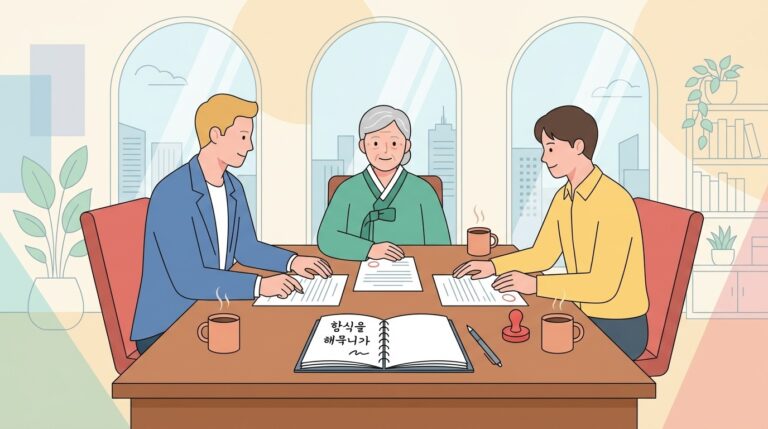
Setting: A modern real estate agency in Mapo, Seoul. You (the buyer) are sitting across from Mr. Kim (the seller) and Ms. Park (the professional licensed realtor).
Characters:
- Mr. Kim (매도인 – Seller): A conservative landlord who wants to sell the house “as-is” without spending extra money.
- Realtor Park (공인중개사 – Realtor): A veteran broker who wants to close the deal smoothly.
Dialogue:
- Realtor Park: “자, 여기 계약서 초안입니다. 특별히 원하시는 특약 사항이 있으신가요?”
(Ja, yeo-gi gye-yak-seo cho-an-im-ni-da. teuk-byeol-hi won-ha-si-neun teug-yak sa-hang-i is-seu-sin-ga-yo?)
“Here is the draft contract. Do you have any specific special terms you’d like to add?” -
You (Buyer): “
🎭 (Assertive yet polite posture, taking a sip of coffee)등기부등본을 보니 채권최고액이 잡혀 있더라고요. 잔금 지급일 전까지 이 근저당은 전부 말소해 주시는 거죠?”
(Deung-gi-bu-deung-bon-eul bo-ni chae-gwon-choe-go-aek-i jap-hyeo it-deo-ra-go-yo. Jan-geum ji-geub-il jeon-kka-ji i geun-jeo-dang-eun jeon-bu mal-so-hae ju-si-neun geo-jyo?)
“Looking at the certified copy of the register, I noticed there is a maximum debt amount registered. You will completely clear this mortgage before the final payment date, correct?” -
Mr. Kim (Seller): “아니, 그건 당연히 잔금 받아서 바로 상환할 건데, 굳이 특약에까지 넣을 필요가 있나요? 서로 믿고 하는 거지.”
(A-ni, geu-geon dang-yeon-hi jan-geum bad-a-seo ba-ro sang-hwan-hal geon-de, gut-i teug-yag-e-kka-ji neo-eul pil-yo-ga is-nae-yo? Seo-ro mit-go ha-neun geo-ji.)
“Well, of course I’ll repay it as soon as I get the balance, but do we really need to put that in the special terms? Can’t we just trust each other?” -
You (Buyer): “
🎭 (Looking Mr. Kim in the eye with a calm smile)사장님 말씀 믿지만, 거액이 오가는 계약인 만큼 절차대로 기재하는 것이 서로에게 안전할 것 같습니다. ‘잔금일 이전까지 피담보채무를 완제하고 근저당권을 말소한다’는 조항을 넣어 주세요.”
(Sa-jang-nim mal-ssem mit-ji-man, geo-aek-i o-ga-neun gye-yak-in man-kum jeol-cha-dae-ro gi-jae-ha-neun geos-i seo-ro-e-ge an-jeon-hal geos gat-seum-ni-da. ‘Jan-geum-il i-jeon-kka-ji pi-dam-bo-chae-mu-reul wan-je-ha-go geun-jeo-dang-gwon-eul mal-so-han-da’-neun jo-hang-eul neo-eo ju-se-yo.)
“I trust you, sir, but since this contract involves a massive sum of money, writing it down according to procedure is safer for both of us. Please include the clause: ‘The seller shall fully repay the secured debt and clear the mortgage before the final payment date.'” -
Realtor Park: “김 사장님, 매수인 말이 맞습니다. 요즘은 이게 기본 포맷이에요. 제가 문구 잘 정리해서 넣어 드릴게요.”
(Gim sa-jang-nim, mae-su-in mal-i mat-seum-ni-da. Yo-jeum-eun i-ge gi-bon po-maet-i-e-yo. Jae-ga mun-gu jal jeong-ri-hae-seo neo-eo deu-ril-ge-yo.)
“Mr. Kim, the buyer is right. This is the standard format these days. I’ll draft the clause nicely and put it in.” -
Mr. Kim (Seller): “그럼 그렇게 해요. 대신, 집이 연식이 좀 있으니까 보일러나 누수 같은 거 나중에 딴소리 없기예요. ‘현 상태 그대로 인도한다’는 문구도 넣어 줘요.”
(Geu-reom geu-reoh-ge hae-yo. Dae-sin, jip-i yeon-sig-i jom is-seu-ni-kka bo-il-leo-na nu-su gat-eun geo na-jung-e ttan-so-ri eob-gi-e-yo. ‘Hyeon sang-tae geu-dae-ro in-do-han-da’-neun mun-gu-do neo-eo jwo-yo.)
“Fine, let’s do that. Instead, since the house is a bit old, no changing words later about things like the boiler or leaks. Put in the phrase ‘Hand over in its current state’ too.” -
You (Buyer): “
🎭 (Politely raising an index finger)‘현 상태 인도’에는 동의하지만, 기본 설비의 중대한 하자는 법적 담보책임 범위 내에서 매도인이 책임지는 것으로 명시하고 싶습니다. 특히 누수 여부는 잔금일로부터 6개월간 보장해 주셔야 합니다.”
( ‘Hyeon sang-tae in-do’-e-neun dong-ui-ha-ji-man, gi-bon seol-bi-ui jung-dae-han ha-ja-neun beop-jeok dam-bo-chaek-im beom-wi nae-e-seo mae-do-in-i chae-gim-ji-neun geos-eu-ro myeong-si-ha-go sip-seum-ni-da. Teuk-hi nu-su yeo-bu-neun jan-geum-il-lo-bu-teo yuk-gae-wol-gan bo-jang-hae ju-syeo-ya ham-ni-da.)
“I agree to the ‘as-is’ handover, but I want to specify that the seller is responsible for major defects in basic facilities within the scope of legal warranty liability. Specifically, leaks must be guaranteed for six months from the final payment date.” -
Realtor Park: “서로 조금씩 양보하셔서 좋은 거래 합시다. 매수인님 요구대로 누수 부분만 6개월 워런티 넣는 걸로 절충안을 쓰겠습니다. 두 분 다 괜찮으시죠?”
(Seo-ro jo-geum-ssik yang-bo-ha-syeo-seo jo-eun geo-rae hap-si-da. Mae-su-in-nim yo-gu-dae-ro nu-su bu-bun-man yuk-gae-wol wo-reon-ti neo-neun geol-lo jeol-chung-an-eul sseu-ges-seum-ni-da. Du bun da gwaen-chan-eu-si-jyo?)
“Let’s compromise a little and make a great deal. I’ll write a compromise clause putting a 6-month warranty only on water leaks, as the buyer requested. Are both of you okay with this?”
🔀 Interactive Choice Point
How would you respond to Realtor Park’s compromise offer?
* Option A: “네, 좋습니다. 누수 보장만 확실히 해주시면 도배나 자잘한 수리는 제가 알아서 하겠습니다.” (Accept the compromise, showing flexibility on minor issues.)
* Feedback (Best): Excellent choice. Showing flexibility on minor cosmetic repairs (like wallpaper/painting) while securing the legally crucial leak warranty builds goodwill and closes the deal securely.
* Option B: “안 됩니다. 보일러뿐만 아니라 모든 전자기기까지 다 6개월 동안 보장해 주셔야 계약하겠습니다.” (Demand full warranty on everything, including appliances.)
* Feedback (Risk): Too aggressive. Demanding warranties on wear-and-tear items in an old house can offend the seller and break down the negotiation entirely.
* Option C: “그럼 그냥 부동산에서 알아서 적당히 문구 써서 넣어 주세요.” (Leave it entirely up to the realtor without checking.)
* Feedback (Bad): Dangerous. Real estate contracts must be explicitly clear. Leaving it “vague” often leads to unfavorable terms for the buyer.
Phase 6: 10-Second Emotion Shadowing Drill
Train your muscle memory and emotional delivery with these high-frequency negotiation lines. Pay attention to the pauses (/) and the emotional markers.
[😊 Firm but respectful tone]
“거액이 오가는 계약인 만큼 / 절차대로 기재하는 것이 / 서로에게 안전할 것 같습니다.”
(Geo-aek-i o-ga-neun gye-yak-in man-kum / jeol-cha-dae-ro gi-jae-ha-neun geos-i / seo-ro-e-ge an-jeon-hal geos gat-seum-ni-da.)
“Since this is a massive transaction / writing it down according to procedure / seems safest for both of us.”-
[🤨 Disappointed but bargaining tone]
“현 상태 인도 조건이라도 / 누수 같은 중대한 하자는 / 매도인이 책임지셔야죠.”
(Hyeon sang-tae in-do jo-geon-i-ra-do / nu-su gat-eun jung-dae-han ha-ja-neun / mae-do-in-i chae-gim-ji-syeo-ya-jyo.)
“Even under the as-is condition / major defects like leaks / must be the seller’s responsibility.”
Phase 7: K-Culture Mini-Dictionary
- 특약 사항 (Teug-yak Sa-hang) | Special Terms/Rider Clauses
- Extra clauses added to the standard real estate contract. In Korea, 특약 always overrides the pre-printed standard terms.
- 등기부등본 (Deung-gi-bu-deung-bon) | Certified Copy of Real Estate Register
- The holy grail document showing who owns the property and if there are any mortgages or liens on it.
- 근저당권 (Geun-jeo-dang-gwon) | Collateral/Mortgage
- A right established by banks over the property when the owner borrows money. It must be cleared upon sale.
- 잔금 (Jan-geum) | Final Payment/Balance
- The last and largest payment made on the moving day, usually representing 70-80% of the property value.
Phase 8: Survivor’s Kit for Foreign Buyers
Survival Phrases TOP 3:
- “등기부등본 실시간으로 발급해 주세요.” (Deung-gi-bu-deung-bon sil-si-gan-eu-ro bal-geup-hae ju-se-yo.)
- Pro Tip: Use this on the day of signing and the day of final payment to make sure no new loans were taken out.
- “영수증 발급해 주시고 계좌이체로 진행하겠습니다.” (Yeong-su-jeung bal-geup-hae ju-si-go gye-jwa-i-che-ro jin-haeng-ha-ges-seum-ni-da.)
- Pro Tip: Never hand over cash. Always do bank transfers (계좌이체) to keep a paper trail.
- “소유권 이전 등기는 법무사를 통해 진행할게요.” (So-yu-gwon i-jeon deung-ghee-neun beop-mu-sa-reul tong-hae jin-haeng-hal-ge-yo.)
- Pro Tip: Hire an independent judicial scrivener (법무사) to handle the deed registration instead of relying solely on the seller’s helper.
🗺️ Editor’s Travel & Living Note:
To check properties and find registered realtors in Seoul, do not use random search engines. Download 공인중개사협회 (Korea Association of Realtors) or utilize the 인터넷등기소 (Internet Registry Office App) to verify the legal status of any building yourself. Note: App structures and national fees may change; always check the official government registry website for the latest updates before transferring funds.
Phase 9: Deep Thoughts (한 발 더 깊이)
In many Western cultures, property transactions are handled almost entirely by lawyers. In South Korea, however, licensed real estate agents (공인중개사) act as mediators, counselors, and social buffers between the buyer and seller. This reflects the Korean value of 정 (Jeong – mutual bond) and 눈치 (Nunchi – social reading). A successful transaction is often as much about building a polite, respectful relationship during the meeting as it is about strict legal compliance.
💬 Your Turn: Have you ever negotiated a contract in Korea or your home country? What was the biggest cultural shock you experienced? Share your stories in the comments below!
Phase 10: FAQ & Common Mistakes
Q: What happens if a leak is discovered 3 months after buying the house, but there was no ‘leak clause’ in the 특약?
A: Under Article 580 of the Korean Civil Act, the seller is still liable for hidden defects (하자담보책임) if the buyer did not know about them at the time of purchase. However, proving this in court can take years. Writing it down in the 특약 saves you the legal hassle.
Q: Can the realtor sign on behalf of the seller?
A: Only if they have an official power of attorney (위임장) stamped with the seller’s registered personal seal certificate (인감증명서). Never sign based on verbal promises from a broker.
Q: How much is the typical broker fee (중개수수료)?
A: It is regulated by municipal laws based on a percentage of the transaction amount. Always ask for a fee calculator receipt (중개보수 요율표) to avoid being overcharged.
🚨 Common Mistakes Alert!
- Mistake 1: Agreeing to pay the 잔금 (balance) before verifying the updated 등기부등본 on the exact morning of the transfer.
- Correct Action: Request a fresh, real-time printout of the register at the realtor’s office right before you click “transfer” on your banking app.
- Mistake 2: Believing the phrase “내가 다 책임질게” (I’ll take responsibility for everything) spoken casually by the seller.
- Correct Action: Politely say, “사장님 말씀을 믿으니 계약서 특약 사항에 그대로 적어 주시면 감사하겠습니다.” (Since I trust you, please write that exact statement in the special terms.)
Phase 11: Action Mission
- 🥉 Bronze Mission: Read the dialogue in Phase 5 out loud twice, focusing on the correct intonation of legal vocabulary.
- 🥈 Silver Mission: Write down a mock 특약 사항 clause for your dream house in Seoul, including a pet policy or a repair request.
- 🥇 Gold Mission: Go onto a Korean real estate app like 직방 (Zigbang) or 다방 (Dabang), find a premium apartment, and practice identifying the “근저당” status in their descriptions.
Phase 12: Interactive Quiz
Test your real estate negotiation instincts!
1. Which of the following is the most professional legal term for “canceling/deleting” a registered mortgage in a contract?
- A) 지우기 (ji-u-gi)
- B) 삭제 (sak-je)
- C) 말소 (mal-so)
Reveal Answer & Explanation
Correct Answer: C) 말소 (mal-so)
While 지우기 means erasing and 삭제 means deletion in general software/text contexts, 말소 is the official legal term used for public registers and real estate deeds in Korea.
2. True or False: If a contract includes “현 상태 이대로 인도한다” (hand over as-is), the seller has absolutely zero liability for any leaks discovered after purchase.
Reveal Answer & Explanation
Correct Answer: False
Even with an







