

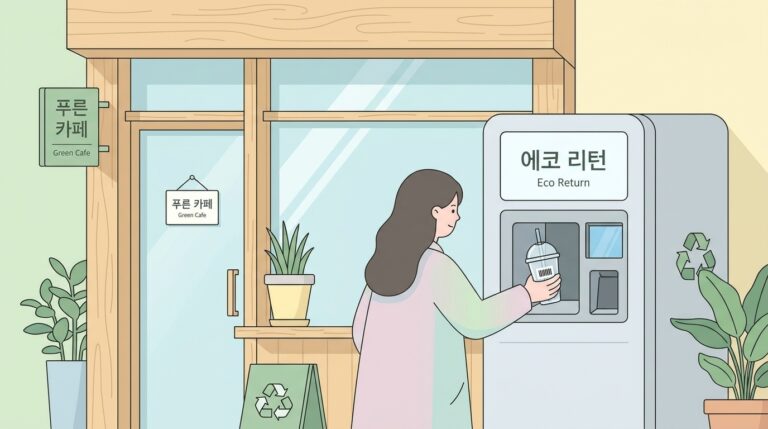
Navigating Korea’s Eco-Friendly Cafe Chaos: The Disposable Cup Deposit System
Phase 1: Empathy (스토리 몰입형 오프닝)
안녕하세요! Your Korean best friend and editor at Daily Hangul (매일한글) is back!
Imagine this: You walk into a sleek, minimalist cafe in Jeju Island or Sejong City. The aroma of freshly roasted espresso fills the air. You confidently approach the counter and order an Iced Americano to go. But instead of the usual quick payment, the barista hesitates, looks at you with a mix of politeness and subtle anxiety, and starts explaining a complex system involving a 300-won deposit (보증금), a special barcode app, and returning the cup to get your money back.
You stand there, frozen. You understand the words, but the sheer logistical chaos of returning a cup just to get 300 won back leaves you bewildered.
This isn’t just a language barrier; it’s a real-world policy shift that has sparked massive debates across South Korea—the Disposable Cup Deposit System (일회용 컵 보증금제). Don’t worry! Today, we are going to dive deep into the sophisticated vocabulary and nuanced cultural contexts you need to navigate this specific “cafe chaos” like a true C2-level native speaker. Let’s master the art of eco-friendly Korean café talk!
Phase 2: Deep Dive into 3 Essential Expressions (핵심 표현 3선 심층 분석)
1. 제도적으로 정착되다 (Je-do-jeok-eu-ro jeong-chak-doe-da)
- Pronunciation: Jeh-doh-jeok-euh-roh jeong-chahk-deh-dah (Rhymes with “say-dough-juck” + “jung-chock”)
- Meaning: To become institutionally established / rooted in system.
- K-Culture Moment: You will hear this expression on JTBC news panels or read it in editorials discussing the efficacy of South Korea’s environmental policies.
- Editor’s Insight: This is a high-level (C2) phrase used when discussing social systems, laws, or corporate policies that are trying to find their footing in everyday life. Use this to sound intellectual when discussing green policies with Korean friends.
- Situation Spectrum: Casual 🚫 | Semi-formal ⚠️ | Formal ✅
- 🤔 Think About It: How does your home country enforce recycling? Is it more peer-pressure-based (social) or policy-driven (institutional)?
2. 혼선을 빚다 (Hon-seon-eul bit-da)
- Pronunciation: Hohn-seon-eul beet-dah (Think of “home-sun” + “bead-ah”)
- Meaning: To cause confusion / create a mix-up / experience friction.
- K-Culture Moment: Often used in K-Dramas featuring corporate PR crises or public sector workers trying to manage sudden policy shifts.
- Editor’s Insight: This beautiful idiomatic expression literally translates to “weaving tangled wires.” It perfectly describes the operational friction cafes face when customers don’t understand the new cup recycling laws.
- Situation Spectrum: Casual ⚠️ | Semi-formal ✅ | Formal ✅
- 🤔 Think About It: When policies change overnight, who bears the burden of the “confusion”—the business owners or the consumers?
3. 보증금을 환급받다 (Bo-jeung-geum-eul hwan-geup-bat-da)
- Pronunciation: Boh-jeung-geum-eul hwahn-geup-baht-dah (Sounds like “bow-jung-gum” + “hwan-goop-baht”)
- Meaning: To get a deposit refunded.
- K-Culture Moment: When you see a young Korean scanning a QR code on a cup return machine in a convenience store or cafe lobby.
- Editor’s Insight: While casual speakers might say “돈 돌려받다” (get money back), using “환급받다” (refund/rebate) shows a sophisticated grasp of financial and administrative vocabulary.
- Situation Spectrum: Casual ⚠️ | Semi-formal ✅ | Formal ✅
- 🤔 Think About It: Why does Korea prefer digital app-based refunds over immediate cash back? (Hint: Korea is almost entirely cashless!)
Phase 3: Textbook Korean vs. Real-World Korean (교과서 한국어 vs 진짜 한국어)
Let’s compare stiff, textbook-style Korean with natural, C2-level expressions that show you truly understand the social climate.
Situation 1: Expressing that the cup deposit policy is too complicated.
- 📖 Textbook Style: “일회용 컵 보증금 제도는 너무 복잡해서 이해하기 어렵습니다.”
(The disposable cup deposit system is too complex, so it is difficult to understand.) - 🗣️ Real-World Style: “취지는 좋은데, 일일이 바코드 찍고 반납하려니 여간 번거로운 게 아니에요.”
(The intention is good, but having to scan barcodes and return them one by one is incredibly tedious/bothersome.) - 💡 Why the difference? C2 speakers use the grammatical structure “여간 ~게 아니다” (it is no ordinary [adjective], meaning it is extremely so) to show polite frustration while acknowledging the good intentions (“취지는 좋은데”) of the environmental law.
Situation 2: Explaining the confusion at the cafe register.
- 📖 Textbook Style: “손님들이 제도를 몰라서 가게가 혼란스럽습니다.”
(Customers do not know the system, so the store is confused.) - 🗣️ Real-World Style: “현장에서는 가이드라인이 명확하지 않아 상인들과 소비자들 사이에 혼선이 가중되고 있어요.”
(On the ground, because guidelines aren’t clear, confusion is intensifying between merchants and consumers.) - 💡 Why the difference? “현장” (on the ground/the actual site) and “혼선이 가중되다” (confusion is escalating) are highly sophisticated, news-level vocabulary choices that elevate your speaking style instantly.
Phase 4: K-Culture Deep Dive & Non-verbal Manners (K-Culture 딥다이브 & 비언어적 매너)
4-1. The Art of “Nunchi” (눈치) at the Register
When the barista explains the 300-won deposit, do not panic or hold up the line. Koreans value speed (Palli-Palli, 빨리빨리). If there is a line behind you, the best non-verbal gesture is a polite nod of understanding while holding up your phone to indicate you will pay with a card. If you are confused, step slightly to the side to scan the QR code rather than blocking the register.
4-2. The Cultural Conflict of Eco-Policies
Korea is renowned for its rapid adoption of technology and green initiatives (like meticulous food waste recycling). However, the Disposable Cup Deposit System has faced pushback from local cafe owners who feel they are bearing the administrative burden. In K-Dramas, you might see small business owners complaining about “탁상행정” (tak-sang-haeng-jeong), which means “tabletop administration” or impractical desk-bound policies designed by politicians who don’t know the real-world struggle.
Phase 5: Interactive Roleplay Scenario (실전 롤플레이 시나리오)
Setting: A busy, trendy local cafe in Sejong City.
Characters:
* 민우 (Min-woo): An overworked barista who is tired of explaining the deposit system to angry customers.
* 지민 (Ji-min): You, a sophisticated C2-level foreign resident who wants to be eco-friendly but finds the process a bit overwhelming.
- 민우: 🎭 (Apologetically, pointing to the sign) 손님, 저희 매장은 일회용 컵 보증금제 시범 운영 매장이라 음료 값에 300원이 추가되는데 괜찮으실까요?
- 지민: 🎭 (Nodding understandingly) 아, 그 보증금제요? 뉴스에서 보긴 했는데, 구체적으로 어떻게 돌려받는 건가요?
- 민우: 🎭 (Relieved that you aren’t angry) 테이크아웃 하신 후에, 전용 앱으로 컵에 붙은 바코드를 스캔하시고 매장 반납기에 넣어주시면 보증금이 즉시 환급됩니다.
- 지민: 🎭 (Frowning slightly but smiling) 아, 앱을 따로 설치해야 하는군요. 환경을 생각하면 좋은 제도인데, 매번 이렇게 하려면 현장에서도 혼선이 꽤 많겠어요.
- 민우: 🎭 (Sighing softly, leaning in) 맞아요. 특히 바쁜 시간대에는 손님들 대기 시간도 길어지고, 기계 오류라도 나면 정말 진땀이 납니다.
- 지민: 🎭 (Empathetic tone) 자영업자분들 노고가 많으시겠네요. 혹시 매장 내에서 유리잔으로 마시고 가면 보증금은 안 내도 되는 거죠?
- 민우: 🎭 (Brightening up) 네, 맞습니다! 매장 컵을 이용해 주시면 보증금은 부과되지 않습니다.
- 지민: 🎭 (Handing over the card) 그럼 머그잔에 담아주세요. 매장에서 조금 마시다 가겠습니다.
🔀 Your Turn: Choose Your Path!
How would you respond if the refund machine suddenly broke down?
* Option A: “이거 안 되는데 그냥 300원 현금으로 거슬러 주시면 안 돼요?” (Can’t you just give me 300 won back in cash since this isn’t working?)
* Feedback (Risk): Pragmatic, but might violate store policy if their POS system is digitally tied to the app. Might fluster the barista.
* Option B: “기계가 작동을 안 하네요. 제가 사용법을 잘 몰라서 그런 걸까요? 한번 봐주시겠어요?” (The machine isn’t working. Is it because I don’t know how to use it? Could you take a look?)
* Feedback (Best): Extremely polite and cooperative. Shifts the blame away from the barista while asking for assistance.
* Option C: “그냥 300원 안 받을게요. 바쁘니까 그냥 갈게요.” (I just won’t take the 300 won. I’m busy so I’ll just go.)
* Feedback (Bad): Leaves the plastic cup behind and defeats the purpose of the recycling initiative. Shows frustration.
Phase 6: 10-Second Emotion Shadowing Drill (10초 감정 섀도잉 드릴)
Practice these natural pauses (/) and emotional intonations to sound incredibly native!
- [🥺 Empathetic & Concerned]
- “취지는 참 좋은데, / 자영업자분들이 감당하기에는 / 현실적인 번거로움이 / 여간 큰 게 아니네요.”
- Chwi-ji-neun cham jo-eun-de, / ja-yeong-eop-ja-bun-deul-i gam-dang-ha-gi-e-neun / hyeon-sil-jeok-in beon-geo-ro-um-i / yeo-gan keun ge a-ni-ne-yo.
- [😊 Rational & Softly Complaining]
- “매번 앱으로 바코드 찍고 / 반납하려니까 / 솔직히 번거롭기는 하더라고요.”
- Mae-beon aep-eu-ro ba-ko-deu jjik-go / ban-nap-ha-ryeo-ni-kka / sol-jik-hi beon-geo-rop-gi-neun ha-deo-ra-go-yo.
Phase 7: K-Culture Mini Dictionary (K-Culture 미니 사전)
- 자영업자 (Ja-yeong-eop-ja) | Self-employed / Small Business Owner
- Often referred to as the backbone of Korea’s service industry. Their struggles with government regulations are a frequent topic in daily social discussions.
- 탁상행정 (Tak-sang-haeng-jeong) | Bureaucratic Red Tape / Tabletop Administration
- A critical term used when government officials design policies in their offices without understanding actual fieldwork realities.
- 일회용품 규제 (Il-hoe-yong-pum gyu-je) | Single-use Plastics Regulations
- Laws aimed at reducing plastic waste, which are highly active in Korean cafes, such as banning plastic straws and cups for dine-in customers.
- 진땀을 빼다 (Jin-ttam-eul ppae-da) | To break into a cold sweat / sweat bullets
- An idiom used to describe when someone is put in an extremely difficult, awkward, or stressful situation.
Phase 8: Traveler’s Survival Kit (여행자를 위한 생존 키트)
Survival Expressions for Eco-Conscious Travelers
- “텀블러 할인 되나요?” (Teom-beul-ler hal-in doe-na-yo?)
- Pro Tip: Many Korean cafes offer a 100 to 500-won discount if you bring your own tumbler!
- “먹고 갈 건데, 남으면 테이크아웃 잔에 옮겨 주실 수 있나요?” (Meok-go gal geon-de, nam-eu-myeon te-i-keu-a-ut jan-e olg-yeo ju-sil su in-na-yo?)
- Pro Tip: By law, cafes cannot give you plastic cups if you start drinking inside. Use this phrase if you plan to sit for a bit then leave.
- “보증금 반납 기계는 어디에 있어요?” (Bo-jeung-geum ban-nap gi-gye-neun eo-di-e is-seo-yo?)
- Pro Tip: Use this to ask where the automatic cup return machine is located.
📌 Editor’s Travel Note: To easily return cups and claim your refunds, we highly recommend downloading the “자원순환보증금 (COSMO)” app from the Google Play Store or Apple App Store. It manages your barcode deposits smoothly!
(Note: App policies and availability are subject to change based on local government regulations.)
Phase 9: “Going Deeper” Humanities Essay (한 발 더 깊이)
Korea’s rapid transition toward zero-plastic policies reflects a unique cultural phenomenon: the push for collective civic duty versus economic pragmatism. On one hand, Koreans take immense pride in being global leaders in recycling. On the other hand, the friction caused by the disposable cup deposit system highlights the tension between top-down government mandates and the daily struggles of local cafe owners (자영업자). It raises the philosophical question: Should environmental sustainability be enforced through individual financial penalties, or through structural changes in manufacturing?
💬 Your Turn: What do you think about Korea’s cup deposit system? Leave a comment below with your thoughts using the phrase “취지는 좋으나…” (The intention is good, but…)!
Phase 10: FAQ & Avoiding Misunderstandings (FAQ & 오해 방지)
Q: Does the cup deposit system apply to all cafes in Korea?
A: No, currently it is being pilot-tested primarily in specific regions like Jeju Island and Sejong City, and mostly applies to franchise cafes with more than 100 outlets.
Q: Can I return a cup from Cafe A to Cafe B?
A: Yes, under the unified system, you can return standard deposit cups to any participating franchise brand’s cup return machine.
Q: Do I have to pay the deposit if I order via a delivery app?
A: Yes, if the shop is a participating store, the 300-won deposit will be automatically added to your delivery receipt.
🚨 Common Mistakes Warning Board
- Mistake 1: Demanding cash refunds from the cashier.
- Correct Action: Use the designated COSMO app or the automated machine at the storefront.
- Mistake 2: Trying to return heavily soiled cups filled with liquid or trash.
- Correct Action: Empty and lightly rinse the cup before inserting it into the return kiosk.
- Mistake 3: Assuming all cups have a deposit.
- Correct Action: Only cups with the official yellow circular “보증금” sticker or printed barcode are eligible for the 300-won refund.
Phase 11: Action Mission & Participation (액션 미션)
- Bronze Mission 🥉: Practice the Phase 6 shadowing drill in front of a mirror until you can say “여간 번거로운 게 아니에요” naturally without stuttering.
- Silver Mission 🥈: Next time you go to a local Korean-style cafe in your city, ask if they offer discounts for bringing your own tumbler using “텀블러 할인 되나요?“.
- Gold Mission 🥇: Record a short video or audio of yourself explaining your country’s recycling system using high-level vocabulary like 제도적으로 정착되다 and share it with us!
🎮 K-Culture Search Mission: Watch a recent Korean vlog or news segment about “일회용 컵 보증금제” on YouTube and count how many times they say “혼선” (confusion) or “번거롭다” (bothersome).
Phase 12: Interactive Quiz Challenge (인터랙티브 퀴즈 챌린지)
1. Contextual Judgment
Which expression is most natural when you want to politely complain about the inconvenience of a new government app to a friend?
* A) 이 앱은 아주 나쁩니다.
* B) 취지는 좋은데, 막상 쓰려니까 여간 번거로운 게 아니에요.
* C) 혼선을 빚어서 화가 납니다.
👉 Click to see the Answer & Explanation
Correct Answer: B
Explanation: Option B is a perfect C2-level expression. It acknowledges the good intent (취지는 좋은데) but uses natural grammar (여간 ~게 아니에요) to express genuine, polite frustration. Option A is too simplistic, and Option C is grammatically awkward for natural conversation.
2. Fill in the Blank
“갑작스러운 정책 변화로 인해 매장 계산대에서는 큰
( )을/를 빚고 있습니다.”
* Hint: The word means “confusion/tangled wires.”
👉 Click to see the Answer & Explanation
Correct Answer: 혼선 (Hon-seon)
Explanation: The full sentence translates to: “Due to the sudden policy change, great confusion is occurring at the store register.”






