

Navigating Korean Pharmacies: How to Get the Right Medicine Without a Doctor’s Note (B2 Level Guide)
Phase 1: Empathy (The K-Drama Pharmacy Dilemma)
안녕하세요! It’s your friendly neighborhood Korean editor and cultural navigator from “Daily Hangul” (매일한글)! 🌸
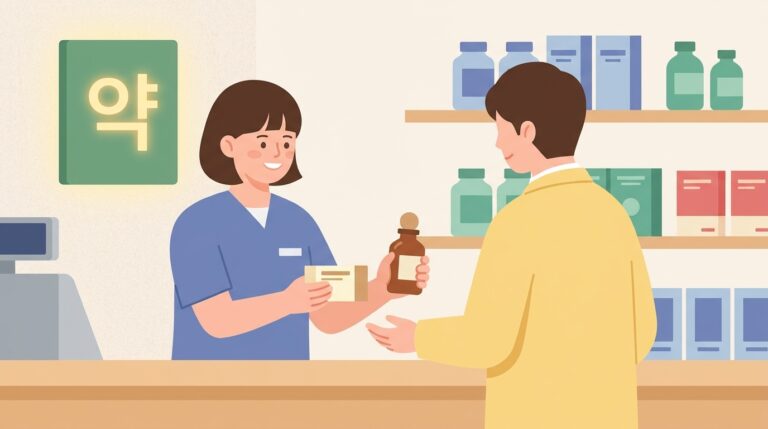
Imagine this: You’re walking around Hongdae, enjoying the vibrant buskers and delicious street food. Suddenly, a throbbing headache strikes. Or maybe that spicy tteokbokki is starting to rebel in your stomach. You see the familiar green glowing sign of a 약 (yak / pharmacy). You walk in confidently, but as you look at the counter, your mind goes blank.
“Can I just ask for Ibuprofen directly? Do I need a prescription for this? What’s the Korean word for a mild painkiller vs. something stronger?”
If you’ve watched K-dramas, you’ve probably seen a character running to a 24-hour pharmacy late at night to buy medicine for a feverish partner. But in reality, navigating a Korean pharmacy (약국 – yak-guk) involves understanding the strict line between 일반 의약품 (Over-The-Counter/OTC drugs) and 전문 의약품 (Prescription-only drugs). Today, we will master the essential phrases, the “nunchi” (social intuition) needed at the counter, and how to get exactly what you need without feeling awkward. Let’s dive in!
Phase 2: Deep-Dive into 3 Essential Expressions
Let’s break down three critical phrases you’ll need when discussing OTC vs. prescription meds with a Korean pharmacist (약사 – yak-sa).
1. 처방전 없이 살 수 있는 약 있나요? (Cheo-bang-jeon eop-si sal su in-neun yak in-na-yo?)
- Pronunciation: Chuh-bang-jeon up-shee sal soo een-noon yak een-nah-yo? (Sounds like “chuh-bang” + “jun” without “sal” + “su” in the “yak”)
- Meaning: “Is there medicine I can buy without a prescription?” (Looking for OTC medicine/일반 의약품)
- K-Culture Moment: In slice-of-life K-dramas, you often see characters going to the pharmacy to get a quick patch for muscular pain (파스 – pa-seu) or digestive medicine (소화제 – so-hwa-je) without showing any paperwork. This is the exact phrase they use.
- Editor’s Insight: 처방전 (cheo-bang-jeon) means “prescription.” Adding 없이 (eop-si) means “without.” If you ask for a specific drug name (like “Amoxicillin”), the pharmacist will shake their head and say “처방전 있어야 돼요” (You must have a prescription). Use this phrase to ask for a safe, non-prescription alternative.
- Situation Spectrum: Casual (⚠️ – too formal for close friends, but okay) / Semi-formal (✅ – Perfect for the pharmacist) / Formal (✅)
- 🤔 Think About It: In many Western countries, you can grab painkillers from open shelves in a supermarket. In Korea, even OTC medicines are usually kept behind the counter, requiring a brief consultation with the pharmacist. Why do you think Korean culture prefers this face-to-face interaction for medicine?
2. 처방전이 있어야 살 수 있어요. (Cheo-bang-jeon-i is-seo-ya sal su is-seo-yo.)
- Pronunciation: Chuh-bang-jeon-ee ee-suh-ya sal soo ee-suh-yo.
- Meaning: “You can only buy this with a prescription.” (This is what the pharmacist will say to you!)
- K-Culture Moment: When a character tries to buy strong sleeping pills or antibiotics because they are stressed out, the strict pharmacist always points to the sign and delivers this line firmly but politely.
- Editor’s Insight: This uses the grammar structure -어야/아야 살 수 있다 (-eoya/aya sal su it-da), which means “must [do something] in order to be able to buy.” If you hear this, you cannot negotiate! You will need to visit a 내과 (internal medicine clinic) or 소아과 (pediatrics/general clinic) first.
- Situation Spectrum: Casual (🚫) / Semi-formal (✅) / Formal (✅)
3. 센 걸로 주세요 / 순한 걸로 주세요. (Sen geol-ro ju-se-yo / Sun-han geol-ro ju-se-yo.)
- Pronunciation: Sen gul-lo joo-seh-yo / Soon-han gul-lo joo-seh-yo.
- Meaning: “Please give me a strong one” / “Please give me a mild one.”
- K-Culture Moment: After a long night of drinking or working overtime (야근 – ya-geun), characters often ask for a 센 것 (strong option) to cure their headache instantly before a big meeting.
- Editor’s Insight: 세다 (se-da) means strong, and 순하다 (sun-ha-da) means mild/gentle (often used for stomach medicine or medicine for children). Expressing your preferred intensity helps the pharmacist pick the right OTC brand for you.
- Situation Spectrum: Casual (⚠️) / Semi-formal (✅) / Formal (✅)
Phase 3: Textbook Korean vs. Real-Life Korean
Let’s compare stiff textbook phrases with what Koreans actually say in a pharmacy.
Situation 1: Asking for cold medicine
- 📖 Textbook Korean: “종합 감기약을 원합니다.” (Jong-hap gam-gi-yak-eul won-ham-ni-da.) – “I want comprehensive cold medicine.” (Very robotic; sounds like a translation software.)
- 🗣️ Real-Life Korean: “종합 감기약 하나 주세요.” (Jong-hap gam-gi-yak ha-na ju-se-yo.) or “목감기 기운이 있는데, 먹을 만한 약 있을까요?” (Mok-gam-gi gi-un-i in-neun-de, meog-eul man-han yak is-seul-kka-yo?) – “I have a scratchy throat (cold symptoms), is there some good medicine for this?”
- 💡 Why the difference? Koreans prefer describing the symptoms (기운이 있다 – to have a touch of/symptoms of) rather than demanding a specific product class. It invites the pharmacist to recommend the best option.
Situation 2: Asking for a band-aid/ointment
- 📖 Textbook Korean: “상처에 바르는 연고와 일회용 밴드를 구매하겠습니다.” (Sang-cheo-e ba-reu-neun yeon-go-wa il-hoe-yong baen-deu-reul gu-mae-ha-ges-seum-ni-da.) – “I will purchase ointment applied to wounds and disposable bandages.”
- 🗣️ Real-Life Korean: “마데카솔(또는 후시딘)이랑 대일밴드 좀 주세요.” (Madekasol-i-rang Dae-il-baen-deu jom ju-se-yo.) – “Please give me Madecassol (or Fucidin) and some band-aids.”
- 💡 Why the difference? Koreans use brand names as generic terms. 대일밴드 (Dae-il band) is the household name for band-aids, and 마데카솔 (Madecassol) / 후시딘 (Fucidin) are the two legendary wound healing ointments found in every Korean home.
Phase 4: K-Culture Deep-Dive & Non-Verbal Manners
4-1. Nunchi & Gestures: Respecting the Counter
- Two-handed Receipt: When receiving your medicine and card back, always take them with both hands (or with your left hand supporting your right forearm). It’s a sign of respect, especially since pharmacists are highly respected medical professionals in Korea.
- Pointing to the Pain: If you don’t know the exact anatomical word, touch the area (stomach, temple, throat) while making a slightly painful facial expression. Koreans are highly empathetic to physical discomfort and will immediately understand.
4-2. Cultural Code: The “Pari-Pari” (Fast-Fast) Recovery Culture
Korea’s medicine culture is highly optimized for quick recovery. If you get a prescription, the pharmacy will often package your pills in tiny, individual plastic pouches labeled 아침 (morning), 점심 (lunch), and 저녁 (dinner). You swallow the entire pouch’s contents at once. This ensures high compliance because Koreans want to get well immediately and return to their busy lives!
Phase 5: Real-Life Roleplay Scenario
Setting: A neat local pharmacy near Mapo Station. Pharmacist Mr. Kim (helpful but busy) is behind the counter. Alex (B2 level learner) walks in clutching his stomach.
- Mr. Kim: 어서 오세요. 어디가 불편하세요?
(Eo-seo o-se-yo. Eo-di-ga bul-pyeon-ha-se-yo?)
🎭 Politely looks up, adjusting his glasses.
“Welcome. Where does it feel uncomfortable?” -
Alex: 아, 어제부터 체한 것 같아서요. 속이 계속 더부룩해요.
(Ah, eo-je-bu-teo che-han geot gat-ah-seo-yo. Sok-i gye-sok deo-bu-ruk-hae-yo.)
🎭 Holds his stomach with a grimace.
“Ah, I think I have indigestion since yesterday. My stomach feels bloated and heavy.” -
Mr. Kim: 아, 체하셨군요. 열은 안 나세요? 혹시 두통도 있으신가요?
(Ah, che-ha-syeot-gun-yo. Yeol-eun an na-se-yo? Hok-si du-tong-do is-seu-sin-ga-yo?)
🎭 Leans forward with a concerned look.
“Ah, indigestion. Do you have a fever? By any chance, do you have a headache too?” -
Alex: 머리도 약간 띵해요. 처방전 없이 먹을 수 있는 잘 듣는 약 있을까요?
(Meo-ri-do yak-gan tting-hae-yo. Cheo-bang-jeon eop-si meog-eul su in-neun jal deut-neun yak is-seul-kka-yo?)
“My head is a bit heavy/dizzy too. Is there an effective medicine I can take without a prescription?” -
Mr. Kim: 그럼 이 소화제랑 알약 같이 드세요. 마시는 소화제도 하나 드릴게요. 같이 드시면 훨씬 빨라요.
(Geu-reom i so-hwa-je-rang al-yak gat-i deu-se-yo. Ma-si-neun so-hwa-je-do ha-na deu-ril-ge-yo. Gat-i deu-si-myeon hwol-ssin ppal-la-yo.)
🎭 Places a small box of pills and a brown glass bottle on the counter.
“Then take this digestive pill together with this capsule. I’ll also give you a liquid digestive drink. Taking them together is much faster.” -
Alex: 아, 다행이네요. 이거 하루에 몇 번 먹어야 돼요?
(Ah, da-haeng-i-ne-yo. I-geo ha-ru-e myeot beon meog-eo-ya dwae-yo?)
“Ah, what a relief. How many times a day should I take this?” -
Mr. Kim: 식사 후에 한 알씩, 하루 세 번 드세요. 마시는 건 지금 바로 드시고요.
(Sik-sa hu-e han al-ssik, ha-ru se beon deu-se-yo. Ma-si-neun geon ji-geum ba-ro deu-si-go-yo.)
🎭 Taps the liquid bottle pointing to the cap.
“Take one pill after meals, three times a day. Drink the liquid one right now.” -
Alex: 네, 알겠습니다. 얼마예요?
(Ne, al-get-seum-ni-da. Eol-ma-yeo-yo?)
🎭 Pulls out his card with both hands.
“Yes, I understand. How much is it?”
🔀 Interactive Choice Point
What should Alex say next to ensure he gets the receipts for his insurance later?
- A. “영수증은 버려주세요.” (Yeong-su-jeung-eun beo-ryeo-ju-se-yo.)
- B. “실비 청구하게 영수증 좀 챙겨주세요.” (Sil-bi cheong-gu-ha-ge yeong-su-jeung jom chaeng-gyeo-ju-se-yo.)
- C. “처방전 여기 있어요.” (Cheo-bang-jeon yeo-gi is-seo-yo.)
Feedback:
- Selection A (Bad): You just asked him to throw away the receipt! If you have travel or local expat insurance, you’ll need this receipt to get your money back.
- Selection B (Best!): “Please give me the receipt so I can claim my actual-expense insurance (실비).” This is highly natural, B2-level phrasing that will make the pharmacist look at you with deep respect!
- Selection C (Risk): You don’t have a prescription for OTC drugs, so presenting a non-existent prescription will confuse the pharmacist.
Phase 6: 10-Second Emotion Shadowing Drill
To sound like a native, you must practice the emotional flow of the sentence. Try speaking these out loud with the marked pauses (/) and emotional cues:
[🥺 In pain and desperate]
“머리가 / 너무 아픈데 / 잘 듣는 약 / 있어요?”
(Meo-ri-ga / neo-mu a-peun-de / jal deut-neun yak / is-seo-yo?)
My head hurts so much… is there an effective medicine?-
[😊 Relieved and thankful]
“아, / 처방전 / 없어도 / 살 수 있군요! / 감사합니다!”
(Ah, / cheo-bang-jeon / eop-seo-do / sal su in-gun-yo! / Gam-sa-ham-ni-da!)
Ah, so I can buy it even without a prescription! Thank you!
Phase 7: K-Culture Mini-Dictionary
- 해열제 (Hae-yeol-je) | Antipyretic (Fever Reducer)
- Literally means “heat-solving medicine.” Used commonly when children run a high fever.
- 소화제 (So-hwa-je) | Digestive Medicine
- In Korea, instead of Tums, people drink liquid herbal medicine like Gas Hwal-myeong-su (가스활명수). It works incredibly fast!
- 파스 (Pa-seu) | Medicated Patch / Pain Relief Patch
- Derived from the German word “Plaster.” If you have muscle pain after a long hike up Bukhansan, ask for this.
- 연고 (Yeon-go) | Ointment
- Used for skin abrasions and small cuts.
Phase 8: Survivor’s Kit for Travelers
Survival Phrases TOP 3
- “타이레놀 있어요?” (Tai-re-nol is-seo-yo?)
- Pro Tip: If you can’t remember any Korean medical words, simply ask for “Tylenol.” It is universally sold in Korean pharmacies and even convenience stores.
- “약 먹고 졸릴까요?” (Yak meog-go jol-lil-kka-yo?)
- Pro Tip: Use this to ask if the cold medicine will make you drowsy, especially if you have travel plans during the day.
- “이거 빈속에 먹어도 돼요?” (I-geo bin-sok-e meog-eo-do dwae-yo?)
- Pro Tip: “Can I take this on an empty stomach?” essential for painkillers.
Editor’s Travel Note
- Convenience Store Medicine: Since 2012, basic OTC drugs like Tylenol, pediatric fever reducers, and digestive tablets can be purchased at 24-hour convenience stores (편의점). However, selection is very limited. Use Kakao Maps or Naver Map to search for “약국” (Yakguk) for a wider range of medications.
- Disclaimer: Pharmacies generally open from 9:00 AM to 7:00 PM, but some “late-night pharmacies” (공공심야약국) operate until midnight or 24/7 in major districts.
Phase 9: “Going Deeper” (Cultural Reflection)
In Korea, medicine is intimately tied to the concept of 정 (Jeong / Affection). If you tell a Korean friend you are sick, they won’t just say “get well soon.” They will likely send you a KakaoTalk gift coupon for a warm bowl of 죽 (Juk / Rice porridge) and ask, “Have you eaten? You must eat before taking your medicine.” Taking medicine on an empty stomach is considered a cardinal sin in Korean self-care culture, showing how food and health are deeply intertwined.
💬 Your Turn: Does your country have a similar habit of checking if someone has eaten before they take pills? Tell us in the comments below!
Phase 10: FAQ & Common Mistakes
Q: Can I buy birth control pills without a prescription in Korea?
A: Yes! Emergency contraceptive pills (morning-after pills) require a prescription (전문 의약품), but regular daily contraceptive pills (피임약) can be purchased over the counter (일반 의약품) directly from the pharmacist.
Q: Can I buy antibiotics directly at a Korean pharmacy?
A: No. Antibiotics are strictly classified as 전문 의약품 (prescription-only) to prevent drug resistance. You must visit a clinic first to get a prescription.
Q: What is the difference between a Pharmacy (약국) and a Drugstore (like Olive Young)?
A: Unlike Western drugstores, Korean stores like Olive Young or LOHBs do not sell actual medicine (not even Tylenol). They only sell cosmetics, supplements, and beauty products. For real medicine, you must look for the 약 sign.
🚨 Common Mistakes Alert
- Mistake: Asking the convenience store clerk for prescription medicine.
- Correct Action: Convenience stores only sell 13 basic OTC items. Go to a licensed pharmacy (약국) for specific needs.
- Mistake: Saying “감기약 주세요” when you specifically have a dry throat.
- Correct Action: Say “목감기약 주세요” (Throat cold medicine) or “코감기약 주세요” (Runny nose cold medicine) to avoid getting heavy, drowsiness-inducing general pills.
Phase 11: Action Mission
- 🥉 Bronze Mission: Practice reading the Phase 6 Shadowing Drill sentences three times in front of the mirror.
- 🥈 Silver Mission: Next time you go to a convenience store or pass by a pharmacy, try to spot where the 타이레놀 (Tylenol) or 대일밴드 (Band-aids) are kept.
- 🥇 Gold Mission: Watch a K-drama medical scene and write down in the comments if you hear them saying “처방전” (prescription) or “소화제” (digestive medicine)!
Phase 12: Interactive Quiz Challenge
Test your B2-level pharmacy Korean!
1. Situation Quiz
You have a severe headache and want a fast-acting, strong painkiller. What do you say to the pharmacist?
* A) 순한 해열제 주세요.
* B) 머리 아픈데 센 약으로 주세요.
* C) 처방전 여기 있습니다.
Click to view the Answer & Explanation
Correct Answer: B
Explanation: “머리 아픈데” (My head hurts, and…) followed by “센 약으로 주세요” (Please give me strong medicine) is the perfect combination. Option A is for a mild fever reducer, and Option C is for when you have a prescription sheet.
2. True or False
In Korea, you can buy antibiotics at any local pharmacy without seeing a doctor first.
* True / False
Click to view the Answer & Explanation
Correct Answer: False
Explanation: Antibiotics are 전문 의약품 (Prescription-only medicines). You must visit a doctor to get a prescription before a pharmacy can dispense them to you.







