

Master PC Bang Korean: How to Game Like a Local with Your Friends
Phase 1: Empathy (Welcome to the Ultimate PC Bang Experience!)
안녕하세요! (Annyeonghaseyo!) I’m your senior editor and local culture navigator at Daily Hangul.
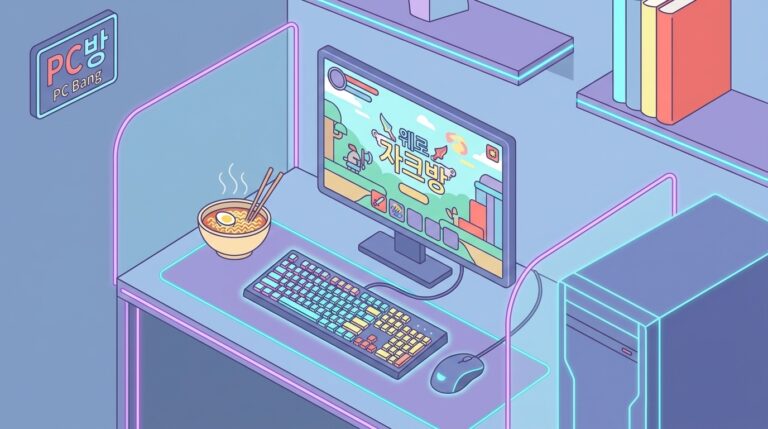
Imagine this: You step into a dimly lit, neon-glowing Korean PC Bang (PC방). The air is filled with the click-clack of mechanical keyboards, the savory aroma of instant ramen, and the passionate shouts of gamers playing League of Legends (LoL). You sit next to your Korean friends, put on your headset, and open Discord. But suddenly, a wave of anxiety hits you.
“How do I tell my friend to watch my back?” “What do they mean by ‘Ggong’ or ‘Noba’?”
If you only rely on textbook Korean, you’ll find yourself completely lost in the fast-paced world of Korean gaming culture. Today, we’re going to dive into the real, living slang and essential phrases used in Korean PC Bangs. This guide is based on real feedback from international students who successfully integrated into local gaming squads. By the end of this post, you’ll be able to queue up, coordinate plays, and celebrate victories like a true Seoul local!
Phase 2: Deep Dive into 3 Essential Gaming Expressions
1. 한 판 더 하자! (Han pan deo haja!)
- Pronunciation: Hahn-pahn-duh-hah-jah! (Sounds like “Han” as in Han Solo, “pan” like frying pan, and “deh-ha-ja”)
- Meaning: Let’s play one more round! (Literally: “One board/round more let’s do!”)
- K-Culture Moment: This is the ultimate “trap” phrase in Korean youth culture. In K-Dramas featuring college life, characters say they will play “just one more game” at 11 PM, only to walk out of the PC Bang as the sun rises.
- Editor’s Insight: The word 판 (pan) refers to a single round of a game or match. In Korea’s fast-paced society, leaving after just one game is almost a crime. Saying this shows your passion and commitment to the squad.
- Situation Spectrum: Casual (✅) / Semi-formal (⚠️ – only with close colleagues) / Formal (🚫)
- 🤔 Think About It: In your home country, do gamers have a specific phrase to coax friends into “just one more game,” or do you simply press “Rematch” in silence?
2. 아, 까비! (Ah, kka-bi!)
- Pronunciation: Ah, kkah-bee! (Rhymes with “hobby” but with a sharp ‘k’ sound)
- Meaning: Ah, so close! / Almost had it! (Shortened from 아깝다 A-kkap-da, meaning “What a waste” or “Too bad”)
- K-Culture Moment: You often hear this high-pitched sigh from Korean streamers on Twitch or YouTube when their champion misses a skill shot by a millimeter.
- Editor’s Insight: Gaming is highly competitive in Korea, but “까비” softens the blow of a mistake. It’s an empathetic way to comfort a teammate while acknowledging they did their best.
- Situation Spectrum: Casual (✅) / Semi-formal (🚫) / Formal (🚫)
- 🤔 Think About It: Why do you think Korean gaming culture developed shortened words like Kka-bi instead of using full dictionary forms? (Hint: In LoL, every millisecond counts!)
3. 버스 태워 줘 (Beo-seu tae-wo jwo)
- Pronunciation: Buh-suh tae-wah jwah (Like “bus” with a soft ‘uh’ + “tae” as in Tae-Kwon-Do + “wo jwo”)
- Meaning: Carry me / Give me a ride on your bus! (Literally: “Give me a ride on the bus”)
- K-Culture Moment: Used when a lower-ranked player joins a high-tier friend’s lobby, hoping the skilled friend will win the game for them single-handedly.
- Editor’s Insight: The player doing the carrying is the “Bus Driver” (버스 기사 – Beoseu gisa), and the one being carried is the “Passenger” (승객 – Seunggaek). It’s a playful, humble way to admit you need help.
- Situation Spectrum: Casual (✅) / Semi-formal (⚠️ – as a joke with close senior coworkers) / Formal (🚫)
- 🤔 Think About It: How does comparing a game carry to a “bus ride” reflect the everyday public transit life of Koreans?
Phase 3: Textbook Korean vs. Real-Life Korean
Situation 1: Suggesting to play a game of League of Legends
- 📖 Textbook Korean: “우리 같이 리그 오브 레전드 게임을 합시다.” (Uri gachi Rigeu Obeu Rejeondeu geimeul hapsida.) – “Let us play a game of League of Legends together.”
- 🗣️ Real-Life Korean: “롤 한 판 고?” (Lol han pan go?) – “LoL, one round, go?”
- 💡 Why the difference? Koreans value efficiency and speed (빨리빨리 – Ppalli-ppalli). Brand names are shortened (League of Legends becomes Lol), and grammar is stripped down to a simple “Go?”
Situation 2: Asking someone to wait a moment during a chaotic fight
- 📖 Textbook Korean: “잠시만 기다려 주십시오.” (Jamsiman gidaryeo jusipsio.) – “Please wait for a moment.”
- 🗣️ Real-Life Korean: “잠깐만! 나 아직 쿨타임이야!” (Jamkkanman! Na ajik kul-ta-im-i-ya!) – “Hold on! I’m still on cooldown!”
- 💡 Why the difference? Real-time strategy games require instant, highly specific gaming terms mixed with Konglish (Korean-style English). “Cooldown” is naturalized as 쿨타임 (kul-ta-im).
Phase 4: K-Culture Deep Dive & Non-Verbal Manners
4-1. Nunchi (눈치) & Keyboard Etiquette
In a Korean PC Bang, you are sharing space with dozens of other passionate gamers.
* The “Nunchi” Rule: While shouting is common, pay attention to the room’s vibe. If your team is losing, banging your desk (샷건 – Shotgunning) is considered rude and childish.
* The Headset Gesture: When your friend taps your shoulder, don’t just say “What?” Slide one ear cup off your ear while maintaining eye contact—it shows you are actively balancing the game audio and their voice.
4-2. The PC Bang Culinary Culture (K-Food)
Modern PC Bangs are actually premium restaurants. You can order food directly from your computer monitor!
* The Combo: The ultimate gamer meal is 짜계치 (Jja-gye-chi)—Jjapaghetti black bean noodles topped with a fried egg (계란) and processed cheese (치즈). Pair it with an iced Americano (아아) served in a massive 1-liter plastic cup.
Phase 5: Real-Life Roleplay Scenario
Characters:
* Min-jun (민준): Your high-skilled Korean gaming buddy (The “Bus Driver”).
* You (B1 Level Gamer): A determined player trying to hold your own in a high-intensity match.
Scene: Inside a bustling PC Bang in Sinchon. Headphones on, eyes glued to the monitors.
- Min-jun: 야, 오늘 라인업 좋은데? 롤 한 판 고?
(Ya, oneul rain-eop jo-eunde? Lol han pan go?)
(Hey, the lineup looks good today. LoL, one round, go?) - You: 🎭 [Nervously rubbing your hands] 당연하지! 오늘 나 버스 좀 태워 줘.
(Dang-yeon-haji! Oneul na beoseu jom tae-wo jwo.)
(Of course! Carry me on your bus today.) - Min-jun: 오케이, 픽(Pick) 하자. 너 무슨 챔프 할 거야?
(Okay, pick haja. Neo museun chaem-peu hal geoya?)
(Okay, let’s pick. Which champion are you going to play?) - You: 🎭 [Confidently hovering your cursor] 나 미드(Mid) 갈게. 나만 믿어!
(Na mideu galge. Naman mideo!)
(I’m going Mid. Trust me!) - Min-jun: 🎭 [10 minutes into the game, shouting] 야! 상대 정글러 미드로 간다! 조심해!
(Ya! Sangdae jeong-geul-reo mideu-ro ganda! Josimhae!)
(Hey! The enemy jungler is going Mid! Watch out!) - You: 🎭 [Panic flashing but dying anyway] 아, 죽었다! 미안해, 내 실수!
(Ah, jugeotda! Mianhae, nae silsu!)
(Ah, I died! Sorry, my mistake!) - Min-jun: 아, 까비! 거의 살 수 있었는데. 괜찮아, 집중하자!
(Ah, kka-bi! Geoui sal su isseotneunde. Gwaenchanha, jip-jung-haja!)
(Ah, so close! You almost survived. It’s okay, let’s focus!) - You: 🎭 [Taking a deep breath] 응, 이번엔 진짜 이기자. 한 판 더 하자!
(Eung, iboneun jinja igija. Han pan deo haja!)
(Yeah, let’s win for sure this time. Let’s play one more round!)
🔀 Interactive Choice Point
Min-jun’s champion is about to make a risky play to save your character. What do you say?
* Option A: “야, 가자! 맞짱 뜨자!” (Ya, gaja! Mat-jjang tteuja! – Hey, let’s go! Let’s fight face-to-face!)
* Option B: “도망쳐! 살려줘!” (Do-mang-chyeo! Sallyeo-jwo! – Run away! Save me!)
* Option C: “죄송합니다, 뒤로 가십시오.” (Joesong-hapnida, dwi-ro gasipsio. – I am sorry, please go back.)
Feedback:
- Best (Option A): Perfect! “맞짱 뜨자” is a highly authentic slang for a 1v1 fight. Min-jun will be hyped up by your energy.
- Risk (Option B): Too dramatic, but works if you are in high panic. It sounds like a movie scene rather than casual gaming.
- Bad (Option C): Too polite! Using formal honorifics like “죄송합니다” in the middle of a gaming battle ruins the fast-paced friendly dynamic.
Phase 6: 10-Second Emotion Shadowing Drill
Practice these with the exact pauses (/) and emotional cues to sound like a native speaker!
[🥺 Desperate & Pleading]
*
Frequently Asked Questions (FAQ)
Q: What does "한 판 더 하자! (Han pan deo haja!)" mean in Korean and how do you pronounce it?
A: In Korean, "한 판 더 하자! (Han pan deo haja!)" is pronounced [Hahn-pahn-duh-hah-jah! (Sounds like "Han" as in Han Solo, "pan" like frying pan, and "deh-ha-ja"] and means: Let's play one more round! (Literally: "One board/round more let's do!")
Q: What does "아, 까비! (Ah, kka-bi!)" mean in Korean and how do you pronounce it?
A: In Korean, "아, 까비! (Ah, kka-bi!)" is pronounced [Ah, kkah-bee! (Rhymes with "hobby" but with a sharp 'k' sound] and means: Ah, so close! / Almost had it! (Shortened from 아깝다 A-kkap-da, meaning "What a waste" or "Too bad")
Q: What does "버스 태워 줘 (Beo-seu tae-wo jwo)" mean in Korean and how do you pronounce it?
A: In Korean, "버스 태워 줘 (Beo-seu tae-wo jwo)" is pronounced [Buh-suh tae-wah jwah (Like "bus" with a soft 'uh' + "tae" as in Tae-Kwon-Do + "wo jwo"] and means: Carry me / Give me a ride on your bus! (Literally: "Give me a ride on the bus")







