How Do You Get to Work? Master Subway & Bus Talk Like a Native Seoulite!
Phase 1: Empathy (Welcome to the Hustle & Bustle of Seoul!)
안녕하세요! (An-nyeong-ha-se-yo!) Hello, my lovely language learners! It’s your K-culture navigator and bestie from Daily Hangul (매일한글).
Imagine this: You’re watching your favorite K-Drama, and the main characters are squeezing onto a packed subway train during the crazy Seoul rush hour—a phenomenon Koreans lovingly call 지옥철 (ji-ok-cheol), a mix of “hell” and “subway.” Or maybe you’ve just landed in Seoul for your dream trip, and a friendly local asks you, “How did you get here today?”
Talking about your daily commute is one of the most common ways to break the ice in Korea. Whether you’re chatting with a coworker by the water cooler or talking to a new friend at a cafe, mastering how to say “I take the subway” or “I transfer to the bus” will make you sound instantly more natural and culturally aware. Let’s dive into the ultimate guide to talking about your daily commute in Korea!
Phase 2: Deep Dive into 3 Essential Expressions
1. 지하철로 출근해요 (Ji-ha-cheol-lo chul-geun-hae-yo)
- Pronunciation: Jee-hah-chul-lo chool-geun-heh-yo (Think “jee” like jeep, “chul” like chunk with an ‘l’, “chool” like cool with a ‘ch’, and “heh-yo” like hair without the ‘r’).
- Meaning: “I commute to work by subway.”
- K-Culture Moment: You’ve definitely seen this in office dramas like Business Proposal or Misaeng. Characters are always rushing down the stairs of a Seoul subway station holding an iced Americano.
- Editor’s Insight: The particle ~로/으로 (~lo/eu-lo) means “by” or “using” when attached to a vehicle. If the noun ends in a vowel or ‘ㄹ’, use ~로. If it ends in any other consonant, use ~으로.
- Situation Spectrum: Casual (⚠️ needs modification to ‘지하철로 출근해’), Semi-formal (✅), Formal (✅ 지하철로 출근합니다)
- 🤔 Think About It: In Korea, public transport is incredibly punctual and clean. How does this compare to the commute in your hometown?
2. 버스를 타고 가요 (Beo-seu-reul ta-go ga-yo)
- Pronunciation: Buh-seu-reul tah-go gah-yo (Think “buh” like bus without the ‘s’, “seul” like soft ‘s’ with a flat ‘eu’ sound, and “tah-go gah-yo”).
- Meaning: “I ride the bus” (Literally: “I ride the bus and go”).
- K-Culture Moment: Think of those romantic K-Drama scenes where the main characters sit next to each other on the back row of a green Seoul city bus, sharing wired earbuds.
- Editor’s Insight: Koreans rarely just say “I ride a bus” (버스를 타요). We almost always pair the verb 타다 (ta-da / to ride) with 가다 (ga-da / to go) using the connector ~고 (~go / and). It sounds much more natural!
- Situation Spectrum: Casual (⚠️ 버스를 타고 가), Semi-formal (✅), Formal (✅ 버스를 타고 갑니다)
- 🤔 Think About It: Why do you think Korean uses two verbs (“ride” and “go”) to describe a single trip? It shows how much we focus on the movement and process of the journey!
3. 여기서 갈아타야 돼요 (Yeo-gi-seo gal-a-ta-ya dwae-yo)
- Pronunciation: Yuh-gi-suh gahl-ah-tah-yah dweh-yo (Think “yuh” like yummy, “gahl-ah” running together smoothly, and “dweh-yo” like play-doh with a ‘w’).
- Meaning: “I have to transfer here.”
- K-Culture Moment: Hearing the beautiful, iconic transfer music (played with traditional Korean instruments like the haegeum) on the Seoul Subway Line 2 or Line 4!
- Editor’s Insight: 갈아타다 (gal-a-ta-da) is a magic word combining change (갈다) and ride (타다). The ending ~야 돼요 (~ya dwae-yo) means “must” or “have to.”
- Situation Spectrum: Casual (⚠️ 여기서 갈아타야 돼), Semi-formal (✅), Formal (✅ 여기서 갈아타야 합니다)
- 🤔 Think About It: Transferring is free in Seoul if you tap your card within 30 minutes. Isn’t that an amazing system?
Phase 3: Textbook Korean vs. Real-Life Korean
Let’s compare what textbooks teach you with how real Koreans actually talk during their daily commute.
Situation 1: Describing a crowded train
- 📖 Textbook: “지하철에 사람이 아주 많습니다.” (Ji-ha-cheol-e sa-ram-i a-ju man-seub-ni-da.) – “There are many people on the subway.”
- 🗣️ Real Life: “오늘 지하철 완전 지옥철이에요!” (O-neul ji-ha-cheol wan-jeon ji-ok-cheol-i-e-yo!) – “The subway today is total hell-subway (packed like sardines)!”
- 💡 Why is it different? While the textbook version is grammatically perfect, “지옥철” (Hell-subway) captures the real, exhausting emotion of the Seoul rush hour that every local relates to.
Situation 2: Asking someone how they got to a meeting
- 📖 Textbook: “어떤 교통수단으로 오셨습니까?” (Eo-tteon gyo-tong-su-dan-eu-ro o-syeot-seub-ni-kka?) – “By what means of transportation did you arrive?”
- 🗣️ Real Life: “오늘 뭐 타고 오셨어요?” (O-neul mwo ta-go o-syeot-eo-yo?) – “What did you ride to get here today?”
- 💡 Why is it different? The textbook phrase sounds like an official police interrogation! Real Koreans simply ask “What did you ride and come?” (뭐 타고 왔어요?) which is friendly, warm, and natural.
Phase 4: K-Culture Deep Dive & Non-Verbal Manners
4-1. Subway Etiquette & “Nunchi” (눈치)
When taking public transit in Korea, 눈치 (Nunchi – situational awareness/reading the room) is key.
* The Silent Zone: Unlike in some countries, Korean subways and buses are incredibly quiet. People rarely talk loudly on their phones. If you must take a call, keep your voice to a whisper or send a text.
* The Pink Seats: You will see specially marked pink seats in subways. These are strictly for pregnant women. Even if the train is packed, locals leave these seats empty!
4-2. The “T-Money” Card Culture
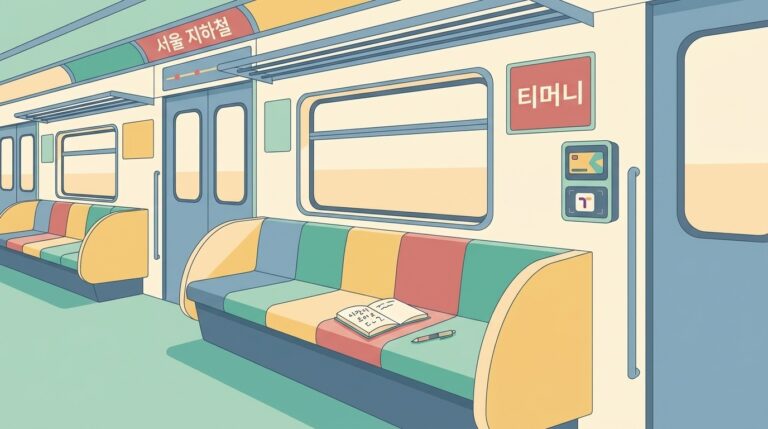
Koreans don’t use cash for transit. Everyone uses a T-Money card or their smartphone. Tapping your card when you get on and when you get off is a non-verbal ritual. If you forget to tap off, you’ll get charged a double fare on your next ride!
Phase 5: Interactive Roleplay Scenario
Meet Min-jun (민준), your sweet Korean coworker who always wants to make sure you didn’t get lost on your way to the office in Gangnam.
- Character: Min-jun (Warm, friendly, drinks 3 iced Americanos a day)
- Setting: The office elevator lobby at 8:50 AM.
Min-jun: 🎭 (Smiling warmly) 어! 에디 씨, 안녕하세요! 아침에 차 안 막혔어요?
         (Eo! Eddie ssi, an-nyeong-ha-se-yo! A-chim-e cha an mak-hyeot-eo-yo?)
         "Oh! Eddie, hello! Was the traffic okay this morning?"

Eddie: 🎭 (Wiping a bit of sweat) 안녕하세요, 민준 씨! 저 오늘 지하철 타고 왔어요.
       (An-nyeong-ha-se-yo, Min-jun ssi! Jeo o-neul ji-ha-cheol ta-go wa-sseo-yo.)
       "Hello, Min-jun! I took the subway today."

Min-jun: 🎭 (Surprised) 아, 진짜요? 오늘 지하철에 사람 진짜 많았죠?
         (Ah, jin-jja-yo? O-neul ji-ha-cheol-e sa-ram jin-jja man-at-jyo?)
         "Oh, really? Was the subway super crowded today?"

Eddie: 🎭 (Nodding) 네, 완전 지옥철이었어요! 2호선은 늘 그래요.
       (Ne, wan-jeon ji-ok-cheol-i-eot-eo-yo! I-ho-seon-eun neul geu-rae-yo.)
       "Yes, it was total hell-subway! Line 2 is always like that."

Min-jun: 🎭 (Laughing) 맞아요, 2호선은 정말 힘들어요. 환승도 해야 하죠?
         (Ma-ja-yo, i-ho-seon-eun jeong-mal him-deul-eo-yo. Hwan-seung-do hae-ya ha-jyo?)
         "Right, Line 2 is really tough. Did you have to transfer too?"

Eddie: 🎭 (Sighing playfully) 네, 신도림역에서 한 번 갈아탔어요.
       (Ne, Sin-do-rim-yeok-e-seo han beon gal-a-tat-eo-yo.)
       "Yes, I transferred once at Sindorim Station."

Min-jun: 🎭 (Patting your shoulder) 고생하셨어요! 우리 빨리 아메리카노 마시러 가요.
         (Go-saeng-ha-syeot-eo-yo! U-ri ppal-li a-me-ri-ka-no ma-si-reo ga-yo.)
         "You went through a lot! Let’s quickly go get an Americano."

Eddie: 🎭 (Brightening up) 와, 좋아요! 제가 살게요!
       (Wa, jo-ah-yo! Je-ga sal-ge-yo!)
       "Wow, sounds great! My treat!"
🔀 Interactive Choice Point
Now, imagine Min-jun asks you: “내일은 어떻게 올 거예요?” (How will you come tomorrow?) How do you respond?
* A) “내일은 버스를 타고 올 거예요.” (Nae-il-eun beo-seu-reul ta-go ol geo-ye-yo.)
* B) “내일은 그냥 걸어서 오겠습니다.” (Nae-il-eun geu-nyang geol-eo-seo o-get-seub-ni-da.)
* C) “내일은 택시를 탈래요! 돈이 많아요!” (Nae-il-eun taek-si-reul tal-rae-yo! Don-i man-a-yo!)
Feedback:
- Selection A (Best): Perfect! It’s natural, grammatically correct, and polite. Min-jun will say: “버스도 편하고 좋아요!” (Buses are comfortable and nice too!)
- Selection B (Risk): Grammatically correct, but “걸어서 오겠습니다” (I will walk) sounds very stiff and militaristic for a casual chat. Also, unless you live next door, Gangnam is too far to walk!
- Selection C (Bad): While “택시를 탈래요” (I want to ride a taxi) is okay, boasting “돈이 많아요” (I have lots of money) sounds a bit boastful and overly blunt in Korean culture, even if said as a joke!
Phase 6: 10-Second Emotion Shadowing Drill
To sound like a native speaker, you need to master the rhythm and emotion of the sentence. Try speaking these out loud with the correct feeling!
- [🥺 Exhausted and tired]
오늘 / 지하철은 / 완전 / 지옥철이었어요…
(O-neul / ji-ha-cheol-eun / wan-jeon / ji-ok-cheol-i-eot-eo-yo…)
“Today… the subway… was complete… hell-subway…” -
[😊 Bright and relieved]
다행히 / 자리가 있어서 / 앉아서 왔어요!
(Da-haeng-hi / ja-ri-ga is-seo-seo / an-ja-seo wa-sseo-yo!)
“Thankfully, there was a seat, so I sat down on my way here!”
Phase 7: K-Culture Mini Dictionary
- 지옥철 (Ji-ok-cheol) | Hell-Subway | A combination of 지옥 (Hell) and 지하철 (Subway). Used to describe extremely crowded subway lines during rush hour (usually 8:00 AM – 9:00 AM and 6:00 PM – 7:00 PM).
- 환승 (Hwan-seung) | Transfer | Changing from one transit line to another (subway to subway, or subway to bus). Highly recommended to use your card to get the transfer discount!
- 막차 (Mak-cha) | The Last Train/Bus | The absolute last ride of the night. Missing the mak-cha means you have to pay for a pricey night taxi!
- 출퇴근 (Chul-toeg-eun) | Commute | A portmanteau of 출근 (going to work) and 퇴근 (leaving work). It covers the entire concept of the daily commute.
Phase 8: The Traveler’s Survival Kit
Survival Phrases TOP 3
- 이거 홍대 가요? (I-geo Hong-dae ga-yo?) – “Does this go to Hongdae?” (Perfect when boarding a bus and you aren’t 100% sure).
- 카드 충전해 주세요. (Ka-deu chung-jeon-hae ju-se-yo.) – “Please top up/recharge my card.” (Say this at any convenience store with cash).
- 내릴게요! 잠시만요! (Nae-ril-ge-yo! Jam-si-man-yo!) – “I’m getting off! Excuse me!” (Use this when you are stuck behind people on a packed train/bus).
Editor’s Travel Note
Before you step foot in Korea, make sure you download the Naver Map App or KakaoMap. Google Maps does not work well in Korea due to national security data laws! These local apps will tell you down to the exact second when your bus or subway train will arrive.
Phase 9: “A Step Deeper” (Thinking Corner)
In Korea, talking about how long your commute takes is a badge of honor. It’s common for young professionals to spend 1 to 1.5 hours commuting one-way from Gyeonggi Province (the suburban area surrounding Seoul) into the city center. This lifestyle has birthed words like 경기도민 (Gyeonggi-do-min – Gyeonggi Resident), often jokingly associated with always being tired. Sharing your commute story isn’t just about sharing logistics; it’s a way of saying, “I am working hard, just like you.”
💬 Your Turn: How do you commute in your country? Do you prefer taking the train, driving, or walking? Let me know in the comments below!
Phase 10: FAQ & Common Mistakes
Q: Can I use “타다” for all vehicles?
A: Yes! You can use 타다 (ta-da) for subways, buses, taxis, bicycles, and even airplanes. Just attach the object particle ~을/를 (~eul/reul) to the vehicle (e.g., 택시를 타요).
Q: What is the difference between 출근 (Chul-geun) and 퇴근 (Toe-geun)?
A: 출근 (Chul-geun) is specifically going to work in the morning, while 퇴근 (Toe-geun) is leaving work to go home at night.
Q: Do I need cash for taxis in Korea?
A: No, almost all Korean taxis accept international credit cards and T-Money cards. However, having a little cash is always a safe backup!
🚨 Common Mistakes Alert!
- Wrong: “지하철를 타요” (Ji-ha-cheol-reul ta-yo)
- Correct: “지하철을 타요” (Ji-ha-cheol-eul ta-yo)
- Why? “지하철” ends in a consonant (ㄹ), so you must use 을, not 를!
Phase 11: Action Mission!
- Bronze Medal: Write down your actual commute method in the comments using: “저는 [Vehicle] 타고 출근해요/학교 가요!”
- Silver Medal: Try listening for the transfer announcement music next time you watch a K-Drama set in Seoul.
- Gold Medal: Record yourself saying: “여기서 갈아타야 돼요!” with the perfect exhausted emotion and share it with a study buddy!
Phase 12: Interactive Quiz Challenge!
Test your knowledge before you go! Click the boxes below to check your answers.
Q1. What does “지옥철” mean?
👉 Click to reveal the answer!
Answer: Hell-Subway (An extremely crowded subway train during rush hour).
Explanation: It combines ‘지옥’ (Hell) and ‘지하철’ (Subway).
Q2. Fill in the blank: “버스를 ___ 가요.”
👉 Click to reveal the answer!
Answer: 타고 (ta-go)
Explanation: We say “버스를 타고 가요” (I ride and go) to mean “I take the bus.”
Q3. True or False: You should talk loudly on your phone in Korean subways.
👉 Click to reveal the answer!
Answer: False!
Explanation: Korean public transit etiquette strongly values silence. Keep phone calls short and quiet!