

Master the Korean Library Study Room: How to Ticket Your Seat Like a Local
Phase 1: Empathy (Welcome, Buddy! 👋)
안녕하세요! (An-nyeong-ha-se-yo!) Your Korean bestie and Daily Hangul Editor is here!
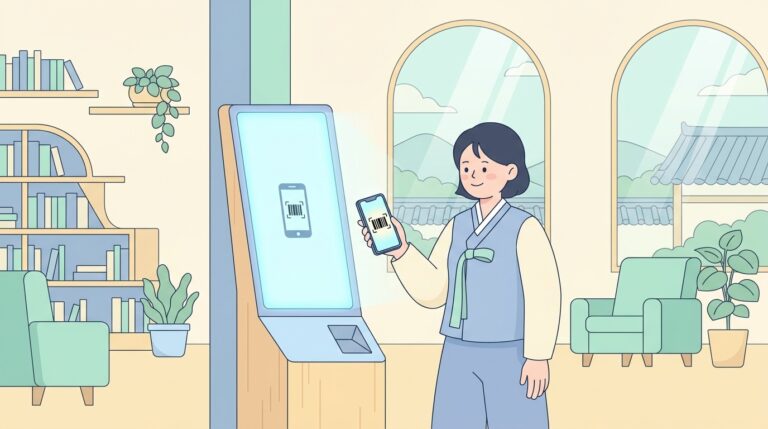
Imagine this: You’ve walked into a beautiful, state-of-the-art public library in Seoul. You’ve got your laptop, your favorite notebooks, and you’re ready to study like a hard-working character in your favorite K-Drama. But as you look around, you realize there are no empty tables—everyone is sitting in a special, glass-walled study room (열람실 – yeol-lam-sil). To get in, locals are tapping their phones or cards at a digital kiosk.
Suddenly, anxiety kicks in. “Do I need a membership? How do I select a seat? What if I accidentally take someone’s spot?”
Don’t worry! Getting a seat in a Korean library is actually super easy once you know the system and the key phrases. Today, we’re going to walk through the exact steps and expressions you need to confidently ticket your seat at a library kiosk, so you can study in peace like a true Seoulite. Let’s dive in!
Phase 2: Deep-Dive into 3 Key Expressions 🔑
Here are the top three expressions you absolutely need to know when navigating a Korean library kiosk.
1. 좌석 발권 (Jwa-seok bal-gwon)
- Pronunciation: Jwa-seok (like “ja-suk” but with a soft ‘w’) bal-gwon (like “bahl-gwon”)
- Meaning: Seat Ticketing / Issuance
- K-Culture Moment: You will see this written on the main screen of almost every library and study cafe kiosk. It’s the digital gateway to securing your study spot!
- Editor’s Insight: 좌석 means “seat,” and 발권 means “issuing a ticket.” In Korea, because public spaces are highly organized, you must always “ticket” your seat first rather than just walking in and sitting down.
- Situation Spectrum:
- Casual: 🚫 (Too formal for casual chat)
- Semi-formal: ✅ 좌석 발권 먼저 해야 돼요. (You have to ticket your seat first.)
- Formal: ✅ 좌석 발권을 시작해 주십시오. (Please begin seat ticketing.)
- 🤔 Think About It: In your home country, do libraries require you to check in digitally for a standard study seat, or is it first-come, first-served? How does this digital reservation system reflect Korea’s love for efficiency and technology?
2. 이용증 바코드 (I-yong-jeung ba-ko-deu)
- Pronunciation: E-yong-jeung (“ee-yong-jung”) ba-ko-deu (“bar-code”)
- Meaning: Library Card Barcode / User Pass Barcode
- K-Culture Moment: The kiosk screen will flash a message: “이용증 바코드를 대주세요” (Please scan your library card barcode). Locals will slickly pull up their mobile library card on their phones and tap it under the red laser scanner.
- Editor’s Insight: 이용증 literally means “use certificate/card.” Nowadays, physical cards are rare; most Koreans use mobile barcodes via local library apps.
- Situation Spectrum:
- Casual: ⚠️ 이용증 있어? (Do you have your library pass?)
- Semi-formal: ✅ 이용증 바코드가 안 찍혀요. (The library card barcode isn’t scanning.)
- Formal: ✅ 이용증 바코드를 인식시켜 주시기 바랍니다. (Please scan your library card barcode.)
- 🤔 Think About It: Why do you think Korea adapted mobile barcodes so quickly compared to plastic cards? (Hint: It’s all about fast-paced convenience!)
3. 좌석 연장 (Jwa-seok yeon-jang)
- Pronunciation: Jwa-seok (“ja-suk”) yeon-jang (“yuhn-jahng”)
- Meaning: Seat Extension
- K-Culture Moment: In Korean libraries, seats are usually issued for 3 to 4 hours. If you want to keep studying, you must go back to the kiosk and select “좌석 연장” before your time runs out, or someone else can reserve your seat!
- Editor’s Insight: 연장 means “extension” or “prolonging.” If you forget to do this, the system will automatically check you out, and you might get a polite but awkward tap on the shoulder from the next user.
- Situation Spectrum:
- Casual: ✅ 나 좌석 연장하고 올게. (I’m going to go extend my seat reservation.)
- Semi-formal: ✅ 좌석 연장은 어떻게 해요? (How do I extend my seat reservation?)
- Formal: 🚫 (Not used in formal presentations, but standard for official instructions)
- 🤔 Think About It: This system ensures everyone gets a fair turn. How does this rule reflect the collective Korean mindset of consideration for others (배려 – bae-ryeo)?
Phase 3: Textbook Korean vs. Real-Life Korean 🗣️
Let’s compare what textbooks teach you versus how real Koreans actually talk in the library lobby.
Situation 1: Asking how to use the ticketing machine
- 📖 Textbook Korean: “열람실 좌석을 어떻게 예약합니까?” (Yeol-lam-sil jwa-seok-eul eo-tteo-ke ye-yak-hap-ni-ka? – “How do I reserve a study room seat?”) -> Very stiff, sounds like a written manual.
- 🗣️ Real-Life Korean: “이거 자리 어떻게 끊어요?” (I-geo ja-ri eo-tteo-ke kkeun-eo-yo? – “How do I get/tick a seat here?”)
- 💡 Why the difference? Locals use the verb 끊다 (kkeun-ta), which literally means “to cut” or “to snap,” but in daily life, it colloquially means “to purchase/issue a ticket” (like buying a movie ticket or train ticket). Also, 자리 (ja-ri) is the friendly, casual word for 좌석 (seat).
Situation 2: Telling your friend you need to renew your seat
- 📖 Textbook Korean: “저는 좌석 사용 시간을 연장해야 합니다.” (Jeo-neun jwa-seok sa-yong si-gan-eul yeon-jang-hae-ya hap-ni-da. – “I must extend my seat usage time.”) -> Too robotic!
- 🗣️ Real-Life Korean: “나 자리 연장해야 돼.” (Na ja-ri yeon-jang-hae-ya dwae. – “I need to extend my seat.”)
- 💡 Why the difference? Dropping “사용 시간” (usage time) and replacing “좌석” with “자리” makes you sound like a natural, friendly native speaker instantly.
Phase 4: K-Culture Deep Dive & Non-Verbal Manners 🤫
4-1. Nunchi (눈치) & Kiosk Etiquette
Korean libraries are quiet zones, but the quietness starts in the lobby! When using the seat kiosk:
* Lower the volume of your phone: Before you even walk in, make sure your phone is on silent (무음 – mu-eum) or vibrate (진동 – jin-dong).
* Don’t linger: If there’s a line behind you, use your Nunchi (wits/situational awareness). Have your barcode ready on your phone screen before you reach the machine.
* No chatting at the kiosk: Keep your voice to a whisper if you need to ask for help.
4-2. The Library Cafe Culture
Many modern public libraries in Korea, like the famous Seoul Metropolitan Library or local district libraries, have amazing rest zones and cafes inside. However, the study rooms are strictly for studying. You will often see students placing their coffee cups in designated cup holders or leaving them outside. Keeping your desk clean is a huge part of being a respectful library goer in Korea!
Phase 5: Real-Life Roleplay Scenario 🎭
You are at the Mapo District Library (마포평생학습관). You want to get a seat in the quiet study room, but you are confused by the kiosk. You decide to ask a friendly-looking student nearby.
Characters:
- You (유진 – Yu-jin): A determined Korean learner who wants to study.
- Min-jun (민준): A helpful local university student who is an expert at library systems.
Script:
- You: 🎭 (Approaches hesitantly, pointing at the screen)
저기요, 죄소한데 이것 좀 여쭤봐도 될까요?
Jeo-gi-yo, joe-song-han-de i-geot jom yeo-jjeo-bwa-do doel-ka-yo?
(“Excuse me, I’m sorry, but could I ask you something about this?”) -
Min-jun: 🎭 (Takes off one earbud, smiles warmly)
아, 네! 어떤 것 때문에 그러세요?
Ah, ne! Eo-tteon geot ttae-mun-e geu-reo-se-yo?
(“Oh, yes! What seems to be the problem?”) -
You: 🎭 (Tapping the kiosk screen)
열람실 좌석 발권하고 싶은데, 이용증 바코드가 꼭 있어야 해요?
Yeol-lam-sil jwa-seok bal-gwon-ha-go si-peun-de, i-yong-jeung ba-ko-deu-ga kkok is-seo-ya hae-yo?
(“I want to ticket a study room seat, but do I absolutely need a library card barcode?”) -
Min-jun: 🎭 (Nodding)
네, 바코드를 찍어야 자리를 선택할 수 있어요. 혹시 비회원이신가요?
Ne, ba-ko-deu-rul jjik-eo-ya ja-ri-reul seon-taek-hal su is-seo-yo. Hok-si bi-hoe-won-i-sin-ga-yo?
(“Yes, you have to scan the barcode to select a seat. By any chance, are you a non-member?”) -
You: 🎭 (Nervously checking phone)
네, 아직 회원가입을 안 했어요. 그럼 오늘 이용 못 하나요?
Ne, a-jik hoe-won-ga-ip-eul an haes-seo-yo. Geu-reom o-neul i-yong mot ha-na-yo?
(“Yes, I haven’t registered as a member yet. Does that mean I can’t use it today?”) -
Min-jun: 🎭 (Pointing to the side desk)
아니요, 괜찮아요! 저기 데스크 직원분께 여권 보여주시면 일일 이용권 끊어주실 거예요.
A-ni-yo, gwaen-chan-ha-yo! Jeo-gi de-seu-keu jik-won-bun-kke yeo-gwon bo-yeo-ju-si-myeon il-il i-yong-gwon kkeun-eo-ju-sil geo-ye-yo.
(“No, it’s fine! If you show your passport to the staff member at that desk, they will issue a daily pass for you.”) -
You: 🎭 (Relieved, bowing slightly)
아, 정말 감사합니다! 덕분에 살았어요.
Ah, jeong-mal gam-sa-hap-ni-da! Deok-bun-e sal-as-seo-yo.
(“Oh, thank you so much! You saved my life.”) -
Min-jun: 🎭 (Smiling)
별말씀을요. 화이팅하세요!
Byeol-mal-sseum-eul-yo. Hwa-i-ting-ha-se-yo!
(“Don’t mention it. Good luck!”)
🔀 Interactive Choice Point!
Now you have your daily pass! You walk back to the kiosk. What is your next move?
* A) Tap the screen randomly and hope for the best.
* B) Scan the barcode first, choose a green (available) seat, and print the seat ticket.
* C) Just walk into the study room and sit on an empty seat without using the kiosk.
Feedback on your choice:
- A (Risk): You might end up reserving a seat in a “laptop-free zone” (문서작성 금지 구역) when you actually need to type. Read the screen carefully!
- B (Best 👍): Perfect! In Korea, green or blue usually means “available” (공석), and red means “occupied” (사용중). Print your ticket and keep it; it has your check-out time!
- C (Bad ❌): Oh no! Someone who officially ticketed that seat will arrive in a few minutes, leading to an extremely awkward situation. Always ticket first!
Phase 6: 10-Second Emotion Shadowing Drill 🗣️
Practice speaking like a native with emotional cues and natural pauses (/ indicates a short pause).
- [🥺 Confused & Asking for Help]
저기요… / 이것 좀 / 도와주실 수 있나요?
Jeo-gi-yo… / i-geot jom / do-wa-ju-sil su in-na-yo?
(“Excuse me… / could you / help me with this?”) -
[😊 Relieved & Grateful]
아, / 알려주셔서 / 정말 감사합니다!
Ah, / al-ryeo-ju-syeo-seo / jeong-mal gam-sa-hap-ni-da!
(“Oh, / thank you so much / for letting me know!”) -
[🤫 Whispering quietly in the library]
자리 연장 / 하셨어요?
Ja-ri yeon-jang / ha-syeos-seo-yo?
(“Did you / extend your seat reservation?”)
Phase 7: K-Culture Mini Dictionary 📖
- 열람실 (Yeol-lam-sil) | Study Room / Reading Room
- The dedicated quiet zone in public libraries. Usually divided into “laptop zones” (노트북 존) and “super quiet zones” (일반 열람실).
- 일일 이용권 (Il-il i-yong-gwon) | Daily Pass
- A temporary pass issued to travelers or non-residents so they can experience the library for a single day.
- 퇴실 (Toe-sil) | Check-out / Leaving the room
- When you are done studying, you must scan your barcode at the kiosk and select “퇴실” (Check-out) to free the seat for others. Leaving without checking out is considered bad library manners!
- 사물함 (Sa-mul-ham) | Locker
- Many Korean libraries offer coin or digital lockers so you can store your heavy books safely.
Phase 8: Traveler’s Survival Kit 🎒
Survival Phrases TOP 3:
- “일일 회원가입 하고 싶어요.” (Il-il hoe-won-ga-ip ha-go si-peo-yo.)
- Pro Tip: Use this at the information desk if you want to sign up for a temporary daily account.
- “여기 와이파이 비밀번호가 뭐예요?” (Yeo-gi wa-i-pa-i bi-mil-beon-ho-ga mwo-yeo-yo?)
- Pro Tip: “What is the Wi-Fi password here?” (Essential for digital nomads!)
- “콘센트 있는 자리 있어요?” (Kon-sen-teu in-neun ja-ri is-seo-yo?)
- Pro Tip: “Are there seats with power outlets?”
📝 Editor’s Travel Note:
To access public libraries easily, download the Seoul Citizens Card (서울시민카드) App or check out the local district library websites. Most district libraries allow foreigners with an Alien Registration Card (ARC) or even tourists with a passport to get a daily pass. Note: Library operating hours and registration policies may vary by location and local government regulations.
Phase 9: “Going Deeper” (A Touch of Korean Culture) 🧠
In Korea, the library is more than just a place to borrow books; it’s a battlefield of academic passion and self-improvement (자기계발 – ja-gi-gye-bal). From high schoolers preparing for the college entrance exam (수능 – Suneung) to job seekers studying for civil service exams, the energy in a Korean yeol-lam-sil is incredibly focused and intense. This intense environment has even birthed high-end, paid private libraries called “Study Cafes” (스터디카페) on almost every street corner. When you study here, you are participating in a major pillar of Korean youth culture.
💬 Your Turn: Have you ever studied in a public space in Korea? What surprised you the most? Let me know in the comments below!
Phase 10: FAQ & Common Mistakes 🙋♀️
Q: Can foreigners use Korean public libraries for free?
A: Yes! Entry to the library building is completely free, and you can read books in the open lounge areas. However, to use the closed study rooms (열람실) or computers, you usually need to register for a daily pass or a library card at the information desk using your passport or Alien Registration Card.
Q: What happens if I don’t extend (연장) my seat on time?
A: The kiosk system will automatically cancel your seat, and it will be shown as “empty” to other users. If the library is busy, someone else might book it immediately, and you will have to packing your things and leave.
Q: Are there laptop-friendly zones in the study room?
A: Yes! Always look for the labels “노트북 존” (Laptop Zone) or “타이핑 가능” (Typing Allowed). In other areas, typing noise is considered extremely rude, and people might give you a sharp look (or leave a polite post-it note on your desk!).
🚨 Common Mistakes Alert!
- Mistake: Sitting in a seat just because it’s empty without checking the kiosk.
- Correct Action: Always get a seat ticket (발권) first!
- Mistake: Leaving the library without checking out (퇴실).
- Correct Action: Scan your barcode and tap “퇴실” before leaving so someone else can use the space.
- Mistake: Making phone calls inside the study room.
- Correct Action: Walk out to the lobby or the designated phone-call booth (통화 부스).
Phase 11: Action Mission & K-Culture Challenge 🏆
- Bronze Medal: Read the key expressions out loud 5 times using the emotional cues in Phase 6.
- Silver Medal: Visit a local Korean public library (or look up a virtual tour of the Starfield Library or Seoul Book Bogo online) and identify where the kiosks are.
- Gold Medal: Next time you are in Korea, walk up to a library desk and confidently ask: “일일 이용권 어떻게 발급받아요?” (How do I get a daily pass?)
🎮 K-Culture Mission:
Watch a Korean school drama (like True Beauty or Reply 1988). Spot the scenes where characters are studying in a library or a study room. Pay attention to how quiet they are and what they have on their desks!
Phase 12: Interactive Quiz Challenge 🧠
Test your library survival skills!
Q1. What does the word “좌석 발권” mean on a kiosk screen?
- A) Book borrowing
- B) Seat ticketing / issuance
- C) Cafeteria menu
Reveal Answer & Explanation
Correct Answer: B
‘좌석’ (Jwa-seok) means seat, and ‘발권’ (Bal-gwon) means ticketing. Tap this button to start your study session!
Q2. True or False: You can type loudly on your mechanical keyboard in any library study room area.
- A) True
- B) False
Reveal Answer & Explanation
Correct Answer: B (False)
You must only type in designated ‘노트북 존’ (Laptop Zones) to avoid disturbing others. Quiet typing or silent keyboards are highly recommended!







