

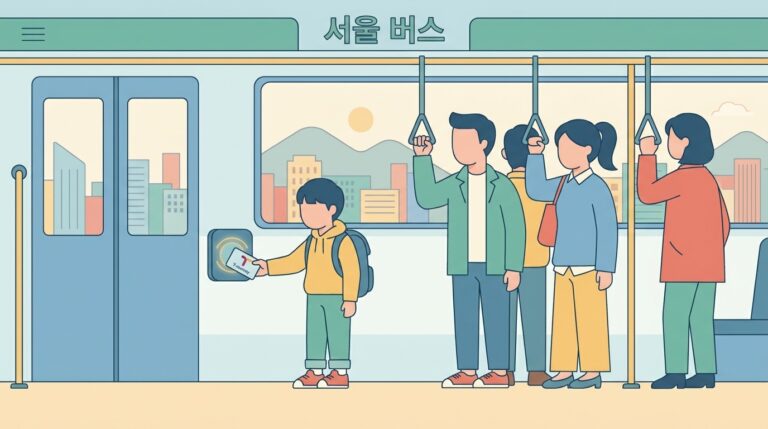
Hold On Tight! Navigating Korea’s “Ppalli-Ppalli” Culture on the City Bus
Phase 1: Empathy (스토리 몰입형 오프닝)
안녕하세요! (Annyeonghaseyo!) It’s your K-culture navigator and Korean bestie from Daily Hangul.
Picture this: You are riding a bustling city bus in Seoul. The digital screen shows your stop is next. You decide to wait politely until the bus comes to a complete halt before standing up—just like you were taught back home for safety. But as soon as the bus slows down, you notice everyone else has already stood up, tapped their transit cards, and queued up at the back door like Olympic sprinters. By the time the bus actually stops, the doors open for exactly three seconds, and the driver is already looking in the rearview mirror, ready to close them. You panic, stumble forward, and feel the silent pressure of fifty pairs of eyes on you.
Welcome to Korea’s infamous 빨리빨리 (Ppalli-Ppalli / Hurry, Hurry) culture in its purest, most chaotic form: getting up before the bus even stops.
If you’ve ever felt intimidated or rushed on Korean public transport, don’t worry! This is a classic “foreigner rite of passage.” Today, we’ll decode the unspoken rules of the Korean transit system, learn the exact phrases to help you claim your exit smoothly, and understand the cultural heartbeat behind this speedy lifestyle. This guide is based on real-world feedback from hundreds of B1 learners who went from stumbling on the Seoul green buses to riding like true locals.
Phase 2: Deep Dive into 3 Essential Expressions (핵심 표현 3선 심층 분석)
To survive and thrive on a Korean bus, you need to master these three powerhouse expressions. Let’s break them down!
1. 내릴게요! (Naerilgeyo!)
- Pronunciation: Nay-ril-gey-yo! (Rhymes with “pay-peel-game-yo” without the ‘m’)
- Meaning: “I am getting off!” / “I’m stepping down!”
- K-Culture Moment: You’ll hear this shouted from the back of a crowded bus in K-Dramas when a character realizes they’ve almost missed their stop because they were daydreaming about the main lead.
- Editor’s Insight: 내리다 (naerida) means “to get off/descend.” Adding -(으)ㄹ게요 (-(eu)lgeyo) expresses your strong intention to do something. It’s polite yet firm. It acts as an acoustic horn; it instantly alerts the driver and the passengers blocking your path that you are on the move.
- Situation Spectrum: Casual ✅ | Semi-formal ✅ | Formal ⚠️
- 🤔 Think About It: In many Western cultures, shouting on a bus is considered rude. In Korea, shouting “내릴게요!” is actually seen as proactive and helpful because it prevents the bus from delaying. How does your culture view vocalizing your needs in public spaces?
2. 잠시만요, 지나갈게요. (Jamsimanyo, jinagalgeyo.)
- Pronunciation: Jam-si-man-yo, ji-na-gal-gey-yo. (Sounds like “Jam-see-man-yo, gee-nah-gal-gay-yo”)
- Meaning: “Just a moment, I will pass through.”
- K-Culture Moment: Commonly used in crowded subway stations, busy street markets like Myeongdong, or when navigating through a packed standing-room-only bus.
- Editor’s Insight: While 실례합니다 (sillyehamnida / Excuse me) is grammatically correct, it can sound a bit too stiff on a bus. 잠시만요 (Just a moment) combined with 지나갈게요 (I will pass through) is the gold standard of polite physical navigation. It signals to the people in front of you that they need to step aside or tilt their shoulders.
- Situation Spectrum: Casual ⚠️ | Semi-formal ✅ | Formal ✅
- 🤔 Think About It: Why do you think Koreans prefer “Just a moment” over “I am sorry” in crowded spaces? (Hint: It’s about efficiency and keeping the flow moving!)
3. 기사님, 문 좀 열어주세요! (Gisanim, mun jom yeoreojuseyo!)
- Pronunciation: Gi-sa-nim, mun jom yuh-ruh-ju-seh-yo. (Make sure to stretch the “nim” politely!)
- Meaning: “Driver, please open the door!”
- K-Culture Moment: This is your emergency button phrase. Use this when the doors have closed right before you could step off, or if you were stuck in the crowd and couldn’t reach the exit in time.
- Editor’s Insight: 기사님 (gisanim) is the respectful title for drivers (buses, taxis). 좀 (jom) means “please/a little” and softens the command 열어주세요 (yeoreojuseyo / please open). It sounds warm, respectful, and urgent all at once.
- Situation Spectrum: Casual 🚫 | Semi-formal ✅ | Formal ✅
- 🤔 Think About It: Addressing service workers with highly respectful titles like 기사님 is deeply rooted in Korea’s honorific system. How do you address public service workers in your language?
Phase 3: Textbook Korean vs. Real-Life Korean (교과서 한국어 vs 진짜 한국어)
Let’s compare what you learn in classroom textbooks with what actually comes out of a Korean’s mouth when they are in a rush.
Situation A: Trying to squeeze past someone blocking the exit door.
- 📖 Textbook Korean: 실례합니다, 내리겠습니다. (Sillyehamnida, naerigessnida.) – “Excuse me, I will get off.”
- 🗣️ Real-Life Korean: 저 내릴게요! (Jeo naerilgeyo!) – “Me, getting off!”
- 💡 Why the difference? 내리겠습니다 is grammatically perfect but feels like an official announcement. In the fast-paced environment of a bus, 저 내릴게요! is shorter, punches through the noise better, and sounds much more natural to native ears.
Situation B: Asking the driver to wait a second because you are running to the bus.
- 📖 Textbook Korean: 버스를 정지해 주십시오. (Beoseureul jeongjihae jusipsio.) – “Please halt the bus.”
- 🗣️ Real-Life Korean: 잠시만요! 같이 가요! (Jamsimanyo! Gachi gayo!) – “Just a second! Let’s go together!”
- 💡 Why the difference? The textbook version sounds like a police command or a formal announcement. Saying 같이 가요! (Let’s go together!) is a charming, urgent, and highly common way to ask a bus or elevator to wait for you.
Phase 4: K-Culture Deep Dive & Non-Verbal Etiquette (K-Culture 딥다이브 & 비언어적 매너)
4-1. Nunchi (눈치) & Bus Body Language
In Korea, surviving a bus ride is 50% language and 50% Nunchi (tact/situational awareness).
* The Card Tap Dance: On Korean buses, you tap your transit card (T-money) when you get on, and also when you get off (to get transfer discounts). The “Ppalli-Ppalli” etiquette dictates that you should have your card in your hand before you reach the sensor. Fumbling through your bag at the door is a major public transit crime!
* The Pre-Exit Stance: One stop before yours, start shifting your body toward the aisle. If you are sitting on the inside seat, make eye contact with your seat partner, give a slight nod, and stand up. This non-verbal cue signals: “My turn to move.”
4-2. The Cultural Code: Why is the bus so fast?
Why does the bus driver start driving before you even sit down? Korea transformed from a war-torn country to a global economic powerhouse in just a few decades. This rapid development birthed the 빨리빨리 (Ppalli-Ppalli) mindset. To keep Seoul’s massive population of 10 million moving on time, city buses run on incredibly tight schedules. The drivers aren’t being mean; they are dancing to the rhythm of a hyper-efficient city.
Phase 5: Real-Life Roleplay Scenario (실전 롤플레이 시나리오)
Setting: You are on the blue bus #143 heading to Gangnam. The bus is packed. You are standing near the middle of the bus, and your stop is “Sinsa Station” (신사역). The next stop announcement just played. Your NPC opponent is Min-woo (민우), a busy college student blocking the path to the exit, wearing headphones.
[Bus Speaker]: 다음 정류장은 신사역입니다. (Next stop is Sinsa Station.)

You: 🎭 (Slightly nervous, nudging forward) 저기요, 죄송한데 저 다음 정류장에서 내려요.
     (Jeogiyo, joesonghande jeo daeum jeongryujang-eseo naeryoyo.)
     "Excuse me, sorry, but I am getting off at the next stop."

Min-woo: 🎭 (Looks up, pulls one earbud out) 아, 네? 뭐라고 하셨어요?
         (Ah, ne? Mworago haseosseoyo?)
         "Ah, yes? What did you say?"

You: 🎭 (Speaking louder and clearer) 저 이번에 내릴게요! 지나갈게요.
     (Jeo ibone naerilgeyo! Jinagalgeyo.)
     "I am getting off this time! Passing through."

Min-woo: 🎭 (Nods quickly and steps to the side) 아, 네! 죄송합니다. 먼저 가세요.
         (Ah, ne! Joesonghamnida. Meonjeo gaseyo.)
         "Ah, yes! Sorry. Go ahead first."

[Bus stops, but the crowd is thick, and you are still 3 steps away from the card reader. The door opens.]

You: 🎭 (Squeezing past, tapping card) 잠시만요, 지나갈게요!
     (Jamsimanyo, jinagalgeyo!)
     "Just a moment, passing through!"

[As you reach the door, the door begins to make a beeping sound warning it's about to close!]

You: 🎭 (To the driver, with urgent but polite tone) 기사님! 내릴게요! 문 좀만 열어주세요!
     (Gisanim! Naerilgeyo! Mun jomman yeoreojuseyo!)
     "Driver! I'm getting off! Please open the door for just a second!"

Bus Driver: 🎭 (Glances at mirror, sighs softly, holds door open) 네, 내리세요. 조심히 내리세요.
            (Ne, naeriseyo. Josimhi naeriseyo.)
            "Yes, get off. Get off safely."

You: 🎭 (Stepping off onto the sidewalk, bowing slightly) 감사합니다!
     (Gamsahamnida!)
     "Thank you!"
🔀 Interactive Choice Point
You are stuck in the back of the bus, and the doors are already closing. What do you do?
* Option A: Stand silently and just ride to the next stop to avoid making a scene.
* Option B: Shout “기사님, 내릴게요! 문 열어주세요!” (Gisanim, naerilgeyo! Mun yeoreojuseyo!)
* Option C: Try to pry the doors open with your hands.
Feedback:
- Option A (Bad): You will waste time and might get lost. In Korea, expressing your need to get off is totally normal. Speak up!
- Option B (Best): Perfect! The driver will almost always open the door for you, and fellow passengers will respect your proactive communication.
- Option C (Risk): Highly dangerous! The pneumatic doors are strong, and doing this will cause a safety alarm to go off, delaying everyone and making you look very foolish.
Phase 6: 10-Second Emotion Shadowing Drill (10초 감정 섀도잉 드릴)
Practice these with the correct emotional rhythm. The / indicates a micro-pause for natural pacing.
[🥺 Urgent and Pleading]
기사님! / 저 아직 안 내렸어요! / 문 좀 열어주세요!
(Gisanim! / jeo ajik an naeryeosseoyo! / mun jom yeoreojuseyo!)
“Driver! / I haven’t gotten off yet! / Please open the door!”-
[😊 Polite and Swift]
잠시만요, / 저 내릴게요. / 감사합니다!
(Jamsimanyo, / jeo naerilgeyo. / gamsahamnida!)
“Just a moment, / I’m getting off. / Thank you!”
Phase 7: K-Culture Mini-Dictionary (K-Culture 미니 사전)
- 하차태그 (Hacha-taegeu) | Exit Card Tap | Tapping your card when exiting public transport. Essential for transfer discounts within 30 minutes.
- 정류장 (Jeongryujang) | Bus Stop | The physical bus stop. You will hear this word constantly in automated announcements.
- 빨리빨리 (Ppalli-Ppalli) | Hurry, Hurry | The cultural mindset of speed, efficiency, and dynamic action that defines modern Korean lifestyle.
- 만원버스 (Manwon-beoseu) | Packed Bus | Literally “10,000-won bus,” meaning a bus so full of people that there is absolutely no breathing room.
Phase 8: Travel Survival Kit (여행자를 위한 생존 키트)
Survival Phrases TOP 3:
- 이번에 내려요. (Ibeone naeryoyo.) – “I’m getting off this time.” (Great for telling the person blocking you).
- 카드 찍어주세요. (Kadeu jjigeojuseyo.) – “Please tap your card.” (If the driver asks you to re-tap).
- 정차 후 일어나세요. (Jeongcha hu ireonaseyo.) – “Please stand up after the bus stops.” (You will see this written on bus walls, though ironically, almost nobody follows it!).
Editor’s Travel Note:
To navigate Korean buses like a pro, do not use general global map apps as they often lag on bus arrival times. Instead, make sure to download Naver Map (네이버 지도) or KakaoBus. They provide real-time updates down to the second, telling you exactly how many seats are left on the incoming bus!
Note: Public transport fares in Seoul are subject to change; as of 2024, base bus fare starts at 1,500 KRW using a transportation card.
Phase 9: “A Step Deeper” – Cultural Reflection (“한 발 더 깊이”)
At first glance, the bus rush might look like impatience or rudeness. However, if you look closer, it’s actually a form of collective consideration. On a crowded bus, if one person takes 10 seconds to get off, it delays the entire bus of 50 people by 10 seconds. In Korea’s communal culture, being fast is a way of showing respect for other people’s valuable time. It’s a beautiful paradox: we rush so we don’t inconvenience others.
💬 Your Turn: Have you ever experienced a “Ppalli-Ppalli” moment in Korea or your own country? How did you handle it? Let me know in the comments below!
Phase 10: FAQ & Common Mistakes (FAQ & 오해 방지)
Q: Is it actually illegal or dangerous to stand up before the bus stops in Korea?
A: No, it is not illegal. While there are safety signs that say “Please stand up after the bus stops,” in reality, almost all locals stand up as the bus approaches the stop. However, please hold onto the handrails tightly, as Korean bus drivers are known for sudden braking!
Q: What should I do if my T-money card says “Error” (삐빅- 처리되었습니다/잔액이 부족합니다) when exiting?
A: Don’t panic and block the door. Step to the side, look at the driver, and say “잔액이 부족한가 봐요” (Janaegi bujokhanga bwayo / I think the balance is insufficient). They will assist you or let you go if it’s a minor error.
Q: Can I bring my take-out coffee cup onto the Korean bus?
A: No! Seoul city buses strictly ban open food and take-out drink containers (like plastic cups with straws) to prevent spills. If you try to board with a plastic cup of iced americano, the driver will politely but firmly deny you entry. Empty it or finish it before boarding!
🚨 Common Mistakes Warning Board
- Mistake 1: Standing right in front of the door three stops early.
- Correct Action: Sit or stand near your seat until the announcement for your stop plays, then make your move.
- Mistake 2: Saying “Excuse me” in English loudly to get past people.
- Correct Action: Say “잠시만요” (Jamsimanyo). It’s short, polite, and instantly understood.
- Mistake 3: Forgetting to tap your card on the way out.
- Correct Action: Always tap! Even if you don’t transfer immediately, failing to tap can result in a penalty fare on your next ride.
Phase 11: Action Mission (액션 미션)
- 🥉 Bronze Mission: Practice saying “내릴게요!” (Naerilgeyo!) in front of the mirror 5 times with a confident voice.
- 🥈 Silver Mission: Next time you ride a bus (even in your own country), practice the “Nunchi slide”—prepare your exit path one stop early without looking rushed.
- 🥇 Gold Mission: Use “잠시만요, 지나갈게요” in a real Korean mart, restaurant, or street when navigating through a crowd!
Phase 12: Interactive Quiz Challenge (인터랙티브 퀴즈 챌린지)
1. What is the most natural way to tell someone you are getting off the bus?
- A) 비켜주세요! (Bikyeojuseyo!)
- B) 저 내릴게요! (Jeo naerilgeyo!)
- C) 실례합니다만 길을 잃었습니다. (Sillyehamnidaman gireul ireosseonmida.)
Click for the Answer & Explanation!
Correct Answer: B
“저 내릴게요!” is the most natural, polite, and effective way to signal your exit. Option A (“Move!”) sounds too aggressive, and Option C (“Excuse me but I am lost”) is too long and irrelevant!
2. True or False: You can board a Seoul city bus with a hot cup of coffee without a lid.
- A) True
- B) False
Click for the Answer & Explanation!
Correct Answer: B (False)
Seoul buses ban all open take-out containers for safety and cleanliness. Always finish your drink before boarding!







