

Master the Art of Business Greetings: How to Say “Nice to Meet You” Formal Style!
Phase 1: Empathy (Story-driven Opening)
안녕하세요! (Annyeonghaseyo!) Hello! It’s your Korean bestie and Daily Hangul’s editor here!
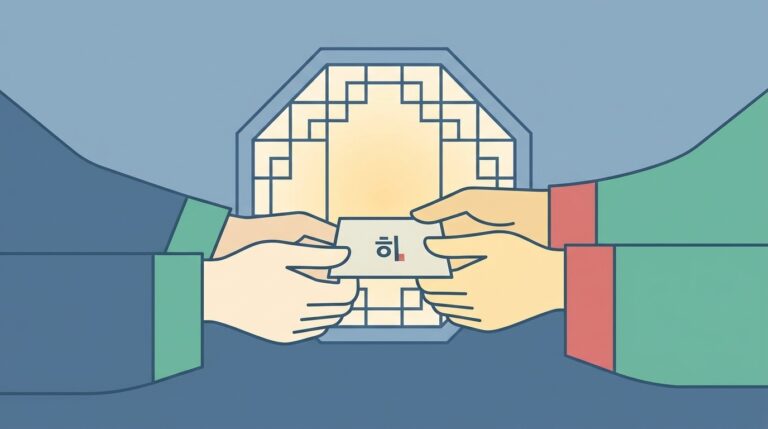
Imagine this: You’ve flown all the way to Seoul for an exciting new business partnership. You walk into a sleek, high-rise office in Gangnam. The elevator doors open, and there they are—your potential Korean partners, bowing slightly with their business cards held in both hands. Suddenly, your mind goes blank. You want to say “Nice to meet you,” but is “Annyeong” too casual? Is “Bangawoyo” respectful enough?
Don’t worry! This is the ultimate survival zone for every beginner. Today, we are mastering 반갑습니다 (Bangapsumnida)—the gold-standard formal greeting that instantly earns you respect and builds shilloe (trust) in a Korean workplace. Let’s make sure you nail your first impression!
Phase 2: Deep Dive into Top 3 Formal Greetings
1. 반갑습니다 (Bangapsumnida)
- Pronunciation: Bahng-gahp-seum-nee-dah (Think of saying “bahng-gop” like a soft pop, followed by “soom-nee-dah”)
- Meaning: “I am glad to meet you” (Formal/Polite)
- K-Culture Moment: In the hit office K-Drama Misaeng (Incomplete Life), you see interns bowing at a 30-degree angle while delivering this exact line to their new directors.
- Editor’s Insight: This is the most reliable, safe, and professional way to say “Nice to meet you.” It shows that you respect the hierarchy and the formal setting.
- Situation Spectrum: Casual (🚫) / Semi-formal (⚠️) / Formal (✅)
- 🤔 Think About It: In English, we often say “Hey, nice to meet you!” with a wave. Why do you think Korean uses distinct levels of formality depending on who you are talking to?
2. 처음 뵙겠습니다 (Cheoeum Boepgetseumnida)
- Pronunciation: Chuh-eum boep-get-seum-nee-dah (Pronounce “chuh-eum” like “chum” but with a soft “uh” in the middle)
- Meaning: “I am meeting you for the first time” / “How do you do?”
- K-Culture Moment: Used during formal match-making dates (Seon) or when a new CEO is introduced to the board members in K-Dramas.
- Editor’s Insight: Use this only the very first time you meet someone. If you say this to someone you’ve met before, they might think you forgot them!
- Situation Spectrum: Casual (🚫) / Semi-formal (⚠️) / Formal (✅)
- 🤔 Think About It: How does starting a relationship by acknowledging “this is our first time meeting” shape the atmosphere of a business partnership?
3. 잘 부탁드립니다 (Jal Butakdeurimnida)
- Pronunciation: Jahl boo-tahk-deu-reem-nee-dah (Pronounce “jahl” like “Jul” in July)
- Meaning: “Please look after me” / “I look forward to working with you”
- K-Culture Moment: K-Pop idols always shout this together to the camera before performing on music shows!
- Editor’s Insight: This is the ultimate Korean relationship-builder. It humbly asks the other person for their cooperation and guidance.
- Situation Spectrum: Casual (🚫) / Semi-formal (✅) / Formal (✅)
- 🤔 Think About It: Why does Korean business culture place such a high value on asking others to “look after them” at the very first meeting?
Phase 3: Textbook Korean vs. Real Korean
Let’s compare textbook-stiff Korean with the actual, polished natural speech used by modern Korean professionals.
Situation 1: Meeting a client for the first time
- 📖 Textbook Korean: 만나서 반갑습니다. (Mannaseo bangapsumnida.) – “Because I meet you, I am glad.”
- 🗣️ Real Korean: 처음 뵙겠습니다. 잘 부탁드립니다. (Cheoeum boepgetseumnida. Jal butakdeurimnida.) – “How do you do? I look forward to working with you.”
- 💡 Why the difference? While “Mannaseo bangapsumnida” is grammatically correct, real professionals combine “first meeting” with the humble “please look after me” to show proactive enthusiasm.
Situation 2: Replying when someone says “Nice to meet you”
- 📖 Textbook Korean: 저도 반갑습니다. (Jeodo bangapsumnida.) – “I am glad too.”
- 🗣️ Real Korean: 네, 말씀 많이 들었습니다. 반갑습니다. (Ne, malsseum manhi deureosseumnida. Bangapsumnida.) – “Yes, I’ve heard a lot about you. Nice to meet you.”
- 💡 Why the difference? Saying “I’ve heard great things about you” shows that you have active interest in them and their company before the meeting even started.
Phase 4: K-Culture Deep Dive & Non-Verbal Etiquette
4-1. Nunchi & Business Card (Myeongham) Etiquette
In Korea, non-verbal cues (Nunchi) speak louder than words. When exchanging business cards:
1. Two Hands Rule: Always present and receive business cards with both hands.
2. Read It: Do not immediately put the card in your pocket. Look at it respectfully for at least 5 seconds, nod, and place it on the table in front of you during the meeting.
3. The Bow: Bow slightly (about 15 to 30 degrees) while greeting. Keep your eyes lowered to show respect.
4-2. The Business Dinner (Hoesik) Culture
After the meeting, you might be invited to a Hoesik (work dinner). This is where the real bonding happens over Korean BBQ. Remember: when someone older or higher-ranking pours you a drink, hold your cup with both hands! Turn your head slightly away when drinking as a sign of respect.
Phase 5: Real-Life Roleplay Scenario
Setting: The conference room of “Seoul Tech Corp.”
Characters:
* You (A1 Learner): Visiting from the global branch.
* Manager Kim (NPC): The polite head of marketing.
Scenario Dialogue (8 Turns)
- Manager Kim: “안녕하세요! 서울 테크의 김민수 부장입니다.”
(Annyeonghaseyo! Seoul Tekeui Kim Min-su bujangimnida.)
“Hello! I am Marketing Manager Min-su Kim of Seoul Tech.” -
You:
🎭 (Bow hands politely)“처음 뵙겠습니다. [Your Name]입니다.”
(Cheoeum boepgetseumnida. [Your Name]imnida.)
“How do you do? I am [Your Name].” -
Manager Kim: “만나서 정말 반갑습니다. 한국에 오신 것을 환영합니다!”
(Mannaseo jeongmal bangapsumnida. Hanguge osin geoseul hwanyeonghamnida!)
“It is truly nice to meet you. Welcome to Korea!” -
You:
🎭 (Presenting your business card with both hands)“감사합니다. 잘 부탁드립니다.”
(Gamsahamnida. Jal butakdeurimnida.)
“Thank you. I look forward to working with you.” -
Manager Kim:
🎭 (Receiving your card with both hands and reading it)“아, 글로벌 마케팅 담당이시군요. 말씀 많이 들었습니다.”
(Ah, geullobeol maketing damdangisigunyo. Malsseum manhi deureosseumnida.)
“Ah, you are in charge of Global Marketing. I’ve heard a lot about you.” -
You:
🎭 (Smiling politely)“감사합니다. 저도 말씀 많이 들었습니다.”
(Gamsahamnida. Jeodo malsseum manhi deureosseumnida.)
“Thank you. I have heard a lot about you as well.” -
Manager Kim: “오늘 미팅이 아주 기대됩니다. 이쪽으로 앉으세요.”
(Oneul mitingi aju gidaedeumnida. Ijjogeuro anjeuseyo.)
“I am looking forward to today’s meeting. Please sit here.” -
You:
🎭 (Sitting down gently)“네, 감사합니다.”
(Ne, gamsahamnida.)
“Yes, thank you.”
🔀 Interactive Choice Point
Manager Kim offers you a cup of green tea. How do you receive it?
- A) “Grab it quickly with one hand while typing on your phone.”
- B) “Receive the cup with both hands, bow your head slightly, and say ‘Gamsahamnida’.”
- C) “Refuse it by saying ‘No thanks, I only drink iced Americano’.”
Feedback:
- Best Choice – B: Perfect! Receiving items with both hands is the gold standard of Korean respect. You just earned major business points!
- Risk Choice – A: Oops! Using one hand makes you look distracted and dismissive. Avoid this in professional meetings.
- Bad Choice – C: Refusing directly can disrupt the harmonious flow (Kibun). It’s better to accept the tea politely, even if you only sip it once.
Phase 6: 10-Second Emotion Shadowing Drill
Practice speaking with the right rhythm (/ means pause) and emotion!
- [😊 Polished and Proud]
- 처음 뵙겠습니다 / [Your Name]입니다.
- Cheoeum boepgetseumnida / [Your Name]imnida.
- [🤝 Humble and Eager]
- 잘 부탁드립니다 / 감사합니다.
- Jal butakdeurimnida / gamsahamnida.
- [✨ Friendly and Welcoming]
- 말씀 / 많이 들었습니다!
- Malsseum / manhi deureosseumnida!
Phase 7: K-Culture Mini Dictionary
- 명함 (Myeongham): Business Card. In Korea, this is considered the “face” of the professional. Never write on or fold someone’s card.
- 부장님 (Bujangnim): Department Manager. Always address your partners by their job title + “nim” (respectful suffix) rather than just their first name.
- 회사 (Hoesa): Company / Office.
- 미팅 (Miting): Business meeting. (Note: A romantic blind date is called a “Sogeting” or simply “Miting” among university students, but in offices, it means business!)
Phase 8: Survivor’s Kit for Travelers
Survival Phrases TOP 3
- 화장실 어디예요? (Hwajangsil eodiyeyo?): “Where is the restroom?” (Essential for long meetings!)
- 와이파이 비밀번호가 뭐예요? (Waipai bimilbeonhoga mwoyeyo?): “What is the Wi-Fi password?”
- 명함 한 장 주시겠어요? (Myeongham han jang jusigesseoyo?): “Could I have your business card?”
Editor’s Travel Note:
To navigate Seoul like a pro, download the KakaoMap App for real-time subway/bus arrivals and accurate walking routes. Standard Google Maps does not work well in Korea due to local security regulations. (Note: Transit fares and app features are subject to change over time.)
Phase 9: “One Step Deeper” (Reflective Thought)
In English, we aim for horizontal equality: “Hi, I’m John.” In Korea, language is a map of relationships. By using formal honorifics like 반갑습니다 and 잘 부탁드립니다, you aren’t just being polite—you are actively showing that you value the other person’s status and want to build a harmonious community (Uri).
💬 Your Turn: How does your native language handle formal meetings? Do you have different ways of speaking to your boss versus your friend? Tell us in the comments below!
Phase 10: FAQ & Avoiding Common Mistakes
Q: Can I say “Annyeong” to my Korean business partner if they are younger than me?
A: Absolutely not! In a business context, age does not override professional rank. Always use formal language (Yo-form or Sumnida-form) with colleagues and partners, regardless of age, until you both explicitly agree to speak casually (Banmal).
Q: What is the difference between 반갑습니다 (Bangapsumnida) and 반가워요 (Bangawoyo)?
A: 반갑습니다 is formal (highly recommended for clients, bosses, and official meetings). 반가워요 is semi-formal/polite (good for colleagues of the same rank or peer-to-peer networking events).
Q: Is it rude to shake hands?
A: Shaking hands is common, but wait for the older or higher-ranking person to initiate the handshake. Always support your right elbow with your left hand while shaking hands to show respect!
🚨 Common Mistakes Alert!
- Mistake: Bowing with hands in your pockets.
- Correct Action: Keep your arms straight down at your sides or folded politely in front of your waist.
- Mistake: Throwing your business card across the table.
- Correct Action: Stand up, walk over, and hand it to them with two hands.
- Mistake: Calling a manager “Min-su!”
- Correct Action: Use their title: “Kim Bujangnim” (Manager Kim).
Phase 11: Action Mission
- 🥉 Bronze Mission: Record yourself saying “반갑습니다” three times in a row with a warm smile in front of the mirror.
- 🥈 Silver Mission: Write down “처음 뵙겠습니다, [Your Name]입니다” in your notebook and practice writing your name in Hangeul!
- 🥇 Gold Mission: Go to a Korean restaurant or business, exchange a polite bow with the staff, and greet them using your new formal phrases.
- 🎮 K-Culture Mission: Watch a business K-Drama scene (like King the Land or Business Proposal) and spot how many times characters bow when greeting each other!
Phase 12: Interactive Quiz Challenge
1. Situational Judgment
You are introduced to the CEO of a partner company. Which phrase is the MOST appropriate?
* A) 반가워 (Bangawo)
* B) 처음 뵙겠습니다 (Cheoeum boepgetseumnida)
* C) 안녕 (Annyeong)
💡 Click to reveal the Answer & Explanation
Correct Answer: B
Explanation: B is the highest formal greeting used for first-time meetings. A and C are casual forms (Banmal) which would be considered highly disrespectful in a business meeting.
2. Fill-in-the-Blank
“잘 ____드립니다.” (Please look after me / I look forward to working with you.)
* A) 감사 (Gamsa)
* B) 안녕 (Annyeong)
* C) 부탁 (Butak)
💡 Click to reveal the Answer & Explanation
Correct Answer: C
Explanation: 부탁드립니다 (Butakdeurimnida) means “I request/entrust.” Combining it with “Jal” (well) creates the perfect professional phrase 잘 부탁드립니다.
3. True or False
“When receiving a business card, you should immediately write the date and location of the meeting on the card to remember the contact details.”
* True
* False
💡 Click to reveal the Answer & Explanation
Correct Answer: False
Explanation: Writing on a person’s business card in front of them is considered rude as the card represents the person themselves. If you need to write notes, do it on your own notepad or wait until after the meeting.







