

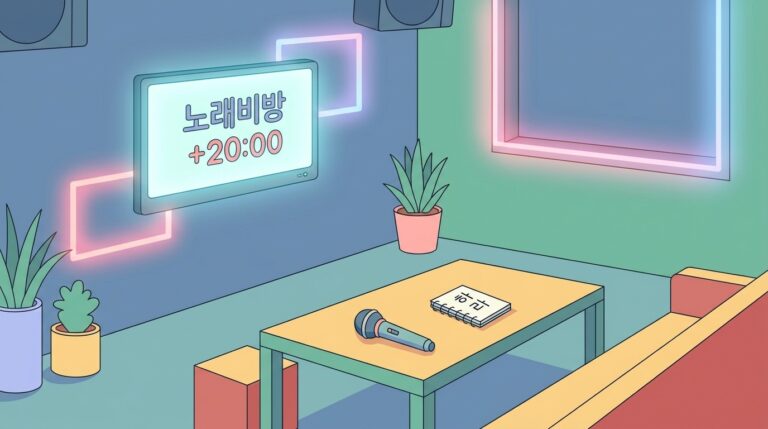
Hello! Welcome to Daily Hangul! 🎤
안녕하세요! (An-nyeong-ha-se-yo!) I’m your Daily Hangul Editor, your native bestie here to guide you through the dazzling, neon-lit world of Korean Noraebang (노래방 – karaoke)!
Imagine this: You are hitting high notes with your friends, your throat is a bit dry, and the timer on the screen shows 0:00. You are ready to pack your bags. But wait! Suddenly, the screen flashes and magically jumps back to 30:00 with the word 서비스 (Seo-bi-seu) on it!
Many of my students panic here, thinking: “Did I press something wrong? Do I have to pay extra?” No! You just received the ultimate Korean hospitality. Today, we’ll learn exactly how to handle and ask for this magical “Service Time” like a true local, even if you are an absolute beginner (A1)!
Phase 2: Three Magic Sentences for Free Karaoke Time!
Here are the 3 key expressions you need to survive and thrive during Noraebang bonus time.
1. 서비스 많이 주세요! (Seo-bi-seu man-i ju-se-yo!)
- Pronunciation: “Suh-bee-suh mahn-ee joo-seh-yo!” (Think of “Suh” as in “Subway”, “ju-se-yo” as “Juice-yo”)
- Meaning: Please give us a lot of “service” (free bonus time)!
- K-Culture Moment: You usually say this with a cute, hopeful smile to the staff at the counter when you first pay for your room.
- Editor’s Insight: In Korea, “service” (서비스) means “free of charge” or “on the house.” It’s not about customer service quality, but free perks!
- Situation Spectrum:
- Casual (with friends): ⚠️ (Too polite for friends, perfect for staff)
- Semi-formal (to staff): ✅ (The perfect, sweet spot!)
- Formal (business): 🚫 (Too casual for a high-end corporate setting)
- 🤔 Think About It: In your country, do businesses give free extra time just for fun? Why do you think Korean Noraebangs love giving “service”?
2. 서비스 또 나왔어요! (Seo-bi-seu tto na-wat-eo-yo!)
- Pronunciation: “Suh-bee-suh ttoh nah-waht-suh-yo!” (“Tto” sounds like “Toe” with a sharp T!)
- Meaning: Wow, we got “service” again!
- K-Culture Moment: You are about to leave, but the screen suddenly adds 20 more minutes. You scream this in joy to your friends!
- Editor’s Insight: Yes, some generous Noraebang owners will give you service 2, 3, or even 4 times if you sing passionately!
- Situation Spectrum:
- Casual: ✅ | Semi-formal: ✅ | Formal: ⚠️
3. 이제 집에 가야 해요. (I-je jip-e ga-ya hae-yo.)
- Pronunciation: “Ee-jeh jeep-eh gah-yah hae-yo.” (Think of “jeep” for “jip”)
- Meaning: Now I have to go home.
- K-Culture Moment: When the owner keeps giving you service, but your voice is completely gone and you are exhausted, you tell your friends this to politely escape!
- Editor’s Insight: Sometimes “Service Time” is an endless loop of fun, but you must know when to declare defeat!
- Situation Spectrum:
- Casual: ✅ | Semi-formal: ✅ | Formal: ✅
Phase 3: Textbook Korean vs. Real-Life Korean
Let’s see how real Koreans speak compared to rigid textbooks!
Situation 1: Asking for more time
- 📖 Textbook Korean: 시간을 더 주실 수 있습니까? (Si-gan-eul deo ju-sil su it-seup-ni-ka? – “Are you able to grant us more time?”)
- 🗣️ Real-Life Korean: 서비스 더 주세요! (Seo-bi-seu deo ju-se-yo! – “More service, please!”)
- 💡 Why the difference? The textbook version is too cold and mechanical. In a fun place like a Noraebang, using the friendly word “Service” builds an instant warm connection with the owner!
Situation 2: When you are too tired to sing anymore
- 📖 Textbook Korean: 저는 피곤해서 가겠습니다. (Jeo-neun pi-gon-hae-seo ga-get-seup-ni-da. – “Because I am fatigued, I shall depart.”)
- 🗣️ Real-Life Korean: 목 아파서 이제 갈래요. (Mok a-pa-seo i-je gal-rae-yo. – “My throat hurts, so I’m gonna head out now.”)
- 💡 Why the difference? Singing for 3 hours straight makes your throat sore. Saying “Mok a-pa-yo” (My throat hurts) is the ultimate, universally understood excuse in Korea!
Phase 4: K-Culture Deep Dive & Manner Tips
4-1. The “Nunchi” (눈치) of Service Time
When the owner gives you service time, they often look at a master monitor in the lobby. If you just sit there on your phone waiting for the free time to end, they might stop giving it to you!
* The Secret Gesture: Sing passionately even during the free time. If the owner sees you dancing through the glass window, your chances of getting another 20 minutes skyrocket!
4-2. The “Service” Culture
Whether you are eating at a Korean BBQ place and get a free steamed egg (계란찜), or at a Noraebang getting free minutes, “Service” is the cornerstone of Korean 정 (Jeong)—the feeling of warm attachment and generosity. It is a sign that the business owner likes your energy!
Phase 5: Real-Life Roleplay Scenario
Meet Minji (민지), the friendly Noraebang owner who is ready to give you free time if you show some excitement!
- Setting: A cozy, neon-lit Noraebang in Hongdae. You are at the counter paying.
[Round 1]
Minji (Owner): 어서 오세요! 몇 분이세요?
(Eo-seo o-se-yo! Myeot bun-i-se-yo? / "Welcome! How many people?")

You: 두 명이요! 방 있어요?
(Du myeong-i-yo! Bang it-eo-yo? / "Two people! Do you have a room?")

[Round 2]
Minji (Owner): 네, 5번 방으로 가세요. 1시간에 2만 원입니다.
(Ne, o-beon bang-eu-ro ga-se-yo. Il-si-gan-e i-man won-im-ni-da. / "Yes, go to Room 5. It's 20,000 KRW for 1 hour.")

You: 🎭 (Smiling cutely) 저기... 서비스 많이 주세요!
(Jeo-gi... seo-bi-seu man-i ju-se-yo! / "Excuse me... please give us lots of service!")

[Round 3]
Minji (Owner): 하하, 네! 서비스 많이 넣어 줄게요!
(Ha-ha, ne! Seo-bi-seu man-i neo-heo jul-ge-yo! / "Haha, yes! I'll put in lots of service!")

(30 minutes later inside Room 5... the timer goes from 0:00 to 20:00!)

You: 🎭 (Pointing at the screen in surprise) 와, 서비스 또 나왔어요!
(Wa, seo-bi-seu tto na-wat-eo-yo! / "Wow, service came out again!")

Friend: 대박! 우리 진짜 열심히 노래하자!
(Dae-bak! U-ri jin-ja yeol-sim-hi no-rae-ha-ja! / "Awesome! Let's sing really hard!")

[Round 4]
(Another 30 minutes pass, and another 20 minutes of service is added! You are exhausted.)

You: 🎭 (Holding your throat) 아... 이제 집에 가야 해요. 목 아파요!
(Ah... i-je jip-e ga-ya hae-yo. Mok a-pa-yo! / "Ah... now I have to go home. My throat hurts!")

Friend: 동감이야. 탈출하자!
(Dong-gam-i-ya. Tal-chul-ha-ja! / "I agree. Let's escape!")
🔀 Your Interactive Choice:
The owner comes over and says, “I added 30 more minutes! Enjoy!” What do you do?
* A) “감사합니다! (Gam-sa-ham-ni-da!)” and keep singing even if your voice cracks.
* B) “죄송해요, 이제 집에 가야 해요. (Joe-song-hae-yo, i-je jip-e ga-ya hae-yo.)” with a polite bow.
* C) Just walk out without saying anything.
💡 Feedback on Your Choice:
- Best Choice – B: Perfect! It’s polite, honest, and respects their generosity without hurting your throat.
- Risk Choice – A: Energetic, but you might lose your voice for a week!
- Bad Choice – C: Leaving without a small wave or “Thank you” might make the friendly owner feel ignored. Always acknowledge the kindness!
Phase 6: 10-Second Emotion Shadowing Drill
Let’s practice speaking with the right feelings! The slash (/) means a tiny pause.
- [🥺 Asking cutely to the owner]:
- 서비스 / 많이 / 주세요! (Seo-bi-seu / man-i / ju-se-yo!)
- [🎉 Excitedly to your friends]:
- 와! / 서비스 / 또 나왔어요! (Wa! / Seo-bi-seu / tto na-wat-eo-yo!)
- [🥵 Tired, holding your neck]:
- 이제… / 집에 / 가야 해요. (I-je… / jip-e / ga-ya hae-yo.)
Phase 7: K-Culture Mini Dictionary
- 노래방 (Noraebang) | Karaoke Room | Literally “Song Room”. Private rooms where you rent by the hour to sing with friends.
- 서비스 (Seo-bi-seu) | Service / Freebie | Any free extra item or extra time given by a business owner as a token of kindness.
- 대박 (Daebak) | Awesome / Jackpot | A super common exclamation used when something amazing (like getting free service) happens.
- 목 아프다 (Mok a-peu-da) | Throat hurts | The default excuse used to politely leave a singing session or drinking party.
Phase 8: Traveler’s Survival Kit
Survival Phrases TOP 3
- 물 한 병 주세요. (Mul han byeong ju-se-yo.) – “One bottle of water, please.” (Essential for your throat!)
- 템포 올려주세요! (Tempo ol-ryeo-ju-se-yo!) – “Speed up the tempo!”
- 여기 화장실 어디예요? (Yeo-gi hwa-jang-sil eo-di-yeo-yo?) – “Where is the restroom here?”
📌 Editor’s Travel Note: To find the best Noraebangs in Seoul, avoid searching on Google Maps as its Korean database is limited. Download Naver Map (네이버 지도 App) to find top-rated spot locations nearby!
Phase 9:
Frequently Asked Questions (FAQ)
Q: What does "서비스 많이 주세요! (Seo-bi-seu man-i ju-se-yo!)" mean in Korean and how do you pronounce it?
A: In Korean, "서비스 많이 주세요! (Seo-bi-seu man-i ju-se-yo!)" is pronounced ["Suh-bee-suh mahn-ee joo-seh-yo!" (Think of "Suh" as in "Subway", "ju-se-yo" as "Juice-yo"] and means: Please give us a lot of "service" (free bonus time)!
Q: What does "서비스 또 나왔어요! (Seo-bi-seu tto na-wat-eo-yo!)" mean in Korean and how do you pronounce it?
A: In Korean, "서비스 또 나왔어요! (Seo-bi-seu tto na-wat-eo-yo!)" is pronounced ["Suh-bee-suh ttoh nah-waht-suh-yo!" ("Tto" sounds like "Toe" with a sharp T!] and means: Wow, we got "service" again!
Q: What does "이제 집에 가야 해요. (I-je jip-e ga-ya hae-yo.)" mean in Korean and how do you pronounce it?
A: In Korean, "이제 집에 가야 해요. (I-je jip-e ga-ya hae-yo.)" is pronounced ["Ee-jeh jeep-eh gah-yah hae-yo." (Think of "jeep" for "jip"] and means: Now I have to go home.






