

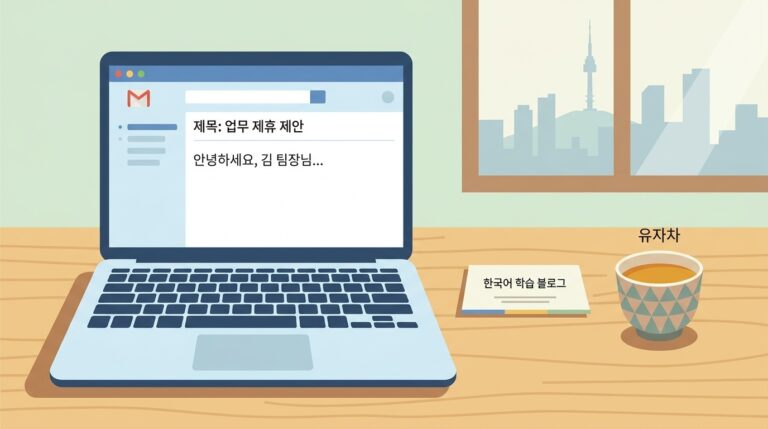
Master Formal Greetings & Introductions in Korean Business Emails (B2 Level)
Phase 1: Empathy (Your Korean Business Journey Starts Here!)
안녕하세요! It’s your friendly Daily Hangul editor here! 👋
Picture this: You’ve just landed an amazing project or partnership with a highly respected company in Seoul. You open your inbox, click “Compose,” and then… panic sets in. You want to make a stellar first impression, but your mind goes blank. “Should I start with ‘안녕하세요’? Is that too casual? Do I use ‘저는’ or ‘제가’? And how on earth do I introduce my position without sounding like a textbook from the 1990s?”
If you’ve felt this anxiety, you are not alone! In Korea’s business ecosystem, the opening line of an email is like a respectful bow at the office door. It sets the tone for your entire professional relationship. Today, we are going beyond the basic greetings to master the art of polished, natural, and culturally savvy business email introductions designed specifically for intermediate (B2) learners. Let’s make sure your emails never get ignored! 😉
Phase 2: Deep Dive into Top 3 Core Expressions
To write a flawless business email, you need to master these three powerhouse introductory phrases. Let’s dissect them like a pro!
1. 처음 인사드립니다 (cheo-eum in-sa-deu-rim-ni-da)
- Pronunciation: chuh-um een-sah-deu-reem-nee-dah (Rhymes with “drum” + “in-sah” + “dream-nee-dah”)
- Meaning: “I am writing/greeting you for the first time.”
- K-Culture Moment: You see this whenever a new team leader joins a corporate office in K-Dramas like Misaeng (Incomplete Life) or Start-Up. It’s the ultimate golden key for cold emails.
- Editor’s Insight: While “안녕하세요” is polite, “처음 인사드립니다” immediately elevates your email to a premium, highly professional level. It shows you understand corporate etiquette.
- Situation Spectrum: Casual: 🚫 | Semi-formal: ⚠️ | Formal: ✅
- 🤔 Think About It: Why does Korean culture place such heavy emphasis on explicitly stating that it is the “first time” greeting someone? How does this reflect the value of relationship-building in Korean business?
2. ~의 ~업무를 담당하고 있는 [이름]입니다 (~ui ~eop-mu-reul dam-dang-ha-go in-neun [name]-im-ni-da)
- Pronunciation: ~ui ~up-moo-reul dahm-dahng-hah-go een-neun [name]-eem-nee-dah
- Meaning: “I am [Name], in charge of [Task/Business] at [Company/Department].”
- K-Culture Moment: Think of Nam Do-san in Start-Up introducing his role in Samsan Tech to potential investors. This is the exact phrase he would use in an email.
- Editor’s Insight: Instead of just saying “I am a manager,” Korean professionals prefer to state their specific domain of responsibility (“업무를 담당하고 있는…”). It sounds highly proactive and reliable.
- Situation Spectrum: Casual: 🚫 | Semi-formal: ⚠️ | Formal: ✅
- 🤔 Think About It: In English, we often say “I am the Marketing Manager.” In Korean, we say “I am the person responsible for the marketing task.” How does this shift focus from ‘status’ to ‘duty’?
3. 귀사의 일익 번창을 기원합니다 (gwi-sa-ui il-ik beon-chang-eul gi-won-ham-ni-da)
- Pronunciation: gwee-sah-ui eel-eek bun-chahng-eul gee-won-hahm-nee-dah
- Meaning: “I wish your company continued growth and prosperity.”
- K-Culture Moment: This is the standard opening line found in formal business letters and official B2B emails. It’s the equivalent of “I hope this email finds you well,” but with a corporate-growth twist!
- Editor’s Insight: Do not use this with internal colleagues! This is strictly for external partners, clients, or vendors. It shows immense respect for the recipient’s organization.
- Situation Spectrum: Casual: 🚫 | Semi-formal: 🚫 | Formal: ✅
- 🤔 Think About It: How does starting an email with a blessing for another company’s business success show the collectivist nature of Korean business culture?
Phase 3: Textbook Korean vs. Real-World Korean
Let’s compare the rigid phrases found in standard textbooks with what real corporate Koreans actually use in contemporary business.
Scenario A: Introducing Your Position
- 📖 Textbook Korean: 저는 마케팅 매니저입니다. (Jeon-eun ma-ke-ting mae-ni-jeo-im-ni-da.) – “I am the marketing manager.”
- 🗣️ Real-World Korean: 마케팅 부서의 김준호 대리라고 합니다. (Ma-ke-ting bu-seo-ui Kim Jun-ho dae-ri-ra-go ham-ni-da.) – “I am called Deputy Manager Jun-ho Kim of the Marketing Department.”
- 💡 Why the difference? Koreans rarely use the direct English translation “매니저” (manager) unless it’s their official flat corporate title. Instead, they refer to their department and specific Korean corporate rank (대리, 과장, 차장) using the humbling form “~라고 합니다” (I am called…).
Scenario B: Wishing them well at the beginning
- 📖 Textbook Korean: 잘 지내셨습니까? (Jal ji-nae-syeot-seup-ni-ka?) – “Have you been doing well?”
- 🗣️ Real-World Korean: 노고가 많으십니다. (No-go-ga man-eu-sip-ni-da.) – “Thank you for your hard work/effort.”
- 💡 Why the difference? “잘 지내셨습니까?” can sound a bit too personal or awkward in a cold professional email. “노고가 많으십니다” (or “늘 애써주셔서 감사합니다”) acknowledges the recipient’s daily hard work, which is highly appreciated in Korean corporate culture.
Phase 4: K-Culture Deep Dive & Non-Verbal Etiquette
4-1. Nunchi (눈치) & Email Formatting
In Korea, Nunchi (the art of reading the room and context) applies to emails too! It’s not just what you write, but how it looks.
* Spacings & Paragraphs: Korean business emails are highly structured. Use clear paragraph breaks after your greeting, your introduction, and your main point. Crowded emails are seen as lacking manners.
* Honorifics (존댓말): Always use the highest formal ending (-습니다/습니까) in your first email. Transitioning to -아요/어요 (polite, semi-formal) is only acceptable after a rapport has been established over multiple exchanges.
4-2. The Culture of Rank (직급)
In K-Dramas, you’ll notice characters constantly checking business cards to see titles like Sa-jang-nim (CEO) or Bu-jang-nim (Department Head). In emails, you must address the recipient by their Name + Title + Honorific suffix 님. For example:
* Correct: 김민준 부장님 (Manager Min-jun Kim)
* Incorrect/Rude: 김민준 (Just the name) or 민준 씨 (Too casual for B2B)
Phase 5: Real-World Roleplay Scenario
Background: You are Alex, a Business Development Lead at a global tech firm. You are reaching out to Ms. Park Ji-won, the Team Leader of the Global Partnership team at a major Korean corporation (Hankook Tech), to introduce yourself and propose a collaboration.
Dialogue
- Alex:
🎭 (Polishing keyboard, taking a deep breath)
안녕하십니까, 한국테크 글로벌협력팀 박지원 팀장님.
(An-nyeong-ha-sim-ni-ka, Han-guk-te-keu Geul-lo-beol-hyeop-ryeok-tim Park Ji-won Tim-jang-nim.)
“Hello, Team Leader Ji-won Park of the Hankook Tech Global Partnership Team.” -
Ji-won:
🎭 (Reading incoming mail, sipping her morning coffee)
네, 안녕하세요. 메일 잘 확인했습니다.
(Ne, an-nyeong-ha-se-yo. Me-il jal hwa-gin-haet-seup-ni-da.)
“Yes, hello. I have received your email.” -
Alex:
🎭 (Writing professionally and clearly)
처음 인사드립니다. 저는 글로벌 글로벌 솔루션즈의 사업 개발 담당자 알렉스라고 합니다.
(Cheo-eum in-sa-deu-rim-ni-da. Jeon-eun Geul-lo-beol Sol-lu-syeon-jeu-ui sa-eop gae-bal dam-dang-ja Al-lek-seu-ra-go ham-ni-da.)
“I am writing to you for the first time. I am Alex, in charge of Business Development at Global Solutions.” -
Ji-won:
🎭 (Nodding in approval of the polite greeting)
아, 사업 개발 담당자분이시군요. 반갑습니다, 알렉스 님.
(Ah, sa-eop gae-bal dam-dang-ja-bun-i-si-gun-yo. Ban-gap-seup-ni-da, Al-lek-seu nim.)
“Ah, you are the person in charge of business development. Nice to meet you, Alex.” -
Alex:
🎭 (Injecting professional goodwill)
귀사의 일익 번창을 기원하며, 평소 한국테크의 혁신적인 기술력에 깊은 인상을 받았습니다.
(Gwi-sa-ui il-ik beon-chang-eul gi-won-ha-myeo, pyeong-so Han-guk-te-keu-ui hyeok-sin-jeok-in gi-sul-ryeok-e gip-eun in-sang-eul bat-at-seup-ni-da.)
“I wish your company prosperity, and I have always been deeply impressed by Hankook Tech’s innovative technology.” -
Ji-won:
🎭 (Smiling, feeling proud of her company)
그렇게 좋게 평가해 주시니 진심으로 감사드립니다.
(Geu-reot-ge jo-hyeop pyeong-ga-hae ju-si-ni jin-sim-eu-ro gam-sa-deu-rim-ni-da.)
“Thank you very much for evaluating us so highly.” -
Alex:
🎭 (Politely stating the purpose of the email)
이번 신규 프로젝트와 관련하여 정식으로 저희 회사와 협력 방안을 제안드리고자 연락드렸습니다.
(I-beon sin-gyu peu-ro-jek-teu-wa gwan-ryeon-ha-yeo jeong-sik-eu-ro jeo-hui hoe-sa-wa hyeop-ryeok bang-an-eul je-an-deu-ri-go-ja yeon-rak-deu-ryeot-seup-ni-da.)
“In connection with this new project, I am contacting you to formally propose a partnership with our company.” -
Ji-won:
🎭 (Intrigued by the polite approach)
네, 알렉스 님. 제안서를 검토해 본 후 다시 회신해 드리겠습니다.
(Ne, Al-lek-seu nim. Je-an-seo-reul geom-to-hae bon hu da-si hoe-sin-hae deu-ri-get-seup-ni-da.)
“Yes, Alex. I will review your proposal and reply to you soon.”
🔀 Interactive Decision Point
How should Alex reply to Ji-won’s last message to seal a great first impression?
- A) “빨리 답장 주세요. 기다릴게요.” (Ppal-li dap-jang ju-se-yo. Gi-da-ril-ge-yo.)
- B) “바쁘신 와중에도 검토해 주셔서 대단히 감사드립니다. 회신 기다리겠습니다.” (Ba-peu-sin wa-jung-e-do geom-to-hae ju-syeo-seo dae-dan-hi gam-sa-deu-rim-ni-da. Hoe-sin gi-da-ri-get-seup-ni-da.)
- C) “네, 알겠습니다. 바이바이!” (Ne, al-get-seup-ni-da. Bai-bai!)
Feedback:
- Selection A (Bad): Too direct and demanding. Asking a busy corporate lead to “reply fast” breaks professional etiquette.
- Selection B (Best!): Extremely polite, acknowledges their busy schedule (“바쁘신 와중에도”), and shows professional patience. Perfect B2 business Korean!
- Selection C (Risk): “Bye bye” in English characters (or Hangul) is way too casual and ruins the entire formal tone you worked hard to build.
Phase 6: 10-Second Emotion Shadowing Drill
Let’s practice saying these lines with natural flow, pauses, and the right corporate attitude. (Pause at / and match the emotion!)
[😊 Highly respectful & confident]
안녕하십니까, / 처음 인사드립니다. / 저는 / 마케팅 담당자 / 알렉스입니다.
(An-nyeong-ha-sim-ni-ka, / cheo-eum in-sa-deu-rim-ni-da. / Jeon-eun / ma-ke-ting dam-dang-ja / Al-lek-seu-im-ni-da.)-
[🤝 Sincere and hoping for cooperation]
귀사의 / 일익 번창을 기원하며, / 긍정적인 회신을 / 기다리겠습니다.
(Gwi-sa-ui / il-ik beon-chang-eul gi-won-ha-myeo, / geung-jeong-jeok-in hoe-sin-eul / gi-da-ri-get-seup-ni-da.)
Phase 7: K-Culture Mini Dictionary
- 담당자 (Dam-dang-ja) | Person in charge / Representative | Crucial word in Korean business. If you don’t know who to email, direct it to “글로벌 사업 담당자님” (To the person in charge of Global Business).
- 귀사 (Gwi-sa) | Your esteemed company | Used exclusively in formal written letters/emails to address the client’s or partner’s company.
- 노고 (No-go) | Hard work / Trouble | Usually used in the phrase “노고에 감사드립니다” (Thank you for your hard work).
- 회신 (Hoe-sin) | Reply / Response | Formal business synonym for ‘답장’ (dap-jang). Always use “회신 부탁드립니다” (Please reply) in business emails.
Phase 8: Survival Kit for Travelers & Business Expats
Survival Expressions TOP 3
- 명함 있으신가요? (Myeong-ham is-seu-sin-ga-yo?)
- “Do you have a business card?” (Essential for networking events in Seoul!)
- 메일로 연락드리겠습니다. (Me-il-lo yeon-rak-deu-ri-get-seup-ni-da.)
- “I will contact you via email.” (A clean way to wrap up a meeting.)
- 잘 부탁드립니다. (Jal bu-tak-deu-rim-ni-da.)
- “I look forward to working with you.” (The golden closing phrase for everything.)
Editor’s Travel Note
When heading to Seoul for business meetings, make sure you download the Naver Map App immediately. Google Maps is notoriously inaccurate for walking routes in corporate hubs like Yeouido or Teheranno (Gangnam). Also, remember to hand over your business card (명함) with both hands with the text facing the recipient so they can read it instantly!
Note: Local transport fares and app interfaces are subject to updates by operators.
Phase 9:
Frequently Asked Questions (FAQ)
Q: What does "처음 인사드립니다 (cheo-eum in-sa-deu-rim-ni-da)" mean in Korean and how do you pronounce it?
A: In Korean, "처음 인사드립니다 (cheo-eum in-sa-deu-rim-ni-da)" is pronounced [chuh-um een-sah-deu-reem-nee-dah (Rhymes with "drum" + "in-sah" + "dream-nee-dah"] and means: "I am writing/greeting you for the first time."
Q: What does "~의 ~업무를 담당하고 있는 [이름]입니다 (~ui ~eop-mu-reul dam-dang-ha-go in-neun [name]-im-ni-da)" mean in Korean and how do you pronounce it?
A: In Korean, "~의 ~업무를 담당하고 있는 [이름]입니다 (~ui ~eop-mu-reul dam-dang-ha-go in-neun [name]-im-ni-da)" is pronounced [~ui ~up-moo-reul dahm-dahng-hah-go een-neun [name] and means: "I am [Name], in charge of [Task/Business] at [Company/Department]."
Q: What does "귀사의 일익 번창을 기원합니다 (gwi-sa-ui il-ik beon-chang-eul gi-won-ham-ni-da)" mean in Korean and how do you pronounce it?
A: In Korean, "귀사의 일익 번창을 기원합니다 (gwi-sa-ui il-ik beon-chang-eul gi-won-ham-ni-da)" is pronounced [gwee-sah-ui eel-eek bun-chahng-eul gee-won-hahm-nee-dah] and means: "I wish your company continued growth and prosperity."







