

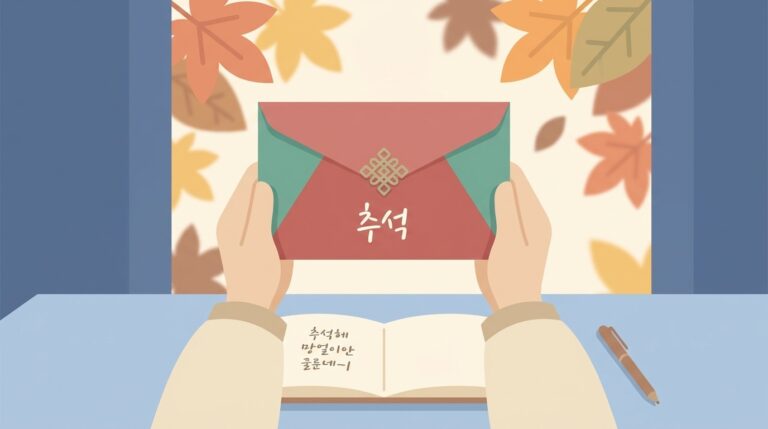
Master Chuseok Etiquette: How to Give ‘Yongdon’ (Allowance) to Korean Parents
Phase 1: Empathy (Welcome to Daily Hangul!)
안녕하세요! (Annyeonghaseyo!) I’m your Daily Hangul editor and your personal cultural navigator. 🍂
Imagine this: It’s Chuseok (추석 – Korean Thanksgiving), the air is crisp, and the table is overflowing with delicious Songpyeon (송편). You’re gathered with your Korean partner’s family or your own Korean in-laws. The mood is warm, but suddenly, a wave of anxiety hits you. It’s time for the ultimate Korean holiday ritual: presenting Yongdon (용돈 – pocket money/allowance) to the parents.
You have the cash prepared in a beautiful envelope, but your mind goes blank. What do I say? Do I just hand it over like a business card? Will I look disrespectful if I use the wrong words?
Take a deep breath! Many of our intermediate (B1) learners share this exact worry. Handing over money in Korea isn’t just a financial transaction; it is a highly emotional, respectful art form. Today, we’ll learn the exact phrases, the physical etiquette, and the cultural nuances to make your Chuseok experience incredibly heartwarming and socially flawless. Let’s dive in! 🚀
Phase 2: Deep Dive into 3 Essential Expressions
1. 작지만 제 성의예요 (Jak-ji-man je seong-ui-yeo-yo)
- Pronunciation: Jak-ji-man je sung-ui-ye-yo (Sounds like: “Jack-jee-mahn jeh sung-we-yeh-yo”)
- Meaning: It’s small, but it’s a token of my appreciation (sincerity).
- K-Culture Moment: In K-Dramas, you’ll often see a humble daughter-in-law shyly handing over a crisp white envelope to her mother-in-law over tea, whispering this phrase with a gentle bow.
- Editor’s Insight: The word 성의 (seong-ui) means “sincerity” or “devotion.” Even if the envelope contains a generous amount, Korean culture highly values humility. Saying “it’s small” (작지만) takes the focus off the monetary value and highlights your respect.
- Situation Spectrum: Casual ⚠️ | Semi-formal ✅ | Formal ✅
- 🤔 Think About It: In many Western cultures, downplaying a gift by calling it “small” might sound like you didn’t effort much. In Korea, why do you think humility is considered the ultimate form of respect?
2. 약소하지만 부모님 용돈 준비했어요 (Yak-so-ha-ji-man bu-mo-nim yong-don jun-bi-haess-eo-yo)
- Pronunciation: Yak-so-ha-jee-mahn boo-mo-nim yong-don joon-bee-haet-uh-yo
- Meaning: It is humble, but I prepared some pocket money for you.
- K-Culture Moment: A son returning home after a successful year in the city sits down with his aging parents after Chuseok dinner and presents this gift.
- Editor’s Insight: 약소하다 (yaksohada) is a beautiful, slightly more formal word for “meager” or “small.” Using this word instantly upgrades your Korean to a highly polite, respectful level that will pleasantly surprise any Korean parent.
- Situation Spectrum: Casual 🚫 | Semi-formal ✅ | Formal ✅
- 🤔 Think About It: How does using elevated vocabulary like ‘약소하다’ change the atmosphere of a family gathering?
3. 맛있는 거 사 드세요 (Mas-iss-neun geo sa deu-se-yo)
- Pronunciation: Mah-shin-neun guh sah deu-seh-yo
- Meaning: Please buy yourself something delicious.
- K-Culture Moment: This is the ultimate, affectionate phrase used by adult children. It is often written on the envelope itself or said with a playful, loving smile.
- Editor’s Insight: In Korea, food is love. Telling your parents to buy “something delicious” is a warm, indirect way of saying “Please take care of your health and enjoy your life.”
- Situation Spectrum: Casual ✅ | Semi-formal ✅ | Formal ⚠️
- 🤔 Think About It: Why is “eating well” such a central theme in Korean expressions of love and care compared to your home country?
Phase 3: Textbook vs. Real Life
Let’s compare what rigid textbooks teach you versus how modern Koreans actually talk.
Scenario A: Handing over the envelope
- 📖 Textbook Korean: “부모님, 돈을 받으십시오.” (Bu-mo-nim, don-eul bad-eu-sip-si-o. – Parents, receive this money.)
- Why it’s awkward: Sounds like a robotic transaction or an official business payment. Extremely cold!
- 🗣️ Real Life Korean: “엄마, 아빠, 이거 작지만 제 성의예요. 두 분 맛있는 거 사 드세요!” (Eomma, appa, i-geo jak-ji-man je seong-ui-yeo-yo. Du bun mas-iss-neun geo sa deu-se-yo! – Mom, Dad, this is a small token of my appreciation. Please buy yourselves something delicious!)
- 💡 Why it works: It combines respect (성의) with warm, affectionate family terms (엄마, 아빠, 두 분).
Scenario B: Describing the gift
- 📖 Textbook Korean: “이것은 저의 기부입니다.” (I-geos-eun jeo-ui gi-bu-im-ni-da. – This is my donation.)
- Why it’s awkward: Never use “donation” (기부) for family! It sounds like charity.
- 🗣️ Real Life Korean: “추석이라 부모님 용돈 조금 준비했어요.” (Chu-seok-i-ra bu-mo-nim yong-don jo-geum jun-bi-haess-eo-yo. – Since it’s Chuseok, I prepared a little pocket money for you.)
- 💡 Why it works: It references the specific holiday (추석이라) and uses “조금” (a little) to remain humble.
Phase 4: K-Culture Deep Dive & Non-Verbal Manners
4-1. The Art of the Hand Delivery (Gesture & Nunchi)
In Korea, how you give is just as important as what you give.
1. Two Hands are Mandatory: Always present the envelope with both hands. Hold the envelope by the bottom corners with both hands, or support your right wrist/forearm with your left hand.
2. The Eye Contact & Bow: Make gentle eye contact, give a soft smile, and slightly bow your head as you present the envelope. Do not look down at the floor or hand it over casually while looking at your phone!
3. The Envelope Rules: Never give bare cash. Always use a clean, elegant envelope (용돈 봉투). Writing a short, handwritten message on the back of the envelope adds 1000% more emotional value.
4-2. The “Nunchi” Dance of Acceptance
When you offer the envelope, Korean parents will almost certainly say: “Oh no, you don’t have to do this! Keep your money!” (아이구, 돈 안 줘도 되는데!).
This is a cultural dance of politeness! Do not pull the envelope back immediately. This is where your Nunchi (눈치 – situational quickness) comes in. Smile, gently push the envelope closer to them, and say, “아니에요, 부모님! 제 성의예요. 꼭 받으세요.” (No, parents! It’s my sincerity. Please accept it.) They will gladly accept it on the second or third try.
Phase 5: Real-Life Roleplay Scenario
The Setup
- Setting: The cozy living room of your Korean partner’s parents after Chuseok lunch.
- NPC Character: 어머님 (Eomeonim – Mother-in-law). She is warm but traditional, wearing a beautiful apron.
Dialogue
- 어머님: “아이고, 우리 사위/며느리 먼 길 오느라 고생 많았어. 밥은 입에 맞았니?”
(Aigo, uri sawi/myeoneuri meon gil oneura gosaeng manasseo. Babeun ibe majanni?)
“Oh, our son-in-law/daughter-in-law, you went through so much trouble coming all this way. Did you like the food?” -
You: 🎭 (Smiling warmly, taking out the envelope) “네, 어머님! 음식이 정말 맛있었어요. 갈비찜 최고예요!”
(Ne, eomeonim! Eomsigi jeongmal mas-isseosseo-yo. Galbijjim choegoyeyo!)
“Yes, Mother! The food was absolutely delicious. The Galbijjim (braised short ribs) was the best!” -
어머님: “그래, 많이 먹어서 다행이다. 명절인데 푹 쉬다 가렴.”
(Georae, mani meogeoseo dahaengida. Myeongjeorinde puk swida garyeom.)
“I’m so glad you ate well. Since it’s the holiday, rest well before you go.” -
You: 🎭 (Holding the envelope with both hands, bowing head slightly) “어머님, 아버님. 추석이라 약소하지만 두 분 용돈 좀 준비했어요.”
(Eomeonim, abeonim. Chu-seok-i-ra yak-so-ha-ji-man du bun yong-don jom jun-bi-haess-eo-yo.)
“Mother, Father. Since it’s Chuseok, I prepared some humble pocket money for the two of you.” -
어머님: 🎭 (Waving her hands in polite refusal) “아유, 무슨 용돈이야! 너희들 쓸 돈도 부족할 텐데 그냥 가져가!”
(Ayu, museun yongdon-iya! Neohuideul sseul dondo bujokhal tende geunyang gajeoga!)
“Oh, what pocket money! You guys probably don’t have enough money to spend yourself, just take it back!” -
You: 🎭 (Gently pressing the envelope into her hands with a bright smile) “아니에요, 어머님. 작지만 제 성의예요. 두 분 맛있는 거 꼭 사 드세요.”
(Anieyo, eomeonim. Jak-ji-man je seong-ui-yeo-yo. Du bun mas-iss-neun geo kkok sa deu-se-yo.)
“No, Mother. It’s small, but it’s my sincerity. Please buy yourselves something delicious without fail.” -
어머님: 🎭 (Accepting the envelope with a proud, happy smile) “아이구… 정말 고마워. 매번 이렇게 신경 써줘서 정말 고맙구나.”
(Aigu… jeongmal gomawo. Maebeon ireohke singyeong sseojwoseo jeongmal gomapguna.)
“Oh dear… thank you so much. Thank you so much for always caring for us like this.” -
You: 🎭 (Bowing slightly) “아니에요. 건강하게만 지내주세요, 어머님.”
(Anieyo. Geon-gang-ha-ge-man ji-nae-ju-se-yo, eomeonim.)
“Not at all. Just please stay healthy, Mother.”
🔀 Choose Your Path
How do you respond when the Mother-in-law first refuses the money?
* Option A: “아, 네. 그럼 다시 가져갈게요!” (Oh, okay. Then I’ll take it back!)
* Option B: “아니에요, 어머님! 제 성의니까 꼭 받으셔야 돼요!” (No, Mother! It’s my sincerity, so you absolutely must receive it!)
* Option C: “엄마 용돈 많이 벌었으니까 걱정 마세요!” (Don’t worry, Mom, because I earned a lot of pocket money!)
🧐 Path Feedback:
- Option A (Bad): 🚫 Too fast! Accepting their refusal immediately looks like you didn’t actually want to give it. Keep playing the polite push-and-pull dance!
- Option B (Best): Perfect! Respectful, affectionate, and shows your sincere heart without being overly aggressive.
- Option C (Risk): ⚠️ Too boastful. While confidence is nice, bragging about your income to parents-in-law can sometimes break the humble atmosphere highly valued in Korean family gatherings.
Phase 6: 10-Second Emotional Shadowing Drill
Practice saying these out loud with the correct rhythm and emotional warmth! The slash (/) indicates a natural pause.
- [😊 Humble & Respectful]
“어머님, / 추석이라 / 약소하지만 / 용돈 좀 준비했어요.”
(Eomeonim, / Chu-seok-i-ra / yak-so-ha-ji-man / yong-don jom jun-bi-haess-eo-yo.) - [🥺 Sincere & Warm]
“작지만 / 제 성의예요. / 꼭 받으세요!”
(Jak-ji-man / je seong-ui-yeo-yo. / Kkok bad-eu-se-yo!) - [💖 Bright & Affectionate]
“두 분 / 맛있는 거 / 사 드세요!”
(Du bun / mas-iss-neun geo / sa deu-se-yo!)
Phase 7: K-Culture Mini Dictionary
- 용돈 봉투 (Yongdon Bongtu) | Pocket Money Envelope
- Special decorative envelopes used for giving money to parents or children during holidays. They often have elegant traditional Korean patterns or warm modern illustrations.
- 효도 (Hyodo) | Filial Piety
- The deep-rooted Confucian value of loving, respecting, and supporting one’s parents. Giving Yongdon is considered a practical, modern expression of Hyodo.
- 신사임당 (Shin Saimdang) | Shin Saimdang
- The prominent historical female artist featured on the 50,000 KRW bill (the highest denomination bill in Korea). Giving a stack of these yellow bills is often playfully referred to as “giving Saimdang.”
- 세뱃돈 (Sebaetdon) | New Year’s Money
- While Yongdon is general pocket money given anytime (especially Chuseok), Sebaetdon is specifically the cash given during Lunar New Year (Seollal) after performing a formal bow (saebae).
Phase 8: Traveler’s Survival Kit
Survival Expressions for Chuseok Holidays
- 즐거운 추석 보내세요! (Jeul-geo-un Chu-seok bo-nae-se-yo!)
- “Have a wonderful/happy Chuseok!” (Perfect for text messages to friends and colleagues).
- 보름달 보고 소원 빌었어요? (Bo-reum-dal bo-go so-won bil-eoss-eo-yo?)
- “Did you make a wish upon the full moon?” (Chuseok features a giant full moon).
- 남은 연휴 잘 보내세요! (Nam-eun yeon-hyu jal bo-nae-se-yo!)
- “Have a great rest of your holiday!” (Great to say at the end of the break).
💡 Editor’s Travel Note:
If you are traveling in Korea during Chuseok, note that many local family-owned shops and clinics might close. Keep Naver Map (네이버 지도) installed on your phone to check real-time business hours. Public transit often operates on holiday schedules, so book your KTX train tickets weeks in advance!
Phase 9:
Frequently Asked Questions (FAQ)
Q: What does "작지만 제 성의예요 (Jak-ji-man je seong-ui-yeo-yo)" mean in Korean and how do you pronounce it?
A: In Korean, "작지만 제 성의예요 (Jak-ji-man je seong-ui-yeo-yo)" is pronounced [Jak-ji-man je sung-ui-ye-yo (Sounds like: "Jack-jee-mahn jeh sung-we-yeh-yo"] and means: It's small, but it’s a token of my appreciation (sincerity).
Q: What does "약소하지만 부모님 용돈 준비했어요 (Yak-so-ha-ji-man bu-mo-nim yong-don jun-bi-haess-eo-yo)" mean in Korean and how do you pronounce it?
A: In Korean, "약소하지만 부모님 용돈 준비했어요 (Yak-so-ha-ji-man bu-mo-nim yong-don jun-bi-haess-eo-yo)" is pronounced [Yak-so-ha-jee-mahn boo-mo-nim yong-don joon-bee-haet-uh-yo] and means: It is humble, but I prepared some pocket money for you.
Q: What does "맛있는 거 사 드세요 (Mas-iss-neun geo sa deu-se-yo)" mean in Korean and how do you pronounce it?
A: In Korean, "맛있는 거 사 드세요 (Mas-iss-neun geo sa deu-se-yo)" is pronounced [Mah-shin-neun guh sah deu-seh-yo] and means: Please buy yourself something delicious.







