

Master the Art of Docent Tours: Level Up Your Korean Art Discourse (C1)
Phase 1: Empathy (공감) — The Art of Deep Listening
안녕하세요! It’s your Korean culture navigator and editor from Daily Hangul (매일한글).
Imagine stepping into the sleek, sunlit galleries of the National Museum of Modern and Contemporary Art (MMCA, 국립현대미술관) in Seoul. You’re surrounded by thought-provoking installations, and a small crowd begins to gather around a charismatic guide—the docent. You step closer, eager to dive deep into Korea’s vibrant contemporary art scene. But as the docent begins to speak, you realize that textbook Korean didn’t quite prepare you for the abstract, philosophical vocabulary of art criticism, or the polite, subtle ways to ask a docent to unpack a complex concept.
Many C1 learners tell us: “I can order food and chat with friends, but when I try to discuss art or ask questions during a museum tour, I freeze. I don’t want to sound rude or overly academic.”
Don’t worry! Today, we are going beyond “이것은 무엇입니까?” (What is this?). We will master the exact expressions and cultural nuances you need to confidently engage with docents and art enthusiasts in Korea. Let’s elevate your Korean to a truly sophisticated level.
Phase 2: Key Expressions (핵심 표현 3선 심층 분석)
1. 작가의 의도를 어떻게 해석해야 할까요? (Jak-ga-ui ui-do-reul eo-tteo-ke hae-seok-hae-ya hal-kka-yo?)
- Pronunciation: Jak-ga-ui (sounds like ‘chack-gah-ui’) ui-do-reul (‘ui-doh-reul’) eo-tteo-ke (‘uh-tteoh-keh’) hae-seok-hae-ya (‘hae-suk-hae-yah’) hal-kka-yo? (‘hal-kkah-yoh?’)
- Meaning: How should we interpret the artist’s intention?
- K-Culture Moment: You will hear this frequently in modern art documentaries on platforms like Watcha or in interviews with directors at the Gwangju Biennale.
- Editor’s Insight: In Korean art spaces, directly asking “What does this mean?” (이게 무슨 뜻이에요?) can sound a bit dry or simplistic. Using “해석하다” (to interpret) and “의도” (intention) elevates your query, showing respect for the artist’s creative process.
- Situation Spectrum: Casual: 🚫 | Semi-formal: ⚠️ | Formal: ✅
- 🤔 Think About It: Why does Korean art discourse emphasize the “artist’s mind/intention” (의도) so heavily compared to just looking at the physical object?
2. 이 작품에 담긴 시대적 배경이 궁금합니다 (I jak-pum-e dam-gin si-dae-jeok bae-gyeong-i gung-geum-hap-ni-da)
- Pronunciation: I (‘ee’) jak-pum-e (‘chack-poom-eh’) dam-gin (‘dahm-gheen’) si-dae-jeok (‘she-dae-juck’) bae-gyeong-i (‘bae-gyung-ee’) gung-geum-hap-ni-da (‘goong-goom-hap-nee-dah’)
- Meaning: I am curious about the historical/societal background reflected in this piece.
- K-Culture Moment: Essential for understanding Dansaekhwa (Korean monochrome painting) or Minjung art, which are deeply tied to Korea’s turbulent 20th-century history.
- Editor’s Insight: The verb “담기다” (to be contained/imbued) is a beautiful, passive way to say that an artwork holds history or emotion within it.
- Situation Spectrum: Casual: 🚫 | Semi-formal: ⚠️ | Formal: ✅
- 🤔 Think About It: How does knowing the socio-political backdrop of Korea change your perception of its modern minimalism?
3. 여백의 미가 돋보이는 것 같아요 (Yeo-baek-ui mi-ga dot-bo-i-neun geot gat-a-yo)
- Pronunciation: Yeo-baek-ui (‘yuh-baek-ui’) mi-ga (‘mee-gah’) dot-bo-i-neun (‘dot-boh-ee-noon’) geot (‘gut’) gat-a-yo (‘gah-tah-yoh’)
- Meaning: I feel like the beauty of empty space (white space) really stands out.
- K-Culture Moment: Used by curators to describe traditional ink wash paintings or modern minimalist sculptures.
- Editor’s Insight: “여백의 미” (The beauty of empty space/void) is a core concept in Korean aesthetics. Saying something “돋보이다” means it stands out in a refined, beautiful way.
- Situation Spectrum: Casual: ⚠️ | Semi-formal: ✅ | Formal: ✅
- 🤔 Think About It: How does “여백의 미” reflect the broader Korean philosophical value of modesty and leaving room for nature?
Phase 3: Textbook vs. Real Korean (교과서 한국어 vs 진짜 한국어)
Situation 1: Asking the docent to repeat or clarify an abstract explanation.
- 📖 Textbook: 다시 한 번 설명해 주세요. (Dasi han beon seol-myeong-hae ju-se-yo. / Please explain it once more.)
- 🗣️ Real Korean: 방금 말씀하신 개념이 조금 어렵게 다가오는데, 조금 더 쉽게 풀어주실 수 있을까요? (Bang-geum mal-sseum-ha-sin gae-nyeom-i jo-geum eo-ryeop-ge da-ga-o-neun-de, jo-geum deo swip-ge pul-eo-ju-sil su is-seul-kka-yo? / The concept you just mentioned feels a bit difficult to grasp, could you perhaps unpack it a bit more simply?)
- 💡 Why the difference? Textbook Korean is grammatically correct but can sound demanding. Real C1 Korean uses “다가오다” (to approach/feel to someone) to politely shift the “difficulty” to yourself, and “풀어주다” (to unpack/untangle) to make the request sound smooth and respectful.
Situation 2: Expressing deep resonance with a piece.
- 📖 Textbook: 이 그림은 정말 감동적입니다. (I geu-rim-eun jeong-mal gam-dong-jeok-im-ni-da. / This painting is very touching.)
- 🗣️ Real Korean: 이 작품은 보면 볼수록 가슴에 와닿는 면이 있네요. (I jak-pum-eun bo-myeon bol-su-rok ga-seum-e wa-dat-neun myeon-i it-nae-yo. / The more I look at this piece, the more it strikes a chord in my heart.)
- 💡 Why the difference? “보면 볼수록” (the more I look at it, the more…) shows deep engagement with the art, and “가슴에 와닿다” (to touch/strike a chord in one’s heart) sounds infinitely more natural and poetic than “감동적이다”.
Phase 4: K-Culture Deep-Dive & Non-Verbal Etiquette
4-1. Art Gallery Etiquette & Gestures in Korea
When attending a docent tour in Korea, non-verbal cues speak volumes:
* The “Thoughtful” Nod (끄덕임): Slowly nodding while maintaining gentle eye contact with the docent shows you are following their narrative.
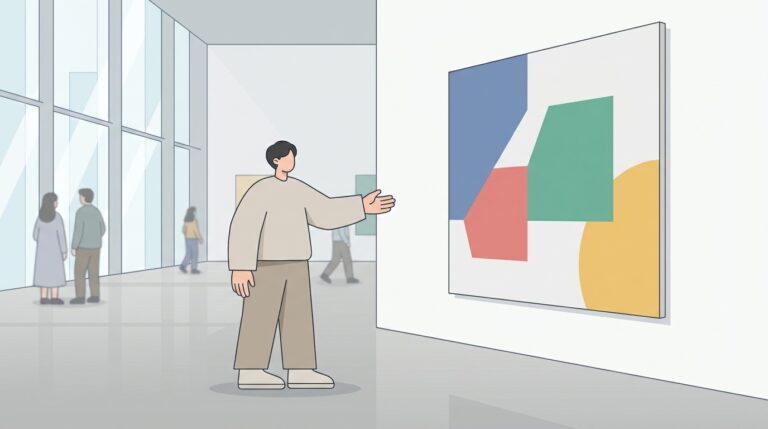
* The Two-Handed Gesture: If pointing at a detail in a painting, never use a single finger. Instead, open your hand flat with palm up and gently gesturate towards the painting. This is the ultimate sign of respect for both the art and the guide.
4-2. The Rise of “Art-tech” (아트테크) in Korea
In modern Korea, visiting galleries isn’t just an elite hobby. Young Koreans (MZ Generation) have popularized “Art-tech” (art investment) and “Art-vacation” (art-mung / 아트멍 – spacing out while looking at art). Showing interest in these contemporary trends during your tour will instantly connect you with local art lovers.
Phase 5: Real-Life Roleplay Scenario
Setting: Hanwon (한원), a contemporary art gallery in Samcheong-dong, Seoul.
Characters:
* 지우 (Jiwoo – Docent): An articulate, passionate modern art docent.
* 민우 (Minwoo – Learner): A passionate C1 Korean learner visiting the gallery.
- 지우: 🎭 (작품 앞을 손으로 가리키며) 이 작품의 붉은 선들은 작가가 겪은 내면의 갈등과 사회적 억압을 시각화한 것입니다.
- 민우: 🎭 (진지하게 고개를 끄덕이며) 아, 그렇군요. 혹시 이 작품에 담긴 시대적 배경에 대해 조금 더 설명해 주실 수 있나요?
- 지우: 좋은 질문입니다. 작가는 1980년대 한국의 급격한 산업화 과정 속에서 소외된 인간의 외로움을 표현하고자 했습니다.
- 민우: 🎭 (작품을 유심히 바라보며) 설명을 들으니 작가의 의도가 더 잘 가슴에 와닿는 것 같아요.
- 지우: 그렇게 느껴주시다니 기쁘네요. 혹시 이 옆의 여백에 대해서는 어떻게 생각하시나요?
- 민우: 🎭 (미소를 지으며) 오히려 비어 있는 공간 덕분에 인물의 고독함이 더 극대화되는, 일종의 여백의 미가 느껴집니다.
- 지우: 정확하게 보셨습니다! 바로 그 여백이 감상자 스스로 생각할 공간을 만들어주죠.
- 민우: 오늘 도슨트 투어 덕분에 작품을 훨씬 더 깊이 있게 감상할 수 있게 되었어요. 정말 감사합니다.
🔀 Interactive Choice Point
At the end of the tour, how should you respond to Jiwoo to ask for further recommendations?
* Option A: “이 미술관에서 또 볼 만한 다른 전시가 있을까요?” (Is there another exhibition worth seeing in this museum?)
* Option B: “여기서 제일 비싼 그림이 어디에 있어요?” (Where is the most expensive painting here?)
* Option C: “선생님이 개인적으로 가장 아끼시는 작품은 무엇인지 궁금합니다.” (I’m curious which piece is your personal favorite, teacher.)
Feedback:
- Option A (Good): Practical and polite. A safe choice to continue your gallery tour.
- Option B (Bad): While curious, asking about prices to a docent breaks the artistic atmosphere and can be seen as overly materialistic.
- Option C (Best/Highly Recommended): Flattering and highly sophisticated! Using “선생님” (teacher/expert) for the docent and asking for their personal favorite (“가장 아끼시는”) builds a beautiful emotional connection and yields fascinating recommendations.
Phase 6: 10-Second Shadowing Drill
Let’s practice speaking with the exact rhythm and emotion of an art connoisseur. Pay attention to the pauses (/) and the emotional cues!
[😌 감탄하며 부드럽게 / Softly with admiration]- Sentence: 이 작품은 / 보면 볼수록 / 가슴에 깊이 / 와닿네요.
- Pronunciation: I jak-pum-eun / bo-myeon bol-su-rok / ga-seum-e gip-i / wa-dat-nae-yo.
[🤔 진지하고 지적인 톤으로 / Serious and intellectual tone]- Sentence: 작가의 의도와 / 시대적 배경이 / 어떻게 맞닿아 있는지 / 궁금합니다.
- Pronunciation: Jak-ga-ui ui-do-wa / si-dae-jeok bae-gyeong-i / eo-tteo-ke mat-da-a in-neun-ji / gung-geum-hap-ni-da.
Phase 7: K-Culture Mini Dictionary
- 도슨트 (Docent): A museum guide. In Korea, docents are highly respected as cultural mediators.
- 도슨트 투어 (Docent Tour): Guided tours usually held at set times (e.g., 11 AM, 2 PM, 4 PM). They are usually free with museum admission.
- 도슨트기기 (Audio Guide Device): Handheld audio guides. Often available for rent at the lobby for a small fee (~3,000 KRW).
- 미술관 투어 (Art Gallery Tour): A popular weekend date or healing activity in areas like Samcheong-dong, Hannam-dong, or Insadong.
Phase 8: Traveler’s Survival Kit
Survival Phrases for Art Lovers
- 혹시 오늘 도슨트 투어 시간이 어떻게 되나요? (Hok-si o-neul do-seun-teu tu-eo si-gan-i eo-tteo-ke doe-na-yo?)
- Pro Tip: Use this at the ticket booth to plan your gallery visit.
- 오디오 가이드 대여할 수 있는 곳이 어디인가요? (O-di-o ga-i-deu dae-yeo-hal su in-neun got-i eo-di-in-ga-yo?)
- Pro Tip: Useful if you miss the live docent tour.
- 전시장 내에서 사진 촬영이 가능한가요? (Jeon-si-jang nae-e-seo sa-jin chwal-yeong-i ga-neung-han-ga-yo?)
- Pro Tip: Essential query, as some exhibitions strictly prohibit photography.
Editor’s Travel Note: Always check the MMCA Official Website or use the Naver Map App (네이버 지도 앱) to check real-time exhibition schedules and holiday closures. Note: Exhibition details are subject to change, so a quick online check before heading out is recommended.
Phase 9: “Going Deeper” — Cultural Insight
In Korean art spaces, the relationship between the docent and the visitor is not just one-way information delivery. It is a shared emotional experience known as 공감 (gong-gam / empathy).
By asking questions that reference the “artist’s heart” or the “era’s pain,” you are participating in a collective contemplation. Korean society values this shared vibe (분위기) deeply. When you speak about art, you aren’t just analyzing colors; you are connecting with the Korean soul.
💬 Your Turn: Have you ever visited an art gallery in Korea? What kind of artwork resonates with you the most? Share your thoughts in the comments below! (Korean replies welcome!)
Phase 10: FAQ & Common Mistakes
Q: Can I use informal Banmal (반말) when discussing art with someone my age at a gallery?
A: It is highly recommended to stick to polite 존댓말 (Jeondetmal) in public art spaces, even with peers, to maintain the elegant, respectful atmosphere of the venue.
Q: What is the difference between ‘작품’ (jak-pum) and ‘그림’ (geu-rim)?
A: ‘그림’ specifically refers to drawings or paintings. ‘작품’ translates to “artwork” or “masterpiece” and encompasses sculptures, installations, media art, and paintings.
Q: How do I tell the docent I didn’t understand without sounding unintelligent?
A: Use the phrase “미술 용어가 아직 저에게는 조금 낯설어서요” (Art terminology is still a bit unfamiliar to me). Docents love explaining concepts to enthusiastic learners!
🚨 Common Mistakes Alert!
- Saying “이 그림 얼마예요?” (How much is this painting?) at a national museum. National galleries do not sell art. Only ask this in commercial galleries (화랑) in a discreet manner.
- Pointing with your index finger close to the canvas. Security guards will quickly intervene. Keep a safe distance of at least 30cm.
- Using too many translated English art terms. Instead of saying “콘셉트” (concept), try using the native word “개념” (gae-nyeom) or “의도” (ui-do) to sound far more natural.
Phase 11: Action Mission!
- 🥉 Bronze Medal: Find a Korean artwork online (e.g., a painting by Kim Whanki) and write one sentence describing it using “여백의 미가 느껴집니다.”
- 🥈 Silver Medal: Share this post on your Instagram Stories and write your favorite art-related Korean word!
- 🥇 Gold Medal: Next time you visit a Korean museum, ask the docent: “작가가 이 작품을 통해 전하고자 한 메시지는 무엇인가요?”
Phase 12: Interactive Quiz Challenge
Test your knowledge before you head to the gallery!
Q1. Which of the following is the most polite way to ask for an explanation of an artwork’s background?
- 이 그림 배경이 뭐야?
- 이 작품에 어떤 시대적 배경이 담겨 있나요?
- 왜 이렇게 그렸어요?
Click here for Answer & Explanation
Correct Answer: 2
Explanation: Option 2 uses formal honorifics and the beautiful verb “담기다” (to be contained), making it perfect for a C1 learner speaking to a docent. Option 1 is casual banmal, and Option 3 sounds slightly demanding.
Q2. True or False: “여백의 미” (Yeobaek-ui mi) is only used for traditional Joseon Dynasty paintings.
Click here for Answer & Explanation
Correct Answer: False
Explanation: While it originated in traditional ink paintings, “여백의 미” is widely used today to describe modern minimalist art, home interior designs, and even spatial architecture in Korea.







