

안녕하세요! 매일한글 에디터입니다. 🌿
Have you ever scrolled through Instagram or watched a K-Drama like Monthy House or Our Beloved Summer, looking at those pristine, minimalist Korean apartments (랜선 집들이 – online housewarmings) and thought, “I can absolutely do that myself!”?
We’ve all been there. The minimalist wooden aesthetic, the warm indirect lighting, the perfectly balanced pastel walls. But then reality hits. You buy the wrong wallpaper, drill into a load-bearing wall, or end up with furniture that blocks your front door.
In Korea, the self-interior (셀프 인테리어) craze is huge, but so are the epic failures (폭망 – complete ruins). Today, we are diving deep into the high-level, sophisticated Korean vocabulary you need to discuss these design disasters and triumphs like a true native. This guide is based on real-life feedback from our advanced learners who tried to renovate their officetels (오피스텔) in Seoul. Let’s get started!
Phase 2: 핵심 표현 3선 심층 분석 (Deep Dive into Key Expressions)
1. 배보다 배꼽이 더 크다 (Bae-boda bae-kkobi deo keuda)
- Pronunciation: Bae-boda bae-kkobi deo keuda (Sounds like “Payer-boda payer-co-bee der coo-da”)
- Meaning: The belly button is bigger than the belly (Idiom: The hidden/incidental costs outweigh the main expense).
- K-Culture Moment: You decide to change your bathroom tiles yourself to save ₩500,000. You accidentally crack a water pipe, flooding your neighbor’s ceiling. The repair bill is ₩3,000,000. Your friend sighs and says, “거봐, 배보다 배꼽이 더 컸네!”
- Editor’s Insight: This is a classic Korean idiom perfectly suited for C2 speakers. In interior design, choosing DIY often leads to buying specialized tools you’ll use only once, making the DIY cost higher than hiring a professional (업체 부르기).
- Situation Spectrum: Casual ✅ | Semi-formal ✅ | Formal ⚠️
- 🤔 Think About It: How does your culture view the risk of DIY versus hiring professionals? Do you have an equivalent idiom for this economic irony?
2. 가성비 극대화하려다 가심비까지 버리다 (Gaseongbi geukdaehwadeuryeoda gasimbi-kkaji beorida)
- Pronunciation: Ga-seong-bi geuk-dae-hwa-hyeo-ryeo-da ga-sim-bi-kka-ji beo-ri-da
- Meaning: Trying to maximize cost-effectiveness (가성비) but ending up throwing away emotional satisfaction (가심비).
- K-Culture Moment: Buying cheap plastic shelves that smell like chemicals and look terrible, just to save a few bucks. Your aesthetic peace of mind is ruined.
- Editor’s Insight:
가성비(Price-to-performance ratio) is a staple of Korean consumer culture. But modern Koreans also care deeply about가심비(Price-to-heart ratio, i.e., emotional satisfaction). C2 speakers should master the contrast between these two modern neologisms. - Situation Spectrum: Casual ✅ | Semi-formal ✅ | Formal 🚫
- 🤔 Think About It: When decorating your personal space, which one do you prioritize: Gaseongbi (utility) or Gasimbi (aesthetic joy)?
3. 손을 대다 / 손을 못 대다 (Soneul daeda / Soneul mot daeda)
- Pronunciation: So-neul dae-da / So-neul mot dae-da
- Meaning: To touch/start a project vs. Not being able to lay a finger on it (overwhelmed by the scale of the mess).
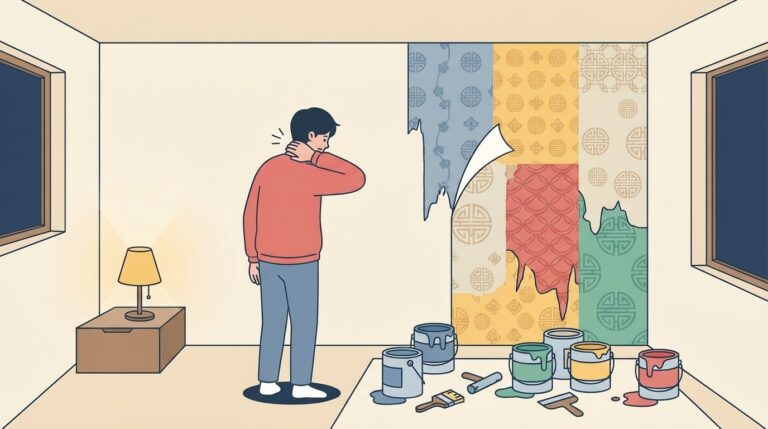
- K-Culture Moment: Walking into a room where you stripped the wallpaper halfway, paint cans are leaking, and the floor is sticky. You stand at the door, completely paralyzed: “어디서부터 손을 대야 할지 모르겠어…”
- Editor’s Insight: While
손literally means hand,손을 대다idiomatically means to initiate a repair, modification, or creative work. In C2 level discourse, it shows a highly natural command of figurative verbs. - Situation Spectrum: Casual ✅ | Semi-formal ✅ | Formal ✅
- 🤔 Think About It: Why does Korean use the metaphor of “hand” (손) for undertaking complex logistical tasks?
Phase 3: 교과서 한국어 vs 진짜 한국어 (Textbook vs. Real-life Korean)
Situation 1: Describing a DIY project that went completely wrong.
- 📖 교과서 한국어: “셀프 인테리어를 하다가 실수를 해서 방이 아주 지저분해졌습니다.” (I made a mistake doing self-interior, and the room became very messy.)
- 🗣️ 진짜 한국어: “감성 인테리어 하려다가 집구석을 완전히 폭망 상태로 만들어 버렸어요.” (I tried to do an aesthetic interior, but I completely ruined my corner of the house.)
- 💡 왜 다를까? Textbook Korean uses passive, sterile terms like ‘지저분해지다’. Real Koreans use highly descriptive slang like ‘폭망’ (explosive ruin) and ‘집구석’ (a slightly self-deprecating, cozy term for one’s living space) to express dramatic frustration.
Situation 2: When you need to call a professional after a failed attempt.
- 📖 교과서 한국어: “전문가를 불러서 수리를 해야 할 것 같습니다.” (I think I need to call an expert to do repairs.)
- 🗣️ 진짜 한국어: “아, 결국 전문가 찬스 써야겠어요. 혼자서는 답이 안 나오네요.” (Ah, in the end, I have to use the ‘expert chance’. No answer is coming out by doing this alone.)
- 💡 왜 다를까? ‘찬스’ (Chance/privilege card) is widely used in Korea to describe calling in help (e.g., 엄마 찬스, 전문가 찬스). ‘답이 안 나오다’ is a fantastic idiomatic phrase meaning a situation is hopelessly stuck.
Phase 4: K-Culture 딥다이브 & 비언어적 매너 (K-Culture & Non-verbal Manners)
4-1. The Body Language of DIY Despair
When Koreans realize their DIY project is ruined, they don’t usually scream. They perform the “뒷목 잡기” (holding the back of the neck). You will see this constantly in K-Dramas when a character experiences sudden high blood pressure from stress. If you ruin your wallpaper, place one hand on the back of your neck, let out a deep sigh (하아~), and shake your head.
4-2. Today’s Culture Code: 집꾸미기 (Zip-kkumigi) Culture
Korea’s dense apartment and officetel culture means space is premium. Renters often cannot make permanent changes due to strict landlords (임대인). This has birthed the trend of “못 없이 인테리어” (No-drill interior design) using tension rods, magnetic hooks, and peel-and-stick wallpapers. Understanding this limitation is key to discussing design trends in Korea!
Phase 5: 실전 롤플레이 시나리오 (Real-Life Roleplay Scenario)
This is a dialogue between Ji-min (지민), a self-interior enthusiast, and Jun-ho (준호), her brutally honest friend, in Ji-min’s half-painted studio apartment.
- 지민: (바닥의 페인트 자국을 보며 한숨을 쉬며) 🎭 [뒷목을 잡으며] 아, 준호야… 나 진짜 이번에는 성공할 줄 알았거든? 근데 벽지 뜯어내고 보니까 벽면에 곰팡이가 가득해. 어디서부터 손을 대야 할지 모르겠어.
- 준호: (눈을 동그랗게 뜨고 방을 둘러보며) 🎭 [어이없다는 듯 헛웃음을 치며] 와… 지민아, 이거 장난 아닌데? 너 친환경 벽지 산다고 돈 엄청 쓰지 않았냐?
- 지민: (풀 죽은 목소리로) 🎭 [바닥을 내려다보며] 응… 친환경 풀에 수입 실크 벽지까지 질렀지. 근데 벽면 기초 공사(초배지 작업)를 제대로 안 해서 다 들뜨고 있어.
- 준호: (머리를 긁적이며) 🎭 [지민의 어깨를 토닥이며] 이거야말로 배보다 배꼽이 더 큰 상황이네. 자재비로만 수십만 원 날리고, 결국 사람 불러야 하잖아.
- 지민: (울상을 지으며) 🎭 [준호의 소매를 붙잡고] 가성비 극대화하려다 내 가심비까지 완전히 버렸어. 내 주말 돌려내…
- 준호: (단호하게) 🎭 [팔짱을 끼며] 더 늦기 전에 빨리 전문가 찬스 쓰자. 이건 우리가 어떻게 비벼볼 수 있는 수준이 아니야. 답이 안 나와.
- 지민: (단호한 준호의 말에 체념하며) 🎭 [깊은 한숨을 내쉬며] 그래… 당장 숨고(Soomgo) 앱 켜서 고수님 수배해야겠다.
- 준호: (스마트폰을 내밀며) 🎭 [미소를 지으며] 굿 초이스. 자, 고수님 평점 잘 비교해 봐.
🔀 인터랙티브 선택지 (Your Choice!)
How should Ji-min reply to Jun-ho’s advice to call an expert?
- Choice A: “그래, 소 잃고 외양간 고치는 격이지만 지금이라도 불러야겠어.”
- Feedback (Best): Perfect C2 usage! You used a proverbs about fixing the stable after losing the cow. Highly natural and displays deep cultural awareness.
- Choice B: “아니야, 내가 유튜브 보고 끝까지 직접 해결해 볼래!”
- Feedback (Risk): Brave, but dangerous! In reality, this might lead to more structural damage and costlier repairs. Your Korean is grammatically correct, but logically stubborn!
- Choice C: “그냥 이대로 살지 뭐. 이것도 내추럴 빈티지 감성이잖아?”
- Feedback (Bad): Funny, but moldy walls are a health hazard! Culturally, hiding a complete failure as “vintage” is a common joke (정신 승리 – mental victory), but not a real solution.
Phase 6: 10초 감정 섀도잉 드릴 (10-Sec Emotional Shadowing Drill)
Practice saying these high-level sentences with the exact dramatic rhythm of a native speaker! / indicates a slight pause.
[🥺 세상 무너진 듯한 목소리로 - Depressed and helpless]- 어디서부터 / 손을 대야 할지 / 진짜 / 하나도 모르겠어…
- eo-di-seo-bu-teo / soneul dae-ya hal-ji / jin-jja / ha-na-do mo-reu-ges-seo…
[😤 어이없고 허탈하게 - Flabbergasted at the cost]- 돈 아끼려다가 / 수리비가 더 나오게 생겼으니 / 진짜 / 배보다 배꼽이 더 크네!
- don a-kki-ryeo-da-ga / su-ri-bi-ga deo na-o-ge saeng-gyeot-seu-ni / jin-jja / bae-boda bae-kkobi deo keu-ne!
Phase 7: K-Culture 미니 사전 (Mini-Dictionary)
- 반셀프 인테리어 (Ban-self interior) | Partial DIY. You design and source the materials, but hire specialized workers (plumbers, tilers) for technical parts.
- 공사 소음 동의서 (Gong-sa so-eum dong-ui-seo) | Construction noise consent form. Essential in Korea; you must get signatures from your neighbors before starting any loud DIY.
- 체리 몰딩 (Cherry molding) | Reddish-brown wood trims common in early 2000s Korean apartments, considered the ultimate “aesthetic enemy” by young decorators today.
- 랜선 집들이 (Laen-seon jip-deu-ri) | An online housewarming party where creators post photos/videos of their decorated rooms on blogs or Instagram.
Phase 8: 여행자를 위한 생존 키트 (Survival Kit for Living in Korea)
Survival Phrases for Renters:
- “싱크대 물이 안 내려가요.” (sing-keu-dae mool-i an nae-ryeo-ga-yo.)
- Pro Tip: Use this to tell your landlord the sink is clogged before you try to fix it yourself and make it worse.
- “벽지에 곰팡이가 슬었어요.” (byeok-ji-ae gom-pang-i-ga seul-eot-eo-yo.)
- Pro Tip: Report mold immediately; in Korea, who pays for mold treatment can be a major dispute between landlords and tenants.
- “혹시 도배 업체 추천해 주실 수 있나요?” (hok-si do-bae eop-che chu-cheon-hae ju-sil su in-na-yo?)
- Pro Tip: Asking local real estate offices (부동산) for wallpapering services (도배) gets you cheap, reliable local contacts.
📌 Editor’s Travel Note: If you are living in Korea and need quick help with DIY disasters, download the 오늘의집 (Ohouse) 앱 for design inspiration and reliable contractor services. For hiring independent local handymen, search on 숨고 (Soomgo) 공식 웹사이트.
Phase 9: “한 발 더 깊이” (Deep Cultural Insight)
In Korea, the concept of 전세 (Jeonse – key money deposit system) and 월세 (Wolse – monthly rent) drastically changes how people approach interior design. Since tenants do not own the property, any permanent modifications (like painting or drilling) can result in losing your deposit when you move out because of the strict “원상복구 의무” (Duty to restore to original state). This is why “easy-to-remove” DIY products are so highly developed in Korea compared to Western countries where homeowners have more freedom.
💬 Your Turn: Have you ever had a DIY disaster in your home? Tell us your story in the comments below using the expression “배보다 배꼽이 더 컸어요”!
Phase 10: FAQ & 오해 방지 (FAQ & Common Mistakes)
Q: Can I paint the walls of my rented studio apartment in Korea?
A: Generally, no. Most Korean landlords are very conservative about wall colors. Always ask first, or use temporary wallpaper (조각 벽지 / 풀바른 벽지) that can be easily peeled off.
Q: What is the difference between 가성비 and 가심비?
A: 가성비 focuses strictly on the objective price-to-quality ratio. 가심비 is psychological; even if something is expensive, if it makes you feel immensely happy when looking at it, it has high 가심비.
Q: Is DIY actually popular in Korea?
A: It is booming among 20s-30s singles, but it’s mostly focused on light cosmetic changes (styling) rather than heavy structural remodeling, which is strictly left to experts due to dense concrete apartment structures.
🚨 흔한 실수 (Common Mistakes) 경고판:
- Mistake 1: Calling professional handymen “일꾼” (Il-kkun).
- Correct Action: It sounds outdated and slightly disrespectful. Use “기사님” (Gisan-nim) or “사장님” (Sajang-nim).
- Mistake 2: Translating “To paint” literally as “그림을 그리다” (Geurim-eul geurida) when talking about walls.
- Correct Action: Use “페인트칠을 하다” (pe-in-teu-chil-eul ha-da).
- Mistake 3: Using nails without checking.
- Correct Action: Drills in concrete walls require heavy-duty hammer drills. Use “꼭꼬핀” (Kkokko-pin)—a special wall pin designed for wallpaper that leaves no holes.
Phase 11: 액션 미션 & 참여 유도 (Action Missions)
- 🥉 Bronze Mission: Write a sentence in the comments describing a cheap product you bought that broke immediately, using the word 가성비.
- 🥈 Silver Mission: Share this post on Instagram and tag your favorite K-Drama room aesthetic with the hashtag
#매일한글_집꾸미기. - 🥇 Gold Mission: Next time you talk with a Korean friend, use the expression “답이 안 나와서 전문가 찬스 썼어” when explaining how you solved a difficult problem!
Phase 12: 인터랙티브 퀴즈 챌린지 (Interactive Quiz)
1. What does “배보다 배꼽이 더 크다” mean?
정답 보기 (Click to reveal)
정답: The incidental costs of a project end up costing more than the primary budget.
Example: Buying a ₩10,000 table but paying ₩50,000 for shipping.
2. Fill in the blank: “혼자서 벽지 바르려다가 실패해서 결국 ( ) 찬스를 썼어요.”
정답 보기 (Click to reveal)
정답: 전문가 (Jeon-mun-ga – Expert)
Explanation: Using the term ‘전문가 찬스’ indicates calling in a professional after a failed DIY attempt.
3. True or False: In Korea, you can drill holes in any rented apartment wall without the landlord’s permission as long as you fill them before moving out.
정답 보기 (Click to reveal)
정답: False!
Many landlords will charge you to replace the entire wallpaper roll even for a few small drill holes. Always get permission or use 꼭꼬핀 (Kkokko-pin)!






