

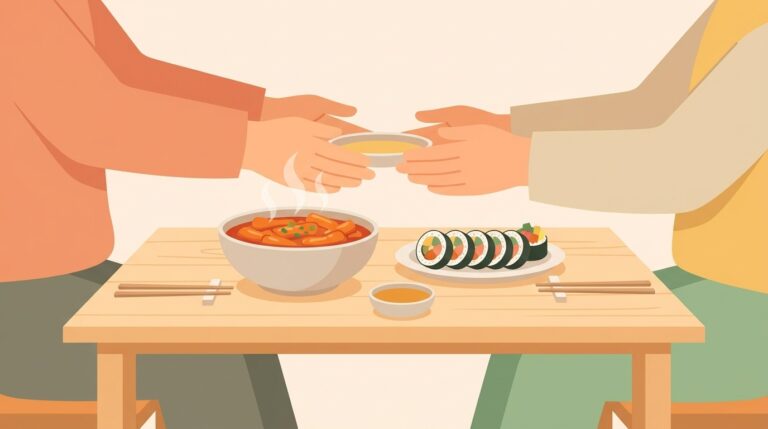
Have You Eaten? The Warm Heart of Korean Food Hospitality
Phase 1: Empathy (공감) — Welcome to My Korean Table!
안녕하세요! (An-nyeong-ha-se-yo!) I am your Senior Editor at Daily Hangul, your best Korean friend and culture navigator!
Imagine this: You’ve finally invited your Korean friends over to your place, or perhaps a warm-hearted Korean host has invited you to their home. You have prepared a wonderful spread of food, or you are looking at a table full of delicious side dishes. Everyone is sitting down, the steam is rising from the rice bowl, and suddenly… you freeze.
How do I politely tell them to eat? How do I show that I put my heart into this meal without sounding too formal or boastful?
Many of our A2-level learners tell us, “I know ‘eat’ is 먹다 (meok-da), but saying ‘먹어 (meok-eo)’ feels too blunt, and ‘드세요 (deu-se-yo)’ feels like a textbook audio track!”
Don’t worry! Today, we are going to master the sweet, warm, and comforting art of 음식 대접하기 (eum-sik dae-jeop-ha-gi – serving and treating someone to food). By the end of this guide, you’ll sound like a natural, caring host who knows exactly how to make guests feel at home. Let’s dive in!
Phase 2: Deep-Dive into Top 3 Key Expressions (핵심 표현 3선)
Let’s look at three magical phrases that will make your guests feel incredibly welcomed.
1. 많이 드세요 (Ma-ni deu-se-yo)
- Pronunciation: Mah-nee deu-seh-yo (Sounds like “Manny” + “deux-say-yo”)
- Meaning: “Please eat a lot!” (Literal: “Eat much”)
- K-Culture Moment: You will hear this in almost every K-Drama when a mother-in-law or a friendly restaurant owner (ajumma) places a steaming bowl of stew in front of the main characters.
- Editor’s Insight: This is the gold standard of Korean food hospitality. In Korea, showing affection is deeply tied to feeding people. Saying “많이 드세요” is the ultimate way of saying “I care about you, so please feel full and happy.”
- Situation Spectrum: Casual ⚠️ | Semi-formal ✅ | Formal ✅
- 🤔 Think About It: In your culture, is it polite to tell guests to “eat a lot”? In Korea, it is a sign of generosity, reflecting a history where sharing food was the ultimate form of community survival.
2. 입에 맞을지 모르겠어요 (Ib-e mat-eul-ji mo-reu-get-eo-yo)
- Pronunciation: Eep-eh mah-deul-jee moh-reu-get-uh-yo
- Meaning: “I hope it suits your taste.” (Literal: “I don’t know if it fits your mouth.”)
- K-Culture Moment: Used by a host when they serve a home-cooked meal to guests they want to impress, showing beautiful Korean humility.
- Editor’s Insight: This is a classic phrase of Korean modesty. Even if you spent 5 hours making the most perfect Bulgogi, saying this shows that you care more about your guest’s comfort and preference than receiving praise.
- Situation Spectrum: Casual ⚠️ | Semi-formal ✅ | Formal ✅
- 🤔 Think About It: Why do Koreans humble themselves even when they are confident in their cooking? It prevents the guest from feeling pressured to give exaggerated compliments.
3. 식기 전에 얼른 드세요 (Sik-gi jeon-e eol-reun deu-se-yo)
- Pronunciation: Sheek-gee juhn-eh uhl-reun deu-seh-yo
- Meaning: “Eat quickly before it gets cold!”
- K-Culture Moment: Often said during cozy winter scenes in dramas, where steaming hot soup or freshly made Korean pancakes (jeon) are served.
- Editor’s Insight: Koreans love their hot foods hot and cold foods cold! This phrase shows your attentiveness to the food quality and your guest’s enjoyment.
- Situation Spectrum: Casual ✅ | Semi-formal ✅ | Formal ⚠️
- 🤔 Think About It: Temperature is a key element of Korean cuisine. This phrase highlights the host’s practical care for the guest’s sensory experience.
Phase 3: Textbook Korean vs. Real-Life Korean
Let’s compare what dry textbooks teach you versus how real Koreans actually talk!
Scenario 1: Telling someone to start eating
- 📖 Textbook Korean: 식사하십시오. (Sik-sa-ha-sip-si-o.) – “Please have your meal.” (Extremely stiff and robotic)
- 🗣️ 진짜 (Real) Korean: 맛있게 드세요! (Ma-sit-ge deu-se-yo!) – “Enjoy the meal! / Eat deliciously!”
- 💡 Why the difference? Unless you are serving a general or a CEO in a military or corporate setting, “식사하십시오” is far too cold. “맛있게 드세요” is warm, polite, and universally loved.
Scenario 2: Asking if they want more
- 📖 Textbook Korean: 더 먹기를 원합니까? (Deo meok-gi-reul won-hap-ni-ka?) – “Do you desire to eat more?” (Sounds like a translation app)
- 🗣️ 진짜 (Real) Korean: 더 드릴까요? (Deo deu-ril-kka-yo?) – “Shall I give you some more?”
- 💡 Why the difference? Koreans prefer soft, indirect offers. “더 드릴까요?” shows high respect (드리다 is the honorific form of ‘to give’) and sounds incredibly caring.
Phase 4: K-Culture Deep-Dive & Non-Verbal Manners
4-1. The Art of “Jeong” (정) and Non-Verbal Care
When serving food in Korea, your actions speak louder than your words!
* The Two-Hand Rule: When passing a plate, bowl, or glass to your guest, always use both hands. Or, place your left hand gently under your right forearm/wrist as support. This shows deep respect.
* The Chopstick Direction: Never stick your chopsticks vertically into your rice bowl. This resembles incense burnt at funerals and is considered bad luck. Always lay them flat on a chopstick rest or the edge of a plate.
4-2. The “Banchan” (반찬) Culture Code
If you watch any K-Food show, you’ll notice the table is covered in small side dishes (banchan). As a host, keeping an eye on these dishes is key. If a guest’s favorite banchan bowl is empty, silently refilling it or asking, “더 드릴까요?” is the ultimate sign of Nunchi (눈치 – social wits and empathy).
Phase 5: Real-Life Roleplay Scenario
Setting: You have invited Minji (your Korean classmate) to your apartment. You made delicious tteokbokki and kimbap. Minji has just taken off her shoes and sat down at the table.
Dialogue (8 Turns)
- You: 민지 씨, 와줘서 고마워요. 얼른 앉으세요.
(Min-ji ssi, wa-jwo-seo go-ma-wo-yo. Eol-reun an-jeu-se-yo.)
🎭 [Smiling warmly, gesturing to the chair]
“Minji, thank you for coming. Please, sit down!” -
Minji: 와, 맛있는 냄새! 직접 다 만든 거예요?
(Wa, ma-sin-neun naem-sae! Jik-jeop da man-deun geo-yeo-yo?)
🎭 [Eyes wide open, sniffing the delicious aroma]
“Wow, smells amazing! Did you make all of this yourself?” -
You: 네, 입에 맞을지 모르겠어요.
(Ne, ib-e mat-eul-ji mo-reu-get-eo-yo.)
🎭 [Shyly rubbing the back of your neck]
“Yes, but I don’t know if it will suit your taste.” -
Minji: 정말 맛있어 보여요! 잘 먹겠습니다.
(Jeong-mal ma-sit-eo bo-yeo-yo! Jal meok-ge-seum-ni-da.)
🎭 [Putting her hands together, looking excited]
“It looks absolutely delicious! I will eat well.” -
You: 식기 전에 얼른 드세요. 많이 드세요!
(Sik-gi jeon-e eol-reun deu-se-yo. Ma-ni deu-se-yo!)
🎭 [Handing her a pair of chopsticks with both hands]
“Please eat quickly before it gets cold. Eat a lot!” -
Minji: (Takes a bite) 진짜 맛있어요! 떡볶이 양념이 최고예요!
(Jin-jja ma-sit-eo-yo! Tteok-bok-ki yang-nyeom-i choe-go-yeo-yo!)
🎭 [Nodding vigorously with thumbs up]
“This is really delicious! The tteokbokki sauce is the best!” -
You: 다행이네요. 여기 튀김도 더 드릴까요?
(Da-haeng-i-ne-yo. Yeo-gi twi-gim-do deo deu-ril-kka-yo?)
🎭 [Pointing to the plate of fried mandu]
“What a relief. Shall I give you some more fried food here too?” -
Minji: 네, 더 주세요! 고마워요.
(Ne, deo ju-se-yo! Go-ma-wo-yo.)
🎭 [Holding out her plate with both hands, grinning]
“Yes, please give me more! Thank you.”
🔀 Interactive Choice Point!
At Turn 7, instead of offering more fried food, how would you respond if Minji finished her water glass?
* A) “물 더 마실래요?” (Mul deo ma-sil-lae-yo?) – “Do you want to drink more water?”
* B) “물 좀 드릴까요?” (Mul jom deu-ril-kka-yo?) – “Shall I give you some water?”
* C) “물 먹어.” (Mul meok-eo.) – “Eat water.”
Feedback:
- Choice A (Risk – Casual/Direct): Not bad, but “마실래요” can sound slightly direct for an A2 host trying to show high politeness. Save this for very close friends.
- Choice B (BEST – Polite & Natural): Perfect! “물 좀 드릴까요?” uses the polite “드릴까요” and the softening word “좀” (a little). It sounds incredibly natural and caring!
- Choice C (BAD – Rude/Grammar Error): Oh no! Not only is “먹어” too informal (Banban) for this guest, but in Korean, we usually drink (마시다) water, not eat (먹다) it, although some colloquial expressions exist.
Phase 6: 10-Second Emotion Shadowing Drill
Practice saying these out loud with the correct feeling to sound like a native!
- [😊 Pleased & Humorous modesty]
“입에 / 맞을지 / 모르겠어요.”
(Ibe / majeul-ji / moreu-gesseo-yo.) -
[💖 Warm & Caring host vibe]
“식기 전에 / 얼른 / 많이 드세요!”
(Sik-gi jeon-e / eol-reun / mani deuse-yo!)
Phase 7: K-Culture Mini-Dictionary
- 정 (Jeong) | Affection / Deep Attachment
A unique Korean concept of warm feeling, attachment, and love that binds people together, often expressed through sharing food. - 손맛 (Son-mat) | Hand-taste
The magical, unique flavor that comes from a cook’s experience, love, and physical touch. Often used to compliment home cooking. - 집밥 (Jip-bap) | Home-cooked meal
Literal “home rice.” It represents comfort, warmth, and nostalgia for Koreans. - 대접 (Dae-jeop) | Treating / Serving
The act of hosting someone with respect and offering them high-quality food or hospitality.
Phase 8: Survivor Kit for Travelers
Survival Expressions TOP 3
- 이거 어떻게 먹어요? (I-geo eo-tteo-ge meok-eo-yo?)
- Pro Tip: “How do I eat this?” Perfect for when you are served a complex dish like Ssam (lettuce wraps) or cold noodles.
- 진짜 맛있어요! (Jin-jja ma-sit-eo-yo!)
- Pro Tip: “It’s really delicious!” Say this with a big smile to your host.
- 잘 먹었습니다! (Jal meok-eot-seum-ni-da!)
- Pro Tip: “I have eaten well!” Say this after the meal to show gratitude.
📌 Editor’s Travel Note: If you are visiting a local Korean home, finding your way might be tricky. Don’t rely on standard Western map apps as they don’t update well in Korea. Before your trip, download the Naver Map App for flawless walking and transit directions. Note: App interface and features may change over time.
Phase 9: “A Step Deeper” (한 발 더 깊이)
In Korea, food is not just nutrition; it is a language of love. Historically, during difficult times, asking “Have you eaten?” (밥 먹었어요? – Bap meok-eot-eo-yo?) became the standard way to ask “Are you doing well?”. When a Korean serves you food and says “많이 드세요,” they are offering you a piece of their heart.
💬 Your Turn: Have you ever cooked for a Korean friend? What dish did you make, or what dish would you love to cook for them? Let us know in the comments below!
Phase 10: FAQ & Common Mistakes
Q: Can I say “많이 먹어” (Ma-ni meok-eo) to someone older than me?
A: Absolutely not! “먹어” is banmal (informal language). You must always say “많이 드세요” (Ma-ni deu-se-yo) to anyone older or higher in status.
Q: What is the polite way to say “I am full” without being rude?
A: You can say “배불러요, 잘 먹었습니다” (Bae-bul-leo-yo, jal meok-eot-seum-ni-da) which means “I am full, I ate very well!” It is very polite.
Q: Is it rude to leave food on my plate when visiting a Korean house?
A: While finishing everything shows appreciation, leaving a tiny bit is totally fine if you are too full. Just make sure to say “정말 맛있었어요” (It was really delicious) so they know it wasn’t because of the taste!
🚨 Common Mistakes Alert!
- Mistake 1: Saying “먹으십시오” (Meok-eu-sip-si-o) to be super polite.
- Correct Action: Use “드세요” (Deu-se-yo) instead. “먹으십시오” sounds like a military command!
- Mistake 2: Pouring your own drink first while hosting.
- Correct Action: Always pour your guest’s drink first with both hands, then let them pour yours.
Phase 11: Action Mission!
- Bronze Medal 🥉: Practice saying “입에 맞을지 모르겠어요” three times in front of the mirror with a modest smile.
- Silver Medal 🥈: Cook a simple Korean meal (even instant ramyun counts!) and post a photo on Instagram with the caption “많이 드세요! #DailyHangul”.
- Gold Medal 🥇: The next time you share food with a Korean friend, look them in the eyes and say, “식기 전에 얼른 드세요!”
Phase 12: Interactive Quiz Challenge!
1. Which phrase means “Please eat before it gets cold”?
- A) 맛이 없어요 (Ma-si eop-seo-yo)
- B) 식기 전에 얼른 드세요 (Sik-gi jeon-e eol-reun deu-se-yo)
- C) 더 드릴까요 (Deo deu-ril-kka-yo)
👉 Click to see the Answer & Explanation
Correct Answer: B
* Explanation: “식기 전에 얼른 드세요” is the perfect phrase to keep the food delicious and show caring warmth. (A means “It tastes bad”, and C means “Shall I give you more?”)
2. True or False: It is polite to stick your chopsticks vertically into your rice bowl.
- True
- False
👉 Click to see the Answer & Explanation
Correct Answer: False
* Explanation: Doing this resembles funeral incense rites and is considered highly unlucky. Always place chopsticks flat!







