

Hello, Travel Buddies! Welcome to Daily Hangul! 👋
Phase 1: Empathy (Your Korean Bus Adventure Begins! 🚌)
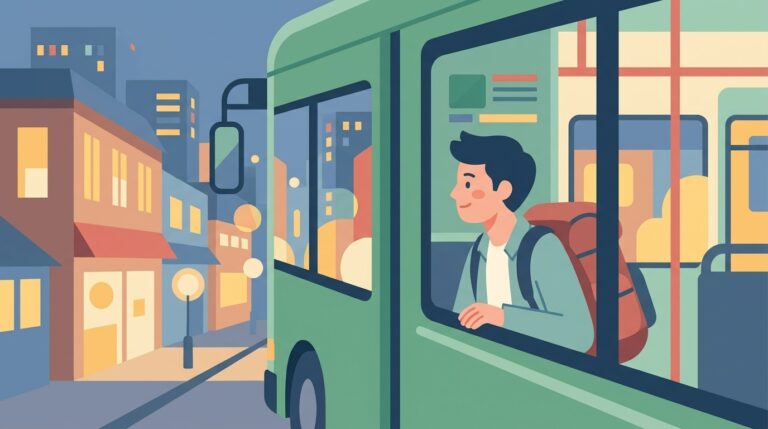
Have you ever boarded a local bus in Seoul, excited to explore a trendy cafe in Hongdae or a historic palace, only to feel your heart start racing?
The bus is moving fast. The electronic screen flashes names in Korean. The voice over the speaker says something rapid-fire. You ask yourself: “Did I miss my stop? Where am I right now?”
You want to ask the kind-looking person next to you or the busy driver, but your mind goes blank.
Don’t worry! This is the most common “bus panic” moment for every traveler in Korea. Today, we are going to learn the ultimate magic sentence that will save you from getting lost, even if you are an absolute beginner (A1). Let’s unlock the confidence to ride Korean buses like a true local!
Phase 2: Deep Dive into 3 Essential Expressions 💎
1. 이번 정류장이 어디예요? (Ibeon jeongryujangi eodiyeoyo?)
- Pronunciation: ee-beon jung-ryu-jang-ee uh-dee-yeh-yo? (Think of “ibeon” as ee-bun, “eodi” as uh-dee)
- Meaning: “Where is this stop?” / “Which stop is this?”
- K-Culture Moment: You will hear this phrase (or a variation of it) in almost every romance K-Drama when the main characters are sitting on the back seat of a glowing green Seoul city bus at night.
- Editor’s Insight: Ibeon means “this time” or “current”. Jeongryujang means “bus stop”. Eodiyeoyo means “where is it?”. Use this when you are on the bus and want to confirm the name of the very next stop.
- Situation Spectrum: Casual ⚠️ | Semi-formal ✅ | Formal ✅
- 🤔 Think About It: In English, we often ask “What stop is next?” focusing on the future. In Korean, “이번 (this time)” focuses on the immediate present. How does focusing on the present moment change how you look at your surroundings?
2. 저기요, 내려요! (Jeogiyo, naeryeoyo!)
- Pronunciation: juh-gee-yo, neh-ryuh-yo!
- Meaning: “Excuse me, getting off!”
- K-Culture Moment: The bus is packed, you are at the back, and the doors are about to close. A seasoned Korean Ajumma (auntie) will shout this out confidently to alert the driver.
- Editor’s Insight: Jeogiyo is the ultimate attention-getter (“Over there/Excuse me”). Naeryeoyo comes from naerida (to get down/get off). Shouting this politely but firmly is totally acceptable when you need the driver to hold the door!
- Situation Spectrum: Casual ✅ | Semi-formal ✅ | Formal ⚠️
- 🤔 Think About It: Why do you think Koreans use “저기요” (literally “over there”) to call someone’s attention instead of “Hey you”? It keeps a polite distance while being highly effective!
3. 다음 정류장에 내려요? (Daeum jeongryujange naeryeoyo?)
- Pronunciation: dah-eum jung-ryu-jang-eh neh-ryuh-yo?
- Meaning: “Are you getting off at the next stop?”
- K-Culture Moment: When the bus is crowded and you are blocking the door, someone might tap your shoulder and ask this softly so they can squeeze past.
- Editor’s Insight: Daeum means “next”. Asking this shows great manners because you are helping coordinate the flow of passengers.
- Situation Spectrum: Casual ⚠️ | Semi-formal ✅ | Formal ✅
- 🤔 Think About It: Korean social etiquette heavily relies on Nunchi (social sensing) to avoid blocking others. How does this phrase show care for the collective group on the bus?
Phase 3: Textbook Korean vs. Real-Life Korean 🗣️
Let’s compare what dry textbooks teach you versus what Koreans actually say in real life!
Scenario A: Asking the driver if the bus goes to your destination
- 📖 Textbook Korean: “이 버스는 명동에 가나요?” (I beoseuneun Myeongdong-e ganayo? – Does this bus go to Myeongdong?)
- 🗣️ Real-Life Korean: “이거 명동 가요?” (Igeo Myeongdong gayo? – This goes to Myeongdong?)
- 💡 Why the difference? Real Koreans love short, fast sentences on busy streets. Drop the particles (“-는”, “-에”) and just say “This [destination] goes?” for instant local vibes!
Scenario B: Trying to squeeze through a crowded bus
- 📖 Textbook Korean: “실례합니다, 지나가겠습니다.” (Sillyehamnida, jinagagessemnida. – Excuse me, I will pass through.)
- 🗣️ Real-Life Korean: “잠시만요~” (Jamsimanyo~ – Just a moment~)
- 💡 Why the difference? “실례합니다” sounds extremely formal, almost like a movie character. “잠시만요” is friendly, quick, and universally understood as “Please let me pass.”
Phase 4: K-Culture Deep Dive & Non-Verbal Manners 🚌✨
4-1. The Art of “Nunchi” & Bus Gestures
When boarding or exiting a Korean bus, actions speak louder than words:
* The Quick Bow: If the bus driver waits for you when you run to catch the bus, give a quick, polite nod of your head as you tap your card. It’s the universal Korean “Thank you!”
* The Card Tap Double-Check: Always tap your transportation card (T-money) on the reader when you get on and when you get off. If you don’t tap off, you will be charged a double fare on your next ride!
4-2. Cultural Insight: The “Bbali-Bbali” (Hurry-Hurry) Bus Culture
Korean city buses are fast, efficient, and do not wait around. Passengers usually stand up and walk toward the exit doors before the bus fully stops. If you wait until the bus completely stops to get out of your seat, you might hear the driver ask, “내리실 분 없어요?” (Anyone getting off?). Be ready!
Phase 5: Interactive Real-Life Roleplay 🎭
Meet Minjun, a friendly local college student sitting next to you on the green Bus No. 7011 heading towards Sinchon. You are nervous about missing your stop.
Minjun: (Noticing you looking nervously at your map app)
        "저기요... 혹시 도와드릴까요?"
        [Jeogiyo... hoksi dowadeurilkkayo? / Excuse me... do you need some help?]

You: 🎭 (With a relieved smile, pointing to the bus screen)
     "아, 감사합니다! 이번 정류장이 어디예요?"
     [Ah, gamsahamnida! Ibeon jeongryujangi eodiyeoyo? / Oh, thank you! Where is this stop?]

Minjun: "아, 이번 정류장은 홍대입구역이에요. 홍대 가세요?"
        [Ah, ibeon jeongryujangeun Hongdae-ipgu-yeok-ieyo. Hongdae gaseyo? / Oh, this stop is Hongik University Station. Are you going to Hongdae?]

You: 🎭 (Nodding happily)
     "네! 홍대 가요!"
     [Ne! Hongdae gayo! / Yes! I am going to Hongdae!]

Minjun: "그러면 다음 정류장에 내리시면 안 돼요. 지금 정류장이에요!"
        [Geureomeon daeum jeongryujange naerisbyeon an dwaeyo. Jigeum jeongryujang-ieyo! / Then you shouldn't get off at the next stop. It is *this* stop right now!]

You: 🎭 (Surprised, quickly standing up)
     "어머! 저 이번에 내려요!"
     [Eomeo! Jeo ibeone naeryeoyo! / Oh my! I am getting off this time!]

Minjun: 🎭 (Pointing to the door button)
     "벨 누르세요!"
     [Bel nureuseyo! / Press the bell!]

You: 🎭 (Pressing the red stop button, bowing slightly)
     "감사합니다! 안녕히 계세요!"
     [Gamsahamnida! Annyeonghi gyeseyo! / Thank you! Goodbye!]
🔀 What would you do next? Choose your path!
- A) You forgot to tap your card while exiting.
- 🔴 Feedback (Bad): You will get a penalty fare on your next transfer. Always tap before stepping off!
- B) You say “잠시만요!” loudly while moving toward the exit door.
- 🟢 Feedback (Best): Perfect! People will naturally step aside to let you exit.
- C) You try to ask the driver to stop in the middle of the road.
- 🟡 Feedback (Risk): Dangerous! Drivers are legally not allowed to open doors outside official stops for safety reasons.
Phase 6: 10-Second Emotion Shadowing Drill 🗣️⚡
Speak with real Korean feelings! Pay attention to the pauses (/).
- [🥺 Panicked & Urgent]
- “저기요! / 저 이번에 / 내려요!”
- Jeogiyo! / Jeo ibeone / naeryeoyo!
- (Excuse me! / I am getting off / this time!)
- [😊 Super Polite & Bright]
- “혹시… / 이번 정류장이 / 어디예요?”
- Hoksi… / ibeon jeongryujangi / eodiyeoyo?
- (By any chance… / where is / this stop?)
Phase 7: K-Culture Mini Dictionary 📖
- 정류장 (Jeongryujang) | Bus Stop
- The physical place where buses stop. Look for the blue or green signs!
- 교통카드 (Gyotong-kadeu) | Transportation Card
- Essential cards like T-money. You can buy and charge them at any convenience store.
- 벨 (Bel) | Stop Bell
- The red buttons located on the walls and pillars inside the bus. Press it before your stop!
- 환승 (Hwanseung) | Transfer
- Transferring between buses or subway lines for free (within 30 minutes!).
Phase 8: Survival Kit for Travelers 🎒
Emergency Bus Phrases TOP 3
- “버스 카드 충전해 주세요.” (Beoseu kadeu chungjeonhae juseyo.)
- “Please charge my bus card.” (Say this at any convenience store before boarding).
- “기사님, 문 열어주세요!” (Gisanim, mun yeoreojuseyo!)
- “Driver, please open the door!” (If the doors closed too fast).
- “여기서 세워주세요.” (Yeogiseo seoweojuseyo.)
- “Please stop here.” (Mainly used in taxis, but good to know!).
Editor’s Travel Note 🗺️
Do not rely on Google Maps for local buses in Korea; it is often inaccurate. Instead, download the Naver Map App or KakaoMap. They show real-time bus locations down to the second, including how crowded the bus is!
(Disclaimer: Standard bus fares are subject to change. Please verify current transit rates upon arrival.)
Phase 9:
Frequently Asked Questions (FAQ)
Q: What does "이번 정류장이 어디예요? (Ibeon jeongryujangi eodiyeoyo?)" mean in Korean and how do you pronounce it?
A: In Korean, "이번 정류장이 어디예요? (Ibeon jeongryujangi eodiyeoyo?)" is pronounced [ee-beon jung-ryu-jang-ee uh-dee-yeh-yo? (Think of "ibeon" as ee-bun, "eodi" as uh-dee] and means: "Where is this stop?" / "Which stop is this?"
Q: What does "저기요, 내려요! (Jeogiyo, naeryeoyo!)" mean in Korean and how do you pronounce it?
A: In Korean, "저기요, 내려요! (Jeogiyo, naeryeoyo!)" is pronounced [juh-gee-yo, neh-ryuh-yo!] and means: "Excuse me, getting off!"
Q: What does "다음 정류장에 내려요? (Daeum jeongryujange naeryeoyo?)" mean in Korean and how do you pronounce it?
A: In Korean, "다음 정류장에 내려요? (Daeum jeongryujange naeryeoyo?)" is pronounced [dah-eum jung-ryu-jang-eh neh-ryuh-yo?] and means: "Are you getting off at the next stop?"







