

Master the Korean Bathhouse (Mokyoktang): Packing Your Bath Basket Like a Pro
Phase 1: Empathy (Welcome to the K-Bathhouse Culture!)
안녕하세요! (Annyeonghaseyo!) Hello! It’s your friendly Korean study bestie and cultural navigator from “Daily Hangul.”
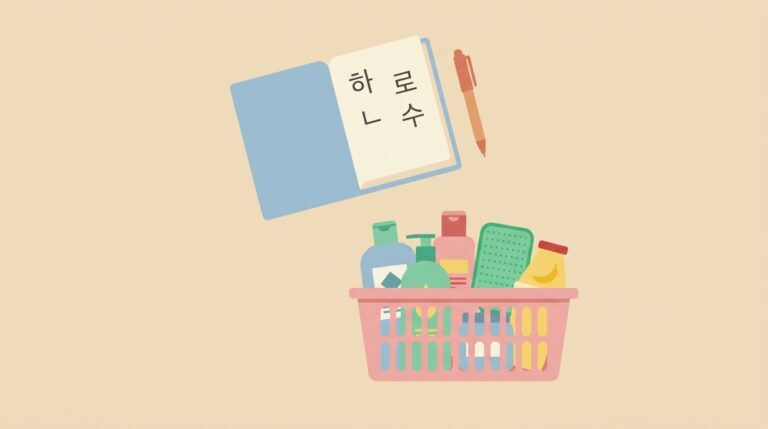
Imagine this: You’ve had a long, exhausting day of walking around Seoul, and your muscles are begging for a deep, hot soak. You decide to try a traditional Korean public bathhouse (목욕탕 – Mokyoktang) or a larger 24-hour sauna (찜질방 – Jjimjilbang). You confidently walk in, ready to relax, but suddenly you notice a fascinating phenomenon: local Koreans are carrying these cute, organized plastic baskets filled with colorful bottles, scrub mitts, and hair clips.
This is the legendary 목욕 바구니 (Mokyok-baguni – bath basket)!
If you show up with just a bar of soap, you might feel a bit lost. Don’t worry! Today, we are going to learn how to pack your bath basket like a local, master the essential Korean phrases you need to get your gear, and avoid any awkward social slip-ups. Let’s dive in!
Phase 2: Core Expressions Deep Dive
Here are three essential expressions you need when preparing or asking about bath supplies.
1. 목욕 바구니 챙겼어요? (Mokyok-baguni chaeng-gyeot-seo-yo?)
- Pronunciation: Mokh-yok bah-goo-nee chaeng-gyut-suh-yo? (Rhymes with “got saw yo”)
- Meaning: “Did you pack/bring your bath basket?”
- K-Culture Moment: You often hear this in family-themed K-Dramas where neighborhood friends or family members meet up in the morning, holding their pastel plastic baskets, on their way to the local bathhouse.
- Editor’s Insight: The verb 챙기다 (chaeng-gida) is a beautiful Korean word that means “to pack,” “to take care of,” or “not to forget.” It shows a warm, caring attitude. When a friend asks you this, they are making sure you have everything you need to have a comfortable time.
- Situation Spectrum:
- Casual: 목욕 바구니 챙겼어? (✅)
- Semi-formal: 목욕 바구니 챙겼어요? (✅)
- Formal: 목욕 바구니 챙기셨습니까? (⚠️ – a bit too formal for bathhouses!)
- 🤔 Think About It: In many Western cultures, bathing is a highly private activity. In Korea, going to the bathhouse with friends or family is a bonding ritual. Why do you think sharing this vulnerable space builds stronger relationships in Korean society?
2. 일회용 샴푸 있어요? (Il-hoe-yong syampu its-eo-yo?)
- Pronunciation: Eel-hweh-yong sham-poo eet-suh-yo? (Think of “eel” like the fish, and “yong” like “young”)
- Meaning: “Do you have single-use/disposable shampoos?”
- K-Culture Moment: If you forget your basket, don’t panic! The front desk or the changing room counter sells tiny, single-use packets of shampoo, conditioner, and body wash for about 500 KRW ($0.40) each.
- Editor’s Insight: 일회용 (Il-hoe-yong) literally translates to “one-time use.” You will see this word everywhere in Korea, from convenience stores to cafes (disposable cups).
- Situation Spectrum:
- Casual: 일회용 샴푸 있어? (✅)
- Semi-formal: 일회용 샴푸 있어요? (✅)
- Formal: 일회용 샴푸 있습니까? (✅)
3. 때타월 하나 주세요. (Ttae-ta-wol hana ju-se-yo.)
- Pronunciation: Ttae-tah-wol ha-nah joo-seh-yo.
- Meaning: “Please give me one exfoliating glove (Korean Italy towel).”
- K-Culture Moment: The iconic bright green or yellow viscose mitt with black stripes! It is the ultimate symbol of Korean bathing culture, used to scrub off dead skin (때 – ttae).
- Editor’s Insight: While it’s called an “Italy towel” (이태리 타올) because the fabric was originally imported from Italy in the 1960s, it is entirely unique to Korean bathing culture. Be gentle when using it for the first time!
- Situation Spectrum:
- Casual: 때타월 하나 줘. (✅ – only to close friends)
- Semi-formal: 때타월 하나 주세요. (✅ – safest for purchasing)
- Formal: 때타월 하나 주시겠습니까? (⚠️ – slightly overly polite but okay)
Phase 3: Textbook Korean vs. Real Korean
Let’s compare formal textbook phrases with what you’ll actually hear or say inside the bathhouse!
Situation A: Buying soap
- 📖 Textbook Korean: “세면도구를 구입하고 싶습니다.” (Se-myeon-do-gu-reul gu-ip-ha-go sip-seup-ni-da. – “I would like to purchase toiletries.”)
- 🗣️ Real Korean: “혹시 세면도구 세트 있어요?” (Hok-si se-myeon-do-gu se-teu its-eo-yo? – “By any chance, do you have a toiletry set?”)
- 💡 Why the difference? No one uses the stiff word “구입” (purchase) in a cozy local bathhouse. Using “혹시” (by any chance) softens your request and makes you sound incredibly natural.
Situation B: Asking to borrow a basket
- 📖 Textbook Korean: “목욕 바구니를 빌려줄 수 있습니까?” (Mokyok-baguni-reul bil-ryeo-jul su its-eup-ni-ka? – “Can you lend me a bath basket?”)
- 🗣️ Real Korean: “바구니 쓰고 제자리에 두면 되죠?” (Baguni sseu-go je-ja-ri-e du-myeon doe-jyo? – “I can use this basket and just put it back, right?”)
- 💡 Why the difference? At many local bathhouses, there are communal plastic baskets you can borrow for free inside the shower area. Instead of asking to “lend” formally, locals just confirm the rule of returning it to its original place (제자리 – je-ja-ri).
Phase 4: K-Culture Deep Dive & Non-Verbal Manners
4-1. The Bathhouse “Nunchi” (눈치 – Situational Wit)
- Mind Your Splash: When washing at the sit-down washing stations, be very careful not to splash soapy water on the people sitting next to or behind you.
- Tie Your Hair: If you have long hair, always tie it up before entering the hot tubs. Letting your hair float in the communal water is considered a major hygiene faux pas. Use a hair clip (집게핀 – jip-ge-pin) or a hair tie.
- The Basket Placement: When you go into the hot tubs, leave your bath basket on the shelves or on the floor next to the shower station you were using. Do not bring your toiletries into the soaking tubs!
4-2. The “Italy Towel” Phenomenon
In Korean dramas (like Vincenzo or various family sitcoms), you often see characters vigorously scrubbing each other’s backs. This is called 등 밀어주기 (Deung mir-eo-ju-gi – back scrubbing). It is a sign of deep trust and intimacy. If a Korean friend offers to scrub your back, it means you are officially part of their inner circle!
Phase 5: Real-Life Roleplay Scenario
Setting: Min-ji (a local regular) is welcoming Sarah (a B1 Korean learner) at the entrance of a cozy neighborhood neighborhood bathhouse in Mapo, Seoul.
Characters:
* 민지 (Min-ji): Friendly, experienced bathhouse lover.
* 세라 (Sarah): A bit nervous but excited to try her first authentic bath.
민지: 세라야, 목욕 바구니 잘 챙겨 왔어?
      (Sarah, did you pack your bath basket well?)

세라: 🎭 (Proudly showing her tote bag) 응! 샴푸랑 바디워시랑 다 가져왔어. 근데 바구니는 없고 그냥 에코백에 넣었어.
      (Yeah! I brought shampoo, body wash, and everything. But I don't have a basket, so I just put them in an eco-bag.)

민지: 에코백은 젖으니까 안 돼! 여기 카운터에서 미니 바구니 하나 사자. 천 원밖에 안 해.
      (The eco-bag will get wet, so you can't use that! Let's buy a mini basket here at the counter. It's only 1,000 won.)

세라: 아, 그렇구나! 🎭 (Approaching the counter) 저기요, 혹시 목욕 바구니만 따로 파나요?
      (Ah, I see! Excuse me, do you sell just the bath baskets separately?)

카운터 직원: 네, 천 원입니다. 때타월도 필요하세요?
            (Yes, it's 1,000 won. Do you also need an Italy towel?)

세라: 네, 때타월 초록색으로 하나 주세요.
      (Yes, please give me one green Italy towel.)

민지: 🎭 (Giggling) 와, 세라 이제 진짜 한국 사람 다 됐네! 초록색이 제일 잘 밀려.
      (Wow, Sarah, you're basically Korean now! The green one scrubs the best.)

세라: 흐흐, 오늘 내 피부 다 벗겨지는 거 아니지?
      (Hehe, my skin isn't going to get completely peeled off today, right?)
🔀 Choose Your Next Move!
Scenario: You finished soaking, and now you are standing in front of the mirrors in the changing room. Your hair is wet, and you see a hairdryer, but it requires a 100-won coin.
- A) Ask the staff: “저기요, 드라이기 쓰려면 동전 필요해요?” (Excuse me, do I need coins to use the hairdryer?)
- Feedback (Best!): Perfect. Most local bathhouses require 100 or 200 won for 2 minutes of hairdryer use. Asking politely will get you change immediately.
- B) Just use it without asking: (Just insert a random coin you have or try to press the button without paying)
- Feedback (Bad): The machine won’t work, and you might cause a small alarm to beep. Always keep a few 100-won coins handy in your bath basket!
- C) Use your towel to dry completely: “그냥 수건으로 다 말릴래.”
- Feedback (Risk): You might catch a cold in the winter! It’s better to ask for change at the desk.
Phase 6: 10-Second Emotion Shadowing Drill
Practice these with natural rhythm and feelings! The / represents a slight pause.
- [😊 Excitedly & proudly]
“저 / 목욕 바구니 / 완벽하게 / 챙겼어요!”
(Jeo / mokyok-baguni / wan-byeok-ha-gae / chaeng-gyeot-seo-yo!)
-> “I / packed my bath basket / perfectly!” -
[🥺 Worried & cute]
“이거 / 너무 아플 것 같은데 / 괜찮을까요?”
(I-geo / neo-mu a-peul geot ga-teun-dae / gwen-cha-neul-kka-yo?)
-> “This / looks like it will hurt a lot / will it be okay?” (Referring to the Italy towel)
Phase 7: K-Culture Mini Dictionary
- 목욕 바구니 (Mokyok-baguni) | Bath Basket
- Usage: A plastic basket with holes to drain water, used to carry personal toiletries into the wet area.
- 이태리 타올 (I-tae-ri ta-ol) | Italy Towel
- Usage: The famous exfoliating cloth, usually green (rough), yellow (medium), or pink (soft).
- 바나나맛 우유 (Banana-mat u-yu) | Banana Flavored Milk
- Usage: The legendary post-bath drink. Drinking a cold banana milk after sweating in the hot tub is a sacred Korean ritual.
- 세면도구 (Se-myeon-do-gu) | Toiletries / Washing Kit
- Usage: Collective noun for toothbrush, toothpaste, soap, and shampoo.
Phase 8: Traveler’s Survival Kit
Survival Phrases TOP 3
- 남탕은 어디예요? / 여탕은 어디예요?
- Rom: Nam-tang-eun eo-di-yeo-yo? / Yeo-tang-eun eo-di-yeo-yo?
- Pro Tip: “Where is the men’s bath? / Where is the women’s bath?” Crucial to avoid walking into the wrong side!
- 수건 더 받을 수 있을까요?
- Rom: Su-geon deo ba-deul su its-eul-kka-yo?
- Pro Tip: “Can I get more towels?” (Note: Men’s sections usually have unlimited towels inside, while women’s sections are handed a set number of towels at the front gate due to historical usage differences!)
- 열쇠 잃어버렸어요.
- Rom: Yeol-soe il-eo-beo-ryeot-seo-yo.
- Pro Tip: “I lost my key.” (Your locker key is usually a wristband. Keep it secure!)
💡 Editor’s Travel Note: To find the best local neighborhood bathhouses, download the Naver Map App and search for 목욕탕 (Mokyoktang) rather than the touristy “Jjimjilbang.” It offers a much more authentic, budget-friendly local experience!
Phase 9: “A Step Deeper” (Cultural Reflection)
In Korea, sharing a bath represents the concept of “Naked Friendship” (목욕탕 우정). Taking off your clothes, soaking in the same water, and helping each other scrub away dead skin removes all social hierarchy, titles, and walls. It is a space where a CEO and a college student are completely equal. It shows how Korean society values collective bonding and stripping away formal masks to connect on a human level.
💬 Your Turn: Would you feel comfortable going to a bathhouse with your friends or coworkers? Let us know your thoughts in the comments below!
Phase 10: FAQ & Avoiding Common Mistakes
Q: Can I wear my swimsuit inside the hot tubs?
A: No. Swimsuits are strictly banned in the gender-segregated bath areas for hygiene reasons. Everyone must be completely naked. Wearing clothes in the tub is considered highly impolite.
Q: What should I do before entering the hot pools?
A: You must wash your entire body thoroughly at the shower stations before stepping into the clean hot tubs. Getting straight into the tubs without showering first will get you some very angry stares from locals!
Q: Is it okay to shave or wash clothes there?
A: Shaving your beard is fine, but body grooming/shaving or doing laundry in the communal sinks is highly frowned upon.
🚨 Common Mistakes Board
- Mistake 1: Walking in with outdoor shoes.
- Correct Action: Put your shoes in the shoe locker first, take the shoe key, and exchange it at the front desk for your locker key.
- Mistake 2: Putting your head/hair into the bathwater.
- Correct Action: Tie your hair up securely.
- Mistake 3: Splashing and swimming in the hot tubs.
- Correct Action: Keep calm, relax, and soak quietly.
Phase 11: Action Mission
- 🥉 Bronze: Practice saying “때타월 하나 주세요” out loud 5 times in front of the mirror.
- 🥈 Silver: Draw or list your own “Dream Bath Basket” checklist in Korean in your study notebook.
- 🥇 Gold: When you visit Korea, search for a local “목욕탕” on Naver Map, buy a green Italy towel at the counter yourself, and drink a Banana Milk afterwards!
Phase 12: Interactive Quiz Challenge
Test your K-Bathhouse knowledge!
1. What does the green “Italy Towel” do?
- A) It’s a decorative hair band.
- B) It’s used to scrub off dead skin cells.
- C) It’s a towel used to dry your wet feet.
2. Fill in the blank: “목욕 _______ 챙겼어요?” (Did you pack your bath basket?)
- A) 바지 (Baji)
- B) 바구니 (Baguni)
- C) 그릇 (Georeut)
🔍 Click here to see the answers!
- Correct Answer: B – The Italy towel is the legendary exfoliating glove.
- Correct Answer: B – 바구니 means basket. (바지 means pants, 그릇 means bowl/dish).







