Master the Soul of Korean Sound: Pansori’s UNESCO Heritage & Deep-Dive C2 Korean Expressions
Phase 1: Empathy (스토리 몰입형 오프닝)
안녕하세요! It’s your Korean bestie and Daily Hangul’s editor-in-chief! 👋
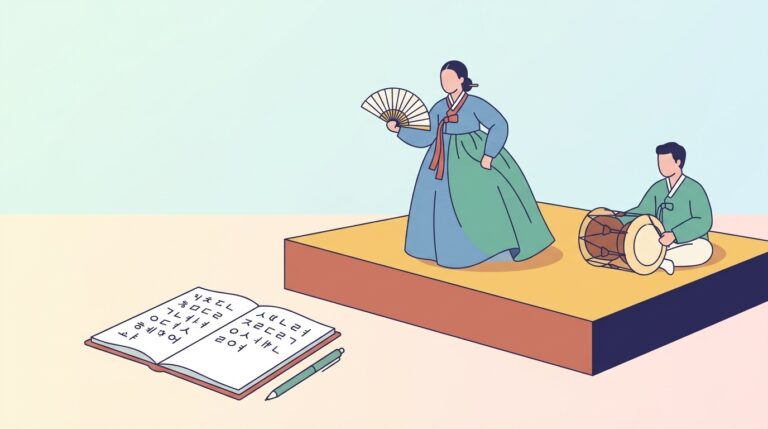
Imagine sitting in a dimly lit, traditional hanok courtyard. A solo singer stands before you with nothing but a folding fan, accompanied by a single drummer. Suddenly, a sound erupts from the singer’s throat—a raspy, thunderous, yet heartbreakingly beautiful wail that seems to carry five thousand years of collective sorrow and joy. You don’t just hear it; you feel it vibrate in your chest. This is Pansori (판소리), Korea’s epic operatic storytelling, recognized globally as a UNESCO Representative List of the Intangible Cultural Heritage of Humanity.
Many advanced C2 learners tell me, “I understand K-dramas, but when I watch a traditional performance or talk about Korean aesthetics, my vocabulary feels so flat! I want to express the deep, soul-stirring aspects of Korean culture without sounding like a dry textbook.”
If you’ve ever struggled to articulate the concepts of human emotion, artistic grit, and communal resonance in Korean, this guide is built for you. Based on feedback from curatorial experts and advanced foreign learners who conquered the high-level art vocabulary, let’s explore the deep, nuanced linguistic landscape of Pansori. Ready to elevate your Korean to the master level?
Phase 2: Deep Dive into 3 Essential Master-Level Expressions (핵심 표현 3선 심층 분석)
1. 한을 풀다 (han-eul pul-da)
- Pronunciation: [han-eul pul-da] (Think of “hahn” as a deep breath, and “pul-da” like pulling open a knotted rope)
- Meaning: To release accumulated deep sorrow/resentment; to sublimate life’s grief through art.
- K-Culture Moment: In the legendary film Sopyonje (서편제), the protagonist sings Pansori until her throat bleeds to masterfully ‘unravel’ her lifelong suffering into pure artistic expression.
- Editor’s Insight: Han (한) is uniquely Korean—a mixture of sorrow, injustice, and longing that cannot be easily resolved. To pulda (풀다 – untie) this knot through singing is the ultimate goal of Pansori.
- Situation Spectrum: Casual 🚫 | Semi-formal ⚠️ | Formal ✅ (Highly poetic and culturally profound)
- 🤔 Think About It: Is there a single word in your native language that captures both sorrow and the artistic drive to overcome it? How does 한을 풀다 challenge your view on emotional expression?
2. 득음하다 (deuk-eum-hada)
- Pronunciation: [deu-geum-ha-da] (Pronounced as deu-geum with a soft, glottal catch on the ‘g’)
- Meaning: To attain the ultimate vocal mastery; literally “to acquire the sound.”
- K-Culture Moment: Often used in historical dramas when an apprentice singer spends years in isolation next to a waterfall, shouting to overcome the noise of the rushing water until their voice breaks and heals into a perfect, textured rasp.
- Editor’s Insight: Beyond just having a “good voice,” 득음 (득음) represents a spiritual breakthrough where the voice becomes a perfect vessel for human emotion.
- Situation Spectrum: Casual ⚠️ | Semi-formal ✅ | Formal ✅ (Can be used playfully among friends when someone hits a ridiculously high note in karaoke/노래방!)
- 🤔 Think About It: How does the physical journey of “acquiring sound” through grit contrast with the Western concept of natural, effortless vocal talent?
3. 추임새를 넣다 (chu-im-sae-reul neo-ta)
- Pronunciation: [chu-im-sae-reul neo-ta] (Think of chu as in “choose”, im as in “him”, and neo-ta like “nuh-tah”)
- Meaning: To shout verbal encouragements/responses; to actively engage as an audience member.
- K-Culture Moment: During a live Pansori performance, the drummer (고수) and the audience do not sit in silent reverence. They shout words like “얼씨구!” (Eolssigu!) or “잘한다!” (Jalhanda!) at key emotional moments.
- Editor’s Insight: This word embodies the Korean collectivist spirit of 신명 (sinmyeong – divine fun/excitement). A performance is not a one-way street; it’s a co-creation.
- Situation Spectrum: Casual ✅ | Semi-formal ✅ | Formal ✅ (Can be used metaphorically in business meetings when you want someone to actively cheer on or validate a colleague’s ideas.)
- 🤔 Think About It: How does the active participation of 추임새 change the power dynamic between the artist and the audience compared to Western classical concerts?
Phase 3: Textbook Korean vs. Real-Life Master Korean
Let’s compare flat, textbook phrasing with the rich, culturally resonant expressions used by true Korean connoisseurs.
Scenario A: Praising a deep, moving voice
- 📖 Textbook Korean: 목소리가 아주 감동적이고 슬픕니다. (Moksoriga aju gamdongjeog-igo seulpeumnida.)
- “The voice is very moving and sad.”
- 🗣️ Real-Life Master Korean: 목소리에 깊은 한이 서려 있어 가슴을 울리네요. (Moksorie gipeun han-i seoryeo isseo gaseumeul ullineyo.)
- “Deep sorrow (han) is deeply infused/entangled in their voice, making it truly resonate in my chest.”
- 💡 Why the difference? 서려 있다 (seoryeo itda) evokes mist or vapor clinging to a surface. Using it with 한 (han) describes an emotion that is beautifully, inextricably woven into the physical sound.
Scenario B: Reacting to active audience support
- 📖 Textbook Korean: 관객들이 호응을 많이 해 줍니다. (Gwangyaekdeuri hoeungeul mani hae jumnida.)
- “The audience responds and supports a lot.”
- 🗣️ Real-Life Master Korean: 관객들의 추임새 덕분에 판이 더 살았어요. (Gwangyaekdeuri chu-im-sae deokbune pan-i deo sarasseoyo.)
- “Thanks to the audience’s spontaneous verbal responses, the entire atmosphere/stage truly came alive.”
- 💡 Why the difference? 판 (pan) refers to the physical and social space of a gathering or play. Saying 판이 살다 means the collective energy of the space became electric.
Phase 4: K-Culture Deep Dive & Non-Verbal Manners
4-1. The Art of the “Chu-im-sae” Gesture
When shouting 추임새 (like 얼씨구! or 좋지!), physical posture matters. You don’t just sit rigidly. Real aficionados will:
1. Lean slightly forward with an open chest.
2. Nod gently with eyes slightly closed, capturing the emotional crest of the singer’s 조 (jo – melodic mode).
3. Keep hand gestures minimal—maybe a soft, open-palm gesture toward the stage, signaling respect and shared presence.
4-2. Cultural Analysis: Pansori in Modern Media
Did you know that K-pop powerhouse Leessang or modern band LEENALCHI (이날치) heavily integrate Pansori vocalizations into modern beats? LEENALCHI’s viral hit “Tiger is Coming” (범 내려온다) took the traditional Pansori piece Sugungga (수궁가) and turned it into an international dance sensation. This fluid adaptation of heritage is exactly why UNESCO values Pansori—it is not a dead, museum piece; it is a breathing, evolving legacy.
Phase 5: Real-Life Roleplay Scenario
Setting: A quiet teahouse in Insadong, Seoul. Min-woo (a Korean traditional arts major) and Clara (an advanced language student) are discussing a Pansori performance they just watched.
Characters:
- 민우 (Min-woo): Passionate, expressive, loves sharing Korean cultural philosophy.
- 클라라 (Clara): Highly articulate C2-level learner who wants to deeply understand artistic nuances.
Dialogue:
- 민우: 🎭 (찻잔을 내려놓으며 감탄 섞인 목소리로) 클라라 씨, 오늘 소리꾼의 목소리 들으셨죠? 정말 대단하지 않았나요?
(Clara, did you hear the singer’s voice today? Wasn’t it absolutely magnificent?) -
클라라: 🎭 (눈을 반짝이며 고개를 끄덕인다) 네, 정말 소름이 돋았어요. 평범한 슬픔이 아니라, 무언가 가슴 깊은 곳에서 끌어올린 울림이었어요.
(Yes, I literally got goosebumps. It wasn’t just ordinary sadness; it was a resonance pulled from the deepest depths of the heart.) -
민우: 🎭 (미소를 지으며) 정확히 보셨네요. 그게 바로 한이 서린 소리예요. 그 고통의 감정을 예술로 승화시키며 한을 푸는 과정인 거죠.
(You saw it exactly. That’s a voice infused with ‘han’. It’s a process of sublimating that painful emotion into art and unraveling the knot of sorrow.) -
클라라: 🎭 (진지한 표정으로) 아, ‘한을 풀다’… 책에서만 보던 표현인데 오늘 공연을 보니 그 의미가 온몸으로 느껴졌어요. 혹시 소리꾼이 그 경지에 도달하는 걸 뭐라고 하나요?
(Ah, ‘han-eul pul-da’… I only ever saw that in books, but watching today’s performance, I felt its meaning with my whole body. What do you call it when a singer reaches that ultimate state?) -
민우: 🎭 (엄지손가락을 세우며) 그걸 바로 득음이라고 해요. 피나는 수련 끝에 마침내 자신만의 독창적인 소리를 얻는 경지죠.
(We call that ‘deuk-eum’. It’s the stage where, after blood-sweating practice, they finally acquire their own unique, masterful sound.) -
클라라: 🎭 (가만히 턱을 괴며 생각에 잠기듯) 득음이라… 정말 멋진 단어네요. 그리고 공연 도중에 관객들이 소리를 지르는 것도 아주 인상적이었어요.
(‘Deuk-eum’… what a beautiful word. And it was highly impressive how the audience members kept shouting during the performance.) -
민우: 🎭 (박수를 가볍게 치며) 아! 고수와 관객들이 외치는 추임새요? 그게 없으면 판소리가 완성되지 않아요. 함께 판을 짜 나가는 동반자니까요.
(Ah! The ‘chu-im-sae’ shouted by the drummer and the audience? Without that, Pansori cannot be complete. Because we are partners creating the space together.) -
클라라: 🎭 (환하게 웃으며) 맞아요! 관객과 예술가가 하나가 되는 상호작용이야말로 판소리가 유네스코 문화유산으로 지정된 진정한 가치인 것 같아요.
(Exactly! That interaction where the audience and the artist become one must be the true value for which Pansori was designated as a UNESCO world heritage.)
🔀 Interactive Choice Point
At this moment, Min-woo asks Clara: “클라라 씨도 다음 공연 때 ‘추임새’를 한번 넣어보실래요? 가장 좋아하는 타이밍이 언제인가요?”
- Choice A: “소리꾼의 호흡이 끝날 때 타이밍을 맞춰서 우렁차게 ‘좋지!’라고 외친다.”
- Feedback (Best!): Perfect! Cheering right at the end of a long narrative phrase (소리) gives the singer a burst of energy to start the next segment. You sound like a true Korean art lover!
- Choice B: “소리꾼이 감정을 잡으며 슬픈 대사를 읊는(아니리) 중간에 끼어들어 ‘얼씨구!’를 크게 외친다.”
- Feedback (Bad/Risk): Oh no! Interrupting a delicate, quiet narrative part (아니리) disrupts the dramatic tension. Always read the room (눈치) and place your encouragement during rhythmic crescendos or pauses.
- Choice C: “쑥스러우니 소리꾼 대신 옆에 있는 고수(북 치는 사람)한테 계속 윙크를 보낸다.”
- Feedback (Funny/Not Recommended): The drummer (고수) needs to focus on keeping the complex 장단 (jangdan – rhythmic cycle)! While friendly, focus your energy on vocal encouragement to keep the whole stage alive!
Phase 6: 10-Second Emotion Shadowing Drill
Practice these emotionally charged sentences. Focus on the pauses (/) and emotional delivery to sound incredibly natural.
- Sentence 1 (With deep awe & respect):
- “소리꾼의 / 목소리에 서린 / 깊은 한이 / 제 가슴을 / 울렸어요.”
- [Pronunciation Guide] So-ri-kkun-ui / mok-so-ri-e seo-rin / gi-peun han-i / je ga-seum-eul / ul-lyeo-sseo-yo.
- [Empathy Marker] [🥺 Soft, deep, and slightly breathless to show intense emotional resonance]
- Sentence 2 (With bright, energetic conviction):
- “관객들의 / 추임새 덕분에 / 판이 / 훨씬 더 / 살아나네요!”
- [Pronunciation Guide] Gwan-gaek-deul-ui / chu-im-sae deok-bu-ne / pan-i / hwol-sin deo / sa-ra-na-ne-yo!
- [Empathy Marker] [😊 Bright, open smile, emphasizing the bounce on ‘판이’ and ‘살아나네요’]
Phase 7: K-Culture Mini Dictionary
- 판소리 (Pansori): Epic, musical storytelling performed by a singer (소리꾼) and a drummer (고수).
- 아니리 (Aniri): The spoken prose/narrative parts of a Pansori performance, bridging the sung passages.
- 발림 (Ballim): The dramatic gestures and physical movements made by the singer, often using a folding fan.
- 장단 (Jangdan): The rhythmic structures and cycles played on the traditional barrel drum (소리북).
Phase 8: Traveler’s Survival Kit
Top 3 Survival Expressions for Traditional Performances
- 리플릿은 어디서 받을 수 있나요?
- Pronunciation: Ri-peul-let-eun eo-di-seo ba-deul su in-na-yo?
- Pro Tip: “Where can I get the brochure?” (Essential for finding multilingual synopses of complex historical plots!)
- 자막 서비스가 제공되나요?
- Pronunciation: Ja-mak seo-bi-seu-ga je-gong-doe-na-yo?
- Pro Tip: “Is there a subtitle service?” (Many modern heritage theaters provide smart-pad or screen translations in English/Chinese/Japanese.)
- 공연 끝나고 사진 촬영이 가능한가요?
- Pronunciation: Gong-yeon kkeut-na-go sa-jin chwal-yeong-i ga-neung-han-ga-yo?
- Pro Tip: “Is photo-taking allowed after the performance?”
🗺️ Editor’s Travel Note
When hunting for authentic, world-class Pansori, try booking tickets at the National Theater of Korea or searching for special outdoor stages in Jeonju Hanok Village via the Jeonju Cultural Heritage Night Walk website.
Disclaimer: Operating schedules and ticket prices for traditional theaters may change seasonally. Always double-check before visiting.
Phase 9: “Going Deeper” (생각 질문)
In Western classical opera, audiences are expected to sit in complete, silent contemplation, saving applause strictly for the end of an aria. In contrast, Pansori actively falls apart without the spontaneous, noisy validation of the audience. This highlights a fundamental pillar of Korean culture: 정 (Jeong – affectionate attachment) and 신명 (Sinmyeong – shared excitement). For Koreans, art is not a solitary monument to be observed from afar; it is a shared space (판) built collectively.
💬 Your Turn: How does your culture view the relationship between performing artists and the audience? Would a concept like 추임새 be welcomed or considered rude in your country’s traditional theater? Let’s discuss in the comments below!
Phase 10: FAQ & Avoiding Common Mistakes
Q: Is Pansori the same as Minyo (민요)?
A: No! While both are traditional vocal genres, Minyo consists of simpler, lyrical folk songs sung by common people. Pansori is a highly complex, theatrical narrative form requiring decades of professional vocal training to master a single epic story that can last up to eight hours.
Q: Can I use the term “득음하다” to describe mastering other skills, like learning Korean?
A: Yes, absolutely! While its literal meaning is tied to vocal mastery, advanced speakers often use it metaphorically. For example, when someone suddenly achieves flawless fluency or captures the subtle accent of a local dialect, you can say: “와, 드디어 한국어 발음에 득음하셨네요!” (Wow, you’ve finally mastered the sound of Korean!)
Q: Is Pansori always sad?
A: Not at all! While it is famous for expressing 한 (grief), it is equally rich in satire, slapstick humor, and joyful triumph (흥). Many stories feature cunning animals, witty peasants outsmarting corrupt officials, and happy endings.