

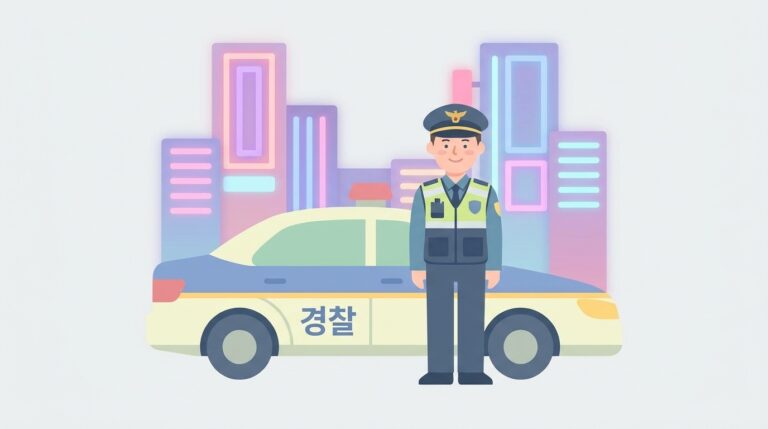
Emergency in Korea? No Panic! How to Call 112 Like a Native (Even with Zero Korean)
Phase 1: Empathy (Your Korean Bestie is Here!)
안녕하세요! (An-nyeong-ha-se-yo!) Your Korean bestie and Daily Hangul editor is here.
Imagine this: You are walking down a beautiful street in Hongdae late at night, enjoying the neon lights. Suddenly, you see someone taking photos of you without permission, or you find yourself in a dangerous situation. You pull out your phone to call 112 (Korea’s emergency police number), but your heart freezes. “What do I say? How do I tell them where I am in Korean?”
Many of our A1 learners tell us, “I am terrified of having an emergency in Korea because my Korean is so basic!” Don’t worry at all. Today, we are going to learn three magical, ultra-simple phrases that will get you help instantly. Even if you only know how to say one word, the Korean police are highly trained to help foreigners. Let’s make sure you feel 100% safe and confident during your stay in Korea!
Phase 2: Top 3 Emergency Phrases (Deep Dive)
Let’s look at the absolute essential phrases. Don’t worry about perfect grammar; in an emergency, speed and clarity are everything!
1. 도와주세요! (Do-wa-ju-se-yo!)
- Pronunciation: Doh-wah-joo-seh-yo! (Sounds like “Doh-wah” + “Juice” + “Yo”)
- Meaning: Please help me!
- K-Culture Moment: You’ve probably heard this in K-Dramas like Squid Game or Crash Landing on You when characters are in trouble. It is the universal cry for help.
- Editor’s Insight: This is the most important word you will learn today. It is polite but urgent. If you can only remember one word under stress, let it be this one!
- Situation Spectrum: Casual (⚠️ – too casual to use in emergencies) / Semi-formal (✅) / Formal (✅)
- 🤔 Think About It: In your country, what is the first word people shout when they need help? Is it “Help” or “Police”? In Korea, asking for help directly (
도와주세요) is the fastest way to alert people around you.
2. 경찰 불러 주세요. (Gyeong-chal bul-leo ju-se-yo.)
- Pronunciation: Gyeong-chal bool-luh-joo-seh-yo. (Sounds like “Gyung-chal” + “Bull-uh” + “Juice” + “Yo”)
- Meaning: Please call the police.
- K-Culture Moment: In K-Dramas, bystanders often shout this when a fight breaks out in a local pocha (street food tent).
- Editor’s Insight:
경찰(Gyeong-chal) means “police.” If you are hurt or cannot make the phone call yourself, look at any passerby, point to your phone, and say this phrase. - Situation Spectrum: Casual (⚠️) / Semi-formal (✅) / Formal (✅)
3. 여기에 … 있어요. (Yeo-gi-e … it-seo-yo.)
- Pronunciation: Yuh-gi-eh … eet-suh-yo.
- Meaning: There is a … here.
- K-Culture Moment: Used constantly in daily life when looking for things, but in emergencies, it helps police identify the threat (e.g., “도둑 (Do-duk – thief) 있어요”).
- Editor’s Insight: This is a magic sentence pattern. You can put any word in the blank. For example,
여기에 도둑 있어요(There is a thief here). - Situation Spectrum: Casual (🚫) / Semi-formal (✅) / Formal (✅)
Phase 3: Textbook Korean vs. Real-Life Korean
Let’s compare what textbooks teach you versus how Koreans actually talk in high-stress situations.
Situation A: Reporting a theft
- 📖 Textbook Korean: “제 지갑을 분실하였습니다.” (Je ji-gab-eul bun-sil-ha-yeot-seub-ni-da.) – “I have lost my wallet.”
- 🗣️ Real-Life Korean: “지갑 잃어버렸어요!” (Ji-gap eer-uh-buh-ryut-suh-yo!) – “I lost my wallet!”
- 💡 Why the difference?: The textbook version is too formal and robotic. In real life, using the conversational
잃어버렸어요sounds more natural and expresses urgency.
Situation B: Asking someone to call the police
- 📖 Textbook Korean: “112에 신고해 주시겠습니까?” (Il-il-i-e sin-go-hae ju-si-get-seub-ni-ka?) – “Would you mind reporting to 112?”
- 🗣️ Real-Life Korean: “112에 신고해 주세요!” (Il-il-i-e sin-go-hae-ju-se-yo!) – “Please report to 112!”
- 💡 Why the difference?: When you need help, don’t ask polite questions. Use the direct, imperative
~해 주세요(Please do this) form to get immediate action.
Phase 4: K-Culture Deep Dive & Non-Verbal Manners
4-1. Emergency Gestures in Korea
If you cannot speak Korean at all during an emergency, non-verbal cues are your best friend:
1. The Phone Gesture: Make a phone shape with your thumb and pinky finger, point to it, and shake your head with an anxious expression while saying “Police!” or “경찰 (Gyeong-chal)!”
2. Body Language: Do not cross your arms or put your hands in your pockets when talking to Korean police. It can look aggressive or dismissive. Keep your hands visible and nod your head to show cooperation.
4-2. The Safety of Korea & “Nunchi”
Korea is famous for being incredibly safe, but emergencies still happen. Koreans have a high sense of community responsibility, but sometimes they hesitate to help foreigners due to a “language barrier phobia.” If you make eye contact, use “Nunchi” (tact/social reading), and shout 도와주세요! (Do-wa-ju-se-yo!) directly to one specific person, they will almost always stop and help you.
Phase 5: Real-Life Roleplay Scenario
Let’s practice! You are in Itaewon, and you notice someone is following you closely. You approach a nearby Korean convenience store worker to ask for help.
Characters:
* You (A1 Korean learner)
* Store Clerk (Min-woo) (A friendly local helper)
The Dialogue
- You: 🎭 [Looking scared and pointing outside]
저기… 도와주세요!
(Jeo-gi… do-wa-ju-se-yo!)
“Excuse me… please help me!” -
Min-woo: 🎭 [Surprised, putting down boxes]
어머, 무슨 일이에요? 괜찮으세요?
(Eo-meo, mu-seun il-i-e-yo? Gwan-chan-eu-se-yo?)
“Oh my, what’s wrong? Are you okay?” -
You: 🎭 [Pointing at a strange man outside the window]
저 사람이… 따라와요.
(Jeo sa-ram-i… tta-ra-wa-yo.)
“That person… is following me.” -
Min-woo: 🎭 [Looking outside frowning]
아, 진짜요? 경찰 불러 줄까요?
(Ah, jin-jja-yo? Gyeong-chal bul-leo jul-kka-yo?)
“Ah, really? Shall I call the police?” -
You: 🎭 [Nodding urgently]
네! 경찰 불러 주세요.
(Ne! Gyeong-chal bul-leo ju-se-yo.)
“Yes! Please call the police.” -
Min-woo: 🎭 [Dialing 112 on his phone]
네, 제가 지금 전화할게요. 여기 매장 안에 있으세요.
(Ne, je-ga ji-geum jeon-hwa-hal-ge-yo. Yeo-gi mae-jang an-e it-seu-se-yo.)
“Yes, I will call now. Please stay inside the store.” -
You: 🎭 [Sighing with relief]
정말 감사합니다.
(Jeong-mal gam-sa-hap-ni-da.)
“Thank you so much.” -
Min-woo: 🎭 [Nodding warmly]
걱정하지 마세요. 이제 안전해요.
(Geok-jeong-ha-ji ma-se-yo. I-je an-jeon-hae-yo.)
“Don’t worry. You are safe now.”
🔀 Choose Your Action!
Situation: The police have arrived! What do you do?
* A) Try to explain everything in long English sentences.
* B) Point to the suspect and say “저 사람!” (Jeo sa-ram! – That person!) and “따라왔어요” (Tta-ra-wat-seo-yo – Followed me).
* C) Say “괜찮아요” (Gwan-chan-ah-yo – I’m okay) and run away because you are nervous.
Feedback:
- Best Choice – B: Perfect! Simple words combined with pointing are highly effective for emergency response.
- Bad Choice – A: While some police officers speak English, complex sentences might slow down their immediate action. Keep it simple first!
- Risk Choice – C: If someone was following you, running away without letting the police resolve it might put you in danger again later. Let them help!
Phase 6: 10-Second Emotion Shadowing Drill
Practice saying these with the right emotion. The slash / means a short pause!
- [🥺 Urgently and scared]
도와주세요! / 저기요!
(Do-wa-ju-se-yo! / Jeo-gi-yo!) -
[😠 Firmly and clearly]
경찰 / 불러 주세요!
(Gyeong-chal / bul-leo ju-se-yo!) -
[😰 Whispering in panic]
도둑 / 있어요!
(Do-duk / it-seo-yo!)
Phase 7: K-Culture Mini Dictionary
- 경찰 (Gyeong-chal) | Police | The general term for police officers and the police force in Korea.
- 112 (Il-il-i) | 112 | The emergency telephone number for the police in South Korea (equivalent to 911 or 999).
- 도와주세요 (Do-wa-ju-se-yo) | Help me | The most polite and common way to ask for assistance in any difficult situation.
- CCTV (C-C-T-V) | Security Camera | Korea has cameras everywhere. If something happens, you can ask for CCTV footage by saying “CCTV 보여주세요” (CCTV bo-yeo-ju-se-yo).
Phase 8: Survivor Kit for Travelers
Survival Phrases TOP 3
- 길을 잃었어요. (Gil-eul eer-eot-seo-yo.)
- Meaning: I am lost.
- Pro Tip: Show your phone screen with your destination map while saying this.
- 여기가 어디예요? (Yeo-gi-ga eo-di-yeo-yo?)
- Meaning: Where is this place?
- Pro Tip: Helpful when you are trying to tell the emergency dispatcher your location.
- 아파요. (Ah-pa-yo.)
- Meaning: It hurts. / I am sick.
- Pro Tip: Point to where it hurts while saying this.
Editor’s Travel Note
- Must-Have App: Download Naver Map immediately upon arriving in Korea. Google Maps does not work well here. If you are lost, Naver Map shows your exact current location in English, which you can show to a police officer.
- Emergency Tip: Did you know that if you dial 112 and speak English, they will automatically connect you to a translation service (BBB Korea or Tourism Translation)? You are never truly alone!
Phase 9: “One Step Deeper” (Cultural Insight)
In Korea, there is a strong cultural concept called “Jeong” (정)—a feeling of warm attachment and shared humanity. Even though young Koreans might look busy scrolling on their phones, they have a lot of “Jeong.” If they see a visitor in distress, their protective instincts kick in. Don’t let your beginner-level Korean stop you from asking for help. The moment you say 도와주세요, you unlock the warm, caring side of Korean society.
💬 Your Turn!
Have you ever had to ask for help in a foreign country? How did you handle it? Let us know in the comments below!
Phase 10: FAQ & Common Mistakes
Q: Can I call 112 if I don’t speak any Korean?
A: Yes! When you call 112, simply say “English, please” or “Foreigner.” The dispatcher will connect you to a three-way call with an interpreter almost immediately.
Q: Is there a different number for medical emergencies?
A: Yes! For police emergencies, call 112. For medical emergencies or fires, call 119.
Q: Can I text the police if I cannot speak?
A: Yes, you can send a text message to 112. You can even send photos or videos of your location or the situation.
🚨 Common Mistakes Alert!
- Shouting “Help!” in English in quiet neighborhoods: While younger Koreans understand “Help,” older generations might not react instantly. Use
도와주세요(Do-wa-ju-se-yo) for a 100% reaction rate. - Confusing 112 and 119: Calling 119 for a stolen phone will waste valuable time. Remember: 112 is for crimes/police, 119 is for fire/ambulances.
- Forgetting to check landmarks: If you don’t know the address, look for nearby convenience store names (like CU, GS25, Seven-Eleven) and tell the police. Each store has a unique branch name printed on its sign.
Phase 11: Action Mission
- Bronze Mission 🥉: Practice shouting
도와주세요!out loud in your room 3 times with real emotion. - Silver Mission 🥈: Bookmark this article on your phone so you can quickly access the phrases in an emergency.
- Gold Mission 🥇: Share this post on your social media to help your fellow travelers stay safe in Korea!
🎮 K-Culture Mission
The next time you watch a action K-Drama, try to spot the moment a character yells 도와주세요 or calls 경찰! Write down the name of the drama in our comments!
Phase 12: Interactive Quiz Challenge
1. What is the Korean emergency phone number for the police?
- A) 119
- B) 112
- C) 120
👉 Click to reveal the answer!
Correct Answer: B) 112
Explanation: 112 is for police, while 119 is for fire and medical emergencies. 120 is the Seoul government helpline.
2. Fill in the blank: “Please call the police” is “경찰 ______ 주세요.”
- A) 가
- B) 불러
- C) 도와
👉 Click to reveal the answer!
Correct Answer: B) 불러 (bul-leo)
Explanation: “경찰 불러 주세요” means “Please call the police.” “도와” is used in “도와주세요” (Help me).
3. True or False: You should use very polite, formal grammar during a dangerous emergency to show respect to the dispatcher.
- A) True
- B) False
👉 Click to reveal the answer!
Correct Answer: B) False
Explanation: In an emergency, clear and short sentences like “도와주세요!” (Help me!) are much better than long, overly polite sentences which might confuse the listener or waste time.







