

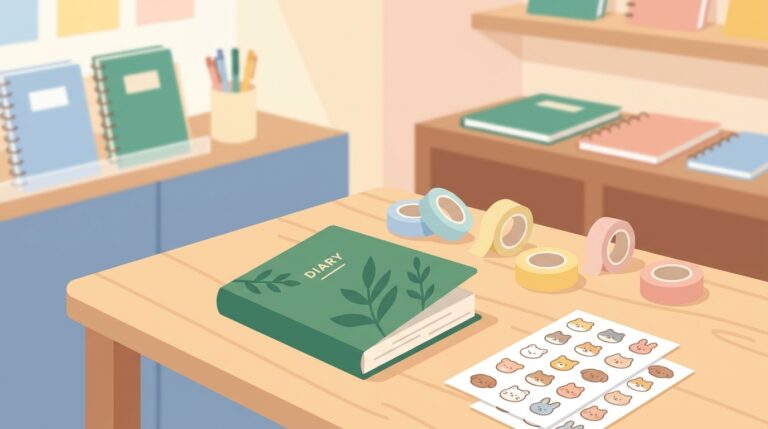
Phase 1: Welcome to the Cozy World of K-Stationery! 🌸
안녕하세요! (Annyeonghaseyo!) Welcome back, my dear friend! It’s your K-culture navigator and Korean bestie from Daily Hangul.
Have you ever walked into a massive Korean bookstore like Kyobo Book Centre (교보문고) or a cute lifestyle shop like ARTBOX (아트박스) and felt your heart skip a beat? In Korea, bookstores aren’t just for reading; they are absolute heavens for gorgeous stationery. And among all the treasures, the Korean diary (다이어리 – daieori) reigns supreme.
Whether it’s the start of a new year, a new semester, or you just want to start a “bullet journal,” choosing a diary in Korea is a sacred ritual. But as an A2 learner, walking up to the clerk to ask about diaries, refill pages, or cute stickers can feel a bit intimidating. Don’t worry! Today, we are going to master the exact, natural phrases you need to buy your dream diary with absolute confidence. Let’s dive in!
Phase 2: Key Expressions for Diary Shopping 🛍️
Let’s look at the top 3 magic phrases you need. These are simple, polite, and highly effective for an A2 learner.
1. 다이어리 어디에 있어요? (Da-i-eo-ri eo-di-e is-seo-yo?)
- Pronunciation: dah-ee-uh-ree uh-dee-eh ees-suh-yo? (Sounds like: “Diary, uh-dear-eh east-saw-yo?”)
- Meaning: “Where are the diaries?”
- K-Culture Moment: Picture yourself stepping into a huge Kyobo Bookstore in Gwanghwamun. It’s crowded, and you don’t want to wander around for hours. You catch the eye of a staff member wearing a neat apron and ask this politely.
- Editor’s Insight:
어디에 있어요?(Where is/are…?) is your ultimate survival pattern in Korea. You can replace “다이어리” with anything (e.g., “볼펜” for pens, “스티커” for stickers). - Situation Spectrum: Casual ⚠️ | Semi-formal ✅ | Formal ✅
- 🤔 Think About It: In English, we often say “Excuse me, could you tell me where…?” but in Korean, simply stating the item +
어디에 있어요?is perfectly polite and much more natural!
2. 이거 만년 다이어리에요? (I-geo man-nyeon da-i-eo-ri-e-yo?)
- Pronunciation: ee-guh mahn-nyeon dah-ee-uh-ree-eh-yo?
- Meaning: “Is this an undated diary?” (Literally: “Is this a ten-thousand-year diary?”)
- K-Culture Moment: You find a gorgeous diary, but you notice the dates aren’t printed. You want to make sure it’s a ” 만년 (undated)” diary so you can fill in the dates yourself!
- Editor’s Insight: In Korea, “만년 (man-nyeon)” literally means “ten thousand years.” It’s a poetic and clever way to say “undated” or “timeless” because you can use it any year!
- Situation Spectrum: Casual ⚠️ | Semi-formal ✅ | Formal ✅
- 🤔 Think About It: Why do you think undated “만년” diaries are so popular in Korea compared to dated ones?
3. 다른 색상도 있어요? (Da-reun saek-sang-do is-seo-yo?)
- Pronunciation: dah-reun saek-sahng-doh ees-suh-yo?
- Meaning: “Are there other colors too?”
- K-Culture Moment: You love the design of a diary, but it’s in bright pink, and you prefer forest green or minimalist beige.
- Editor’s Insight:
다른means “other/different,” and색상means “color.” If you want to ask for a different size, you can say:다른 사이즈도 있어요?(Da-reun sa-i-jeu-do is-seo-yo?). - Situation Spectrum: Casual ⚠️ | Semi-formal ✅ | Formal ✅
Phase 3: Textbook Korean vs. Real-Life Korean 🗣️
Let’s compare what textbooks teach you versus how Koreans actually talk in a stationery store.
Situation 1: Asking if a diary has weekly pages
- 📖 Textbook Korean: “이 일기장은 주간 계획표가 포함되어 있습니까?” (Does this diary include weekly schedules? – Too formal and robotic!)
- 🗣️ 진짜 한국어 (Real Korean): “이거 위클리 페이지도 있어요?” (Does this have weekly pages?)
- 💡 Why the difference? Koreans love using loan words like “위클리 (weekly)” and “페이지 (page)” in casual shopping contexts. It sounds much friendlier and modern!
Situation 2: Checking for stickers
- 📖 Textbook Korean: “다이어리를 꾸미는 접착성 종이를 찾고 있습니다.” (I am looking for adhesive paper to decorate diaries – Sounds like a dictionary!)
- 🗣️ 진짜 한국어 (Real Korean): “다꾸 스티커 어디 있어요?” (Where are the ‘dakku’ stickers?)
- 💡 Why the difference? 다꾸 (Dakku) is an extremely popular Korean slang word. It’s short for 다이어리 꾸미기 (Diary Decorating). It’s a massive subculture in Korea! Using this word will instantly make you sound like a local.
Phase 4: K-Culture Deep Dive & Non-Verbal Manners 💖
4-1. The Art of “Dakku” (다꾸) & Shopping Manners
In Korea, “다꾸” (Diary Decorating) is practically an art form. People use functional stickers, “washi” masking tape (마스킹 테이프), and colorful pens to make their diaries beautiful.
* Non-verbal Tip: When browsing diaries, many samples will have a plastic wrap or a “샘플 (Sample)” sticker on them. Always look for the designated sample book to flip through. If a diary is wrapped in plastic, do not tear it open! If you need help, politely point and ask, “이거 샘플 있어요?” (Is there a sample of this?).
* Handing over your card: When paying at the counter, it is highly polite to hand over your credit card or cash with both hands, accompanied by a gentle nod of the head. It shows immense respect to the cashier!
Phase 5: Real-Life Roleplay Scenario 🎭
Let’s practice! You are at a trendy stationery shop in Hongdae. You want to buy a diary, but you need to ask the friendly shop clerk (민지 – Minji) for help.
- Characters:
- You (유민 – Yumin / Customer)
- 민지 (Minji / Shop Clerk)
[Scene Starts]
Yumin: 🎭 (Approaching Minji politely)
저기요, 다이어리 어디에 있어요?
(Jeo-gi-yo, da-i-eo-ri eo-di-e is-seo-yo?)
“Excuse me, where are the diaries?”
Minji: 🎭 (Smiling and pointing to a wooden shelf)
아! 다이어리는 이쪽 코너에 있어요. 같이 오시겠어요?
(Ah! Da-i-eo-ri-neun i-jjok ko-neo-e is-seo-yo. Gat-i o-si-ges-seo-yo?)
“Ah! The diaries are in this corner. Would you like to come with me?”
Yumin: 🎭 (Following her and looking at a cute diary)
와, 예쁘다! 혹시 이거 만년 다이어리에요?
(Wa, ye-ppeu-da! Hok-si i-geo man-nyeon da-i-eo-ri-e-yo?)
“Wow, pretty! By any chance, is this an undated diary?”
Minji: 네, 맞아요! 날짜가 안 적혀 있어서 언제든 쓰실 수 있어요.
(Ne, ma-ja-yo! Nal-jja-ga an jeok-hyeo is-seo-seo eon-je-deun sseu-sil su is-seo-yo.)
“Yes, that’s right! The dates aren’t printed, so you can use it anytime.”
Yumin: 🎭 (Checking the cover color)
좋네요! 혹시 다른 색상도 있어요?
(Joh-ne-yo! Hok-si da-reun saek-sang-do is-seo-yo?)
“Great! By any chance, are there other colors too?”
Minji: 🎭 (Reaching for a shelf below)
그럼요. 노란색이랑 초록색도 있어요. 보여드릴게요.
(Geu-reom-yo. No-ran-saek-i-rang cho-rok-saek-do is-seo-yo. Bo-yeo-deu-ril-ge-yo.)
“Of course. We have yellow and green too. I’ll show you.”
Yumin: 🎭 (Clasping hands happily)
초록색 너무 예뻐요! 이걸로 할게요. 혹시 다꾸 스티커는 어디 있어요?
(Cho-rok-saek neo-mu ye-ppeo-yo! I-geol-ro hal-ge-yo. Hok-si dak-ku seu-ti-keo-neun eo-di is-seo-yo?)
“The green one is so pretty! I’ll take this one. By the way, where are the ‘dakku’ stickers?”
Minji: 🎭 (Chuckling warmly)
아, 다꾸요? 바로 옆 매대에 다 있어요! 천천히 구경하세요.
(Ah, dak-ku-yo? Ba-ro yeop mae-dae-e da is-seo-yo! Cheon-cheon-hi gu-gyeong-ha-se-yo.)
“Ah, dakku? They are all on the counter right next to us! Take your time looking around.”
[Scene Ends]
🔀 Interactive Choice: What will you say next?
Situation: You found the stickers, and now you are ready to pay. What do you say to Minji at the counter?
- Option A: “이거 주세요.” (I-geo ju-se-yo.)
- Option B: “이거 버려주세요.” (I-geo beo-ryeo-ju-se-yo.)
- Option C: “이거 깎아주세요.” (I-geo kkak-a-ju-se-yo.)
💡 Feedback:
- Best Choice (Option A): 🎉 Perfect! “이거 주세요” means “Please give me this” (I’ll buy this). It’s natural and polite.
- Bad Choice (Option B): 🚫 Oh no! “이거 버려주세요” means “Please throw this away.” Don’t throw your lovely diary in the trash!
- Risk Choice (Option C): ⚠️ Oops! “이거 깎아주세요” means “Please give me a discount.” In modern chain bookstores, prices are fixed, so asking for a discount might make things a bit awkward!
Phase 6: 10-Second Emotion Shadowing Drill 🎙️
Let’s practice speaking with real Korean emotions! Pause slightly at the / marks.
- [😊 Excited & Curious]
- “와, / 진짜 예쁘다! / 이거 만년 다이어리에요?”
- (Wa, / jin-jja ye-ppeu-da! / I-geo man-nyeon da-i-eo-ri-e-yo?)
- [🙋♀️ Polite & Helpful]
- “혹시 / 다른 색상도 / 있어요?”
- (Hok-si / da-reun saek-sang-do / is-seo-yo?)
- [💖 Happy & Eager]
- “초록색 / 너무 예뻐요! / 이걸로 할게요!”
- (Cho-rok-saek / neo-mu ye-ppeo-yo! / I-geol-ro hal-ge-yo!)
Phase 7: K-Culture Mini Dictionary 📖
| Word (Korean) | Romanization | English Translation & Real-life Usage |
|---|---|---|
| 다꾸 | Dakku | Diary Decorating. A major hobby in Korea. If you search “#다꾸” on Instagram, you’ll see millions of gorgeous posts! |
| 만년 다이어리 | Man-nyeon da-i-eo-ri | Undated Diary. A diary where you write in the dates yourself. Perfect if you sometimes skip days! |
| 마테 | Ma-te | Short for 마스킹 테이프 (Masking Tape). Usually decorative washi tape used for journaling. |
| 속지 | Sok-ji | Refill pages / Inner pages. Used when buying binder-style diaries where you can swap out pages. |
Phase 8: Survival Kit for Travelers ✈️
Survival Phrases TOP 3
- “선물 포장해 주세요.” (Seon-mul po-jang-hae ju-se-yo.)
- 👉 Pro Tip: “Please wrap it as a gift.” Perfect if you are buying a lovely diary for a friend back home!
- “봉투 필요해요.” (Bong-tu pil-yo-hae-yo.)
- 👉 Pro Tip: “I need a bag.” In Korea, shopping bags usually cost 100~200 KRW, so they will ask if you need one.
- “영수증 주지 마세요.” (Yeong-su-jeung ju-ji ma-se-yo.)
- 👉 Pro Tip: “Please don’t give me the receipt.” If you don’t need the paper receipt, use this to save paper!
🗺️ Editor’s Travel Note
When hunting for the best diaries in Seoul, head to Kyobo Book Centre (Gwanghwamun Branch) for massive variety, or visit Object (오브젝트) in Hongdae for unique, independent designer stationery. To navigate your way there smoothly, make sure to download the Naver Map App as Google Maps doesn’t work well in Korea!
Phase 9: One Step Deeper (Korean Mindset) 🧠
In Korea, buying a diary is closely tied to the concept of “소확행” (So-hwak-haeng), which means “small but certain happiness.” Taking time out of a busy day to sit in a quiet cafe, write down your thoughts, and decorate your diary with cute stickers is a form of self-care for many young Koreans. It’s a quiet rebellion against the fast-paced “빨리빨리” (hurry, hurry) lifestyle.
💬 Your Turn: Do you prefer dated diaries or undated (만년) diaries? What is your favorite way to practice “소확행”? Let me know in the comments below!
Phase 10: FAQ & Common Mistakes 🚨
Q: What is the difference between 일기장 (il-gi-jang) and 다이어리 (da-i-eo-ri)?
A: 일기장 usually refers to a personal diary used strictly for writing daily reflective journals (like a child’s school diary). 다이어리 is a broader term used for organizers, planners, and highly decorated schedule books.
Q: Can I return a diary if I change my mind?
A: Generally, yes, within 7 days with the receipt. However, if you tore open the plastic wrap of a sealed diary, they will not accept a return. Keep the packaging intact!
Q: What does “인스” (in-seu) mean in stationery shops?
A: It is short for 인쇄소 스티커 (printed stickers). These are sheets of stickers that you have to cut out yourself using scissors, highly popular among hardcore “dakku” fans!
🚨 Common Mistakes Alert!
- Mistake 1: Saying “다이어리 있어요?” when you want to ask where they are.
- Why: “다이어리 있어요?” means “Do you have diaries?” (They obviously do!). Say “다이어리 어디에 있어요?” (Where are the diaries?) instead.
- Mistake 2: Tearing off tape or opening sealed items to test them.
- Correction: Only touch items marked as “샘플” (Sample) or “체험용” (For testing).
Phase 11: Action Mission for You! 🎯
- Bronze Mission 🥉: Stand in front of a mirror and say “이거 만년 다이어리에요?” 3 times smoothly.
- Silver Mission 🥈: Go to Instagram, search the hashtag #다꾸 (or #다이어리꾸미기), and leave a friendly comment on a Korean creator’s post using the phrase: “너무 예뻐요!” (So pretty!).
- Gold Mission 🥇: When you visit Korea, walk into an ARTBOX or Kyobo, find a clerk, and ask: “저기요, 다꾸 스티커 어디 있어요?”
Phase 12: Interactive Quiz Challenge! 🧠
Ready to test your skills? Click the toggles below to see the answers!
1. Match the word to its meaning:
- 만년 다이어리
👉 Click to reveal the answer!
Answer: Undated Diary!
Remember, “만년” means ten thousand years, meaning it lasts forever because you write the dates yourself!
2. Fill in the blank:
- “혹시 다른 ______도 있어요?” (Are there other colors too?)
👉 Click to reveal the answer!
Answer: 색상 (saek-sang)
You can also say 색 (saek) for short! “혹시 다른 색도 있어요?”
3. True or False?
- “다꾸” (Dakku) means decorating a cafe.
👉 Click to reveal the answer!
Answer: False!
“다꾸” is short for 다이어리 꾸미기 (Diary Decorating). Decorating a cafe would be “카꾸” (not a common slang, but nice try!).
Great job today! You are now fully equipped to go on a gorgeous Korean stationery shopping spree. Until next time, keep shining and happy learning! 다음에 또 만나요! (See you next time!) 👋







