

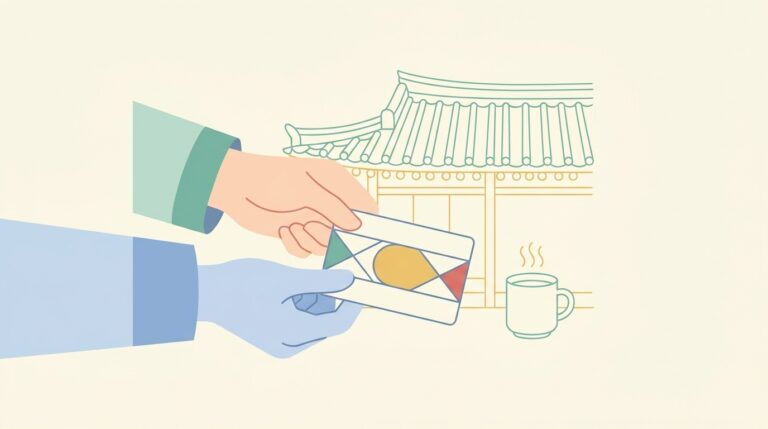
Handling Objects with Both Hands: The Ultimate Korean Manners Guide
Phase 1: Empathy & Storytelling
안녕하세요! (An-nyeong-ha-se-yo!) I’m your Daily Hangul editor and your personal Korean culture navigator!
Imagine this: You are at a trendy cafe in Hongdae. You’ve spent weeks practicing your Korean, and you finally order a delicious Iced Americano flawlessly. But as you hand over your credit card to the barista, you do it with one hand, casually holding your phone in the other. Suddenly, the warm atmosphere feels a tiny bit chilly. The barista takes your card with both hands, giving you a polite but slightly stiff bow.
What happened? You didn’t say anything rude. In fact, your grammar was perfect!
The secret lies in a silent language that speaks louder than words in Korea: body language and physical manners. Specifically, the way you hand over and receive items. In Korea, using two hands to give or take something is the ultimate sign of respect.
If you’ve ever felt confused about when to use two hands, where to place your other hand, or what to say while doing it, don’t worry! This is one of the most common cultural bumps that intermediate (B1) learners face. Today, we’re going to master this beautiful art of respect so you can feel 100% confident in any Korean social setting.
Phase 2: Top 3 Core Expressions for Handing Over Objects
1. 여기 있습니다 (Yeo-gi is-seum-ni-da)
- Pronunciation: Yuh-gi eet-seum-nee-dah (Sounds like “Yuh-gee” + “it’s-me-da” with a soft ‘n’)
- Meaning: “Here it is” / “Here you go” (Formal/Polite)
- K-Culture Moment: You will hear this constantly in K-Dramas whenever a secretary hands a folder to a CEO, or when a waiter serves a steaming bowl of Kimchi Jjigae.
- Editor’s Insight: This is the safest, most standard polite phrase. When you say this, make sure to look the person in the eyes briefly, smile, and deliver the object with both hands.
- Situation Spectrum: Casual: 🚫 | Semi-formal: ✅ | Formal: ✅
- 🤔 Think About It: In your home culture, is there a specific verbal phrase you must say when handing something over, or is a smile enough? How does this compare to the explicit verbal acknowledgment in Korea?
2. 받으세요 (Ba-deu-se-yo)
- Pronunciation: Bah-deu-seh-yo (Sounds like “Bah-du” as in the rhythm + “say-yo”)
- Meaning: “Please receive this” / “Please take it”
- K-Culture Moment: Often used in family-oriented K-Dramas when an aunt hands a beautifully wrapped gift or an envelope of pocket money to her niece.
- Editor’s Insight: While grammatically a command, the ending
-세요 (-se-yo)makes it gentle. However, it is slightly more active than “여기 있습니다”. It implies “I am giving this to you, so please accept it.” - Situation Spectrum: Casual: ⚠️ (with close older relatives) | Semi-formal: ✅ | Formal: ⚠️ (Too direct for extreme hierarchies)
- 🤔 Think About It: Why do you think Korean uses a verb that focuses on the recipient’s action (“receive”) rather than the giver’s action (“give”)? What does this tell us about Korean community mindset?
3. 드리겠습니다 (Deo-ri-get-seum-ni-da)
- Pronunciation: Deu-ree-get-seum-nee-dah (The ‘eu’ sound is like the ‘u’ in ‘pull’)
- Meaning: “I will humbly give this to you”
- K-Culture Moment: Used by flight attendants on Korean Air when handing you a blanket, or by hotel receptionists returning your passport.
- Editor’s Insight: This uses the humble verb 드리다 (deu-ri-da) instead of 주다 (ju-da). It is highly formal and shows the utmost professional respect.
- Situation Spectrum: Casual: 🚫 | Semi-formal: ⚠️ | Formal: ✅
- 🤔 Think About It: How does switching to a completely different verb (“드리다” instead of “주다”) help establish boundaries of respect in professional environments?
Phase 3: Textbook Korean vs. Real Conversational Korean
Situation 1: Giving a business card to a new partner
- 📖 Textbook Korean: 제 명함을 주겠습니다. (Je myeong-ham-eul ju-get-seum-ni-da.) – “I will give you my business card.”
- 🗣️ Real Conversational Korean: 제 명함입니다. 여기 있습니다. (Je myeong-ham-im-ni-da. Yeo-gi is-seum-ni-da.) – “This is my business card. Here you go.”
- 💡 Why the difference? Saying “I will give you” sounds overly robotic and self-centered. Real Koreans state what the object is and use the polite “여기 있습니다” while handing it over with both hands.
Situation 2: Paying at a convenience store
- 📖 Textbook Korean: 돈을 여기에서 받으십시오. (Don-eul yeo-gi-e-seo ba-deu-sip-si-o.) – “Please receive the money here.”
- 🗣️ Real Conversational Korean: (With a polite nod) 카드로 결제할게요. / 감사합니다. (Ka-deu-ro gyeol-je-hal-ge-yo. / Gam-sa-ham-ni-da.) – “I’ll pay by card. / Thank you.”
- 💡 Why the difference? You rarely need to verbally explain that you are handing over money. Instead, state your method of payment or just say “Thank you” while holding the card out with two hands.
Phase 4: K-Culture Deep Dive & Non-Verbal Manners
4-1. The Anatomy of the Two-Handed Gesture
You don’t always have to grip the object with both hands like a trophy! There are levels to this:
1. The Double Grip: Both hands hold the item (e.g., handing a document or a gift).
2. The Under-Arm Support: Your right hand holds the item (card, glass), while your left hand gently touches your right inner wrist or forearm. This stems from historical robes where sleeves had to be held back to prevent them touching food or dirtying the table!
3. The Chest Touch: Your left hand is placed flat over your chest or stomach while your right hand presents the item. This is common in casual service industries.
4-2. The K-Drama Drinking Etiquette
If you watch K-Dramas like Itaewon Class or Work Later, Drink Now, you’ve seen characters drinking together. When an older or higher-status person pours you a drink, you must hold your cup with both hands. When you pour for them, you hold the bottle with your right hand and place your left hand under your right elbow.
Phase 5: Real-Life Roleplay Scenario
Setting: A neat office in Seoul. You (B1 learner) are handing over a physical project report to your Korean supervisor, Team Leader Kim (김 팀장님).
Characters:
- You (Min-jun/Sarah): Excited but nervous intermediate employee.
- Team Leader Kim: Professional, kind, but appreciates strict office etiquette.
1. You: 김 팀장님, 보고서 다 끝났습니다.
   (Gim tim-jang-nim, bo-go-seo da kkeut-nas-seum-ni-da.)
   "Team Leader Kim, I have finished the report."
   🎭 (You step up to his desk with the printed paper in your hands.)

2. Manager Kim: 아, 그래요? 생각보다 빨리 끝났네요.
   (Ah, geu-rae-yo? Saeng-gak-bo-da ppal-li kkeut-nan-ne-yo.)
   "Oh, really? It finished faster than I thought."
   🎭 (He looks up from his computer screen with interest.)

3. You: 네, 여기 있습니다. 한번 확인해 주세요.
   (Ne, yeo-gi is-seum-ni-da. Han-beon hwa-gin-hae ju-se-yo.)
   "Yes, here it is. Please take a look."
   🎭 (You bow slightly and hold the report with both hands, presenting it so the text faces him.)

4. Manager Kim: 고마워요. (Taking the paper with both hands) 역시 민준 씨는 일을 꼼꼼하게 하네요.
   (Go-ma-wo-yo. Yeok-si Min-jun ssi-neun il-eul kkom-kom-ha-ge ha-ne-yo.)
   "Thank you. As expected, Min-jun, you do thorough work."

5. You: 아닙니다. 아직 부족한 점이 많습니다.
   (An-im-ni-da. A-jik bu-jok-han jeom-i man-seum-ni-da.)
   "Not at all. I still have a lot to learn."
   🎭 (You wave your hands slightly in a humble gesture.)

6. Manager Kim: 이 부분 피드백해서 이메일로 보낼게요.
   (I bu-bun pi-deu-baek-hae-seo i-me-il-lo bo-nael-ge-yo.)
   "I will review this part and send feedback via email."

7. You: 네, 잘 부탁드립니다. 감사합니다!
   (Ne, jal bu-tak-deu-rim-ni-da. Gam-sa-ham-ni-da!)
   "Yes, I look forward to your guidance. Thank you!"
   🎭 (You do a polite 15-degree bow as you leave his desk.)
🔀 Interactive Choice Point
How do you respond when Team Leader Kim asks you to hand him a pen that fell on the floor?
* A) Pick it up with one hand and toss it gently on his desk.
* B) Pick it up, hold it with both hands (or support your right arm with your left hand), and present the writing end away from him.
* C) Pick it up with your right hand while keeping your left hand in your pocket, saying “여기요” (Yeo-gi-yo).
Feedback:
- Best Choice (B): Perfect! Handing a sharp or pointy object (like a pen or scissors) should always be done with the blunt end facing the receiver, handed over with two hands. This shows incredible attentiveness!
- Risk Choice (C): Having your hand in your pocket while interacting with a superior is considered extremely rude in Korea. Try to avoid this!
- Bad Choice (A): Tossing items is a major taboo in Korean etiquette. Even if you are close, always hand things over directly.
Phase 6: 10-Second Emotion Shadowing Drill
Practice these with natural rhythm and pauses (/ marks the pausing point).
- [😊 Respectful & Confident]
- 여기 / 있습니다. 한번 / 보세요.
- Yeo-gi / is-seum-ni-da. Han-beon / bo-se-yo.
- “Here / it is. Please / take a look.”
- [🥺 Humble & Grateful]
- 주셔서 / 정말 / 감사합니다.
- Ju-syeo-seo / jeong-mal / gam-sa-ham-ni-da.
- “Thank you / so much / for giving this to me.”
Phase 7: K-Culture Mini Dictionary
- 존댓말 (Jondaetmal) | Honorifics
- The polite and respectful form of the Korean language, used with superiors, strangers, or in professional settings.
- 눈치 (Nunchi) | Social Wit
- The art of reading the room and sensing others’ feelings to act appropriately without verbal communication.
- 정 (Jeong) | Emotional Attachment
- A deep, warm feeling of connection and collective care that shapes Korean social dynamics and polite behaviors.
- 수고하셨습니다 (Sugohasyeotseumnida) | “Thank you for your hard work”
- The phrase used to thank colleagues, teachers, or service providers at the end of a task.
Phase 8: Traveler’s Survival Kit
TOP 3 Survival Phrases
- 카드 여기 있습니다. (Ka-deu yeo-gi is-seum-ni-da.)
- “Here is my card.” (Say this at registers with both hands on the card).
- 봉투 필요해요. (Bong-tu pil-yo-hae-yo.)
- “I need a plastic/shopping bag.”
- 영수증은 버려주세요. (Yeong-su-jeung-eun beo-ryeo-ju-se-yo.)
- “Please throw away the receipt for me.”
Editor’s Travel Note:
When traveling in Seoul, you’ll use public transport constantly. Download the Naver Map App (the most accurate navigation tool in Korea) to easily find subway exits. Note: Transit details and app interfaces may change over time, so check for updates before your trip.
Phase 9: A Step Deeper (Reflection)
In Western cultures, efficiency and eye contact often define polite transactions. You hand over a card quickly, smile, and make eye contact. In Korea, however, physical connection and boundaries of space are emphasized differently. Handing an item with both hands visually reduces physical distance while demonstrating that your full attention is on the recipient. It shows that you value them more than the speed of the transaction.
💬 Your Turn: Have you ever noticed similar hand-gestures in your own culture, or does this feel completely new? Tell us in the comments below!
Phase 10: FAQ & Common Mistakes
Q: Do I have to use two hands even at a local convenience store with younger cashiers?
A: Yes! While they might not take it with both hands, doing so yourself shows that you are a highly polite and cultured person. It always leaves a wonderful impression.
Q: What if my left hand is holding heavy groceries?
A: If your other hand is busy, simply support your right forearm slightly with your left hand’s fingers, or do a gentle bow of your head as you hand over the item with your right hand. Your effort will be recognized!
Q: Can I slide my card across the counter instead of handing it over?
A: Sliding cards or money is considered rude unless there is a designated transaction tray. Try to always place it in their hands or gently on the tray.
🚨 Common Mistakes Warning Board
- The “Frisbee” Toss: Tossing cards or keys onto a desk. Correct Action: Place them down gently with two hands.
- The Left-Hand Only Give: Handing things over with only the left hand (traditionally considered less respectful in historical context). Correct Action: Use the right hand supported by the left.
- Avoiding Eye Contact Completely: Bowing so low you look at the floor for too long. Correct Action: Maintain brief, warm eye contact before and after bowing.
Phase 11: Action Mission!
- 🥉 Bronze Mission: Practice handing your phone to a friend today using both hands and saying “여기 있어” (Yeo-gi is-seo – casual) or “여기 있습니다” (Yeo-gi is-seum-ni-da).
- 🥈 Silver Mission: Film a 5-second video of your hands doing the “wrist-support” gesture and share it with us on social media using
#DailyHangulManners! - 🥇 Gold Mission: Go to a local Korean grocery store or restaurant, pay with both hands on your card, and say “감사합니다” (Gam-sa-ham-ni-da) with a warm nod.
Phase 12: Interactive Quiz Challenge
Test your new K-manners with this quick quiz!
1. Which of the following is the most respectful way to hand over a pen to your teacher?
- A) Holding the writing tip and handing over the top with one hand.
- B) Handing the pen with both hands, ensuring the sharp writing tip points toward yourself.
- C) Tossing it onto the desk so they can grab it easily.
Reveal Answer & Explanation
Correct Answer: B
Always point sharp ends toward yourself and present the safe, blunt end to others with both hands to show thoughtfulness.
2. True or False: Supporting your right elbow with your left hand is a valid alternative to using both hands.
- A) True
- B) False
Reveal Answer & Explanation
Correct Answer: A (True)
This is the classic ‘Under-Arm Support’ which is perfect when your left hand cannot fully grip the object itself.







