

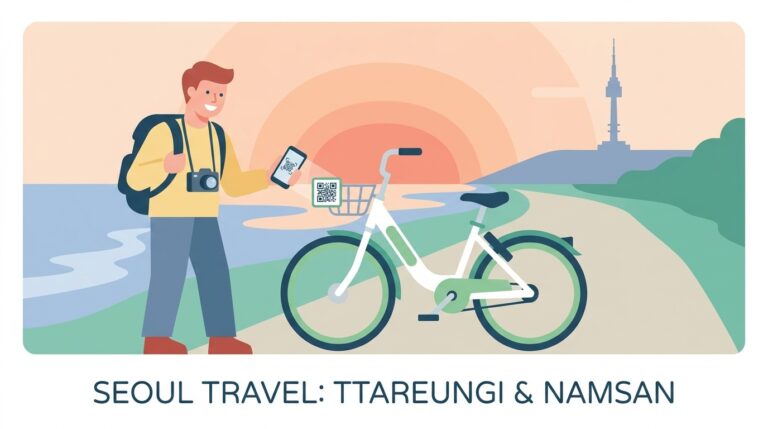
Riding Along the Han River: How to Rent a Bicycle in Korea (Ttareungi Guide)
Phase 1: Empathy (Your Korean Bestie’s Welcome!)
안녕하세요! (An-nyeong-ha-se-yo!) Hello there, my dear friend! It’s your favorite Korean editor and local guide from Daily Hangul.
Imagine this: The sun is setting, casting a golden glow over the Han River (한강). A cool breeze brushes past your face, and around you, locals are laughing, eating instant ramen, and cycling along the beautifully paved riverside tracks. You want to join the fun, but then you look at the green-and-white bicycles parked nearby. How on earth do I rent one? Do I need a Korean phone number? What if the app is only in Korean?
Don’t worry! Renting a bicycle in Seoul (affectionately called 따릉이 – Ttareungi) is incredibly easy once you know a few magic words. Today, we’re going to conquer your rental anxiety and get you riding like a true Seoulite. Let’s dive in!
Phase 2: Deep Dive into 3 Key Expressions
1. 자전거 빌리고 싶어요. (Jeo-jeon-geo bil-ri-go sip-eo-yo.)
- Pronunciation: jah-jeon-geo beel-ree-go sheep-uh-yo (Sounds like “jah-jeon-go” + “bill-ree-go” + “ship-uh-yo”)
- Meaning: I want to rent a bicycle.
- K-Culture Moment: You’ll hear this in healing K-dramas where the main leads decide to take a romantic sunset ride near the Han River or in Gyeongju.
- Editor’s Insight: ‘자전거’ means bicycle, and ‘빌리다’ means to borrow/rent. Combining it with ‘-고 싶어요’ (I want to) makes it polite and clear.
- Situation Spectrum: Casual (⚠️ – too formal for close friends, use ‘자전거 빌릴래’), Semi-formal (✅), Formal (✅)
- 🤔 Think About It: In English, we use “rent” for paid items and “borrow” for free things. In Korean, ‘빌리다’ covers both! Why do you think Korean language simplifies this distinction?
2. 따릉이 어떻게 타요? (Tta-reung-i eo-tteo-ke ta-yo?)
- Pronunciation: tah-reung-ee uh-ttuh-keh tah-yo? (Double ‘t’ sound is bouncy! Like “t-tah-reung-ee”)
- Meaning: How do I ride/use Ttareungi?
- K-Culture Moment: If you are lost at a rental kiosk, you can ask a friendly passerby this exact phrase. Koreans love helping tourists!
- Editor’s Insight: ‘따릉이’ (Ttareungi) is the official name of Seoul’s public bike share system. The name comes from the sound of a bicycle bell: “ttareung-ttareung” (ding-ding!).
- Situation Spectrum: Casual (⚠️), Semi-formal (✅), Formal (✅)
- 🤔 Think About It: Onomatopoeia (sound words) are heavily used in Korean naming. Can you think of any public service in your country named after a sound?
3. 결제가 안 돼요. (Gyeol-je-ga an dwae-yo.)
- Pronunciation: gyul-jeh-gah ahn dweh-yo (Like “gyul” + “jeh” + “gah” + “ahn” + “dway-yo”)
- Meaning: The payment is not working.
- K-Culture Moment: When using a foreign credit card on a Korean app, you might hit a digital wall. This phrase is your lifeline.
- Editor’s Insight: ‘결제’ means payment, and ‘안 돼요’ means “it doesn’t work” or “no.” It’s short, polite, and instantly signals a problem.
- Situation Spectrum: Casual (🚫), Semi-formal (✅), Formal (✅)
- 🤔 Think About It: Korean payment systems are highly secure, which sometimes makes them tricky for foreign cards. Always keep this phrase ready!
Phase 3: Textbook Korean vs. Real Korean
Let’s compare what dry textbooks teach you versus how cool, modern Koreans actually speak.
Scenario 1: Asking how to pay
- 📖 Textbook: 이용권을 어떻게 구매합니까? (I-yong-gwon-eul eo-tteo-ke gu-mae-hap-ni-ka? – “How do I purchase a voucher?”)
- 🗣️ Real Korean: 이거 결제 어떻게 해요? (I-geo gyeol-je eo-tteo-ke hae-yo? – “How do I pay for this?”)
- 💡 Why the difference? The textbook version uses heavy, formal vocabulary (‘구매하다’ – to purchase, ‘이용권’ – voucher) which sounds like a written manual. Real people use simple verbs like ‘하다’ (to do) and ‘결제’ (payment).
Scenario 2: Saying the bike is broken
- 📖 Textbook: 자전거가 고장 났습니다. (Ja-jeon-geo-ga go-jang nat-seup-ni-da. – “The bicycle is broken.”)
- 🗣️ Real Korean: 이거 고장 난 것 같아요. (I-geo go-jang nan geot gat-ah-yo. – “I think this is broken.”)
- 💡 Why the difference? Saying “It is broken” directly can sound a bit harsh in Korean culture. Adding ‘~것 같아요’ (“I think…” or “It seems…”) softens the tone, making you sound extremely polite and natural.
Phase 4: K-Culture Deep Dive & Non-Verbal Manners
4-1. Nunchi (눈치) & Body Language
When approaching a bicycle rack, don’t rush. Look around to see if others are waiting in an invisible queue. If you need help, approach someone with a slight bow (about 15 degrees) and hold your phone out politely with both hands to show the app screen. This gesture alone shows immense respect and warmth.
4-2. The Han River Bike Culture
In Korea, riding a bike along the Han River is not just exercise—it’s a lifestyle. It almost always ends with “Hangang Ramen” (한강 라면) cooked on automatic cooking machines at the convenience store. When renting your Ttareungi, remember to park it safely in designated areas using the built-in lock to avoid fines and keep the riverside beautiful!
Phase 5: Real-Life Roleplay Scenario
Meet Ji-su (지수), a friendly local guide wearing a bright green windbreaker near the Yeouido Han River Park bike rental station.
- Character: Ji-su (Warm, helpful, loves cycling)
- Your Goal: Rent a bike using the QR code, but you are struggling with the app.
👤 You: 저기요, 실례지만... 자전거 빌리고 싶어요.
(Jeo-gi-yo, sil-rye-ji-man... ja-jeon-geo bil-ri-go sip-eo-yo.)
🎭 [Politely waving your hand to get attention]
"Excuse me... I want to rent a bicycle."
🙋♀️ Ji-su: 아, 따릉이요? 앱 설치하셨어요?
(Ah, tta-reung-i-yo? Aep seol-chi-ha-sheot-eo-yo?)
🎭 [Smiling and pointing to your smartphone]
"Ah, Ttareungi? Have you installed the app?"
👤 You: 네, 앱은 있어요. 그런데 결제가 안 돼요.
(Ne, aep-eun it-eo-yo. Geon-de gyeol-je-ga an dwae-yo.)
🎭 [Showing your phone screen with a worried face]
"Yes, I have the app. But the payment isn't working."
🙋♀️ Ji-su: 외국인 카드는 'Foreigner' 탭에서 결제해야 돼요! 제가 도와드릴까요?
(Wae-guk-in ka-deu-neun 'Foreigner' taep-e-seo gyeol-je-hae-ya dwae-yo! Je-ga do-wa-deu-ril-kka-yo?)
🎭 [Taking a step closer to help you tap the screen]
"For foreign cards, you have to pay under the 'Foreigner' tab! Shall I help you?"
👤 You: 와, 정말 감사해요! 이제 어떻게 타요?
(Wa, jeong-mal gam-sa-hae-yo! I-je eo-tteo-ke ta-yo?)
🎭 [Clapping your hands lightly with relief]
"Wow, thank you so much! How do I ride it now?"
🙋♀️ Ji-su: 여기 자전거 뒤에 있는 QR 코드를 스캔해 보세요.
(Yeo-gi ja-jeon-geo dwi-e in-neun QR ko-deu-reul seu-kaen-hae bo-se-yo.)
🎭 [Pointing at the square QR code under the bike seat]
"Try scanning this QR code behind the bicycle."
👤 You: 아! 락(Lock)이 풀렸어요! 감사합니다.
(Ah! Rak-i pul-ryeot-eo-yo! Gam-sa-hap-ni-da.)
🎭 [Smiling widely as the lock clicks open]
"Ah! The lock is released! Thank you."
🙋♀️ Ji-su: 즐거운 시간 보내세요! 조심히 타시고요!
(Jeul-geo-un si-gan bo-nae-se-yo! Jo-sim-hi ta-si-go-yo!)
🎭 [Waving goodbye with a cheerful smile]
"Have a great time! Ride safely!"
🔀 Interactive Choice Point
What will you say to Ji-su before you ride away?
* A: “안녕!” (An-nyeong!)
* 🚫 Risk: Too casual! You just met Ji-su; saying this might sound slightly impolite.
* B: “감사합니다! 좋은 하루 보내세요!” (Gam-sa-hap-ni-da! Jo-eun ha-ru bo-nae-se-yo!)
* 🌟 Best: Perfect! It means “Thank you! Have a nice day!” in a very polite and warm manner.
* C: “자전거 최고!” (Ja-jeon-geo choe-go!)
* ⚠️ Bad: Meaning “Bicycles are the best!” It’s grammatically okay, but a bit random and awkward in this context.
Phase 6: 10-Second Emotion Shadowing Drill
To speak like a native, you need to feel the emotion! Practice these sentences with the correct rhythm and pause (/).
- [🥺 Asking for help desperately]
저기요… / 자전거 결제가 / 안 돼요.
(Jeo-gi-yo… / ja-jeon-geo gyeol-je-ga / an dwae-yo.) - [😊 Filled with joy and relief]
와! / 드디어 / 락이 풀렸어요!
(Wa! / deu-di-eo / rak-i pul-ryeot-eo-yo!)
Phase 7: K-Culture Mini Dictionary
- 따릉이 (Ttareungi): Seoul’s official public bike rental service. Named after the ringing sound of a bicycle bell.
- 헬멧 (Hel-met): Helmet. Essential for safety, though not always provided with public bikes. Keep safety first!
- 반납 (Ban-nap): Returning an item. You must return the bike to a designated Ttareungi station to stop the timer.
- 거치대 (Geo-chi-dae): The docking station or cradle where the bicycles are locked.
Phase 8: Survivor Kit for Travelers
Survival Phrases TOP 3
- 반납 어디서 해요? (Ban-nap eo-di-seo hae-yo?)
- Pro Tip: “Where do I return this?” Use this if you can’t find the docking station.
- 이거 고장 났어요. (I-geo go-jang nat-eo-yo.)
- Pro Tip: “This is broken.” Tell this to the rental center if the gears are faulty.
- 도와주세요! (Do-wa-ju-se-yo!)
- Pro Tip: “Please help me!” A universal emergency phrase.
Editor’s Travel Note
Before heading out, make sure to download the Seoul Bike (따릉이) app from your app store. Disclaimer: App functions, rental rates, and payment gateway interfaces may change over time; always double-check the latest app updates before your trip. For navigation, Google Maps is not very accurate in Korea. Make sure to download the Naver Map App to find the best cycling routes!
Phase 9: “Going One Step Deeper”
In Korea, public services like Ttareungi rely heavily on collective trust. You will notice that these bikes are not chained up like fortresses, and people leave them temporarily outside convenience stores without fear of theft. This reflects Korea’s high-trust society and respect for shared public property. When we use these services, we become part of this beautiful community contract.
💬 Your Turn: How does public bike sharing work in your country? Do people trust each other with public property? Tell us in the comments below!
Phase 10: FAQ & Avoiding Common Mistakes
Q: Can I rent a Ttareungi bike without a Korean phone number?
A: Yes! The “Seoul Bike” app has a “Foreigner” option that allows registration and payment using overseas credit cards without requiring local mobile verification.
Q: What happens if I return the bike late?
A: Additional fees will automatically be charged to your registered payment method. Be sure to check your rental duration limit (usually 1 hour or 2 hours per session).
Q: Where can I ride the bike?
A: Korea has beautifully dedicated bicycle lanes, especially along the Han River. Avoid riding on busy pedestrian sidewalks.
🚨 Common Mistakes Alert!
- Mistake: Locking the bike manually without ending the ride on the app.
- Correct Action: Make sure you hear the automatic voice guidance say “반납되었습니다” (Returned successfully).
- Mistake: Forgetting to lock the bike during a temporary stop.
- Correct Action: Use the “Temporary Lock” feature in the app so no one else rides off with your rental.
- Mistake: Using a Korean credit card option with a foreign card.
- Correct Action: Always select the “Global/Foreigner” menu in the app to use international cards.
Phase 11: Action Mission
- 🥉 Bronze Mission: Write “자전거 빌리고 싶어요” in your journal and practice saying it out loud 3 times!
- 🥈 Silver Mission: Go to your app store, search for the Seoul Bike app, and explore its interface.
- 🥇 Gold Mission: When you visit Korea, take a photo of yourself on a Ttareungi bike by the Han River and tag us on Instagram using
#DailyHangul!
Phase 12: Interactive Quiz Challenge
1. What is the name of Seoul’s public bike system?
- A) 붕붕이 (Bung-bung-i)
- B) 따릉이 (Ttareungi)
- C) 씽씽이 (Ssing-ssing-i)
Reveal Answer & Explanation
Correct Answer: B) 따릉이 (Ttareungi)
Explanation: “Ttareungi” is the beloved name of Seoul’s public bike sharing scheme, mimicking the sound of a bicycle bell! (Bung-bung-i is for cars, Ssing-ssing-i is for electric scooters!)
2. Translate to Korean: “The payment is not working.”
- A) 결제가 안 돼요. (Gyeol-je-ga an dwae-yo.)
- B) 카드 없어요. (Ka-deu eop-seo-yo.)
Reveal Answer & Explanation
Correct Answer: A) 결제가 안 돼요. (Gyeol-je-ga an dwae-yo.)
Explanation: Option B means “I don’t have a card.” Option A is the correct phrase to use when your transaction is failing.







