

Master Korean Convenience Store Delivery (Taekbae) Like a Local! (B2)
안녕하세요! Welcome back to another episode of your ultimate Korean culture guide. I’m your host and editor from Daily Hangul (매일한글). Have you ever stood in a sleek Korean convenience store, holding a heavy package, and frozen in front of the touch screen? Or perhaps you received a text message saying your package has arrived at the local GS25, but you had no idea what to say to the clerk?
Today, we’re cracking the code of Korean Convenience Store Courier Services (편의점 택배 – Pyeon-ui-jeom Taek-bae). Whether you are sending a gift to a friend in Seoul or picking up your K-beauty haul, we’ve got your back with natural, intermediate-level Korean phrases that will make you look like a seasoned resident!
Phase 1: Empathy & The “Convenience Store” Puzzle
Picture this: You are living in a cozy studio apartment in Seoul. You need to send a return package, but you work during post office hours. You hear that you can do it 24/7 at the GS25 or CU right downstairs! But when you walk in, the screen is entirely in fast-scrolling Korean, and the scale is blinking an error message.
Our reader, Sarah (a B2 learner from Canada), shared her experience: “I knew the words ‘택배’ (courier) and ‘보내다’ (to send), but when the clerk asked me about ‘선불’ or ‘착불’, I just stood there blankly while a line formed behind me!”
Don’t worry, Sarah! That’s a classic B2 hurdle. Today, we’ll transform that panic into pure confidence. Let’s master the exact phrases, cultural nuances, and hidden gestures so you can breeze through your next convenience store run.
Phase 2: Core Expressions Deep-Dive
Let’s analyze the three most critical expressions you’ll need for sending and receiving packages.
1. 택배 보내려고 하는데요. (Taek-bae bo-nae-ryeo-go ha-neun-de-yo.)
- Pronunciation: “Taek-bae bo-nae-ryeo-go ha-neun-de-yo” (Sounds like “Tech-beh bo-neh-ryeo-go ha-noon-deh-yo”)
- Meaning: “I’d like to send a package.” (Literal: “I am intending to send a package, and…”)
- K-Culture Moment: In K-Dramas, you often see characters secretly sending packages to their hometowns or returning items they bought impulsively online. They walk up to the counter and say this with a polite, slightly sheepish smile.
- Editor’s Insight: Ending a sentence with
-ㄴ/는데요soft-launches your request. It’s much more natural and polite than saying “택배 보낼래요!” (I want to send a package!), which can sound demanding. - Situation Spectrum: Casual ⚠️ | Semi-formal ✅ | Formal ✅
- 🤔 Think About It: Why does Korean use indirect endings like
-ㄴ/는데요instead of direct imperatives? How does this reflect the Korean cultural value of keeping interpersonal interactions smooth and non-confrontational?
2. 착불인가요, 선불인가요? (Chak-bul-in-ga-yo, seon-bul-in-ga-yo?)
- Pronunciation: “Chak-bul-in-ga-yo, seon-bul-in-ga-yo?” (Sounds like “Chak-bool-in-gah-yo, sun-bool-in-gah-yo?”)
- Meaning: “Is it cash-on-delivery (payee pays) or prepaid (sender pays)?”
- K-Culture Moment: When buying secondhand items on apps like Danggeun Market (당근마켓), players must negotiate who pays for shipping. The buyer might ask, “택배비는 착불인가요?” (Is the shipping cash-on-delivery?).
- Editor’s Insight:
선 (Seon)means “before/pre-” and착 (Chak)means “arrival.”불 (Bul)means “payment.” Memorizing these Hanja roots will help you decode other financial transactions in Korea! - Situation Spectrum: Casual ⚠️ | Semi-formal ✅ | Formal ✅
- 🤔 Think About It: In your home country, is cash-on-delivery for personal packages common? Why do you think Korea’s highly trusted, high-speed delivery infrastructure makes cash-on-delivery so reliable?
3. 택배 보관함에서 찾으러 왔어요. (Taek-bae bo-gwan-ham-e-seo chat-eu-reo wass-eo-yo.)
- Pronunciation: “Taek-bae bo-gwan-ham-eh-suh chah-jeu-ruh wah-ssuh-yo”
- Meaning: “I came to retrieve my package from the delivery locker/storage.”
- K-Culture Moment: Many single-person households in Korea use convenience stores as safe pickup spots (like GS Postbox or CU Postbox) to avoid package theft or missed deliveries.
- Editor’s Insight: The phrase
찾으러 오다means “to come to retrieve/pick up.” If you are just picking it up from the counter counter, you can simplify it to: “택배 찾으러 왔어요.” (I came to pick up a package). - Situation Spectrum: Casual 🚫 | Semi-formal ✅ | Formal ✅
- 🤔 Think About It: How does the integration of convenience stores into daily logistics reflect the rapid, hyper-connected nature of urban Korean life?
Phase 3: Textbook Korean vs. Real-Life Korean
Let’s compare the rigid phrases from traditional textbooks with what native speakers actually say.
Scenario 1: Asking where the delivery machine is located
- 📖 Textbook: “택배 접수 기계는 어디에 있습니까?” (Where is the courier registration machine? – Too formal, sounds like a robot.)
- 🗣️ Real-Life: “혹시 택배 기계 어디 있어요?” (Excuse me, where is the delivery machine? – Natural, soft, and polite.)
- 💡 Why the difference? The word
혹시(by any chance) acts as a beautiful linguistic buffer that softens your question immediately.
Scenario 2: Confirming payment options
- 📖 Textbook: “제가 요금을 지금 내겠습니다.” (I will pay the fee now.)
- 🗣️ Real-Life: “선불로 할게요.” (I’ll do prepaid.)
- 💡 Why the difference? In daily life, Koreans prefer short, noun-centric decisions (선불로 / 착불로) +
~할게요(I will do…) to keep transactions fast and efficient.
Phase 4: K-Culture Deep-Dive & Non-Verbal Etiquette
4-1. Nunchi & Gestures: Speed is King!
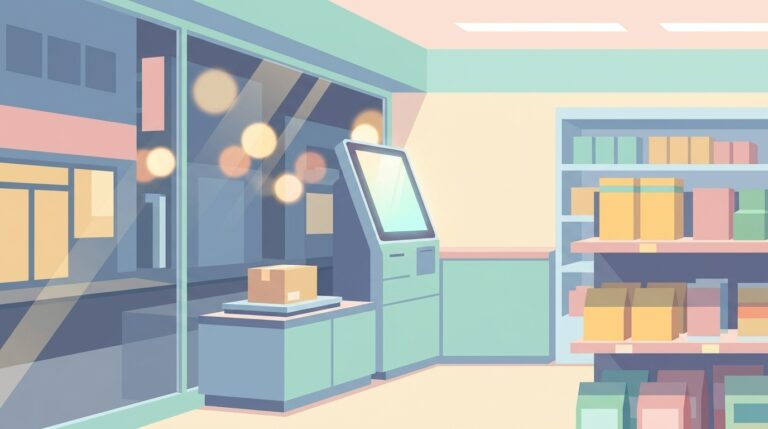
When using the self-service scale (포스트박스) at the convenience store, Nunchi (눈치 – situational quick-wittedness) is key.
* The Gesture: When placing your package on the built-in scale on the machine, hold the package slightly with your hand until the scale registers, then let go completely for a split second to get the accurate weight.
* The Line Etiquette: If someone is waiting behind you, register your address details on your mobile app beforehand (using GS25/CU apps) and simply log in via QR code at the machine. This takes only 5 seconds and will earn you silent respect from the locals!
4-2. The Convenience Store Ecosystem
Korean convenience stores are not just shops; they are lifelines. Known as 편의점 (Pyeon-ui-jeom), they are integrated hubs where you can print documents, pay utility bills, charge transit cards, buy concert tickets, and, of course, send packages anywhere in the country within 24 hours. This is the heart of Korea’s “Ppalli-Ppalli” (빨리빨리 – Hurry, Hurry) culture made accessible and affordable.
Phase 5: Real-Life Roleplay Scenario
Setting: A brightly lit GS25 in Mapo-gu, Seoul. You are standing at the counter with a packaged box. The clerk (Ji-hun) is helpful but busy.
Character
- 지훈 (Ji-hun, Clerk): Friendly, swift, and speaks at a standard Korean speed.
- You (Intermediate Learner): Confident, polite, and trying to send a pre-registered mobile package.
지훈: 어서 오세요! 어떤 것 도와드릴까요?
      (Eo-seo o-se-yo! Eo-tteon geot do-wa-deu-ril-kka-yo?)
      "Welcome! How can I help you?"

You: 🎭 (Smiling, holding up the box slightly)
     안녕하세요, 택배 보내려고 하는데요.
     (An-nyeong-ha-se-yo, taek-bae bo-nae-ryeo-go ha-neun-de-yo.)
     "Hello, I'd like to send a package."

지훈: 아, 기계에서 접수하셨어요, 아니면 앱으로 미리 예약하고 오셨어요?
      (Ah, gi-gye-e-seo jeop-su-ha-syeot-eo-yo, a-ni-myeon aep-eu-ro mi-ri ye-yak-ha-go o-syeot-eo-yo?)
      "Ah, did you register at the machine, or did you make a reservation on the app beforehand?"

You: 🎭 (Showing the barcode on your phone screen)
     앱으로 예약하고 왔어요. 여기 바코드 있어요.
     (Aep-eu-ro ye-yak-ha-go wass-eo-yo. Yeo-gi ba-ko-deu iss-eo-yo.)
     "I reserved on the app. Here is the barcode."

지훈: 네, 확인했습니다. 무게 측정하셔야 하니 저기 기계에 올려놔 주세요.
      (Ne, hwa-gin-haet-seum-ni-da. Mu-ge cheuk-jeong-ha-sya-ya ha-ni jeo-gi gi-gye-e ol-lyeo-nwa ju-se-yo.)
      "Okay, confirmed. You need to weigh it, so please place it on that machine over there."

You: 🎭 (Nodding, placing the box on the scale, waiting for the beep, then returning)
     네, 무게 쟀어요. 운송장 나왔어요.
     (Ne, mu-ge jaet-eo-yo. Un-song-jang na-wass-eo-yo.)
     "Yes, I weighed it. The shipping label came out."

지훈: 감사합니다. 선불이시죠? 카드로 결제하시겠어요?
      (Gam-sa-ham-ni-da. Seon-bul-i-si-jo? Ka-deu-ro gyeol-je-ha-si-get-eo-yo?)
      "Thank you. It's prepaid, right? Would you like to pay by card?"

You: 🎭 (Handing over your card)
     네, 카드로 결제할게요. 상자는 어디에 둘까요?
     (Ne, ka-deu-ro gyeol-je-hal-ge-yo. Sang-ja-neun eo-di-e dul-kka-yo?)
     "Yes, I'll pay by card. Where should I put the box?"

지훈: 저기 문 앞 택배 수거함에 넣어주시면 됩니다. 좋은 하루 보내세요!
      (Jeo-gi mun ap taek-bae su-geo-ham-e neo-eo-ju-si-myeon doem-ni-da. Jo-eun ha-ru bo-nae-se-yo!)
      "Just put it in the courier collection bin next to the door over there. Have a nice day!"
🔀 Interactive Choice Points
Now, how would you respond if the clerk asked: “착불이신가요, 선불이신가요?” (Is it COD or prepaid?)
* A. “네, 맞아요.” (Yes, that’s right.)
* 🔴 Feedback (Risk): Confusing! Since it’s an “A or B” question, saying “Yes” doesn’t answer the prompt. The clerk will have to ask again.
* B. “착불로 해주세요.” (Please do cash-on-delivery.)
* 🟡 Feedback (Bad/Neutral): Grammatically correct, but make sure the recipient knows they have to pay when it arrives! Otherwise, the package might get returned.
* C. “선불로 할게요. 여기 카드요.” (I’ll do prepaid. Here is my card.)
* 🟢 Feedback (Best): Perfect! Clear, natural, and moves the transaction forward instantly like a true Korean.
Phase 6: 10-Second Emotion Shadowing Drill
Let’s practice the rhythm and emotion of native speakers. Pay attention to the pauses (/) and tone targets!
[😊 Politely and warmly]
안녕하세요, / 택배 좀 / 보내려고 하는데요.
(An-nyeong-ha-se-yo / taek-bae jom / bo-nae-ryeo-go ha-neun-de-yo.)-
[🤔 Slightly curious and helpful]
혹시 / 이 근처에 / 택배 보관함이 / 있을까요?
(Hok-si / i geun-cheo-e / taek-bae bo-gwan-ham-i / is-seul-kka-yo?) -
[😎 Confidently and quickly]
어플로 / 이미 예약했어요. / 여기 바코드요!
(Eo-peul-lo / i-mi ye-yak-haes-seo-yo. / Yeo-gi ba-ko-deu-yo!)
Phase 7: K-Culture Mini Dictionary
- 반값택배 (Ban-g값-Taek-bae) | Half-Price Delivery
- GS25’s proprietary system where packages are sent from one GS25 store to another instead of a home. It is incredibly cheap (starting at ~1,800 KRW) and popular among youth.
- 운송장 (Un-song-jang) | Shipping Label / Waybill
- The sticky barcode sheet printed from the machine. You stick the larger part on your box and hand the smaller receipt part to the clerk.
- 수거함 (Su-geo-ham) | Collection Bin
- The designated box (usually near the entrance) where you place your package after paying at the register.
- 택배 앱 (Taek-bae Aep) | Delivery App
- Apps like GS25 내만의 냉장고 or CU Convenience Store App where you can pre-register addresses to skip typing in Korean on the touch screen.
Phase 8: Traveler’s Survival Kit
Survival Phrases TOP 3
- “테이프 혹시 빌릴 수 있을까요?” (Can I borrow some packing tape?)
- Pro Tip: Most convenience stores have a packaging zone with free tape and scissors for customers sending packages.
- “이거 깨지는 물건인데 괜찮나요?” (This is a fragile item, is it okay?)
- Pro Tip: Glass and liquids are often restricted. You must check “파손주의” (handle with care) on the screen.
- “택배 수거해 가셨나요?” (Has the courier picked up today’s packages yet?)
- Pro Tip: Couriers usually pick up packages around 3 PM to 5 PM on weekdays.
Editor’s Travel Note ✈️
To streamline your life in Korea, do not try to type your English address onto the Korean machines. Download the 네이버 지도 (Naver Map) app to copy the exact Korean postal address, and use the GS25 편의점 택배 앱 (GS Postbox App) to book your shipment in advance.
(Note: Service fees, limits, and pick-up schedules are subject to change depending on location and courier policy. Please check in-store notices for the latest updates.)
Phase 9: “A Step Deeper” (Cultural Reflection)
In many Western cultures, delivery is a system managed by large, centralized corporate hubs or national posts. In Korea, however, the convenience store has evolved to become the neighborhood concierge. This hyper-local infrastructure works because of mutual trust and communal efficiency. Store clerks, who are often working students or older adults, manage complex logistical transactions seamlessly alongside selling hot ramyeon and ice cups.
It highlights how Korean society optimizes every square inch of space to maximize public convenience. Next time you send a package, remember you are participating in a beautiful, high-tech dance of urban trust.
💬 Your Turn: How does sending mail in your hometown compare to Korea’s convenience store system? Let us know in the comments below!
Phase 10: FAQ & Common Mistakes
Q: Can I send international packages from a Korean convenience store?
A: Yes! Many larger GS25 and CU stores equipped with “Postbox” screens support DHL or international courier options (국제택배). However, you will need to input detailed English customs information.
Q: What happens if I input the wrong weight?
A: The machine weighs the package automatically. If you manipulate the weight or the clerk notices a stark difference after you register online, the transaction will be cancelled at the cash register.
Q: Can I pick up my online shopping orders at a convenience store?
A: Yes, many online shopping portals (like Coupang or Gmarket) offer a “Pick up at convenience store” (편의점 픽업) option. You will receive a secure pin code via SMS to show the clerk.
🚨 Common Mistakes Alert!
- Mistake: Sticking both sheets of the printed shipping label onto the box.
- Correct Action: The machine prints two halves. Stick the left part (with the address) on the box, and hand the right part (receipt/barcode) to the clerk to scan and pay.
- Mistake: Trying to pay for a “착불” (Cash-on-Delivery) package when sending it.
- Correct Action: Tell the clerk: “착불이에요.” You do not pay anything; the person receiving it pays the delivery driver.
- Mistake: Bringing unboxed items.
- Correct Action: Convenience stores do not sell boxes or pack items for you. You must pack your item completely in a cardboard box or secure vinyl envelope before weighing.
Phase 11: Action Missions
- 🥉 Bronze Mission (Solo): Go to your local convenience store, locate the Postbox machine, and read the interface options without using a translator.
- 🥈 Silver Mission (Social): Take a photo of a Korean convenience store delivery machine or box, post it on Instagram, and tag us with the caption: “오늘도 편의점 택배 완료!”
- 🥇 Gold Mission (Real Life): Send a small snack to a friend in Korea using the “반값택배” (Half-Price Delivery) service and successfully check out in Korean!
Phase 12: Interactive Quiz Challenge
Test your skills! Can you get 3/3?
1. Which word means “prepaid shipping”?
- A) 착불 (Chak-bul)
- B) 선불 (Seon-bul)
- C) 환불 (Hwan-bul)
2. Fill in the blank: “택배를
_______ 왔어요.” (I came to retrieve my package.)
* A) 보내러 (bo-nae-reo)
* B) 찾으러 (chat-eu-reo)
* C) 버리러 (beo-ri-reo)
3. True or False: You should stick the entire printed paper sheet onto the box before going to the register.
- A) True
- B) False
🎉 Click here to reveal the answers and explanations!
- Answer: B) 선불 (Seon-bul). (선 means ‘before/pre’. ‘착불’ is cash-on-delivery, and ‘환불’ means refund!)
- Answer: B) 찾으러 (chat-eu-reo). (찾다 means to find/retrieve. ‘보내러’ means to send, and ‘버리러’ means to throw away!)
- Answer: B) False. (You must keep the receipt part for scanning and only stick the address portion on the box!)







