

Class Schedule 101: Mastering Your Korean School Timetable with Confidence!
Phase 1: Empathy (Your Korean School Life Starts Here!)
안녕하세요! (Annyeonghaseyo!) Hello! It’s your K-culture bestie and editor from Daily Hangul.
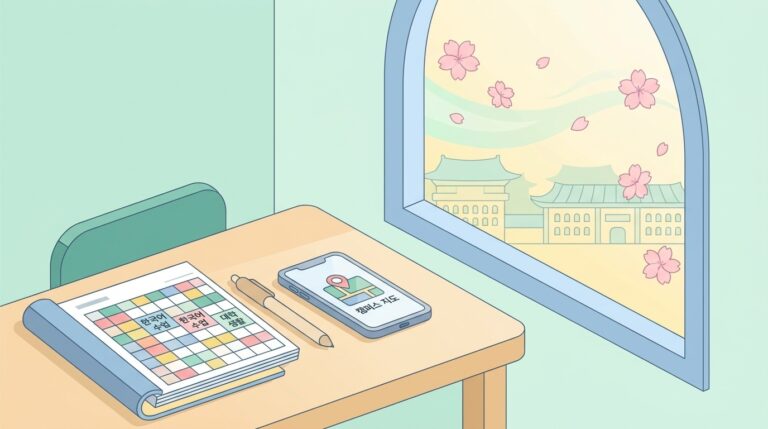
Imagine this: You are standing in the hallway of a beautiful Korean university or high school. The sun is shining, Cherry blossoms are falling, and you look at your phone only to see a class timetable completely written in Korean. “Wait, where is my next class? What is ‘수업’ (sueop)?”
Don’t panic! We have all been there. Understanding your class schedule (시간표 – siganpyo) is your very first step to living your best K-drama school life. Today, we will learn the absolute easiest ways to talk about your schedule, ask your classmates for help, and navigate your school day like a real local. Let’s dive in!
Phase 2: Deep Dive into 3 Key Expressions
1. 몇 시에 시작해요? (Myeot sie sijakhaeyo?)
- Pronunciation: Myut she-eh she-jak-hae-yo? (Sounds like “Mutt” + “she” + “eh” + “see-jack-hay-yo”)
- Meaning: What time does it start?
- K-Culture Moment: You will hear this constantly when students are running to the lecture hall with a sweet potato latte in hand, asking their friends if they are going to be late.
- Editor’s Insight: This is a magic phrase! You can use it for classes, movies, concerts, or even dinner plans.
- Situation Spectrum: Casual (⚠️ 몇 시에 시작해?), Semi-formal (✅ 몇 시에 시작해요?), Formal (✅ 몇 시에 시작합니까?)
- 🤔 Think About It: In Korea, punctuality is key. Classes start exactly on the dot. What time do classes usually start in your country?
2. 오늘 수업 뭐 있어? (Oneul sueop mwo isseo?)
- Pronunciation: Oh-neul soo-up mwo eet-suh? (Sounds like “Oh-neul” + “soo” as in soup + “up” + “muah” + “eat-suh”)
- Meaning: What classes do you have today?
- K-Culture Moment: In K-dramas, classmates ask this while walking to school together or looking at their locker.
- Editor’s Insight: This is the casual form (반말 – banmal) used between close friends of the same age.
- Situation Spectrum: Casual (✅ 오늘 수업 뭐 있어?), Semi-formal (✅ 오늘 수업 뭐 있어요?), Formal (🚫)
- 🤔 Think About It: Koreans love to share their schedules to find matching free times (우주공강 – uju gonggang or “space-like empty gaps between classes”) to eat lunch together.
3. 교실이 어디예요? (Gyosiri eodiyeyo?)
- Pronunciation: Gyo-she-ree uh-dee-yay-yo? (Sounds like “Gyo” + “she” + “ree” + “uh-dee” + “yay-yo”)
- Meaning: Where is the classroom?
- K-Culture Moment: Usually said with a worried face while looking at a massive campus map on the first day of the semester.
- Editor’s Insight: ‘교실’ means classroom. If you want to ask for a specific room number, just say the number + ‘호’ (ho), like “302호가 어디예요?” (Where is Room 302?).
- Situation Spectrum: Casual (⚠️ 교실이 어디야?), Semi-formal (✅ 교실이 어디예요?), Formal (✅ 교실이 어디입니까?)
- 🤔 Think About It: Korean university campuses can be huge and hilly. Finding your classroom quickly is a real survival skill!
Phase 3: Textbook Korean vs. Real Korean
Situation 1: Asking if a friend has class now
- 📖 Textbook Korean: “지금 수업이 있습니까?” (Jigeum sueobi itsseumnikka? – Do you have class now? – Very formal and robotic)
- 🗣️ Real Korean: “지금 수업 있어?” (Jigeum sueop isseo? – You got class now? – Friendly and natural)
- 💡 Why is it different? Real school life is casual! Unless you are talking to a professor, use the comfortable casual form with classmates.
Situation 2: Saying a class is canceled
- 📖 Textbook Korean: “오늘 강의가 취소되었습니다.” (Oneul ganguiga chwisodoeeotsseumnida. – Today’s lecture has been canceled.)
- 🗣️ Real Korean: “오늘 휴강이야!” (Oneul hyugang-iya! – Today is a class cancellation!/No class today!)
- 💡 Why is it different? ‘휴강’ (hyugang) is the specific, everyday school slang/vocabulary that students celebrate hearing!
Phase 4: K-Culture Deep Dive & Non-Verbal Manners
4-1. Nunchi & Body Language in the Korean Classroom
When asking a senior classmate (선배 – seonbae) or a classmate you just met for their schedule, it’s polite to bow slightly. If they are showing you their timetable on their phone, hold your own hands together near your waist (a sign of respect) while looking. Do not point directly at their face or phone with one finger; instead, use an open palm to gently gesture.
4-2. The “Gonggang” Culture
In Korean universities, the ultimate goal of making a timetable is avoiding the dreaded “gonggang” (공강 – empty hours between classes). A three-hour break between two 1-hour classes is called “우주공강” (space-sized gap). Students often use this time to go to PC bangs (gaming cafes), study at pretty cafes, or take a nap in the student lounge!
Phase 5: Real-Life Roleplay Scenario
Meet Minji (민지): Your friendly Korean classmate who loves K-pop and sweet snacks. She sees you looking lost in front of the department bulletin board.
- Minji: “안녕! 오늘 수업 뭐 있어?”
(Annyeong! Oneul sueop mwo isseo?)
🎭 (Waves happily with a warm smile) - You: “안녕! 오늘 한국어 수업 있어.”
(Annyeong! Oneul hangugeo sueop isseo.)
🎭 (Points to your schedule sheet) - Minji: “아, 진짜? 그 수업 몇 시에 시작해?”
(Ah, jinjja? Geu sueop myeot sie sijakhae?)
🎭 (Tilts her head curiously) - You: “오후 두 시에 시작해. 너는?”
(Ohu du sie sijakhae. Neoneun?)
🎭 (Smiles and looks at her timetable) - Minji: “나는 세 시에 마케팅 수업 있어. 우리 두 시 전까지 공강이네!”
(Naneun se sie maketing sueop isseo. Uri du si jeonkaji gonggang-ine!)
🎭 (Claps her hands excitedly) - You: “와, 다행이다! 그럼 우리 같이 점심 먹을래?”
(Wa, dahaeng-ida! Geureom uri gachi jeomsim meogullae?)
🎭 (Asks hopefully) - Minji: “좋아! 학식 먹으러 가자. 근데 교실이 어디야?”
(Joa! Haksik meogeureo gaja. Geunde gyosiri eodiya?)
🎭 (Points toward the campus cafeteria) - You: “교실은 본관 2층이야.”
(Gyosireun bongwan icheung-iya.)
🎭 (Nods confidently)
🔀 Choose Your Path!
What will you say to Minji now?
* A) “가자! 배고파.” (Gaja! Baegopa. – Let’s go! I’m hungry.)
* B) “공부해야 해.” (Gongbuhaeya hae. – I have to study.)
* C) “선생님, 안녕하세요?” (Seonsaengnim, annyeonghaseyo? – Teacher, hello?)
💡 Feedback on Your Choice:
- Best (A): Perfect! It matches the friendly, casual vibe, and you are headed to get delicious cafeteria food together.
- Risk (B): A bit cold! Minji might think you don’t want to hang out with her.
- Bad (C): Oh no! Why are you saying formal greetings to a teacher when talking to your classmate friend?
Phase 6: 10-Second Emotion Shadowing Drill
Let’s practice speaking with real Korean feelings!
[😊 Excited & Relieved]
오늘 / 휴강이야!
(Oneul / hyugang-iya!)
👉 “Today’s class is canceled!” (Say it with a big fist pump!)-
[🥺 Worried & Lost]
저기요, / 교실이 / 어디예요?
(Jeogiyo, / gyosiri / eodiyeyo?)
👉 “Excuse me… where is the classroom?” (Make your voice soft and polite.) -
[🍕 Hungry & Eager]
우리 / 같이 / 점심 먹을래?
(Uri / gachi / jeomsim meogullae?)
👉 “Do you want to grab lunch together?” (Say it with hopeful eyes!)
Phase 7: K-Culture Mini-Dictionary
- 시간표 (Siganpyo): Timetable / Class schedule. Essential for surviving the first week.
- 공강 (Gonggang): Empty period between classes. The best time for coffee and chatting.
- 학식 (Haksik): Short for 학교 식당 (hakgyo sikdang – school cafeteria). Famous for being cheap and delicious!
- 수강신청 (Sugangsincheong): Course registration. In Korea, this is a literal war of fast-clicking!
Phase 8: Survivor Kit for Travelers & Exchange Students
Survival Phrases TOP 3
- 수업 있어요? (Sueop isseo-yo?): Do you have class?
- 몇 호예요? (Myeot ho-ye-yo?): Which room number is it?
- 도와주세요! (Dowajuseyo!): Please help me!
Editor’s Travel Note:
To find your way around Korean campuses, Naver Maps is infinitely better than Google Maps in Korea. Download the Naver Map App before your semester starts to navigate easily!
Phase 9:
Frequently Asked Questions (FAQ)
Q: What does "몇 시에 시작해요? (Myeot sie sijakhaeyo?)" mean in Korean and how do you pronounce it?
A: In Korean, "몇 시에 시작해요? (Myeot sie sijakhaeyo?)" is pronounced [Myut she-eh she-jak-hae-yo? (Sounds like "Mutt" + "she" + "eh" + "see-jack-hay-yo"] and means: What time does it start?
Q: What does "오늘 수업 뭐 있어? (Oneul sueop mwo isseo?)" mean in Korean and how do you pronounce it?
A: In Korean, "오늘 수업 뭐 있어? (Oneul sueop mwo isseo?)" is pronounced [Oh-neul soo-up mwo eet-suh? (Sounds like "Oh-neul" + "soo" as in soup + "up" + "muah" + "eat-suh"] and means: What classes do you have today?
Q: What does "교실이 어디예요? (Gyosiri eodiyeyo?)" mean in Korean and how do you pronounce it?
A: In Korean, "교실이 어디예요? (Gyosiri eodiyeyo?)" is pronounced [Gyo-she-ree uh-dee-yay-yo? (Sounds like "Gyo" + "she" + "ree" + "uh-dee" + "yay-yo"] and means: Where is the classroom?






