

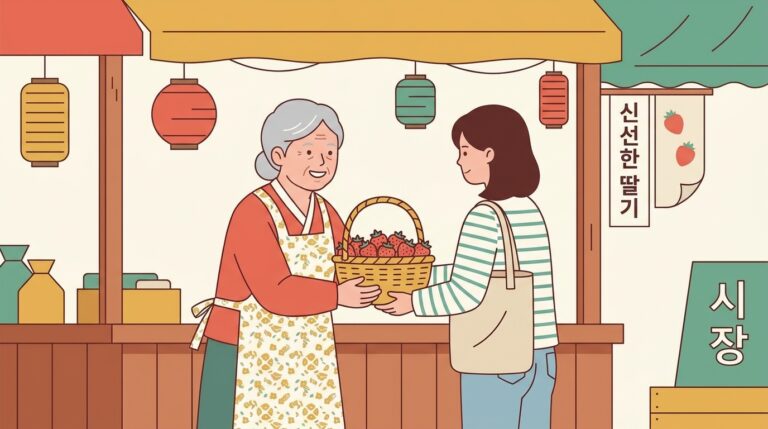
Master the Art of the Korean Market Basket: ‘장바구니’ Survival Guide
Phase 1: Empathy (Welcome to the Market!)
안녕하세요! (An-nyeong-ha-se-yo!) I’m your Daily Hangul Chief Editor and your trusty K-culture navigator.
Picture this: You are standing in the middle of a bustling, vibrant Korean traditional market (전통 시장 – jeon-tong si-jang). The rich aroma of spicy rice cakes (떡볶이 – tteok-bok-ki) fills the air, and heaps of fresh fruits gleam under the colorful lightbulbs. You want to buy some juicy Korean pears and sweet sweet potatoes. But as your hands get full, you realize… you need a basket or a bag.
Many of our beginner students have told us they felt too intimidated to ask for a basket or a plastic bag, resorting to awkwardly hugging their veggies all the way back to their hotel! Don’t worry, my friend. Today, we are going to learn how to confidently navigate the traditional market using the magic word: 장바구니 (jang-ba-gu-ni – shopping basket/bag). By the end of this guide, you will sound like a local who shops at the market every weekend!
Phase 2: Deep-Dive into 3 Essential Expressions
1. 장바구니 있어요? (Jang-ba-gu-ni is-seo-yo?)
- Pronunciation: Jahng-bah-goo-nee ees-suh-yo? (Sounds like “Jang-bah-gooney” + “is there/do you have?”)
- Meaning: “Do you have a shopping basket/bag?”
- K-Culture Moment: You will often hear this in warm K-dramas where the lead character goes grocery shopping for a cozy home-cooked dinner.
- Editor’s Insight: Traditional markets are trying to reduce plastic use. Asking for a reusable basket (장바구니) shows you are eco-friendly and culturally savvy!
- Situation Spectrum: Casual ✅ | Semi-formal ✅ | Formal ⚠️
- 🤔 Think About It: In Korea, asking for things directly is very common. How does this compare to shopping in your hometown?
2. 봉투에 넣어 주세요. (Bong-tu-e neo-eo ju-se-yo.)
- Pronunciation: Bong-too-eh nuh-uh joo-seh-yo. (Sounds like “Bong-too” + “put in” + “please do for me”)
- Meaning: “Please put it in a bag.”
- K-Culture Moment: Seen at checkout counters in every variety show when guests buy snacks for their road trips.
- Editor’s Insight: Traditional markets might give you a black plastic bag (검은 봉지 – geom-eun bong-ji), which is a classic retro market vibe!
- Situation Spectrum: Casual ✅ | Semi-formal ✅ | Formal ⚠️
- 🤔 Think About It: “주세요” (ju-se-yo) is the ultimate magic word in Korean. It makes any request polite!
3. 제 가방에 담을게요. (Je ga-bang-e dam-eul-ge-yo.)
- Pronunciation: Jeh gah-bahng-eh dah-meul-geh-yo. (Sounds like “My bag” + “put in” + “I will”)
- Meaning: “I will put it in my bag.”
- K-Culture Moment: Perfect for the eco-conscious traveler carrying their own canvas tote bag.
- Editor’s Insight: Using the future tense suffix ‘-ㄹ게요’ (-eul-ge-yo) expresses your friendly intention to the seller.
- Situation Spectrum: Casual ✅ | Semi-formal ✅ | Formal ⚠️
- 🤔 Think About It: Why is bringing your own bag becoming a global trend, and how do we express this eco-friendly habit in your language?
Phase 3: Textbook Korean vs. Real Korean
Let’s compare what dry textbooks teach you versus what aunties (이모님 – i-mo-nim) actually want to hear!
Situation 1: Asking for a bag
- 📖 Textbook Korean: 비닐봉지를 제공해 주시겠습니까? (Bi-nil-bong-ji-reul je-gong-hae ju-si-get-seum-ni-ka? – “Would you please provide a plastic bag?”)
- 🗣️ Real Korean: 봉지 하나 주세요! (Bong-ji ha-na ju-se-yo! – “Please give me a bag!”)
- 💡 Why the difference? Traditional markets are casual, warm, and fast-paced. Long, formal sentences sound robotic. A simple “봉지 하나 주세요” with a smile is perfect!
Situation 2: Saying you have your own bag
- 📖 Textbook Korean: 저는 개인용 장바구니를 소지하고 있습니다. (Jeo-neun gae-in-yong jang-ba-gu-ni-reul so-ji-ha-go is-seum-ni-da. – “I am in possession of a personal shopping bag.”)
- 🗣️ Real Korean: 가방 있어요! (Ga-bang is-seo-yo! – “I have a bag!”)
- 💡 Why the difference? Keep it short and sweet. “가방 있어요” gets the point across instantly while you show them your tote.
Phase 4: K-Culture Deep Dive & Non-Verbal Manners
4-1. Nunchi (눈치) & Gestures
When shopping at a traditional market, communication is 50% verbal and 50% non-verbal.
* The Two-Handed Hand-off: When receiving your bag of goods, always use two hands (or support your right elbow with your left hand). This shows deep respect to the market vendors, who are often older than you.
* Eye Contact and Nodding: Make eye contact, nod gently, and say “감사합니다!” (Gam-sa-ham-ni-da).
4-2. The Market Culture Code
Korean traditional markets are famous for 정 (Jeong)—a unique Korean feeling of warm affection, bonding, and generosity. If you use your Korean politely and bring your own 장바구니, the vendor might throw in an extra apple or sweet potato for free! This extra freebie is called 덤 (Deom).
Phase 5: Real-Life Roleplay Scenario
Meet 이모님 (I-mo-nim / Auntie), the warmest fruit stall owner in Mangwon Market! Let’s practice buying some delicious strawberries.
The Dialogue
- You: 안녕하세요! 딸기 얼마예요? (An-nyeong-ha-se-yo! Ttal-gi eol-ma-yeo-yo?)
🎭 [Smile warmly and point to the fresh strawberries] - 이모님: 한 팩에 오천 원! 아주 달아! (Han paek-e o-cheon won! A-ju dal-ah!)
🎭 [Thumbs up enthusiastically] - You: 딸기 한 팩 주세요. (Ttal-gi han paek ju-se-yo.)
🎭 [Hold up one finger] - 이모님: 봉투 필요해요? (Bong-tu pil-yo-hae-yo?)
🎭 [Holds up a black plastic bag] - You: 아, 장바구니 있어요! 제 가방에 담을게요. (Ah, jang-ba-gu-ni is-seo-yo! Je ga-bang-e dam-eul-ge-yo.)
🎭 [Show your canvas bag proudly] - 이모님: 에구, 착해라! 덤으로 몇 개 더 넣어 줄게! (E-gu, chak-hae-ra! Deom-eu-ro myeot gae deo neo-eo jul-ke!)
🎭 [Smiles brightly and drops extra strawberries into your bag] - You: 와, 감사합니다! 많이 파세요! (Wa, gam-sa-ham-ni-da! Ma-ni pa-se-yo!)
🎭 [Bow slightly with gratitude] - 이모님: 또 와요~! (Tto wa-yo~!)
🎭 [Waves goodbye with a huge grin]
🔀 Interactive Branching Point
What do you do when the vendor tries to pack your items in three different plastic bags?
* Choice A: Say nothing, take the plastic bags, and feel eco-guilt.
* Choice B: Wave your hands frantically and scream “NO plastic!”
* Choice C: Open your own bag, smile, and say: “여기에 한꺼번에 넣어 주세요!” (Yeo-gi-e han-kkeo-beon-e neo-eo ju-se-yo! – “Please put them all in here together!”)
Feedback:
- Choice A (Risk): Safe but not eco-friendly. Your hotel room will be overflowing with plastic bags.
- Choice B (Bad): Might startle the sweet vendor. Hand waving can look aggressive in Korea.
- Choice C (Best!): Perfect! It saves plastic, keeps things neat, and shows your excellent Korean skills.
Phase 6: 10-Second Emotion Shadowing Drill
Practice speaking like a native by mimicking these emotional inflections!
- [😊 Bright & Eco-Proud]
- “장바구니 / 있어요!”
- Jang-ba-gu-ni / is-seo-yo!
- [🥺 Polite & Requesting]
- “봉투에 / 넣어 주세요.”
- Bong-tu-e / neo-eo ju-se-yo.
- [😆 Excited & Friendly]
- “제 가방에 / 담을게요!”
- Je ga-bang-e / dam-eul-ge-yo!
Phase 7: K-Culture Mini Dictionary
- 장바구니 (Jang-ba-gu-ni) | Grocery bag / shopping basket. Used daily for green shopping.
- 덤 (Deom) | Free extra goodies given by friendly vendors. A true symbol of Korean Jeong!
- 비닐봉지 (Bi-nil-bong-ji) | Plastic bag. Try to use less of these in Korea!
- 이모님 (I-mo-nim) | Literally “maternal aunt,” but used warmly to address middle-aged female vendors at markets and restaurants.
Phase 8: Survival Kit for Travelers
Survival Expressions TOP 3
- 카드 돼요? (Ka-deu dwae-yo?) | “Do you accept cards?” (Pro Tip: While most accept cards, having cash is highly appreciated in traditional markets!)
- 이거 하나 주세요. (I-geo ha-na ju-se-yo.) | “Please give me one of this.”
- 많이 파세요! (Ma-ni pa-se-yo!) | “Sell a lot!” (A polite blessing to leave with the shop owners as you walk away.)
Editor’s Travel Note
Before heading out, make sure to download the Naver Map App to find the best local traditional markets like Mangwon Market (망원시장) or Tongin Market (통인시장) in Seoul. Note: Market operating hours may vary, so check the app before visiting!
Phase 9: “Going Deeper” (Mini-Essay)
In Korea, traditional markets are not just places to buy food; they are community hubs where generations connect. By refusing plastic bags and using your own 장바구니, you respect the local neighborhood’s eco-efforts. Showing respect to the elders running these stalls bridges cultural gaps instantly.
💬 Your Turn: Have you ever used a reusable bag in another country? How did the locals react? Share your experience in the comments below!
Phase 10: FAQ & Common Mistakes
Q: Can I bring any bag to use as a 장바구니?
A: Yes! Any backpack, eco-bag, or tote bag works perfectly. Simply show it to the vendor and say, “여기 담아 주세요” (Yeo-gi dam-ah ju-se-yo – “Please put it here”).
Q: Do traditional markets charge for plastic bags?
A: Yes, by law, larger marts charge for plastic bags. Traditional markets are more lenient, but bringing your own bag is always appreciated.
Q: Is it rude to reject a plastic bag?
A: Not at all! In fact, vendors love it because it saves them money on buying plastic bags.
🚨 Common Mistakes Alert!
- Saying “안 봉지” (An bong-ji): Hoping to say “No bag.” This is grammatically incorrect.
- Correct Action: Say “봉투 괜찮아요” (Bong-tu gwen-cha-na-yo – “The bag is okay/no thank you”).
- Handing cash with one hand: Avoid grabbing change with one hand.
- Correct Action: Use both hands to receive change and your bag.
- Tucking your eco-bag away silently: The vendor might pack it before you can stop them.
- Correct Action: Show your bag early and say “가방 있어요!”
Phase 11: Action Missions
- 🥉 Bronze Mission: Practice saying “장바구니 있어요” in front of the mirror 3 times.
- 🥈 Silver Mission: Take a photo of your cute eco-bag and share it on Instagram tagging #DailyHangul!
- 🥇 Gold Mission: Use “봉투에 넣어 주세요” or “제 가방에 담을게요” next time you shop at a Korean market or convenience store!
Phase 12: Interactive Quiz Challenge
Test your market-shopping smarts below!
Q1. How do you say “Please put it in a bag” in natural Korean?
Click to reveal Answer & Explanation
Answer: 봉투에 넣어 주세요. (Bong-tu-e neo-eo ju-se-yo.)
Explanation: “봉투” means bag/envelope, and “넣어 주세요” means please put it in. Combine them for the perfect phrase!
Q2. Fill in the blank: “장바구니 _______?” (Do you have a shopping bag?)
Click to reveal Answer & Explanation
Answer: 있어요 (is-seo-yo)
Explanation: “있어요” means “to have” or “to exist” in everyday polite Korean.
Q3. True or False: Traditional market vendors get angry if you refuse their plastic bags.
Click to reveal Answer & Explanation
Answer: False!
Explanation: They will actually smile and praise you for saving them money and protecting the environment! They might even give you some 덤 (freebies)!






