

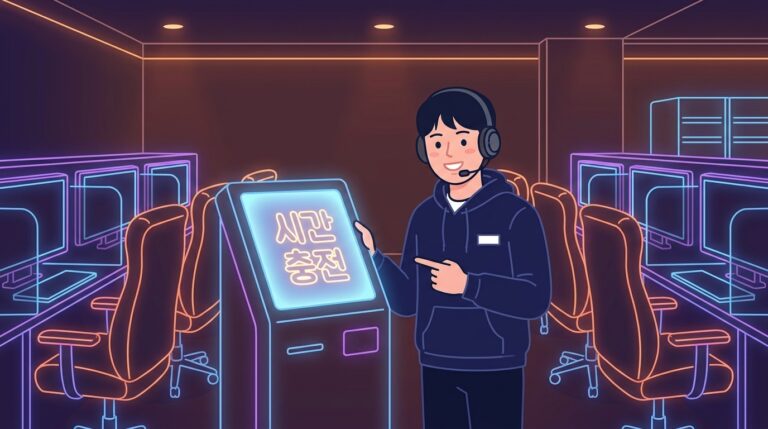
Charge Up Your Gaming: Navigating Korea’s PC Bang Culture Like a Local
Phase 1: Empathy (Welcome to the Neon-Lit Gaming Paradise!)
안녕하세요! (An-nyeong-ha-se-yo!) It’s your friendly Daily Hangul editor and cultural navigator here!
Imagine this: You walk into a sleek, neon-lit room filled with ultra-wide curved monitors, glowing mechanical keyboards, and the enticing aroma of hot ramen being served right to people’s desks. You’ve just entered a Korean PC방 (PC Bang)—the legendary social hub of Korean youth culture and gaming.
But as you stand near the entrance, you’re faced with your first major quest: the kiosk (키오스크). It’s all in Korean, the screen is asking you to “charge your time” (시간 충전), and there are people waiting behind you. Suddenly, your palms are sweaty. How do you buy hours? What do you say if you need to pay with cash at the counter?
Don’t worry! We’ve guided thousands of learners through these exact moments. Today, we’re going to master the art of “charging time” in Korean so you can sit down, order some delicious snacks, and game like a true local. Let’s level up your Korean!
Phase 2: Deep Dive into 3 Essential Expressions
1. 시간 충전해 주세요 (Si-gan chung-jeon-hae ju-se-yo)
- Pronunciation: See-gahn choong-jeon-hae joo-seh-yo (Sounds like “She-gun” + “choong-jeon” with a soft ‘j’ + “hay” + “ju-say-yo”)
- Meaning: Please charge (add) some time.
- K-Culture Moment: You’ll hear this expression whenever someone approaches the front desk because the automated kiosk is acting up or doesn’t accept foreign cards.
- Editor’s Insight: The word 충전 (chung-jeon) literally means “charging” (like charging a battery). In Korea, time is treated like energy—you “charge” your PC bang account with hours!
- Situation Spectrum: Casual ⚠️ | Semi-formal ✅ | Formal ✅
- 🤔 Think About It: In English, we say “buy time” or “top up.” Why do you think Korean uses the word “charge” (충전) for internet time, public transit cards, and phones alike?
2. 회원으로 할게요 (Hoe-won-eu-ro hal-ge-yo)
- Pronunciation: Hway-won-eu-ro hal-geh-yo (Think of “way-one” + “oo-ro” + “hal-geh-yo”)
- Meaning: I will use/register as a member.
- K-Culture Moment: PC bangs have two pricing systems: Non-member (비회원) and Member (회원). Being a member is almost always cheaper and lets you save your remaining time for your next visit!
- Editor’s Insight: Even if you’re visiting just once, signing up as a “회원” is worth it. Saying this phrase tells the staff you want the member rates.
- Situation Spectrum: Casual 🚫 | Semi-formal ✅ | Formal ⚠️
3. 남은 시간 저장해 주세요 (Nam-eun si-gan jeo-jang-hae ju-se-yo)
- Pronunciation: Nah-meun see-gahn juh-jahng-hae joo-seh-yo (“Nah-moon” + “see-gahn” + “juh-jahng” + “hay joo-say-yo”)
- Meaning: Please save my remaining time.
- K-Culture Moment: You have 45 minutes left but your friends want to go eat Korean BBQ. Instead of letting those minutes burn, you log out and ask the system (or counter) to save it.
- Editor’s Insight: 저장 (jeo-jang) means “to save” or “store” (like saving a file in a game). If you logged in as a member, your leftover time is automatically saved when you log out, but asking this ensures it’s secure!
- Situation Spectrum: Casual ⚠️ | Semi-formal ✅ | Formal ✅
Phase 3: Textbook Korean vs. Real-World Korean
Scenario 1: Asking how to buy time
- 📖 Textbook Korean: “시간을 구매하고 싶습니다.” (Si-gan-eul gu-mae-ha-go sip-seub-ni-da. – “I would like to purchase time.”)
- 🗣️ Real-World Korean: “혹시 현금으로 충전 돼요?” (Hok-si hyeon-geum-eu-ro chung-jeon dwae-yo? – “By any chance, can I charge with cash?”)
- 💡 Why the difference? Textbook phrases are often overly formal (“구매” is very commercial). Real locals use “혹시” (by any chance) to soften the question and ask if a specific payment method “works” (돼요).
Scenario 2: Selecting membership status
- 📖 Textbook Korean: “회원 가입을 원합니다.” (Hoe-won ga-ip-eul won-ham-ni-da. – “I desire member registration.”)
- 🗣️ Real-World Korean: “로그인 아이디 만들게요!” (Ro-geu-in a-i-di man-deul-ge-yo! – “I’ll make a login ID!”)
- 💡 Why the difference? Saying “회원 가입” sounds like you are signing a contract. “로그인 아이디 만들게요” is casual, friendly, and gets straight to the point of what you’re doing at the computer screen.
Phase 4: K-Culture Deep Dive & Non-Verbal Manners
4-1. The Art of
Frequently Asked Questions (FAQ)
Q: What does "시간 충전해 주세요 (Si-gan chung-jeon-hae ju-se-yo)" mean in Korean and how do you pronounce it?
A: In Korean, "시간 충전해 주세요 (Si-gan chung-jeon-hae ju-se-yo)" is pronounced [See-gahn choong-jeon-hae joo-seh-yo (Sounds like "She-gun" + "choong-jeon" with a soft 'j' + "hay" + "ju-say-yo"] and means: Please charge (add) some time.
Q: What does "회원으로 할게요 (Hoe-won-eu-ro hal-ge-yo)" mean in Korean and how do you pronounce it?
A: In Korean, "회원으로 할게요 (Hoe-won-eu-ro hal-ge-yo)" is pronounced [Hway-won-eu-ro hal-geh-yo (Think of "way-one" + "oo-ro" + "hal-geh-yo"] and means: I will use/register as a member.
Q: What does "남은 시간 저장해 주세요 (Nam-eun si-gan jeo-jang-hae ju-se-yo)" mean in Korean and how do you pronounce it?
A: In Korean, "남은 시간 저장해 주세요 (Nam-eun si-gan jeo-jang-hae ju-se-yo)" is pronounced [Nah-meun see-gahn juh-jahng-hae joo-seh-yo ("Nah-moon" + "see-gahn" + "juh-jahng" + "hay joo-say-yo"] and means: Please save my remaining time.







