

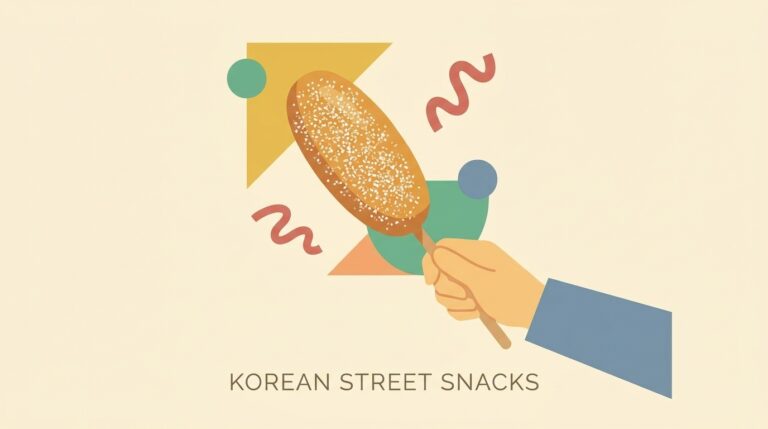
Sweet, Salty, and Crunchy: How to Order K-Hotdogs Like a Local!
안녕하세요! (An-nyeong-ha-se-yo!) Your friendly editor from Daily Hangul is here.
Imagine this: You are walking down the vibrant streets of Myeongdong or Hongdae. The air is filled with the sweet, savory aroma of sizzling food. Suddenly, you spot a food cart with people holding golden-brown, crispy, giant Korean corn dogs (known as 핫도그 – hat-do-geu).
But wait! Before handing it to you, the vendor holds the hot dog over a tray of white sugar and looks at you inquisitively. They ask: “설탕 묻혀 드릴까요?” (Do you want me to roll it in sugar?)
Many of our beginner learners freeze here. “Sugar? On a hot dog with sausage and cheese?!” Yes! In Korea, pairing salty cheese and sausage with a coating of sweet sugar is the ultimate flavor rule. Today, we are going to learn how to confidently ask for sugar on your hot dog like a true Seoul local!
Phase 2: Three Key Expressions to Order Like a Pro
1. 설탕 뿌려 주세요 (Seol-tang ppu-ryeo ju-se-yo)
- Pronunciation: Seol-tang poo-ryeo joo-sey-yo (Sounds like “Seoul-tang” + “poo-ryeo” as in pour + “joo-sey-yo”)
- Meaning: “Please sprinkle sugar on it.”
- K-Culture Moment: You will hear this in almost every Korean food vlog or variety show when celebrities visit traditional markets like Mangwon Market.
- Editor’s Insight: Although the vendor usually rolls (묻히다 – mut-hi-da) the hot dog in sugar, using the word 뿌려 주세요 (please sprinkle/apply) is extremely common, natural, and easy for beginners to pronounce!
- Situation Spectrum: Casual ✅ | Semi-formal ✅ | Formal ⚠️
- 🤔 Think About It: In many Western cultures, hot dogs are purely savory. Why do you think Koreans love the ‘sweet and salty’ (단짠 – dan-jjan) combination so much?
2. 소스 다 발라 주세요 (So-seu da bal-la ju-se-yo)
- Pronunciation: So-seu dah bal-lah joo-sey-yo
- Meaning: “Please put all the sauces on it.”
- K-Culture Moment: If you visit a famous chain like Myungrang Hotdog, you will see a self-saucing station with ketchup, mustard, sweet chili, and cheese sauce.
- Editor’s Insight: If you don’t want to choose, just say 다 발라 주세요 (Please apply everything) or 다 뿌려 주세요. It’s the ultimate hassle-free way to get the best flavor combination!
- Situation Spectrum: Casual ✅ | Semi-formal ✅ | Formal 🚫
- 🤔 Think About It: How does customizing your own street food experience in Korea make you feel more connected to the local culture?
3. 반반으로 주세요 (Ban-ban-eu-ro ju-se-yo)
- Pronunciation: Bahn-bahn-eu-roh joo-sey-yo
- Meaning: “Half-and-half, please.”
- K-Culture Moment: In K-Dramas, characters often order 반반 (half-and-half) fried chicken (original and spicy). For hot dogs, it means half mozzarella cheese, half sausage inside!
- Editor’s Insight: This is the most popular menu item. The top half is gooey, stretchy cheese, and the bottom half is a juicy sausage.
- Situation Spectrum: Casual ✅ | Semi-formal ✅ | Formal ⚠️
- 🤔 Think About It: The word 반 (ban) means “half”. It shows how Korean culture loves efficiency and variety—getting the best of both worlds in one bite!
Phase 3: Textbook Korean vs. Real-Life Korean
Situation 1: Asking for sugar
- 📖 Textbook Korean: 설탕을 묻혀 주십시오. (Seol-tang-eul mut-hyeo ju-sip-si-o. – Please coat it in sugar.) -> Too stiff and formal! It sounds like a military command.
- 🗣️ Real-life Korean: 설탕 뿌려 주세요! (Seol-tang ppu-ryeo ju-se-yo!)
- 💡 Why is it different? Street food stalls are casual and fast-paced. Using friendly, soft polite endings like -주세요 (ju-se-yo) is much more natural.
Situation 2: Asking for ketchup
- 📖 Textbook Korean: 케첩을 위에 가하여 주세요. (Ke-cheop-eul wi-e ga-hayeo ju-se-yo. – Please add ketchup on top.) -> Sounds like a science lab manual!
- 🗣️ Real-life Korean: 케첩만 뿌려 주세요. (Ke-cheop-man ppu-ryeo ju-se-yo. – Just ketchup, please.)
- 💡 Why is it different? Adding the particle -만 (-man) meaning “only” is the easiest way to customize your street food order instantly.
Phase 4: K-Culture Deep Dive & Non-Verbal Manners
4-1. Nunchi (눈치) & Gestures
When the hot dog vendor asks if you want sugar, they will often hold the hot dog over the sugar container.
* If you want sugar: Smile, nod your head slightly, and say “네, 설탕 뿌려 주세요!”
* If you do NOT want sugar: Politely wave your hand side-to-side and say “아니요, 설탕은 괜찮아요 (An-i-yo, seol-tang-eun gwen-chan-a-yo – No, sugar is okay/no thank you).”
4-2. The “Dan-Jjan” (Sweet-Salty) Craving
In Korea, the concept of 단짠 (Dan-Jjan)—a combination of sweet (단맛) and salty (짠맛)—is a national food philosophy. K-Hotdogs are yeast-dough or rice-flour dogs, which are much lighter and crunchier than Western corn dogs. Rolling them in granulated sugar creates an amazing sweet shell that pairs beautifully with savory melted cheese.
Phase 5: Real-Life Roleplay Scenario
Let’s practice! You are at a trendy street food stall in Insadong. The vendor (이모님 – Imo-nim / Auntie) is friendly but super busy.
- Imo-nim (Vendor): 어서 오세요! 뭐 드릴까요?
(Eo-seo o-se-yo! Mwo deu-ril-kka-yo?)
“Welcome! What can I get you?” - You: 저… 핫도그 하나 주세요.
(Jeo… hat-do-geu ha-na ju-se-yo.)
“Uh… One hot dog, please.” - Imo-nim (Vendor): 치즈 들어간 거? 아니면 일반 소시지?
(Chi-jeu deul-eo-gan geo? A-ni-myeon il-ban so-si-ji?)
“The one with cheese inside? Or regular sausage?” - You: 반반으로 주세요!
(Ban-ban-eu-ro ju-se-yo!)
“Half-and-half, please!” - Imo-nim (Vendor): 오케이, 반반! (After frying) 설탕 묻혀 줄까요?
(O-kei, ban-ban! Seol-tang mut-hyeo jul-kka-yo?)
“Okay, half-and-half! …Should I roll it in sugar?” - You: 네, 설탕 많이 뿌려 주세요!
(Ne, seol-tang ma-ni ppu-ryeo ju-se-yo!)
“Yes, sprinkle lots of sugar, please!” - Imo-nim (Vendor): 소스는 어떻게 해 줄까?
(So-seu-neun eo-tteo-ke hae jul-kka?)
“How about the sauce?” - You: 케첩이랑 머스터드 다 뿌려 주세요!
(Ke-cheop-i-rang meo-seu-teo-deu da ppu-ryeo ju-se-yo!)
“Please sprinkle both ketchup and mustard!”
🔀 Interactive Choice Point
The vendor hands you the hot dog, but it’s piping hot! What do you say?
- A) “진짜 뜨거워요!” (Jin-jja tteu-geo-wo-yo!)
- B) “휴지 좀 주세요.” (Hyu-ji jom ju-se-yo.)
- C) “맛있게 먹겠습니다!” (Ma-sit-ge meok-get-seum-ni-da!)
Feedback on Your Choice:
- A (Too blunt): It just means “It’s really hot!” It’s a bit of an awkward statement to make to the chef instead of saying thank you.
- B (Practical): “Please give me some tissues.” Useful if you spilled ketchup, but missing the appreciation!
- Best Choice – C (Excellent!): “I will eat this deliciously!” This is the polite, warm, and native way to show appreciation before eating. The vendor will smile warmly at you!
Phase 6: 10-Second Emotional Shadowing Drill
Practice saying these lines with the right rhythm and emotion to sound completely natural!
- [😊 Excitedly & Politely]
- 설탕 / 많이 / 뿌려 주세요!
- Seol-tang / ma-ni / ppu-ryeo ju-se-yo!
- “Please sprinkle lots of sugar!”
- [😋 Mouth watering]
- 치즈 / 진짜 / 대박이네요!
- Chi-jeu / jin-jja / dae-bak-i-ne-yo!
- “The cheese is absolutely amazing!”
Phase 7: K-Culture Mini-Dictionary
- 단짠 (Dan-jjan) | Sweet and Salty | The ultimate flavor combination highly loved in Korean street foods and snacks.
- 이모님 (Imo-nim) | Auntie / Vendor | A friendly, affectionate way to address middle-aged female restaurant or street food vendors.
- 길거리 음식 (Gil-geo-ri eum-sik) | Street Food | Traditional or trendy foods sold in outdoor stalls, deeply rooted in Korean youth culture.
- 반반 (Ban-ban) | Half-and-Half | A universal food slang used for ordering half-and-half chicken, hot dogs, or toppings.
Phase 8: Survivor Kit for Travelers
Survival Expressions TOP 3:
- 이거 얼마예요? (I-geo eol-ma-yeo?) – “How much is this?”
- 포장해 주세요. (Po-jang-hae ju-se-yo.) – “Please wrap it to-go.”
- 카드 돼요? (Ka-deu dwae-yo?) – “Do you accept cards?”
Editor’s Travel Note:
While most street vendors in large tourist hubs like Myeongdong accept credit cards, some small traditional markets only accept cash or local bank transfers. We highly recommend keeping 10,000 to 20,000 KRW in cash. Use the Naver Map App to find local spots away from tourist traps!
Phase 9: “Going One Step Deeper”
In Korea, eating street food is not just about fuel; it’s a shared social ritual. If you watch young Koreans eating hot dogs, they rarely eat alone. They stand around the food cart, laughing, taking photos of the stretching cheese, and helping each other clean up dropped sugar. The vendor’s stall acts as a warm, temporary community center. Asking for “lots of sugar” with a bright smile breaks down barriers instantly!
💬 Your Turn: Have you ever tried sugar on a corn dog? If you haven’t, would you dare to try it? Let us know in the comments below!
Phase 10: FAQ & Common Mistakes
Q: Can I ask for sugar to be left off entirely?
A: Yes! Simply say, “설탕은 빼 주세요” (Seol-tang-eun pae ju-se-yo), which means “Please leave out the sugar.”
Q: Do K-Hotdogs have meat sausage inside them?
A: Usually, yes! But if you order the 통모짜 (Tong-mo-jja), it is 100% mozzarella cheese with no sausage. It’s perfect for vegetarians!
Q: Is it rude to eat while walking in Korea?
A: While drinking coffee while walking is common, eating messy food on the go can be tricky. It is best to eat your hot dog near the stall or find a nearby bench to avoid dripping sauce on others!
🚨 Common Mistakes Alert!
- Mistake 1: Saying “Sugar please” in English to older vendors.
- Correct Action: Say “설탕 주세요” (Seol-tang ju-se-yo).
- Mistake 2: Grabbing sauces and spraying them before the vendor rolls the hot dog in sugar.
- Correct Action: Always let the vendor roll it in sugar first, then apply your ketchup and mustard!
Phase 11: Action Mission!
- 🥉 Bronze Mission: Say “설탕 뿌려 주세요” out loud in front of your mirror 3 times.
- 🥈 Silver Mission: Write down your dream hot dog order (sauce + fillings) in the comments below using Korean!
- 🥇 Gold Mission: Go to your nearest local Korean market or K-Town hot dog shop and order entirely in Korean!
Phase 12: Interactive Quiz Challenge
Test your skills before you hit the streets of Seoul!
1. Which expression means “Half-and-half, please”?
- A) 다 주세요
- B) 반반으로 주세요
- C) 설탕 뿌려 주세요
Reveal Answer
Correct Answer: B) 반반으로 주세요
Explanation: ‘반반’ (Ban-ban) means half-and-half!
2. True or False: You should apply ketchup BEFORE the vendor rolls the hot dog in sugar.
- True
- False
Reveal Answer
Correct Answer: False
Explanation: The dry sugar must coat the hot dog first. If you put ketchup first, the sugar will turn into a messy syrup!







