

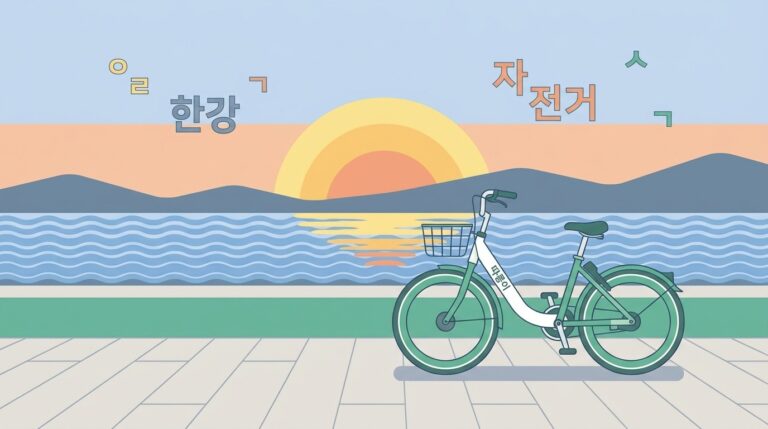
Riding the Breeze: Master Seoul’s ‘Ttareungi’ Public Bikes Like a True Local
안녕하세요! Welcome back to Daily Hangul, your premium cultural navigator. I’m your editor and companion on this journey to mastering real-world Korean.
Picture this: It’s a gorgeous autumn evening in Seoul. The Han River is shimmering under the sunset, and you want to feel that cool breeze on your face. You see rows of sleek, green-and-white bicycles parked nearby. They are 따릉이 (Ttareungi)—Seoul’s incredibly convenient public bike-sharing system.
Many expats and travelers tell me, “I downloaded the app, but I got nervous at the kiosk and gave up!” If that’s you, don’t worry. Today, we are bridging that gap. By the end of this guide, you won’t just know how to rent a bike; you’ll sound like a seasoned Seoulite while doing it!
Phase 2: Deep Dive into 3 Essential Expressions
1. 따릉이 대여 대기 중이에요 (Ttareungi daeyeo daegi jung-i-eyo)
- Pronunciation: Tah-reung-ee dae-yeo dae-gi joong-ee-yo (Sounds like “tah-rung” with a bouncy, rolling double ‘t’)
- Meaning: I am waiting to rent a Ttareungi.
- K-Culture Moment: You are standing near a busy subway exit (like Yeouinaru Station) during sunset, and a friend calls to ask where you are. You answer with this phrase, showing you’re in the middle of unlocking your ride.
- Editor’s Insight: 대여 (daeyeo) means ‘rental’ and 대기 중 (daegi jung) means ‘in the state of waiting’. It sounds much more natural and precise than saying “자전거 기다려요” (I am waiting for a bike).
- Situation Spectrum: Casual ✅ | Semi-formal ✅ | Formal ⚠️
- 🤔 Think About It: Why does Korean have so many Sino-Korean nouns (like 대여, 대기) for public services? How does this compare to how you describe public rentals in your language?
2. 제자리 반납 처리 되었나요? (Je-jari bannap cheori doe-eon-na-yo?)
- Pronunciation: Jeh-jah-ri bahn-nahp chuh-ri dwen-nah-yo?
- Meaning: Has the return been processed correctly at the proper spot?
- K-Culture Moment: You locked your bike at a cradle, but your phone hasn’t buzzed with the KakaoTalk confirmation message. You ask a nearby station helper or call support to double-check.
- Editor’s Insight: 제자리 (je-jari) means ‘its original/correct spot’ and 반납 (bannap) means ‘return of rented items’. Failing to return it properly can incur extra fees, so confirming “반납 처리” (return processing) is highly practical!
- Situation Spectrum: Casual ⚠️ | Semi-formal ✅ | Formal ✅
- 🤔 Think About It: Koreans highly value communal responsibility. “제자리” is a word deeply tied to maintaining public order. Is there a similar emphasis on designated return spots in your city?
3. 따릉이 타고 한강 갈래? (Ttareungi tago Han-gang gallae?)
- Pronunciation: Tah-reung-ee tah-go Han-gang gahl-lae?
- Meaning: Want to ride Ttareungi to the Han River?
- K-Culture Moment: A classic line used in K-dramas when the main characters want a casual, romantic, or breezy escape from their hectic daily lives.
- Editor’s Insight: The suffix -ㄹ래? (-llae?) is a casual way to ask about someone’s preference or propose an action. It’s warm, inviting, and highly conversational.
- Situation Spectrum: Casual ✅ | Semi-formal 🚫 | Formal 🚫
- 🤔 Think About It: Riding a bike to the Han River to eat convenience store ramen (한강 라면) is a modern youth ritual in Korea. What is the equivalent “youth escape” activity in your culture?
Phase 3: Textbook Korean vs. Real-World Korean
Situation 1: Renting a bicycle
- 📖 Textbook Korean: “자전거를 빌리고 싶습니다.” (I want to rent a bicycle.)
- 🗣️ Real-World Korean: “따릉이 하나 대여할게요.” (I’ll rent a Ttareungi.)
- 💡 Why is it different? While “자전거” is correct, everyone in Seoul specifically refers to the public bike by its brand name, “따릉이”. Using the active verb “대여하다” (to rent) sounds much more polished at B2 level than the basic “빌리다”.
Situation 2: Asking if a bike has a flat tire
- 📖 Textbook Korean: “자전거 바퀴에 공기가 없습니다.” (There is no air in the bicycle wheel.)
- 🗣️ Real-World Korean: “바퀴 바람이 빠졌네요.” (The tire’s air seems to have leaked/deflated.)
- 💡 Why is it different? Locals use the phrase “바람이 빠지다” (air slipped out) to describe a flat or low-pressure tire. It is much more idiomatic and immediate.
Phase 4: K-Culture Deep Dive & Non-Verbal Manners
4-1. Nunchi (눈치) & Riding Etiquette
When riding a Ttareungi, 눈치 (Nunchi – situational awareness) is key.
* The Bell Tap: Only ring your bell (따릉따릉) gently once when passing pedestrians on shared paths. Doing it repeatedly is considered aggressive.
* The Lock Check: When locking the bike temporary (자가잠금), make sure you pull the locking lever fully. Walking away without hearing the mechanical clack and voice prompt is a major rookie mistake!
4-2. The Han River Cultural Code
The Ttareungi is not just transit; it’s a lifestyle. In K-Dramas, riding a Ttareungi represents freedom or healing. If you ride down to Banpo Romantic Moonlight Market or Yeouido Han River Park, you’ll see hundreds of couples and friends riding together, parking their bikes, and immediately ordering delivery food to their picnic mats. It is the ultimate social lubricant of Seoul youth.
Phase 5: Interactive Roleplay Scenario
Setting: You are standing in front of a Ttareungi rack near Mapo Station. You are struggling with the QR code scanner on the app. Ji-a, a friendly local holding her own phone, notices your confused expression.
Characters:
- Ji-a (지아): A seasoned Seoulite who rides Ttareungi to commute daily.
- You (우진/너): An intermediate learner trying to navigate the app.
Dialogue:
- 지아: 🎭 (Approaching with a warm smile) “혹시 따릉이 대여하는 데 문제 있으세요?”
(Are you having trouble renting the Ttareungi?) - 너: “네, QR 코드가 자꾸 인식이 안 돼요. 제 휴대폰이 이상한가 봐요.”
(Yes, the QR code keeps failing to scan. Something must be wrong with my phone.) - 지아: “아, 그럴 땐 화면 밝기를 최대로 올려보세요. 그럼 잘 찍혀요.”
(Ah, in that case, try turning your screen brightness to maximum. It scans well then.) - 너: 🎭 (Adjusts brightness and scans successfully) “우와, 진짜 되네요! 신기해요! 감사합니다.”
(Wow, it really works! Amazing! Thank you.) - 지아: “천만에요. 이제 대여 처리 중이라고 뜰 거예요.”
(You’re welcome. It should now show ‘Processing rental’.) - 너: “혹시 한강공원 가려면 이쪽 길로 가면 되나요?”
(By the way, do I go this way to get to the Han River Park?) - 지아: “네, 자전거 전용 도로 따라서 쭉 내려가시면 바로 나와요!”
(Yes, just go straight down along the bicycle-only lane and you’ll hit it right away!) - 너: “친절하게 알려주셔서 정말 감사합니다! 안전 운전 하세요.”
(Thank you so much for kindly letting me know! Ride safely.)
🔀 Interactive Choice Point
You arrived at the Han River, but you need to go to a convenience store for water. You want to leave your bike outside the store safely. What do you do?
- Choice A: Leave it unlocked since Seoul is super safe anyway.
- Choice B: Lock it by sliding the lock lever on the back wheel (자가잠금) and keep your app open.
- Choice C: Look for an official Ttareungi station nearby to fully return it first, then walk.
Feedback:
- Choice A (Bad): 🚫 Risk! While Korea is safe, an unlocked public bike can be ridden away by someone else, or easily flagged as “lost/stolen” which will charge your registered card a hefty fine!
- Choice B (Best): ✅ Perfect! This is called 자가잠금 (Self-locking). Simply lock it; it will lock temporarily and hold your rental. When you return, click ‘Unlock’ (임시잠금 해제) on your app.
- Choice C (Safe but Tedious): ⚠️ Good, but unnecessary. If there’s a station right next to the store, go ahead. But if it’s far, self-locking (Choice B) is much easier!
Phase 6: 10-Second Emotion Shadowing Drill
To sound natural, you need to match the rhythmic pacing and emotional tone of Koreans. Practice saying these aloud:
[😊 Excited & Relieved]- “우와, / 진짜 되네요! / 신기해요!”
- U-wa, / jin-ja doe-neyo! / shin-gi-hae-yo!
[🤔 Concerned but Polite]- “제자리 반납이 / 잘 안 된 것 같은데 / 확인해 주시겠어요?”
- Je-jari ban-nab-i / jal an doen geot gat-eun-de / hwa-gin-hae ju-si-ges-eo-yo?
Phase 7: K-Culture Mini-Dictionary
- 따릉이 (Ttareungi): The official name of Seoul’s public bike. Named after the sound a bicycle bell makes (“따릉따릉”).
- 따세권 (Ttase-gwon): A slang combining Ttareungi and Yeosegwon (station influence area). It describes a residential area that is highly convenient because it has a Ttareungi rack right outside.
- 헬멧 의무화 (Helmet Uimuhwa): The mandatory helmet-wearing law. While not strictly penalized on public roads, it’s highly recommended to wear one.
- 자전거 도로 (Jajeon-geo Doro): Bicycle lanes. Seoul is rapidly expanding these, especially alongside rivers and streams.
Phase 8: Traveler’s Survival Kit
Survival Phrases
- “이거 브레이크가 잘 안 들어요.” (These brakes aren’t working well.)
- Use when you need to swap your bike due to mechanical issues.
- “가까운 따릉이 정류장이 어디예요?” (Where is the nearest Ttareungi station?)
- Ask locals when your phone battery is dying.
- “추가 요금 결제할게요.” (I will pay the surcharge.)
- Useful if you went over the 1-hour or 2-hour limit.
Editor’s Travel Note:
To ride effortlessly, download the Seoul Bike App (Ttareungi) beforehand. You can register as a foreign tourist without a local phone number and purchase a 1-day pass using a foreign credit card.
Note: Traffic laws and rental fees are subject to change. Always refer to official updates on the app.
Phase 9: “A Step Deeper” (Reflections on Korean Mobility)
In Korea, public infrastructure is highly trusted. The fact that thousands of bikes are left unattended, unlocked temporarily at stores with personal items in the front baskets, speaks volumes about Korea’s collective social trust and safety. This shared responsibility makes Ttareungi a beautiful symbol of Seoul’s civic maturity.
💬 Your Turn: Would a system like Ttareungi work in your home country? Have you ever worried about bike theft there? Let us know in the comments below!
Phase 10: FAQ & Common Mistakes
Q: Can foreigners rent a Ttareungi without a Korean SIM card?
A: Yes! The ‘Seoul Bike’ English app allows foreigners to purchase vouchers using foreign cards without demanding local mobile authentication.
Q: What happens if I return the bike after the rental period (e.g., 1 hour)?
A: You will be charged an extra fee (usually 200 KRW per 5 minutes) on your registered payment method. Avoid this by docking and immediately re-renting if you want to ride longer!
Q: Can I ride it on the sidewalk?
A: No, legally you should ride on bicycle paths or the right edge of the road. Sidewalk riding is frowned upon unless designated.
🚨 Common Mistakes Board
- Mistake 1: Forgetting to push the lock lever during return. Result: Your rental time keeps running!
- Mistake 2: Parking in private apartment complexes. Result: Fine or warning message.
- Mistake 3: Ignoring the KakaoTalk/SMS confirmation. Always wait for that “반납 완료” (Return Completed) notification!
Phase 11: Action Mission
- Bronze Medal: Download the ‘Seoul Bike’ app and find the station nearest to your hotel/accommodation.
- Silver Medal: Take a screenshot of your app or a photo of a Ttareungi and post it on Instagram tagging
#DailyHangulwith the caption: “따릉이 타고 싶어요!” - Gold Medal: Actually rent one, ride to the Han River, and order a bowl of convenience store ramen!
Phase 12: Interactive Quiz Challenge
Test your knowledge before you set off!
1. What does the term “제자리” (Je-jari) refer to when returning a bike?
Click to reveal the answer
Answer: The designated, original parking spot or cradle of the official station. Always ensure you return it ‘제자리’ to avoid extra fees!
2. Fill in the blank: “바람이 빠졌어요” means the bike tire is ______.
Click to reveal the answer
Answer: Flat or deflated (literally ‘air has slipped out’).
3. True or False: If you park a Ttareungi outside a store to buy coffee, you don’t need to lock it because Seoul has low theft rates.
Click to reveal the answer
Answer: False! Always use the self-locking (자가잠금) feature on the back wheel to prevent unauthorized use and heavy liability charges.







