

Phase 1: Empathy (스토리 몰입형 오프닝)
안녕하세요! (Annyeonghaseyo!) Your friendly Korean bestie and Daily Hangul Editor is back! 👋
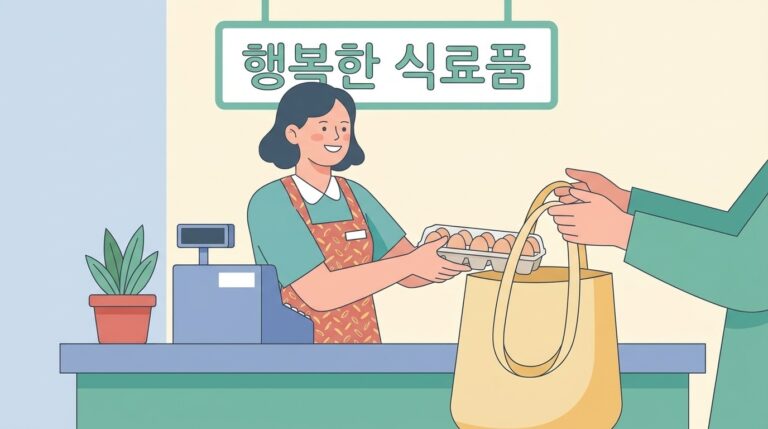
Picture this: You are at a bustling local Mart in Seoul, buying fresh groceries to cook that delicious Ramen or Tteokbokki you saw in your favorite K-drama. You buy some vegetables, a carton of milk, and a pack of fresh eggs. But wait! The cashier is packing fast, and you want to make sure those delicate eggs don’t get crushed under your heavy milk carton. 🥚💥
Many of our learners have told us: “I know how to say ‘egg’ in Korean, but I didn’t know how to politely ask the cashier to pack them gently or place them on top!” Don’t worry! Today, we are going to learn how to shop like a local and protect your precious eggs with simple, easy A2-level Korean phrases. Let’s dive in!
Phase 2: Core Expressions (핵심 표현 3선 심층 분석)
1. 살살 담아주세요. (Salsal damajuseyo.)
- Pronunciation: Sal-sal da-ma-ju-se-yo (Sounds like “Sal-sal” as in “Sal-sa” dance + “dah-mah-joo-say-yo”)
- Meaning: Please pack/put them in gently.
- K-Culture Moment: You often hear “살살” (salsal – gently/softly) in K-dramas when someone is applying medicine to a scratch, or when moving fragile packages.
- Editor’s Insight: “살살” is a magical mimetic word (의태어) meaning “softly” or “gently”. Combined with “담아주세요” (please pack/put inside), it instantly tells the cashier to handle your items with care.
- Situation Spectrum: Casual ⚠️ / Semi-formal ✅ / Formal 🚫
- 🤔 Think About It: In Korean culture, speaking softly and using gentle words like “살살” shows respect for the helper’s effort while conveying your request clearly.
2. 계란은 위에 올려주세요. (Gyeraneun wie ollyeojuseyo.)
- Pronunciation: Gye-ran-eun wi-e ol-lyeo-ju-se-yo (Sounds like “Gye-rahn-oon” + “wee-ay” + “ohl-lyuh-joo-say-yo”)
- Meaning: Please put the eggs on top.
- K-Culture Moment: In Korean grocery stores (마트), cashiers are incredibly fast and efficient. Showing them you want the eggs on top saves everyone’s time!
- Editor’s Insight: “계란” (gyeran) means egg, “위에” (wi-e) means on top, and “올려주세요” (ollyeojuseyo) means please place/put up. Simple but super practical!
- Situation Spectrum: Casual ⚠️ / Semi-formal ✅ / Formal 🚫
- 🤔 Think About It: Why does Korean use position words like “위에” (on top) so often in daily requests? It makes instructions visually clear and polite!
3. 깨지지 않게 조심해 주세요. (Kkaejiji an-ge josimhaejuseyo.)
- Pronunciation: Kkae-ji-ji ahn-ge jo-sim-hae-ju-se-yo (Sounds like “Kkay-jee-jee ahn-gay” + “jo-seem-hay-joo-say-yo”)
- Meaning: Please be careful so they don’t break.
- K-Culture Moment: Often heard when handling pottery, glass, or delicate street foods like Dalgona!
- Editor’s Insight: “깨지다” (kkaejida) means to break/shatter. Adding “-지 않게” makes it “so that it doesn’t break”. It’s a very polite way to ask for careful handling.
- Situation Spectrum: Casual 🚫 / Semi-formal ✅ / Formal ✅
Phase 3: Textbook vs. Real Korean (교과서 한국어 vs 진짜 한국어)
Let’s compare textbook phrases with what Koreans actually say at the grocery store checkout!
Situation 1: Asking to pack fragile items carefully
- 📖 Textbook Korean: 파손되지 않도록 주의해 주십시오. (Pasondoeji antorok juuihae jupsio. – Please exercise caution so they do not get damaged.)
- 🗣️ Real Korean: 안 깨지게 조심해 주세요. (An kkaejige josimhaejuseyo. – Please be careful so they don’t break.)
- 💡 Why is it different? The textbook phrase uses high-level, formal Sino-Korean words (파손, 주의) used in written signs. On a daily basis, locals use the friendly, active verb “깨지다” (to break) with a simple “안” (not) negation.
Situation 2: Asking to put eggs on top
- 📖 Textbook Korean: 계란을 적재 공간의 상단에 배치해 주세요. (Gyeraneul jeokjae gongganui sangdane baechihaejuseyo. – Please place the eggs in the upper section of the loading space.)
- 🗣️ Real Korean: 계란은 맨 위에 담아주세요. (Gyeraneun maen wie damajuseyo. – Please pack the eggs at the very top.)
- 💡 Why is it different? Nobody talks like a logistics manual! “맨 위에” (at the very top) is the most natural, native way to point out the top layer of your shopping bag.
Phase 4: K-Culture Deep Dive & Non-verbal Manners
4-1. Nunchi (눈치) & Hand Gestures
When asking a cashier to be careful with your eggs, body language is key!
* The Two-Handed Gesture: When pointing to the eggs or handing over your shopping bag, always use both hands or support your right wrist with your left hand. This shows extreme politeness (공손함) in Korea!
* Nunchi (눈치 – Wit/Tact): Korean grocery packing tables are fast. Wait for a small pause in scanning before politely making your request with a friendly nod of the head.
4-2. Grocery Bag Culture (장바구니 문화)
In Korea, supermarkets charge a small fee for plastic bags (비닐봉투). Cashiers will usually ask: “봉투 필요하세요?” (Do you need a bag?). To save the environment (and look like a local!), bring your own reusable eco-bag (에코백)! If you brought your own bag, you can say: “장바구니에 담아주세요” (Please pack it in my grocery bag).
Phase 5: Real-Life Roleplay Scenario
Setting: A local neighborhood supermarket called ‘Hana Mart’ (하나마트). You are checking out with a kind, experienced cashier auntie (이모님 – Imonim).
Characters:
* 이모님 (Cashier Auntie): Fast, friendly, but busy.
* 민우 (Minwoo – You): A polite foreigner buying eggs and heavy items.
- 이모님: 봉투 필요하세요?
(Bongtu piryohaseyo?)
🎭 (Holds up a plastic bag, looking at Minwoo)
Translation: Do you need a bag? -
민우: 아니요, 에코백 있어요. 여기 담아주세요.
(Aniyo, ekobaek isseyo. Yeogi damajuseyo.)
🎭 (Politely hands over a reusable eco-bag with both hands)
Translation: No, I have an eco-bag. Please pack it here. -
이모님: 네, 담아드릴게요. 음, 우유랑 계란도 있네요.
(Ne, damadeurilgeyo. Eum, uyurang gyerando inneyo.)
🎭 (Starts scanning the heavy milk carton and the eggs)
Translation: Okay, I will pack them for you. Oh, you have milk and eggs too. -
민우: 아! 이모님, 계란은 위에 올려주세요.
(Ah! Imonim, gyeraneun wie ollyeojuseyo.)
🎭 (Points gently to the egg carton with a polite smile)
Translation: Ah! Auntie, please put the eggs on top. -
이모님: 걱정 마요. 무거운 우유를 아래에 넣을게요.
(Geokjeong mayo. Mugeoun uyureul araee neoulgeyo.)
🎭 (Nods warmly and places the milk carton at the bottom of the bag)
Translation: Don’t worry. I will put the heavy milk at the bottom. -
민우: 감사합니다. 깨지지 않게 살살 담아주세요.
(Gamsahabnida. Kkaejiji ange salsal damajuseyo.)
🎭 (Slightly bows head in gratitude)
Translation: Thank you. Please pack them gently so they don’t break. -
이모님: 그래요, 조심히 잘 담았어요. 여기요!
(Guraeyo, josimi jal damasseoyo. Yeogiyo!)
🎭 (Hands over the safely packed bag)
Translation: Sure, I packed them safely and carefully. Here you go! -
민우: 정말 감사합니다. 많이 파세요!
(Jeongmal gamsahabnida. Mani paseyo!)
🎭 (Smiles brightly and waves lightly)
Translation: Thank you so much. Have a great sales day! (Wishing them good business)
🔀 Interactive Choice Points
If the cashier accidentally starts putting the heavy milk directly on top of your eggs, what do you do?
- Choice A: You shout “안돼요!” (No!) and grab the milk out of their hands.
- Editor’s Feedback (BAD): Too aggressive! Grabbing things might startle the cashier.
- Choice B: You say, “이모님, 계란 깨져요! 살살요!” (Auntie, eggs will break! Softly!)
- Editor’s Feedback (RISK): It’s understandable, but might sound a bit direct or demanding if said with a tense voice.
- Choice C: You say, “죄송한데 계란 위에 올려주실 수 있나요?” (Excuse me, but could you please place the eggs on top?)
- Editor’s Feedback (BEST): Extremely polite, soft, and clear. You will get a big smile and safely packed eggs! 🌟
Phase 6: 10-Second Shadowing Drill
Let’s practice the rhythm of natural Korean! Pause at the / and speak with the suggested emotion!
[🥺 Politely and carefully]
계란은 / 위에 / 올려주세요.
(Gye-ran-eun / wi-e / ol-lyeo-ju-se-yo.)-
[😊 Friendly and warm]
깨지지 않게 / 살살 / 담아주세요.
(Kkae-ji-ji ahn-ge / sal-sal / da-ma-ju-se-yo.)
Phase 7: K-Culture Mini-Dictionary
- 장바구니 (Jang-ba-gu-ni): Reusable grocery basket or shopping bag. Vital for plastic-free shopping in Korea!
- 영수증 (Yeong-su-jeung): Receipt. Cashiers will often ask, “영수증 필요하세요?” (Do you need a receipt?).
- 배달 (Bae-dal): Delivery. Many big supermarkets in Korea (like E-Mart or Lotte Mart) offer free delivery to your home if you buy over a certain amount!
- 묶음 할인 (Mukk-eum hal-in): Bundle discount (like Buy 1 Get 1 Free, or 1+1 / 2+1 deals). Look for these yellow tags on food products!
Phase 8: Survivor Kit for Travelers
Survival Phrases TOP 3
- “이것만 따로 담아주세요.” (Igeotman ttaro damajuseyo.)
- Pro Tip: “Please pack this item separately.” Perfect for delicate items like eggs or soft bread!
- “테이프 어디에 있어요?” (Te-i-peu eo-di-e is-seo-yo?)
- Pro Tip: “Where is the tape?” Many Korean marts have a self-packing station with free cardboard boxes and tape.
- “이거 할인 상품이에요?” (I-geo hal-in sang-pum-i-e-yo?)
- Pro Tip: “Is this a discounted item?” Ask this to confirm bundle sales!
Editor’s Travel Note:
To find the nearest supermarkets in Seoul, don’t use Google Maps (which isn’t fully active in Korea)! Download the Naver Map App for real-time grocery store hours and locations.
Phase 9: “A Step Deeper” (한 발 더 깊이)
In Korea, there is a strong culture of 정 (Jeong – warm feeling of attachment and community). When you go to local neighborhood marts, cashiers are often neighborhood “이모” (aunties) or “삼촌” (uncles). When you use polite expressions like “살살 담아주세요” with a warm smile, they might slip in a free snack or a discount coupon because they feel “Jeong” towards you. Kindness always goes both ways in Korean society!
💬 Your Turn: Have you ever bought something delicate while traveling? How did you communicate? Let me know in the comments below!
Phase 10: FAQ & Common Mistakes
Q: Can I use “달걀” (dalgyal) instead of “계란” (gyeran)?
A: Yes! Both mean “egg”. “계란” is more commonly used in grocery stores and on signs, while “달걀” is a pure Korean word. Both are perfectly fine!
Q: Is “살살” rude to say to older cashiers?
A: Not at all, as long as you add “-주세요” (juseyo) at the end! “살살 담아주세요” sounds very soft, warm, and natural.
Q: What if I want to pack it myself?
A: You can tell them: “제가 담을게요.” (Jega dameulgeyo – I will pack it myself.) Many cashiers will appreciate this as it saves them time!
🚨 Common Mistakes Warning Board
- Incorrect: 에그 조심히 (Egg josim-hi)
- Correction: Use 계란 (gyeran) instead of English “egg”, and add the verb: “계란 조심히 담아주세요.”
- Incorrect: 살살해! (Salsal-hae!)
- Correction: This is informal (반말) and rude to cashiers. Always add “-주세요”: “살살 해주세요.”
Phase 11: Action Mission
- 🥉 Bronze Mission: Practice saying “계란은 위에 올려주세요” aloud 3 times in front of your mirror.
- 🥈 Silver Mission: Share this post on your Instagram Story and tag @DailyHangul to show us you are studying!
- 🥇 Gold Mission: Next time you visit a local Korean mart, use “살살 담아주세요” at the checkout counter and see the cashier’s happy smile!
Phase 12: Interactive Quiz Challenge
Let’s test your knowledge! Click on the toggle boxes below to find the correct answers. 🎉
1. Which word means “softly” or “gently” in Korean?
a) 빨리 (Ppalli)
b) 살살 (Salsal)
c) 크게 (Keuge)
Reveal Answer & Explanation
Correct Answer: b) 살살 (Salsal)
* Explanation: “살살” means gently or softly. “빨리” means quickly, and “크게” means loudly. Always ask for “살살” for fragile items!
2. Translate into Korean: “Please put the eggs on top.”
a) 계란 아래에 주세요.
b) 계란은 위에 올려주세요.
c) 계란 없어요.
Reveal Answer & Explanation
Correct Answer: b) 계란은 위에 올려주세요.
* Explanation: “위에” means on top, and “올려주세요” means please place it. Option (a) means “give it below,” and (c) means “there are no eggs!”







