

Warm Your Hands and Soul: The Ultimate Guide to Eating Goonbam (Roasted Chestnuts) in Korea
SEO Meta Information
- Target Level: B1 (Intermediate)
- Focus Keyword: Goonbam (Roasted Chestnuts), Korean Street Food, Winter in Korea
Phase 1: Empathy (An Invitation to the Cozy Korean Winter)
안녕하세요! (Annyeonghaseyo!) I’m your Daily Hangul editor, your local cultural navigator.
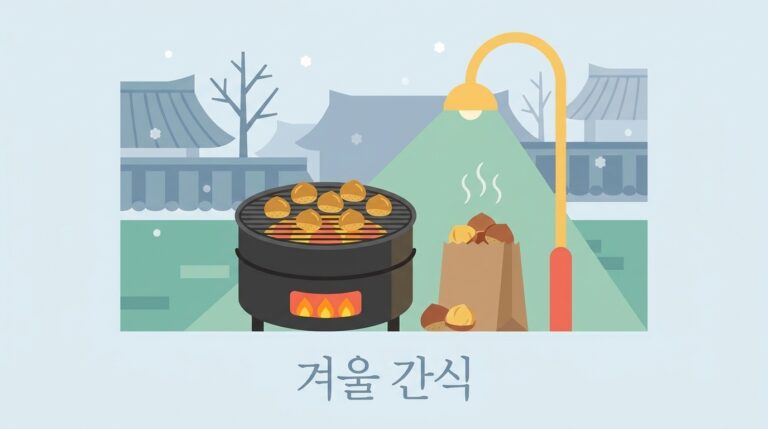
Picture this: It’s a freezing January evening in Seoul. The wind is biting, and your fingers are numb. Suddenly, a sweet, smoky aroma drifts through the chilly air. You follow your nose and find a street vendor standing beside a large, rotating black iron drum. Inside, plump, golden chestnuts are crackling over hot coals.
This is 군밤 (Goonbam – Roasted Chestnuts), the ultimate king of Korean winter street food.
Many of our intermediate learners tell us, “I wanted to buy some goonbam, but I didn’t know how to ask for a warm bag of them, or how to politely ask the vendor to peel them!” Don’t worry! Today, we’ll master the art of ordering, peeling, and talking about this cozy winter treat like a true local. Grab a warm cup of tea, and let’s dive in!
Phase 2: Deep Dive into 3 Essential Expressions
1. 군밤 한 봉지 주세요 (Goon-bam han bong-ji ju-se-yo)
- Pronunciation: Goon-bahm han bong-jee joo-seh-yo (Sounds like “Goon” as in “goon” + “bahm” like the first half of “bomb”. “Bong-ji” rhymes with “G-jeee”.)
- Meaning: “Please give me one bag of roasted chestnuts.”
- K-Culture Moment: In K-Dramas, you often see a couple sharing a single paper bag of chestnuts, putting a warm peeled one into each other’s pockets.
- Editor’s Insight: 봉지 (Bong-ji) specifically refers to a paper or plastic bag. Using this instead of just “one” (하나 주세요) makes you sound incredibly natural.
- Situation Spectrum:
- Casual: 군밤 한 봉지 줘 (🚫 Only for close friends)
- Semi-formal: 군밤 한 봉지 주세요 (✅ Perfect for street vendors)
- Formal: 군밤 한 봉지 부탁드립니다 (⚠️ Too formal for street food)
- 🤔 Think About It: In your country, how do you measure small street foods? Do you use “bags,” “boxes,” or “portions”? How does this shape your local market culture?
2. 이거 다 까진 거예요? (I-geo da kka-jin geo-yeo-yo?)
- Pronunciation: Ee-geo dah kkah-jin guh-yeh-yo? (“Kka” is a tensed ‘K’ sound, like the ‘sk’ in “sky”.)
- Meaning: “Are these all peeled?”
- K-Culture Moment: Some vendors sell chestnuts with the shells still on, while others sell them fully or partially peeled. Asking this saves you from messy soot on your fingers!
- Editor’s Insight: 까다 (Kkada) means “to peel” or “to shell.” 까진 것 (Kkajin-geot) refers to the peeled state. This is highly colloquial and useful for fruits too!
- Situation Spectrum:
- Casual: 이거 다 까진 거야? (⚠️)
- Semi-formal: 이거 다 까진 거예요? (✅ Perfect)
- Formal: 이것들은 모두 탈각된 것입니까? (🚫 Sounds like a scientific report!)
3. 따뜻한 걸로 주세요 (Tta-tteut-han geol-ro ju-se-yo)
- Pronunciation: Tah-teut-han guhl-loh joo-seh-yo (“Tta” is a strong, double ‘t’ sound, like “Italian” style double ‘t’.)
- Meaning: “Please give me the warm/hot ones.”
- K-Culture Moment: Sometimes vendors have bags pre-packed that might have cooled down. A polite request gets you a bag straight from the roasting drum!
- Editor’s Insight: Koreans love hot food (especially in winter!). 따뜻하다 (Tta-tteut-hada) means warm. Adding -로 주세요 (-ro ju-se-yo) means “Please give me [Option A] instead of others.”
- Situation Spectrum:
- Casual: 따뜻한 걸로 줘 (⚠️)
- Semi-formal: 따뜻한 걸로 주세요 (✅ Perfect)
- Formal: 따뜻한 것으로 주십시오 (⚠️ A bit stiff)
Phase 3: Textbook Korean vs. Real-Life Korean
Let’s compare what textbooks teach with what Koreans actually say on the street.
Situation 1: Asking if the chestnuts are hot
- 📖 Textbook: 이 군밤은 뜨겁습니까? (I goon-bam-eun tteu-geop-seup-ni-ka? – “Are these roasted chestnuts hot?”)
- 🗣️ Real Korean: 이거 방금 나온 거예요? (I-geo bang-geum na-on geo-yeo-yo? – “Did these just come out [of the roaster]?”)
- 💡 Why the difference? Street food vendors are always roasting fresh batches. Asking if they “just came out” is the ultimate local way to guarantee you get burning hot, fluffy chestnuts.
Situation 2: Ordering one bag
- 📖 Textbook: 군밤 일 인분 주십시오. (Goon-bam il-in-bun ju-sip-si-o. – “Please give me one portion of roasted chestnuts.”)
- 🗣️ Real Korean: 군밤 오천 원어치만 주세요. (Goon-bam o-cheon-won-eo-chi-man ju-se-yo. – “Please give me just 5,000 won’s worth of roasted chestnuts.”)
- 💡 Why the difference? Street food is often sold by monetary value rather than strict portions. Ordering by “won-eo-chi” (worth of won) is highly natural in traditional Korean markets.
Phase 4: K-Culture Deep Dive & Non-Verbal Manners
4-1. The “Nunchi” (눈치) of Eating Street Food
When buying Goonbam, pay attention to these subtle social manners:
* The Toothpick Gesture: The vendor will usually slip a couple of wooden toothpicks (이쑤시개) into your bag. Use these to poke and eat the chestnuts so your hands stay clean. Never grab them with bare dirty hands if sharing!
* The Shell Trash etiquette: If you bought unpeeled chestnuts, do not throw the shells on the street. Keep them inside the paper bag’s folded corner until you find a trash can.
4-2. Winter Warmth in Korean Culture
In Korea, winter street food is deeply nostalgic. Sharing a bag of Goonbam or Bungeoppang (fish-shaped pastry) represents 정 (Jeong)—the warm feeling of attachment and sharing. It’s common for colleagues to buy a bag for the office on a cold afternoon.
Phase 5: Interactive Roleplay Scenario
Setting: A cozy winter street cart near Jongno, Seoul. The vendor (이모 – Imo/Auntie) is roasting chestnuts. You are cold and hungry.
- Imo: 어서 오세요! 따끈따끈한 군밤 있어요!
(Eo-seo o-se-yo! Tta-keun-tta-keun-han goon-bam is-seo-yo!)
“Welcome! We have hot, warm roasted chestnuts!” - You (🎭 Rubbing your cold hands): 안녕하세요! 군밤 맛있겠네요. 이거 다 까져 있는 거예요?
(An-nyeong-ha-se-yo! Goon-bam mas-it-get-nae-yo. I-geo da kka-jyeo in-neun geo-yeo-yo?)
“Hello! The chestnuts look delicious. Are these all peeled?” - Imo (🎭 Smiling and pointing at a fresh batch): 네, 이건 다 까놓은 거라 먹기 편해요. 하나 먹어봐요!
(Ne, i-geon da kka-nho-eun geo-ra meok-gi pyeon-hae-yo. Ha-na meok-eo-bwa-yo!)
“Yes, these are all peeled so they’re easy to eat. Have a taste!” (Hands you one on a toothpick) - You (🎭 Tasting the sweet chestnut): 와, 진짜 달고 고소해요! 방금 나온 따뜻한 걸로 한 봉지 주세요.
(Wa, jin-jja dal-go go-so-hae-yo! Bang-geum na-on tta-tteut-han geol-ro han bong-ji ju-se-yo.)
“Wow, it’s really sweet and savory! Please give me one bag of the warm ones that just came out.” - Imo: 네, 오천 원어치 듬뿍 담아 줄게요!
(Ne, o-cheon-won-eo-chi deum-ppuk dam-a jul-ge-yo!)
“Okay, I’ll pack a generous 5,000 won’s worth for you!” - You: 감사합니다. 계좌이체 해드려도 돼요?
(Gam-sa-hap-ni-da. Gye-jwa-i-che hae-deu-ryeo-do dwae-yo?)
“Thank you. Can I do a bank transfer?” - Imo (🎭 Pointing to a paper with bank info): 그럼요! 저기 적힌 계좌로 보내줘요.
(Geu-reom-yo! Jeo-gi jeok-hin gye-jwa-ro bo-nae-jwo-yo.)
“Of course! Please send it to the account written over there.” - You (🎭 Showing your phone screen): 네, 송금 보냈습니다! 많이 파세요.
(Ne, song-geum bo-naes-seup-ni-da! Ma-ni pa-se-yo.)
“Yes, I’ve sent the transfer! Hope you sell a lot today (wishing success).”
🔀 Interactive Branching Points
How will you respond to Imo’s warm offer of a free sample?
* Choice A: “너무 맛있어요! 오천 원어치 주세요.” (I love it! Give me 5,000 won’s worth.)
* Feedback: Best! Acknowledging the taste makes the vendor happy and might get you a few extra chestnuts (서비스 – Service)!
* Choice B: “괜찮아요, 안 먹어요.” (It’s okay, I don’t eat it.)
* Feedback: Risk. Sounds a bit cold. Even if you don’t want to eat, saying “감사하지만 괜찮습니다” (Thank you, but I’m okay) is much softer.
* Choice C: “이거 공짜예요?” (Is this free?)
* Feedback: Bad. Asking if a offered sample is free sounds too transactional and slightly impolite.
Phase 6: 10-Second Emotion Shadowing Drill
Practice saying these like a real native! Pay attention to the pauses (/) and emotions.
[😊 Excited & Cold]
와, / 진짜 / 따뜻하다!
(Wa, / jin-jja / tta-tteut-ha-da!)
“Wow, / it’s really / warm!”-
[🥺 Polite & Begging]
이모, / 서비스 몇 개만 / 더 주세요!
(I-mo, / seo-bi-seu myeot gae-man / deo ju-se-yo!)
“Auntie, / just a few extra ones / please!”
Phase 7: K-Culture Mini-Dictionary
- 군밤 (Goonbam): Roasted chestnuts. Goon means roasted/grilled, and bam means chestnut.
- 서비스 (Seo-bi-seu): “Service.” In Korea, this means getting free extra food/items as a gesture of kindness from the owner.
- 계좌이체 (Gye-jwa-i-che): Bank transfer. Since street vendors often don’t take card, transferring money via banking apps is incredibly common in Korea.
- 군고구마 (Goon-goguma): Roasted sweet potatoes. The eternal winter partner of Goonbam.
Phase 8: Survivor Kit for Travelers
Survival Expressions TOP 3
- 카드 돼요? (Ka-deu dwae-yo?) – “Do you accept cards?” (Pro Tip: Most street food carts prefer cash or bank transfer!)
- 이쑤시개 주세요. (I-ssu-si-gae ju-se-yo.) – “Please give me toothpicks.”
- 따뜻할 때 드세요. (Tta-tteut-hal ttae deu-se-yo.) – “Eat it while it’s warm.” (Say this to your friend!)
Editor’s Travel Note
When traveling in Korea, keep some cash (5,000 to 10,000 KRW) in your pocket for street food. Alternatively, make sure you have your Korean banking app ready to do a quick Toss or KakaoPay transfer, as almost all vendors display their bank accounts on a small board.
Phase 9: “Going Deeper” (A Touch of Humanity)
In Korea, street food vendors aren’t just businesses; they are keepers of neighborhood memories. When you say “많이 파세요” (Ma-ni pa-se-yo – “Sell a lot”) instead of just “Goodbye,” you are practicing a beautiful linguistic culture of wishing prosperous blessings upon local merchants.
💬 Your Turn: Have you ever tried street food in Korea during winter? What is your favorite winter comfort food in your home country? Tell us in the comments!
Phase 10: FAQ & Common Mistakes
Q: Can I pay with credit cards at street food stalls?
A: Generally, no. While some modern food trucks accept cards, traditional street carts (like Goonbam or Bungeoppang) usually prefer cash or bank transfers. Always carry a little cash!
Q: What is the difference between 밤 (Bam) and 군밤 (Goonbam)?
A: 밤 (Bam) is the raw chestnut fruit (and also means “night”!). 군밤 (Goonbam) is specifically the roasted version.
Q: Do they sell Goonbam in summer?
A: Very rarely. It is almost exclusively a winter-season treat, usually appearing from November to March.
🚨 Common Mistakes Warning Board
- Mistake 1: Calling the vendor “아줌마” (Ajumma) loudly.
- Correct Action: Use 이모 (Imo – Auntie) or 사장님 (Sajangnim – Owner). It sounds much friendlier!
- Mistake 2: Ordering using “개” (Gae – counter for objects) for bagged chestnuts.
- Correct Action: Ask for 한 봉지 (Han bong-ji – one bag) or by price (오천 원어치 – 5,000 won worth).
Phase 11: Action Mission
- Bronze Mission: Read the expressions in Phase 2 out loud three times.
- Silver Mission: Share this post on your SNS with the hashtag
#DailyHanguland write down your favorite winter food. - Gold Mission: Next time you visit Korea in winter, find a cart and successfully order using: “군밤 따뜻한 걸로 한 봉지 주세요!”
Phase 12: Interactive Quiz Challenge
Test your knowledge! Click on the toggle below to reveal the answers.
1. Which word means “peeled”?
- A) 굽다 (Gup-da)
- B) 까진 것 (Kka-jin geot)
- C) 봉지 (Bong-ji)
Reveal Answer
Answer: B) 까진 것 (Kka-jin geot). 굽다 means to roast, and 봉지 means a paper bag.
2. True or False: It is completely fine to throw chestnut shells on the streets in Korea.
Reveal Answer
Answer: False! You should keep the shells inside your paper bag and throw them in a trash bin later to keep the streets clean.







