

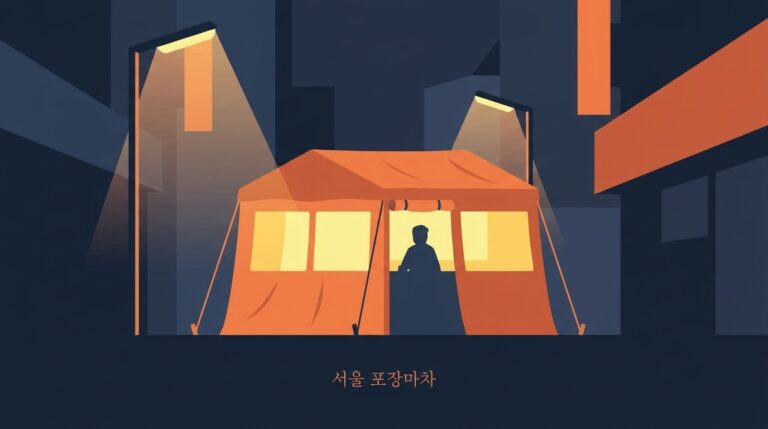
Phase 1: Welcome to the Neon-Lit Magic of Pojangmacha!
안녕하세요! (Annyeonghaseyo!) Hello, my dear friend! I’m your Daily Hangul senior editor and your personal K-culture navigator.
Imagine this: It’s 11 PM in Seoul. The air is slightly chilly, and the neon lights of the city are reflecting on the wet pavement. You turn a corner and see it—a bright orange tent glowing warmly under the streetlights. Steam billows out, carrying the mouth-watering scent of spicy rice cakes and sizzling grilled meats. Inside, locals are laughing, clinking tiny glasses of soju, and sharing warm soup.
Welcome to a Pojangmacha (꼬가ᅢ마차), the iconic Korean street-food tent!
For many first-timers, stepping inside this orange tent can feel a bit intimidating. “Do I just sit down?” “How do I order?” “Will they understand me?” Don’t worry! Today, we are going to learn three magical phrases that will turn you from a nervous tourist into a confident local regular. Let’s dive in!
Phase 2: The Magic Three (Core Phrases)
1. 거기요, 이거 주세요. (Geogiyo, igeo juseyo.)
- Pronunciation: Guh-ghee-yo, ee-guh joo-seh-yo.
- Meaning: “Excuse me (over there), please give me this.”
- K-Culture Moment: You’ve seen this in almost every K-Drama! The main character points excitedly at a steaming plate of tteokbokki (spicy rice cakes) and catches the owner’s attention.
- Editor’s Insight: “Geogiyo” literally means “over there,” but in restaurants and tents, it is the most polite, natural way to say “Excuse me!” to get the owner’s attention. ‘Igeo’ means ‘this’—perfect for A1 learners because you can just point at what you want!
- Situation Spectrum: Casual ✅ / Semi-formal ✅ / Formal ⚠️ (Slightly too casual for a high-end corporate meeting, but perfect for dining out!)
- ὁ️ Think About It: In many Western cultures, making eye contact or waving is enough. In Korea, calling out “Geogiyo!” vocally is expected and considered lively and friendly. How does this compare to your home country?
2. 오대ᅢᆨ궈물 좀 뤄세요. (Odaek-gukmul jom juseyo.)
- Pronunciation: Oh-daeng gook-mool jom joo-seh-yo.
- Meaning: “Please give me some fish cake broth.”
- K-Culture Moment: In K-Dramas, when characters are sad or cold, the kind tent owner (often called Imo, meaning auntie) hands them a cup of warm savory broth for free.
- Editor’s Insight: Here’s a huge insider tip! At a Pojangmacha, the warm fish cake broth (오대ᅢᆨ궈물) is free and unlimited! Asking for it makes you look like a true Seoul expert.
- Situation Spectrum: Casual ✅ / Semi-formal ✅ / Formal ὡ7
- ὁ️ Think About It: Sharing free broth represents the Korean concept of Jeong (정)—a deep feeling of warm attachment and generosity toward others.
3. 개산해주세요. (Gyesanhae juseyo.)
- Pronunciation: Gyeh-san-hae joo-seh-yo.
- Meaning: “Please calculate the bill / Bill, please.”
- K-Culture Moment: The character taps their pockets, pulls out some cash or a card, and calls out to the owner with a big smile after a wonderful night of eating.
- Editor’s Insight: When you are ready to leave the cozy tent, use this phrase. Keep in mind, some older street tents prefer cash or bank transfers, though many modern ones accept cards!
- Situation Spectrum: Casual ✅ / Semi-formal ✅ / Formal ✅
Phase 3: Textbook vs. Real Life
Let’s look at how the books teach you versus how Koreans actually talk in the streets!
Situation 1: Ordering a drink
- Ὅ워교과서 한구거 (Textbook): “소주를 주시개습니까?” (Would you give me some soju?)
- ️ 진애가 한구거 (Real Life): “소주 한 뵁뤄 주세요!” (Soju han byeong juseyo! – One bottle of soju, please!)
- ὁ해 다를까? (Why the difference?): Textbooks teach overly formal grammatical structures. In real life, dropping particles like 를 (reul) and keeping it simple is much more natural and friendly.
Situation 2: Asking for more side dishes
- Ὅ워교과서 한구거 (Textbook): “반찬을 더 요구합니다.” (I request more side dishes.)
- ️ 진애가 한구거 (Real Life): “이모, 이거 더 뤄세요~” (Imo, igeo deo juseyo~ – Auntie, more of this please!)
- ὁ해 다를까? (Why the difference?): Calling the female owner “Imo” (Auntie) instantly builds a warm, family-like connection.
Phase 4: K-Culture Deep Dive & Non-verbal Manners
4-1. Nunchi (눈치) & Pojangmacha Etiquette
- The Eye Contact Call: Don’t raise your hand too high or yell aggressively. Catch the owner’s eye, give a polite nod, and say “Geogiyo~” with a friendly smile.
- The Two-Hand Rule: When the owner hands you your hot bowl of noodles or your drink, always receive it with both hands. It shows respect and keeps you from dropping hot food!
4-2. Culture Code: The “Warmth” of the Korean Night
Pojangmachas are not just places to eat; they are social therapy zones. In Korea, people go there to wash away the stress of the day. It’s a place of democratic comfort—where office workers in expensive suits sit next to students in hoodies, all sharing the same warm space.
Phase 5: Live Roleplay Challenge
Setting: A cozy orange tent in Mapo, Seoul. The sound of rain taps on the plastic roof. You sit on a round plastic stool. The friendly owner, “Mapo Imo,” is wiping the counter.
- Imo: 어서오세요! 뭐드릴까? (Welcome! What can I get you?)
- You: ἷ거기요, 이거 주세요. (Excuse me, please give me this. – Points at the spicy rice cakes)
- Imo: 아~ 뚸보기 한 저ᄇ시! 매운대 갠찬아요? (Ah, one plate of tteokbokki! It’s spicy, are you okay with that?)
- You: ἷ갠찬아요! 소주한뵁도 주세요. (It’s okay! Please also give me a bottle of soju.)
- Imo: 구래, 마시쇄개 모거~ (Sure, enjoy your meal~)
- You: ἷ어대ᅢᆨ궈물 좀 뤄세요. (Please give me some fish cake broth too.)
- Imo: 아이거~ 한구거 잘하내! 여기 다뜻한 개산이다! (Wow, you speak Korean well! Here is some warm soup!)
- You: ἷ개산해주세요. (Bill, please!)
ὐ0 Interactive Decision Point
How will you pay? Choose your path:
* A. Hand over your credit card silently.
* Feedback (Risk): Some traditional street vendors don’t accept foreign credit cards. It’s always safer to ask first or have cash ready!
* B. Hand over cash with two hands while saying “Kamsahabnida!” (Thank you).
* Feedback (Best): Perfect! Imo will give you the biggest smile and maybe even a discount next time.
* C. Leave the money on the table and walk away.
* Feedback (Bad): Oh no! Leaving money on the table without saying goodbye is considered impolite in Korea. Always pay directly to the host!
Phase 6: 10-Second Emotional Shadowing Drill
Let’s practice speaking with the exact emotions of a local! Pause at the slash / marks.
[ὠA Excited & Friendly]거기요, / 이거 / 주세요! (Guh-ghee-yo, / ee-guh / joo-seh-yo!)[ᾗA Cold & Craving Warmth]오대ᅢᆨ궈물 / 좀 / 뤄세요~ (Oh-daeng gook-mool / jom / joo-seh-yo~)[ὠA Satisfied & Polite]개산해 / 주세요! (Gyeh-san-hae / joo-seh-yo!)
Phase 7: K-Culture Mini Dictionary
- 이모 (Imo) | Auntie | Used affectionately to call female owners of casual restaurants.
- 소주 (Soju) | Soju | Korea’s national clear alcoholic drink, best served cold in tiny glass cups.
- 오대ᅢᄀ (Odaeng) | Fish Cake | Skewered fish cakes boiled in a savory seafood broth.
- 정 (Jeong) | Warm attachment | The invisible emotional bond of sharing, giving extra, and caring for others.
Phase 8: Survivor Kit for Travelers
- TOP 1: 물 주세요. (Mul juseyo.) – Water, please.
- TOP 2: 화장실 애디예요? (Hajangsil eodiyeyo?) – Where is the restroom?
- TOP 3: 카드 대요? (Kadeu daeyo?) – Do you accept cards?
Ὅ Editor’s Travel Note:
Street tents don’t show up easily on foreign map apps. For the best local experience, use the Naver Map App to search for nearby Pojangmachas. Also, always keep 10,000 to 20,000 KRW in cash just in case!
Phase 9: A Step Deeper (Reflection)
In Western cultures, dining is often highly individualistic—everyone orders their own plate. But at a Pojangmacha, plates are placed in the middle, and everyone shares. This reflects Korea’s beautiful “Uri” (We/Our) culture. Eating together in a tiny tent brings people closer together, breaking down social walls over a cup of warm soup.
AC Your Turn: Have you ever eaten food in an outdoor tent or street market in your country? How was the vibe different from a standard indoor restaurant? Let me know in the comments below!
Phase 10: FAQ & Common Mistakes
Q: Can I sit at a Pojangmacha if I only want to drink and not order food?
A: Generally, no. Since seating is highly limited, Pojangmacha owners expect every table to order at least one main food dish along with their drinks.
Q: Is it rude to ask for more fish cake soup several times?
A: Not at all! It is a part of their warm hospitality. However, saying “Thank you” (갑사하ᄇ니다!) each time will make the Imo very happy to refill it for you.
Q: Do they have English menus?
A: Major tourist areas like Myeongdong or Mapo might have English menus, but smaller local neighborhoods might not. That’s why learning “Igeo juseyo” (Give me this) while pointing is your ultimate superpower!
Ὢ8 Common Mistakes Board
- Shouting “Hey!” to the owner: Correction: Always use “Geogiyo” or “Imo”.
- Pouring your own drink: Correction: In Korean drinking culture, it is polite to pour drinks for each other rather than pouring your own.
- Trying to pay with a card at a tiny cart: Correction: Check if they have a card terminal first by asking “Kadeu daeyo?”.
Phase 11: Action Missions
- ᾔ7 Bronze Mission: Speak “Geogiyo, igeo juseyo!” out loud 5 times in front of your mirror.
- ᾔ8 Silver Mission: Share this post on your social media with the hashtag
#DailyHanguland tag a friend you want to visit a Pojangmacha with. - ᾔ9 Gold Mission: Find a K-Drama scene featuring a Pojangmacha, listen for the phrase “Gyesanhae juseyo,” and try to mimic the actor’s tone!
Phase 12: Interactive Quiz Challenge
1. What does “Igeo juseyo” mean?
- A) Where is this?
- B) Please give me this.
- C) How much is this?
2. True or False: Fish cake broth (Odaeng-gukmul) is free in Pojangmacha.
- A) True
- B) False
Ἰ9 Click here to reveal the answers!
Answers:
1. B) Please give me this. (Points to you! You can now easily order food anywhere!)
2. A) True (Yes! It’s free. Don’t be shy to ask for it using “Odaeng-gukmul jom juseyo~”!)







