C1-Level Korean Masterclass: Talking Sustainability, Recycling, and the Climate Crisis Like a Local
Phase 1: Empathy (Welcome, Eco-Conscious Friends!)
안녕하세요! Daily Hangul‘s Senior Editor and your cultural navigator here!
Have you ever stood in front of a Korean apartment complex’s recycling station on a Sunday afternoon, clutching an empty delivery container, completely frozen under the watchful eye of an apartment security guard (경비아저씨)?
If so, you are not alone. South Korea has one of the most sophisticated—and frankly, intimidating—recycling systems in the world (known as 분리배출 bun-ri-bae-chul). While it’s fantastic for the planet, it poses a massive linguistic and cultural hurdle for advanced learners. You aren’t just trying to say “save the earth” anymore; at a C1 level, you need to discuss systemic plastic pollution, microplastics (미세플라스틱), and argue for carbon neutrality (탄소중립) in social settings or office debates.
Our advanced students often tell us, “I can talk about my hobbies, but when my Korean colleagues start debating the new eco-tax on disposable cups, I suddenly lose my voice!” Today, we are going to bridge that gap. Let’s upgrade your green vocabulary to a native-level C1 tier so you can express your environmental passion with nuance, precision, and cultural tact. Let’s dive in!
Phase 2: In-Depth Analysis of 3 Key Advanced Expressions
1. 그린워싱 (Geu-rin-wo-sing) / 위장환경주의 (Wi-jang-hwan-gyeong-ju-ui)
- Pronunciation: Geu-rin-wo-sing (Sounds like “Green-washing”) / Wi-jang-hwan-gyeong-ju-ui (“Wee-jahng-hwan-gyung-joo-ee”)
- Meaning: Greenwashing / Pseudo-environmentalism
- K-Culture Moment: You are watching a modern Korean societal satire drama. A major conglomerate launches an eco-friendly tote bag campaign, but a whistleblower reveals the bags are made of non-recyclable synthetic fabrics. A news anchor reports: “대기업들의 위장환경주의, 이대로 괜찮은가?” (Is conglomerates’ greenwashing acceptable at this rate?)
- Editor’s Insight: While “그린워싱” is highly common in casual conversation and marketing media, using “위장환경주의” in academic debates, essays, or formal discussions instantly elevates your speech, signaling a deep, literary command of Korean hanja-derived vocabulary (위장 = disguise, 환경 = environment, 주의 = -ism).
- Situation Spectrum: Casual (⚠️) | Semi-formal (✅) | Formal (✅)
- 🤔 Think About It: Does your native language rely more on loanwords (like “Greenwashing”) or native root words to describe corporate deception? Why do you think Korean media uses both interchangeably?
2. 분리배출 (Bun-ri-bae-chul)
- Pronunciation: Bun-ri-bae-chul (Sounds like “Boon-ree-beh-chool”). Note: Due to liquidization rules, it is pronounced more like Bullei-baechul.
- Meaning: Source separation of waste / Sorting and discharging recyclables (often incorrectly translated as just “recycling” which is 재활용).
- K-Culture Moment: In a slice-of-life drama, a newlywed couple argues over who didn’t wash out the red pepper paste (고추장) from a plastic delivery container before throwing it in the plastic bin. The wife sighs, “제대로 분리배출 안 하면 벌금 나온단 말이야!” (If we don’t separate and discharge it properly, we’ll get fined!)
- Editor’s Insight: 분리 means separation, and 배출 means emission/discharge. In Korea, “분리수거” (separate collection) is what the trucks/landlords do, while “분리배출” is what you do as a citizen. Using 분리배출 correctly shows you understand your civil duty in Korean society.
- Situation Spectrum: Casual (✅) | Semi-formal (✅) | Formal (✅)
- 🤔 Think About It: In Korea, rinsing food waste from plastic is a legal and social expectation. How does this communal responsibility compare to waste disposal laws in your home country?
3. 일회용품 규제 (Il-hoe-yong-pum Gyu-je)
- Pronunciation: Il-hoe-yong-pum Gyu-je (Sounds like “Eel-hweh-yong-poom gyoo-jeh”)
- Meaning: Regulation on single-use / disposable items
- K-Culture Moment: You are in a trendy cafe in Seoul. You ask for a plastic cup to sit inside, but the barista politely declines, citing: “매장 내 일회용품 규제 때문에 유리가 가득 찬 잔에만 제공 가능합니다.” (Due to regulations on single-use items inside the store, we can only serve in glass cups.)
- Editor’s Insight: 일회용품 translates to “one-time-use goods” (disposables). 규제 means restriction/regulation. Government policies around these regulations are a constant hot button issue in Korea, especially for small business owners (자영업자).
- Situation Spectrum: Casual (⚠️) | Semi-formal (✅) | Formal (✅)
- 🤔 Think About It: Why is regulating convenience items like plastic bags and straws such a sensitive topic for local businesses in urbanized environments like Seoul?
Phase 3: Textbook Korean vs. Real-Life Korean
Situation 1: Expressing frustration about excessive plastic packaging
- 📖 Textbook Korean: “과대 포장이 심해서 환경 오염이 우려됩니다.” (I am concerned about environmental pollution due to excessive packaging.) – Too robotic and dry for a casual conversation.
- 🗣️ Real-Life Korean: “포장이 진짜 배보다 배꼽이 더 크네요. 플라스틱 쓰레기만 잔뜩 나오고… 쓰레기 버리는 게 더 일이에요.” (The packaging is seriously bigger than the actual product. It just makes a mountain of plastic waste… getting rid of the trash is more of a chore than buying the item itself.)
- 💡 Why the difference? Real Koreans use idiomatic expressions like “배보다 배꼽이 더 크다” (the belly button is bigger than the belly -> the accessory costs more/is bigger than the main item) to complain about excessive packaging naturally.
Situation 2: Demanding eco-friendly changes at a workplace
- 📖 Textbook Korean: “우리 회사는 친환경 정책을 실시해야 합니다.” (Our company must implement eco-friendly policies.) – Sounds like a translated slogan rather than an authentic argument.
- 🗣️ Real-Life Korean: “우리도 이제 보여주기식 말고, 탕비실에 일회용 컵부터 없애면서 실질적인 제로웨이스트를 실천해야 하지 않을까요?” (Instead of just doing things for show, shouldn’t we start practicing real zero-waste by getting rid of single-use cups in the pantry first?)
- 💡 Why the difference? “보여주기식” (doing something just for display/show) is a highly natural C1 phrase used to criticize superficial corporate policies, contrasting with “실질적인” (practical/substantial).
Phase 4: K-Culture Deep Dive & Non-Verbal Etiquette
4-1. Nunchi (눈치) & Recycling Etiquette
In Korea, recycling is not just an individual choice—it is a collective social contract.
* The “Clean and Dry” Rule: Throwing a dirty plastic container into the recycling bin is considered extremely bad manners (민폐 – min-pye). Passersby or the building manager (경비원) will look at you with silent judgment (눈치를 주다).
* The Gesture of Apology: If you are caught mis-sorting by an elder, slightly bow your head, make eye contact, and say, “아, 제가 잘 몰랐습니다. 다시 하겠습니다” (Ah, I didn’t know well. I will do it again) while quickly correcting your mistake. Never argue or shrug it off; compliance shows respect for communal labor.
4-2. Cultural Code: The Rise of “용기내” (Yong-gi-nae) Campaign
In Korean, Yong-gi (용기) is a beautiful homonym. It means “courage” but also means “container/vessel”.
During the pandemic, food delivery apps caused a massive surge in plastic waste. This sparked the popular consumer movement: “용기내 챌린지” (The ‘Bring Your Own Container’ Challenge / The ‘Be Courageous’ Challenge). Eco-conscious Koreans post videos of themselves going to traditional markets or trendy restaurants, bravely handing over their multi-use Tupperware containers (다회용기) to shop owners. It takes courage to break the social norm of receiving plastic packaging, hence the brilliant pun!
Phase 5: Real-Life Roleplay Scenario
Setting: A trendy shared office kitchen in Seongsu-dong, Seoul.
Characters:
* Ji-min (지민): Your eco-conscious colleague who organizes the office zero-waste group.
* You (C1 Student): An advanced professional who wants to propose a corporate recycling audit.
지민: 🎭 (한숨을 쉬며 탕비실 쓰레기통을 가리킨다)
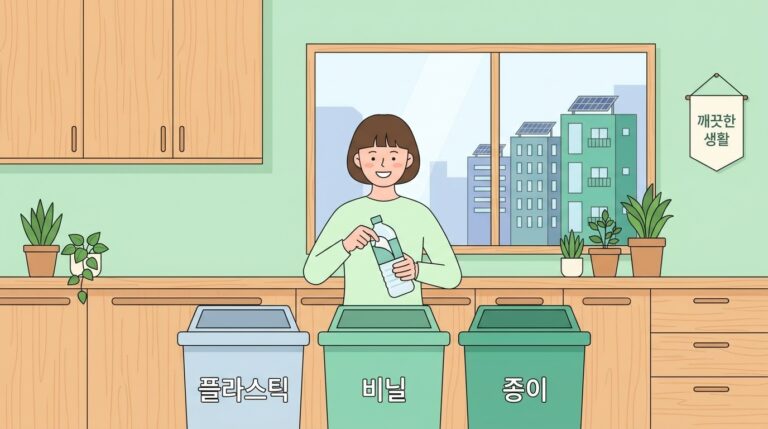
      아니, 다들 플라스틱 페트병 라벨도 안 떼고 그냥 버렸네요. 분리배출이 기본인데 참...
      (Sighs and points at the pantry trash bin)
      Seriously, everyone threw away these plastic bottles without even peeling off the labels. Source separation is the absolute basics, but honestly...

You:  🎭 (공감하며 페트병 하나를 집어 들고 라벨을 뗀다)
      그러게요. 라벨 비닐은 비닐대로, 페트병은 페트병대로 따로 버려야 하잖아요. 아직 인식 개선이 많이 필요한 것 같아요.
      (Agreeing, picks up a bottle and peels the label off)
      I know, right? Plastic labels should go to vinyl, and PET bottles should go to plastic. I think we still need a lot of awareness improvement.

지민: 🎭 (눈이 반짝이며)
      맞아요! 안 그래도 우리 회사에 '용기내 캠페인' 같은 걸 제안해보고 싶은데, 사장님 설득하기가 쉽지 않네요. 너무 '보여주기식' 예산 낭비라고 생각하실까 봐요.
      (Eyes sparkling)
      Exactly! Actually, I want to propose something like the 'Yong-gi-nae (Bring Your Container) Campaign' to our company, but convincing the CEO isn't easy. I'm worried he might think it's just a wasteful 'for-show' initiative.

You:  🎭 (단호하면서도 분석적인 톤으로)
      오히려 반대예요. 일회용품 구입 비용을 줄이면 장기적으로는 회사 예산에도 이득이잖아요. 수치화된 자료를 준비해서 건의해 볼까요?
      (In a firm yet analytical tone)
      Actually, it's the opposite. If we reduce the cost of purchasing single-use items, it will benefit the company budget in the long run. Shall we prepare some quantified data and propose it?

지민: 🎭 (기뻐하며 격하게 고개를 끄덕인다)
      와, 정말 좋은 생각이에요! 역시 같이 기획하길 잘했네요. 그럼 사내 카페부터 텀블러 할인 혜택을 확대하자고 할까요?
      (Delighted, nodding vigorously)
      Wow, that's a fantastic idea! I'm so glad we are planning this together. Then, should we suggest expanding tumbler discounts starting with our in-house cafe?

You:  🎭 (미소를 지으며 의견을 더한다)
      네, 그리고 텀블러 미지참 시 보증금을 부과하는 일명 '다회용 컵 순환 시스템'을 도입하면 강제성도 있고 효과적일 것 같아요.
      (Smiling and adding an opinion)
      Yes, and if we introduce a so-called 'reusable cup circulation system' where a deposit is charged if they don't bring a tumbler, it would be mandatory and highly effective.

지민: 🎭 (감탄하며 엄지를 치켜세운다)
      대박! 씨원(C1) 씨 말대로 하면 단순 캠페인이 아니라 실질적인 친환경 오피스가 되겠어요. 오늘 퇴근하고 기획서 초안 같이 써볼래요?
      (Admiringly, gives a thumbs up)
      Amazing! If we do it your way, it won't just be a simple campaign, but a genuinely practical eco-friendly office. Do you want to draft the proposal together after work today?

You:  🎭 (기분 좋게 하이파이브를 하며)
      좋아요! 회사 앞 제로웨이스트 카페에서 만나요. 제가 텀블러 챙겨갈게요!
      (Happily high-fiving)
      Sounds great! Let's meet at the zero-waste cafe in front of the office. I'll make sure to bring my tumbler!
🔀 Choose Your Adventure (Interactive Branching)
How would you respond to Jimin’s invite to write the proposal?
- Option A (The Passionate Leader): “당연하죠! 이왕 하는 김에 전 사원 대상 플로깅(Plogging) 이벤트도 기획서에 한 줄 넣읍시다!”
- Feedback: Best! Demonstrates incredible initiative and uses “이왕 하는 김에” (while we are at it) naturally alongside eco-trends like 플로깅.
- Option B (The Realistic Coordinator): “좋아요. 하지만 사장님 성향상 예산 절감 수치가 가장 중요하니까, 그 부분 위주로 정리해요.”
- Feedback: Good. Practical and professional, showing high-level business logical flow.
- Option C (The Avoidant Learner): “아… 저는 한국어 보고서 쓰는 게 아직 조금 서툴러서 지민 씨가 다 쓰시면 검토만 할게요.”
- Feedback: Risk. While honest, it misses a great learning opportunity. At C1 level, try to co-write even with errors!
Phase 6: 10-Second Emotional Shadowing Drill
Speak these aloud. Pay attention to the pauses (/) and the emotional cues in the brackets!
- [🥺 Urgently Pleading / Frustrated]
“플라스틱 용기에 / 음식물 자국이 안 지워지면 / 분리배출해도 / 결국 소용없대요! / 꼭 씻어서 버려주세요!”
(Peul-la-seu-tik yong-gi-e / eum-sik-mul ja-guk-i an ji-wo-ji-myeon / bun-ri-bae-chul-hae-do / gyeol-guk so-yong-eop-dae-yo! / Kkok ssi-seo-seo beo-ryeo-ju-se-yo!)“They say if the food stains on plastic containers aren’t washed out, sorting them is completely useless anyway! Please make sure to wash them before throwing away!”
- [🔥 Confidently Arguing in a Meeting]
“친환경 정책은 / 이제 선택이 아닌 / 필수입니다. / 보여주기식 마케팅을 넘어서 / 실질적인 탄소 중립을 / 실천해야 합니다.”
(Chin-hwan-gyeong jeong-chaek-eun / i-je seon-taek-i a-nin / pil-su-im-ni-da. / Bo-yeo-ju-gi-sik ma-ke-ting-eul neo-meo-seo / sil-jil-jeok-in tan-so jung-rip-eul / sil-cheon-hae-ya ham-ni-da.)“Eco-friendly policies are no longer an option, but a must. Beyond performative marketing, we must practice practical carbon neutrality.”
Phase 7: K-Culture Mini-Dictionary (4 Essential Buzzwords)
- 용기내 (Yong-gi-nae)
- Translation: “Bring your own container” / “Be brave.”
- Usage: Going to a local bakery and telling the cashier, “용기내 캠페인 동참하려고 통 가져왔어요!” (I brought a container to join the Yong-gi-nae campaign!)
- 플로깅 (Peul-ro-ging)
- Translation: Plogging (Jogging + picking up litter).
- Usage: A very popular weekend hobby among young Koreans in Han River parks. “이번 주말에 한강으로 플로깅 가실래요?” (Would you like to go plogging at the Han River this weekend?)
- 제로웨이스트 (Je-ro-we-i-seu-teu)
- Translation: Zero Waste.
- Usage: Refers to lifestyles or specialized shops. “요즘 망원동에 예쁜 제로웨이스트 숍이 많이 생겼더라고요.” (I noticed many pretty zero-waste shops have opened up in Mangwon-dong lately.)
- 다회용기 (Da-hoe-yong-gi)
- Translation: Multi-use / reusable container.
- Usage: Opposite of 일회용품. “배달 앱으로 주문할 때 다회용기 선택 옵션이 생겼어요.” (An option to choose reusable containers has been added when ordering through delivery apps.)
Phase 8: The Eco-Traveler’s Survival Kit
Survival Phrases for Eco-Conscious Travelers
- “빨대는 안 주셔도 괜찮아요.” (Pal-dae-neun an ju-syeo-do gwen-chan-a-yo.)
- Pro Tip: Use this at cafes to reject plastic straws. “I don’t need a straw, thank you.”
- “비닐봉지 대신 장바구니에 담아갈게요.” (Bi-nil-bong-ji dae-sin jang-ba-gu-ni-e dam-a-gal-gae-yo.)
- Pro Tip: Keep this handy at convenience stores (편의점) or supermarkets to refuse plastic bags.
- “텀블러에 담아주시면 할인 적용 되나요?” (Teom-beul-reo-e dam-a-ju-si-myeon hal-in jeok-yong doe-na-yo?)
- Pro Tip: Many Korean franchises offer a 100 to 500 KRW discount for using personal tumblers!
Editor’s Travel Note:
To navigate Seoul sustainably, download the Naver Map App (네이버 지도) to locate recycling stations, public bicycle rental stations called Ttareungi (따릉이), and eco-friendly vegan cafes nearby. Additionally, since late 2022, major convenience stores in South Korea are legally banned from selling plastic bags. Always carry a foldable tote bag (장바구니) in your pocket! (Note: Regulations may vary depending on local municipality updates).
Phase 9: “A Step Deeper” (Reflections on Korean Eco-Collectivism)
Korea’s strict trash system (쓰레기 종량제 – Volume-rate waste disposal system) was introduced back in 1995. It was a revolutionary move that forced citizens to buy official municipal garbage bags, effectively charging people based on how much trash they generated.
What makes this work so well in Korea is the deep-rooted cultural collectivism. Koreans are highly sensitive to how their actions affect the community. Leaving a messy pile of unsorted garbage violates the unspoken rule of 공동체 의식 (community consciousness). To be accepted and respected as a neighbor, you must conform to these meticulous rules. It’s a fascinating blend of government enforcement and cultural peer-compliance.
💬 Your Turn: How does your culture view waste? Is recycling seen as an individual personal choice, or is there a strong collective pressure like in Korea? Let us know in the comments below!
Phase 10: FAQ & Common Mistakes
Q: Can I throw away all plastics together in the plastic recycling bin?
A: No! In Korea, transparent PET bottles (투명 페트병) must be separated from colored plastics. You must remove the label, wash the inside, crush the bottle, and place it in a designated bin specifically for clear PET bottles. Colored plastics (like shampoo bottles or delivery containers) go into a different bin.
Q: What happens if I make a mistake with my trash sorting?
A: If you dump mixed waste in non-official bags, you can be fined up to 300,000 KRW (approx. $230 USD). Local governments use CCTV cameras to catch illegal dumping (무단투기).
Q: Is food waste considered trash in Korea?
A: Food waste (음식물 쓰레기) is collected entirely separately to be processed into animal feed or fertilizer. A golden rule: “If an animal can eat it, it’s food waste. If not, it’s general waste.” (e.g., chicken bones, eggshells, and onion skins are general waste, NOT food waste!).
🚨 Common Mistakes Alert!
- Mistaking “비닐” (Vinyl) for “플라스틱” (Plastic):
- Wrong: Putting thin snack packaging or plastic wrap in the plastic bin.
- Correct Action: These must be separated into the “Vinyl” (비닐류) bin.
- Throwing dirty delivery containers in recycling:
- Wrong: Leaving red tteokbokki sauce inside the container and tossing it.
- Correct Action: If the stain won’t wash off with dish soap, it cannot be recycled and must go into the general waste bag (일반쓰레기 종량제 봉투).
- Confusing “재활용” (Recycling) and “재사용” (Reuse):
- Wrong: Using “재활용” when talking about multi-use cups.
- Correct Action: Use 다회용 (multi-use) or 재사용 (reuse). 재활용 means chemical or physical recycling processing.
Phase 11: Action Mission & Engagement
🏆 3-Step Action Mission
- Bronze Mission (Solo): Look up three plastic items in your room right now. Practice naming their material in Korean (e.g., 페트병, 비닐, 유리).
- Silver Mission (Social Media): Post a photo of your tumbler or eco-bag on Instagram/X. Use the tag #용기내챌린지 and write a caption: “오늘부터 저도 일회용품 줄이기에 동참합니다!” (Starting today, I am also participating in reducing single-use items!)
- Gold Mission (Real Life): The next time you visit a Korean restaurant or cafe, confidently decline a straw or plastic bag using our survival phrases.
🎮 K-Culture Mission
Watch a recent Korean vlog or reality show (like 나 혼자 산다 – Home Alone). Spot the recycling bins in the background of their houses. How many different compartments do you see? Tell us your findings in the comments!
Phase 12: Interactive Quiz Challenge
Test your C1 Eco-Korean skills below!
1. Situational Judgment
You ordered chicken, and there are bone scraps left. Which bag should they go into?
* A) 음식물 쓰레기 봉투 (Food waste bag)
* B) 일반 쓰레기 종량제 봉투 (General waste volume-rate bag)
* C) 플라스틱 수거함 (Plastic recycling bin)
Reveal Answer & Explanation
Correct Answer: B
Chicken bones are too hard for animals to digest and cannot be processed into feed, so they are categorized as 일반 쓰레기 (General Waste).
2. Fill in the Blank
“보여주기식 친환경 정책을 펼치는 대기업들의 ( )을/를 규제해야 한다.”
(We must regulate the [ ] of conglomerates that practice show-style eco-friendly policies.)
* A) 분리배출 (Bun-ri-bae-chul)
* B) 그린워싱 (Geu-rin-wo-sing)
* C) 다회용기 (Da-hoe-yong-gi)
Reveal Answer & Explanation
Correct Answer: B
Corporate pseudo-environmentalism is called 그린워싱 (Greenwashing) or 위장환경주의.
3. True or False
In Korea, you can recycle plastic delivery containers even if they are heavily stained with red chili oil, as long as they are made of plastic.
* True
* False
Reveal Answer & Explanation
Correct Answer: False
If the container is heavily stained and cannot be cleaned, it must go to general trash. Contaminated plastics ruin the recycling batch!